Arts, Architecture & Design, Travel

Flânerie in Notts

Promising buildings; shame about the occupants.

Cities, according to Ben Wilson in Metropolis, his impressive new book, are humanity’s greatest invention. The close interaction between many thousands of human lives, and their messy, continuous cycle of decline and renewal are the heartbeat of human civilisation. Cities are where the heights of human sophistication are found – and also the depths of its failure.

A day’s flânerie in Nottingham recently provided ample evidence of this. Almost eighteen months after our last city trip, we finally took another. My wife’s new employer is based in the city, and she needed to show her face; I mostly went along as chauffeur to take the strain of the 270-mile round car trip.  But it also gave me the chance of a day walking a city I last visited as a student in 1986.

The point of flânerie is as much the thinking one does as the shoe leather one wears through – and in about 13km around the city centre, there was plenty of both. It’s about observing city life in all its aspects from a slightly detached, even philosophical viewpoint; no surprise that it’s a French invention rather than a British. My academic interest in urban geography lends itself too, and always provides another reason to investigate and ponder, even (or perhaps especially) the nuts-and-bolts of the city that visitors and shoppers are not supposed to see. Wilson contends, as do I, that the British (and Americans) don’t really ‘do’ urbanism – not in the way continental Europeans do. Their instinct is to head for the cleaner air, quiet and privacy of the suburbs, which size-for-size sprawl far further in this country than in their continental equivalents where higher-density living does not only have extreme social connotations of penthouses and slums that it does here.

All three East Midlands cities (Leicester, Nottingham and Derby) are largely products of the rapid industrial expansion of pre-Victorian market towns through textiles and engineering. All three have signs of the decaying aftermath of their boom times: swathes of red-brick Victoriana of varying quality, areas of post-industrial dereliction, and vast tracts of terraces and bland, early 20th Century suburbs. But they never quite managed to acquire the full, high Victorian civic and cultural grandeur of their larger equivalents further north and west, let alone rival those of the continent, and conventionally are thought of as, well, rather dull.

Sadly, despite my best efforts, I still struggled to like Nottingham; despite its claim to be the principal of the three cities (population 330,000; metropolitan area 770,000), it feels to me like a missed opportunity. Leicester, for my money, is making far more of its modest assets.

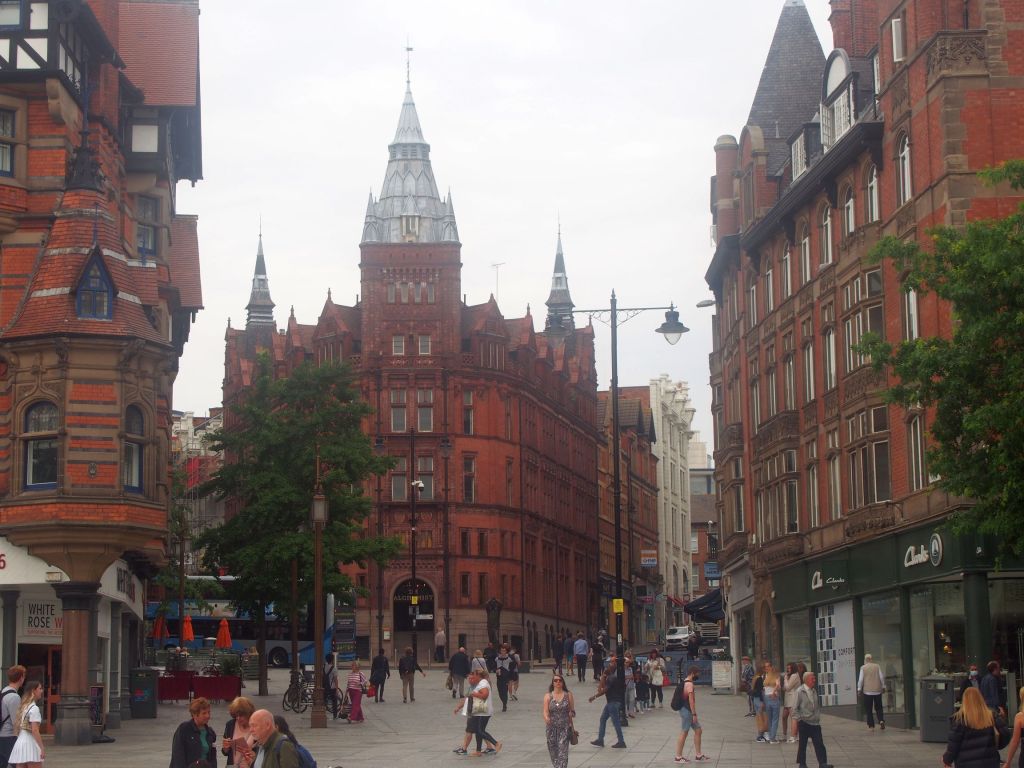
Having left my wife at her workplace, I headed for the city centre; it was pleasant to stroll down a wide, tree-lined pavement for the first time in a while, as the city began its day. Unsurprisingly, there have been significant interventions in the time since I was last there; the most successful by far is the introduction of a tram system that both carries large numbers and lends animation to some of the streets. I wonder whether transport planners give consideration to the theatrical potential of their proposed networks; they should. Nottingham has got this right: the trams descent a steep hill before sweeping dramatically around into the main market square, in front of the imposing City Hall.
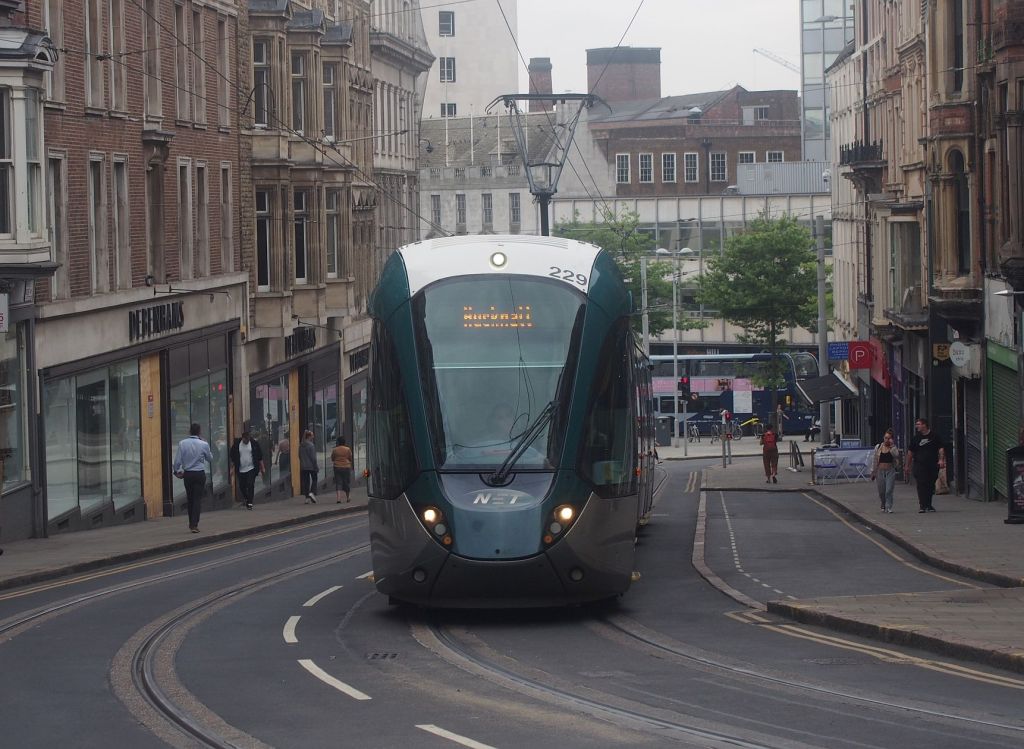
Trams good; state of the built environment, less so.

The square itself has been given new paving and fountains, and ought to be a grand civic space with few equals in provincial Britain. But it somehow misses the mark. I suppose I need to allow for the impact of Covid: all day long, the city had a slightly under-populated feel. While this made proceedings more comfortable, it also meant the absence of ‘buzz’. There are many empty premises, proportionately far more that in my local town, which seems to have survived lockdown relatively unscathed. The closure of Debenhams department stores has left holes in town centres across the country, but I would still have thought that the larger cities had more resilience to weather the storm than smaller centres. In Nottingham’s case, the boarded-up prime site is a large hole indeed.
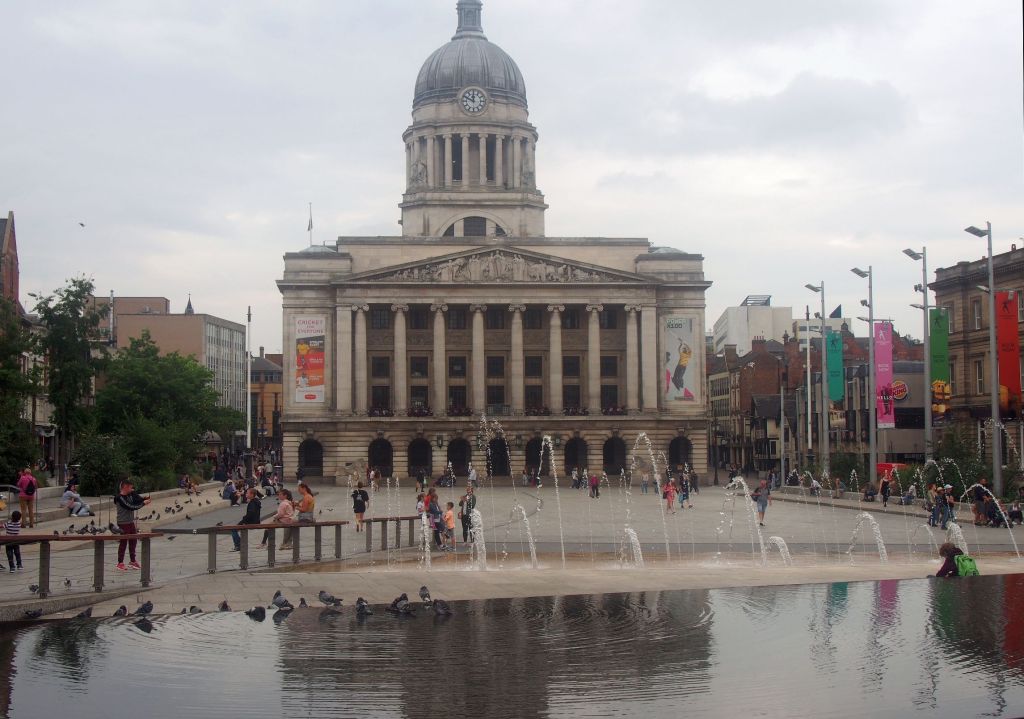
A missed opportunity to create a really splendid piazza…

I suppose I shouldn’t completely blame the city either, for the grubbiness. Local authorities in the U.K. have been so starved of funds that I suspect they simply can’t afford the daily cleaning that one sees in, for example, French cities. But it makes a noticeable difference when the dressed stone is not covered in the stains of takeaway food spills and worse…

A greater ‘miss’ is the lack of imaginative planting: at the height of an admittedly cool summer, the flowers should have been at their best – but the square mostly contained a selection of rather unkempt shrubs, only the display of cannas along the balcony of the city hall really making the grade. It could all have so much more flair…

The geographer in me seeks to assess the underlying socio-economic health of places I visit. Again, Covid may well be affecting the balance: the well-healed professional types are the most likely to be safely working from home, while the low-paid and less-fortunate were perhaps more likely still to be frequenting the city in person; it certainly seemed this way in the first part of the day. The numerous police patrols did not augur well, and I witnessed two altercations in the streets that morning…

For all my appreciation of life’s niceties, I am not an elitist. While the presence of a ‘top end’ is perhaps the most visible indicator of a city’s economic health, I dislike the exclusivity that it can create; cities need to be a mix, and good quality environments and opportunities should be available to all. But it is a two-way street: I am equally bemused by Britons’ inability to ‘inhabit’ their cities in the way the continentals do. This is not a product of wealth, so much as civic attitudes – and for all there were children splashing in the fountains, sadly I saw many people who seemed not to be treating their city centre particularly well, let alone with joy or pride. For many Britons, the city is a purely functional thing…

Once again, I suspect that this is partly a matter bigger than individuals: opportunity and conditioning matter. Like nearly every British town and city, Nottingham has become little more than a huge retail machine for the benefit of the same mainstream chains found across the nation. Meanwhile, I look for the presence and variety of independent shops; in most of the city centre, there were few of note. Nottingham has a reputation as a great shopping destination; I suppose it might be – if your idea of ‘great’ is large branches of all the predictable chains and fast-food outlets that appear everywhere… Expectations and perspectives also matter; the sense of the city as a proud, civic entity seems lacking.

One of the few really distinctive shops that I found in Notts

Feeling rather dejected, I pushed on into the more peripheral parts of the centre, and here, things started to improve somewhat. Having done my homework, I knew where I was going – but the experience was still underwhelming: the billed “bijou cafés” in the city’s finest arcade, where I had planned to find an espresso, turned out to be a branch of Patisserie Valerie; alright as far as it goes – but hardly outstanding or distinctive. Again, it all depends on expectations – and mine have been tuned over the years by the superior experience of too many continental cities…

The Lace Market area is somewhat more successful: tucked away in the older part of the centre, it is home to the National Justice Museum, slightly more choice shops, numerous professional services and buildings of indeterminate use, some rather fine. There I found a few more interesting premises, not to mention a rather different type of inhabitant – but still relatively few of the really interesting outlets one might expect in a large city. Precious little, for example, by way of independent food or clothes shops – or even evidence of where they might previously have been.
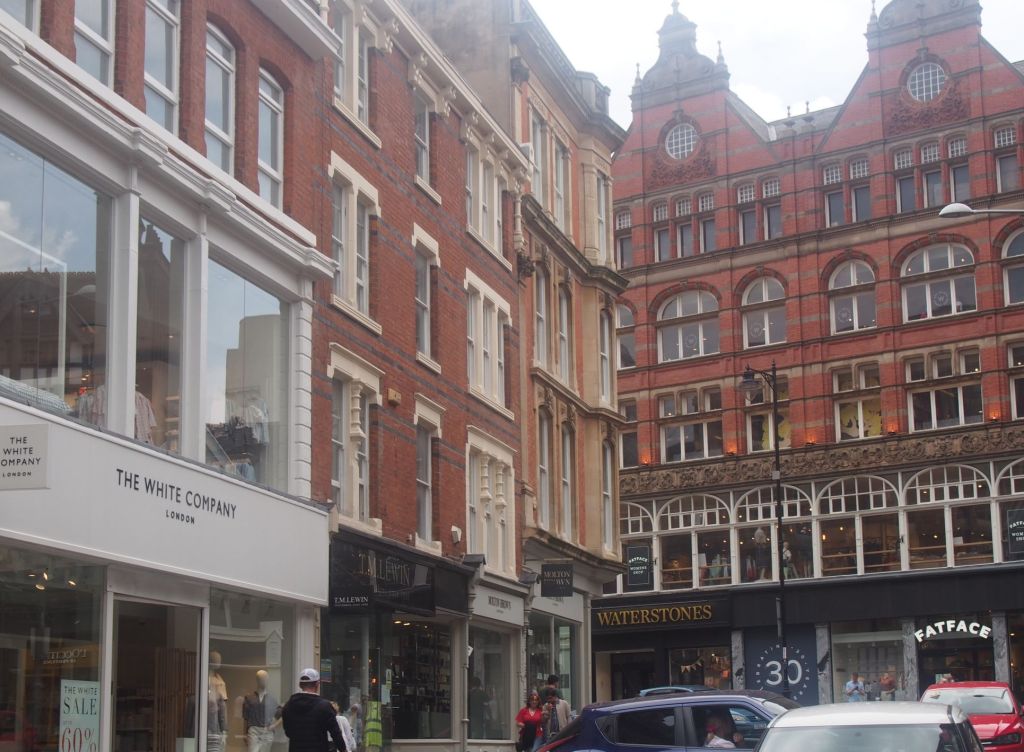
The high end?

In the early Seventies, Nottingham received some of this country’s earliest indoor shopping malls: the Victoria Centre, built on the remains of one of the country’s most atmospheric Victorian railway stations – but it is the other, the Broadmarsh Centre – which has recently made headlines. A vast, brutalist bunker between the remaining railway station and the centre, pre-pandemic it was being bulldozed – when the developer went bankrupt. It has been left, part-replaced, part ruin and work has only just resumed.
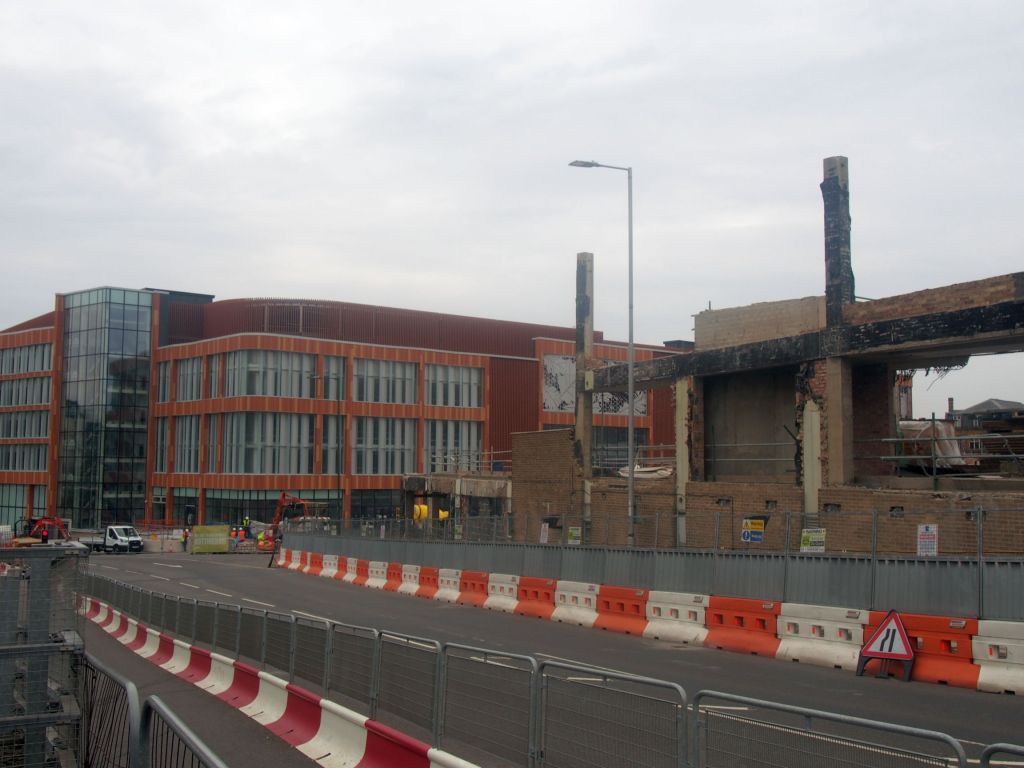
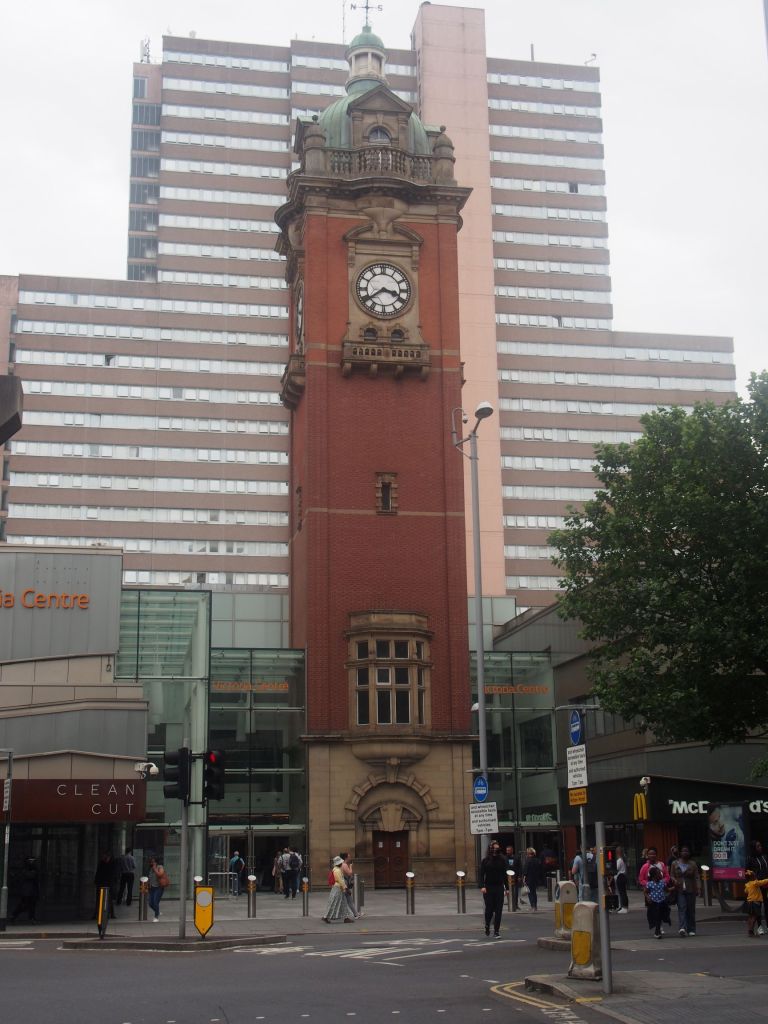
Out with the old, in with the new… But is it much of an improvement?
Victoria: An unhappy marriage. The clock tower is all that remains of a fine railway station.

The whole area to the south of the centre is being rebuilt; the billboards suggest a much-improved environment will result, but still dominated by large-scale retail and commerce. The addition of a new central library and bus station is laudable – but whether this new generation of comprehensive redevelopment will prove superior to its predecessor, only time will tell. Trying again to be charitable, we perhaps take too much for granted in a long storyline here: the lifetimes of city buildings are measured in decades or centuries. We are only just getting round to replacing the disasters that too often were thrown up in the Sixties and Seventies just to fill the bomb sites created in the Forties… Many cities right across Europe suffered the same fate – though the success of the recovery was most certainly not the same everywhere…
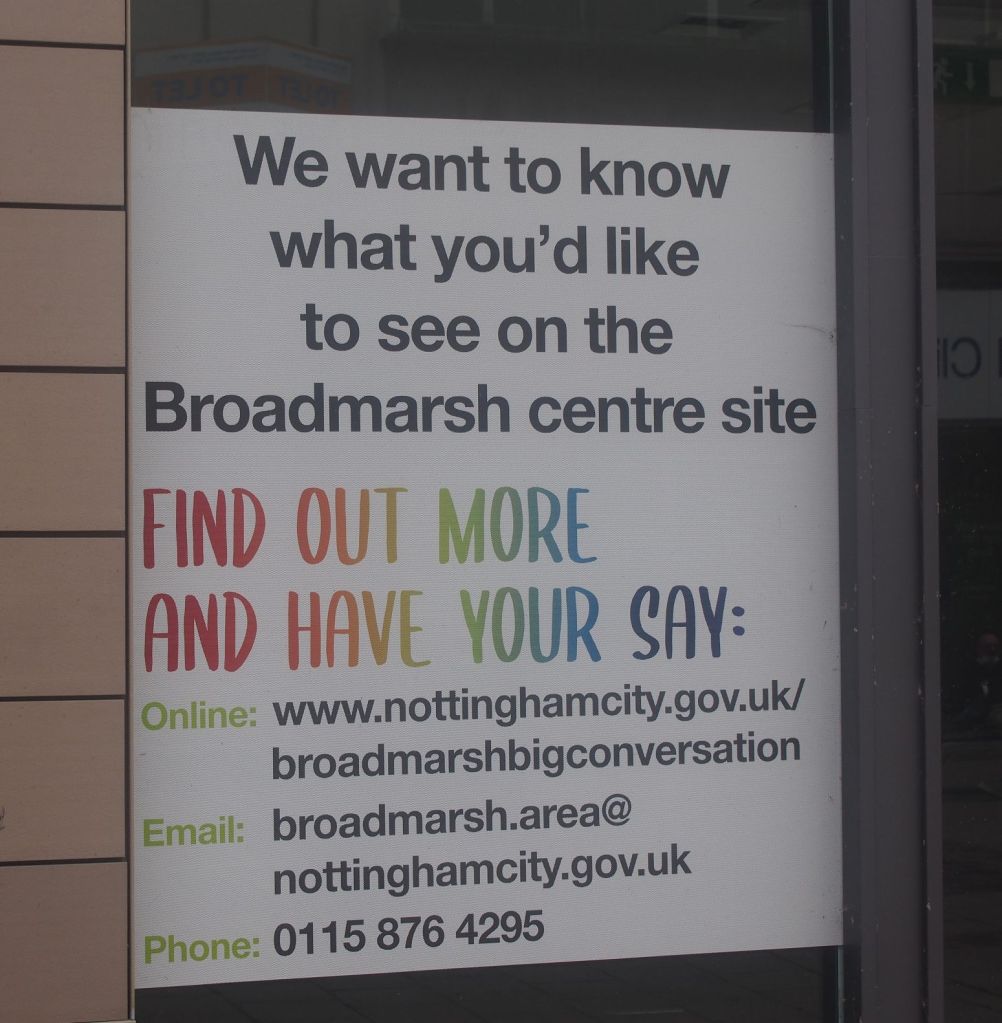
Full marks for consultation.

Post-Covid, there is a debate in the city as to whether more retail capacity is still the best use for this site. The outcome is awaited, with a new city park having been mooted as an alternative. Again, time will tell, but loosening the dominance of big retail in the urban mix need not inevitably be a bad thing.

I eventually came upon two areas that proved the point: Hockley lies to the east of the city centre and is described as the city’s bohemian quarter. Well, I’ve certainly seen substantially more bohemian than this, but the narrow streets of this area are nonetheless occupied by precisely the independent shops and cafes that are so conspicuously absent in the rest of the city centre – and the vitality of the area did indeed prove the point.
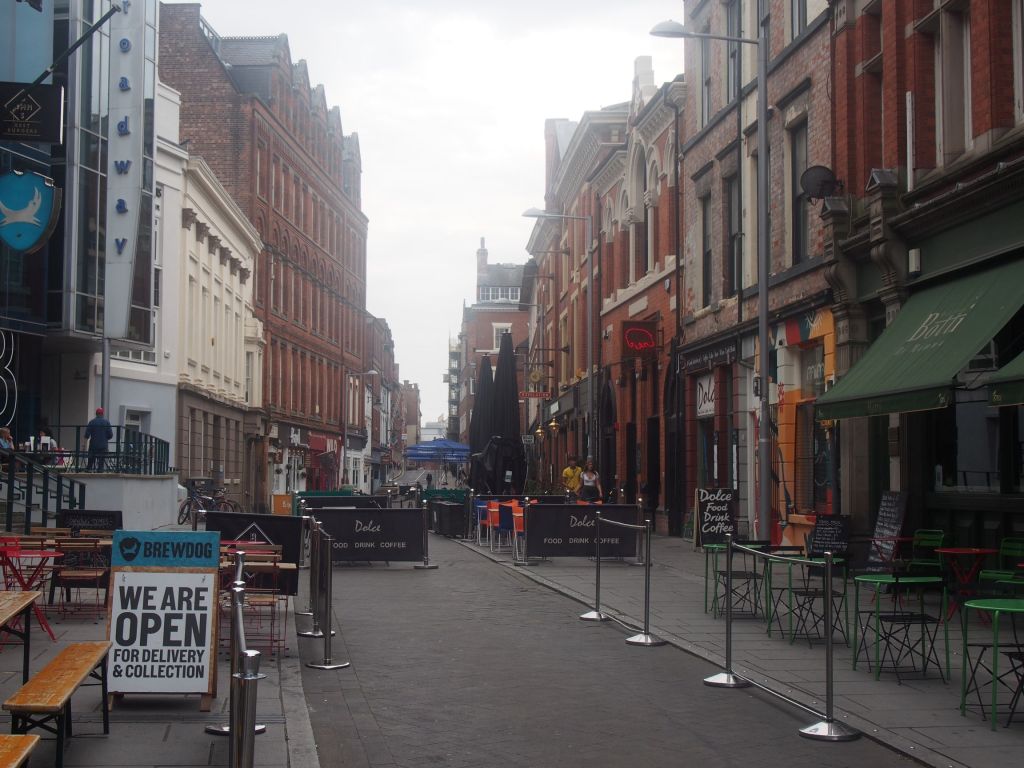
Hockley

After lunch with my wife’s new colleagues, I headed for the second: Nottingham Contemporary, an externally unprepossessing but nonetheless internally convincing modern art gallery. A pleasant hour was spent mooching around its three exhibitions and sitting out a passing rainstorm with a hot chocolate in an attractive (and once again in-house) café. I dwelt on the fact that five decades ago, express trains ran through this very spot on their way into the now-vanished Victoria Station: another building that the city would have done well to keep, rather than replace with a concrete bunker. Hopefully, we know better these days. One of my fellow rain-refugees was thinking the same, and a good conversation followed…
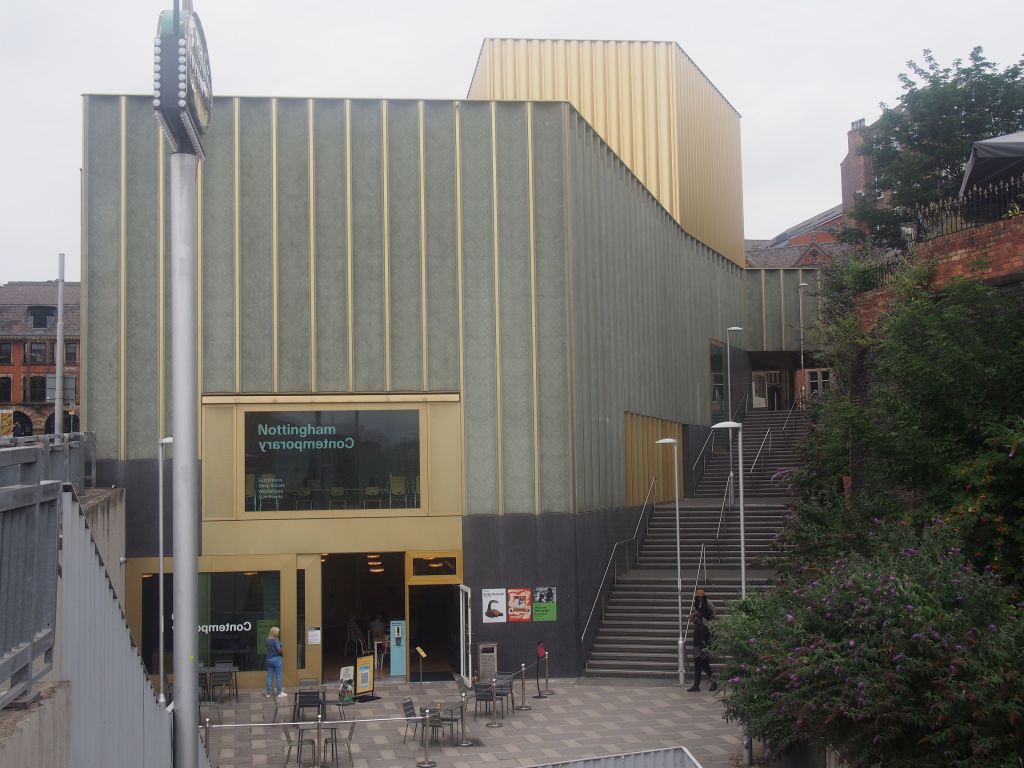
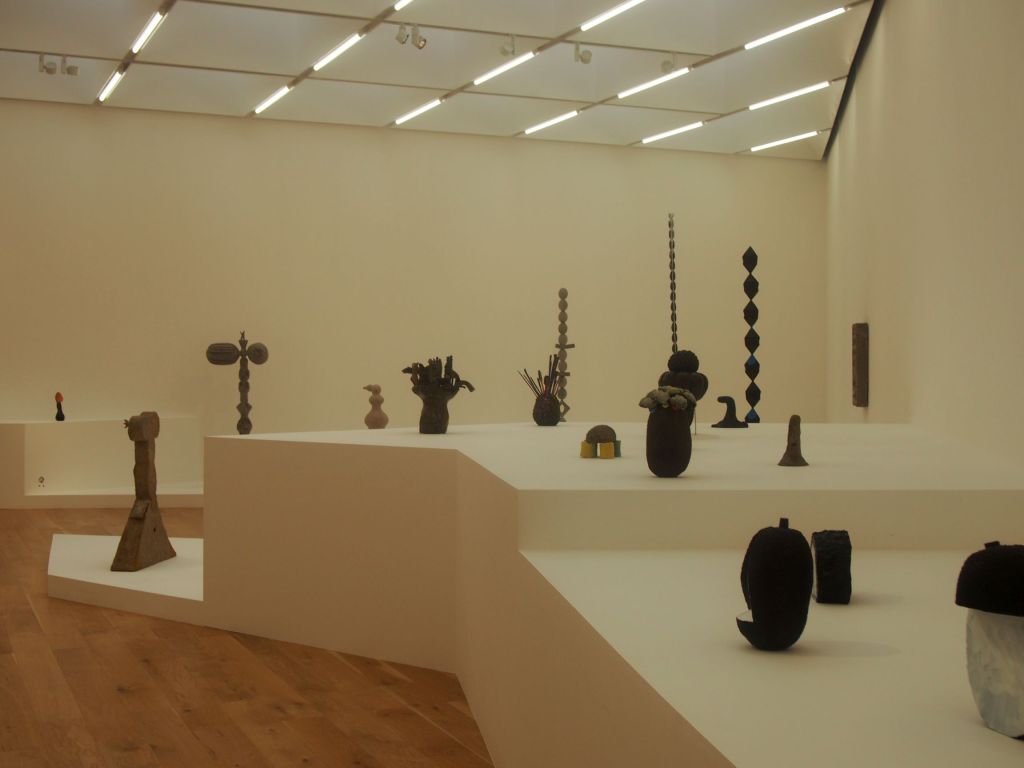
Nottingham Contemporary

As I said, I wanted to like Nottingham; there is little that pleases me more than time spent in a lively and attractive city centre. But even allowing for Covid, Nottingham just isn’t there yet. There is a lot of redevelopment going on – but even more needed to the fabric of the historic city, much of which is still rather shabby compared with that in other city centres. Maybe it will be better in another decade, but what has taken so long? I can accept that Manchester, Liverpool and Glasgow’s needs were more pressing – but there is in any case, only so much that physical renewal can do, no matter how much money is available. What is needed is ambition, imagination and flair – things that can lift rather predictable urban renewal into a genuinely vibrant and characterful place. It’s needed not only from the city leaders, but also by the regular citizens who populate the city day in day out. The clone-shopping experience does not encourage this, but nor does the willing complicity of the junk-food-and-trainers majority, which the architects’ drawings never show.
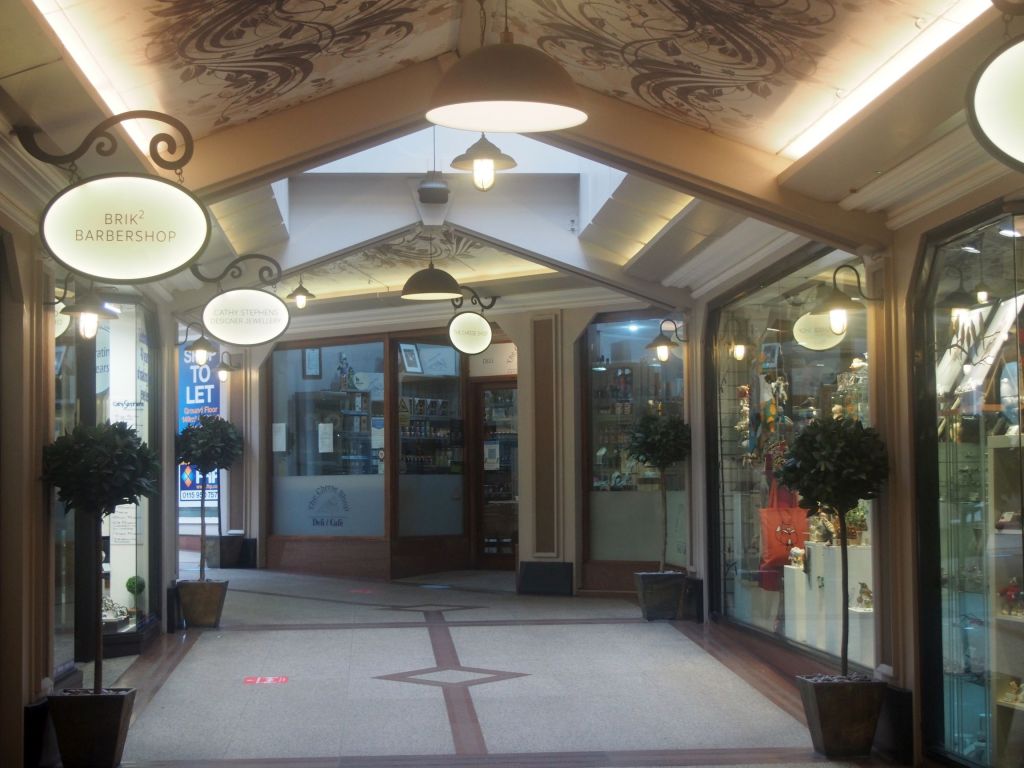
About as chi-chi as Nottingham gets…

It wouldn’t be fair to compare Nottingham with the greatest European cities – but I have seen plenty of second-division equivalents on the continent that far outstrip it – Montpellier in France, for example is a similar size, even if its enviable climate gives it a head start… The problem, I suspect, is that really successful cities are cosmopolitan and even sophisticated – things the British, instinctively, as a nation are not.

Even at their Victorian height, British cities were about imperial bombast – but also mass squalor, the legacy of which is still with us. Nottingham is trying – but I’m still not sure most British cities really ‘get’ vibrant, spontaneous, democratic urbanism any more than they ever did, which is why so many of their more self-conscious efforts never really come off. It will be interesting to see what future visits reveal…

Opinion & Thought

Filling the void

I guess it’s my professional background that is to blame – you can’t really function as a teacher without thinking of the issue of ‘life chances’. When you do a job that largely lacks a clear relationship between inputs and outputs, it is necessary to understand one’s purpose in the longer term. But I’m far from certain that the notion enjoys wide currency amongst those about whom teachers spend so much time thinking. I wonder how many people would consider themselves to be living a life which is mostly of their own determining.

I have recently been trying to help a long-standing friend deal with mental health difficulties, who seems to have had just such a problem. Having “been there” myself, I feel that only those who have been, can really understand it. But it doesn’t make being helpful much easier; the essence of such difficulties is that they distort one’s perception of everything else. Unlike, say, a stomach-ache, where at least one can identify the source of the distress, mental pain projects itself onto everything else, and conceals its true self behind that. It is like wearing a pair of grey glasses: they make the whole world look grey – but it is all too easy to forget that the problem lies with the glasses, not the rest of the world. Hence part of the problem with mental health can be identifying its true source – which may not lie where you think it does. And in turn, this can make it all the more difficult to identify what needs to be done: the temptation is to aim at the smoke rather than the flame…

Such difficulties may be a mixture of inheritance and background. There may not be much we can do about the former – but I suspect that we do nowhere near enough about the latter. As with physical health, we need to set up good habits early in life. But for all the talk about mental health, I wonder how much is being done to make that possible. Prime amongst these should come encouraging people to understand that they can act positively to develop their own selves, where they can cultivate all aspects of their personal identity and needs.

The neglect starts young: many young people are supervised by ‘helicopter’ adults for every moment of their waking lives. My friend seems to have had an early experience of this: she attended a minor public school which, by virtue of its boarders, operated a seven-day week, and made almost as many demands on the day-pupils (of which she was one) as those who lived ‘in’. From an early age, her life was dominated by the externally imposed demands of not only academic work, but sporting and musical life. Combined with high parental expectations, this perhaps leaves little opportunity for young people just to be alone with their thoughts, to learn to understand themselves, and to explore their own tastes and priorities. I suspect that the relief from the treadmill that many say they experienced during lockdown tells an important story here.

My friend was successful, eventually gaining an Oxford degree, and entering a demanding profession in which she has worked ever since. Even from a distance, I could see that her work dominated her life (not that mine as a teacher did not try to, as well…). She admits that her work came to be her main, even only, source of personal validation. In my case, I refused point-blank to let that be the case. There is just too much living to be done to allow that – and I never did see the point of living to work. After all, our masters, who urge us to do so often do not practise what they preach…

The problem with living to work is that those “life chances” become externally-defined – the meeting of targets, the acquisition of wealth and status, the progression of one’s career – or at very least, the pinning of one’s self-esteem solely on the competence with which one does one’s job. As with schooling, the modern workplace leaves precious little time for people to create their own meaning of Self.

Perhaps it doesn’t matter too much, if one is content to live one’s life on others’ terms. Be they inherited from one’s family, or the work-ethic inherited from one’s schooling or workplace, if you narrow your horizons and close off your curiosity, it may provide an adequate if pedestrian life, so long as you Play The Game.

But sometimes, The Game plays you. In both my friend’s case and my own, we found ourselves in workplaces whose toxic culture knew no limits, that ate people whole, chewed them up and if they resisted, spat the remains back out again. The stress of this experience is enough to endanger anyone’s mental health – and that, in both of our cases, it did.

The day when one can no longer do one’s job, a huge hole opens up in life; not only the loss of direction or a defined “role”, but also a large amount of time that needs to be filled. Particularly if one is struggling mentally, this can be difficult; as some found during lockdown, it is frightening how willingly the underoccupied mind fills that void with all sorts of terrors.

This is where the lack of prior thinking can be problematic. If you have become a live-to-work type, you risk having invested so much in that aspect of life that you neglected the rest of it. Who and what are you – really – when you are not at work? When work fills the day (and the mind) you can avoid this question for years, but when work stops, it can be hard to ignore.

My friend thinks that it began early in her life; even during school holidays, the conditioning made her struggle to cope with the absence of ready-made, work-orientated routine. Even her musical and other activities assumed the status of quasi-work – a mad rush to fulfil a large number of commitments that she had felt she had to accept. Listening to her some years ago, even non-work had started to sound like an extension of her job.

Perhaps many people live their entire lives like this: on autopilot. Filling their lives with busy-ness to avoid ever having to address the existential questions about their own meaning. Leisure sounds good, but in reality, can be a problem, unless you take active charge of what you do with it. I suspect that the British psyche adds problems: it is all too easy in this country to conflate positive living with social climbing or the precious pampering of the celebs. Outwith a certain privileged and self-obsessed minority, it is just not done to be too upbeat about how one lives. As a nation, we seem obsessed with the perceived grandeur of superior lives, and yet we often take little care with our own.

But I think there is a difference between self-indulgence and simply making an active decision to try to live well. It can equally be argued that to neglect active thinking about our lives is to waste the most precious asset that we have: life itself. Somewhere in there lies the contradictory legacy of a guilty, Puritan past in which pleasure was a sin… I suspect it lies in neither the entitlement of privilege nor the mindlessness of the herds that many seek to lose themselves in even when not at work; both are the antithesis of the balanced, authentic individual.

We cannot avoid having to dress, to eat, needing homes, interacting with our fellows, even consuming at some level. So we might as well do them well, gratefully, carefully and with enjoyment (however we define it). The mindful pleasure of doing something well generally far exceeds the saved hassle from not bothering. The problem is that this requires more effort than many seem either prepared to make, or to have time and energy left for. Somewhere, this appreciation needs an awokennness to the physical sensations of the world, which again exhaustion or distraction – or that protestant denial – so easily blunts in us.

My go-to psychologist, Mihaly Csikszentmihalyi concluded that the principal source of human fulfilment is the self-challenge that leads to increasing competence and complexity of being. This is why it is worth taking almost any aspect of life beyond the basic. The problem in Britain is that the connoisseurs or cognoscenti who do so are regarded with inverted snobbery, rather than respected for their insight. True, affectation can reinforce a certain impression, but once again we confuse genuine expertise with social display. Yet such insight is open to anyone who makes the effort.

There are, of course, plenty of individuals who do take mindful care of their lives – but I suspect they are still vastly outnumbered by those who don’t. What is more, neglect seems to have become the definition of normality. The overwhelming message is “convenience” – for which read “anything that requires only the minimum of thought or effort”. Don’t try hard. (But let’s not forget that real sprezzatura requires effort….)

I feel thankful now that over the years I found I had to reject this thinking. It meant heading into fields that were, in terms of my upbringing, quite unfamiliar territory; drawing lines around my working life and sometimes stepping outside the norms of my peers. It is undeniable that this set up conflicts that eventually gave me problems. But I remain adamant that a balanced and thoughtfully fulfilled life is both a reasonable aspiration, and in fact makes for a more contented and productive working life as well. In the longer term, it served me well when my own working life collapsed and threatened to take my sanity and sense of self with it.

I pointed this out to my suffering friend; sadly, I got the impression that she rejects it as a kind of vanity – a form of fake “lifestyle” whose purpose is social display or furtherment.

I see it as a matter of authenticity. However, it is true that the similar calculations are done by some simply to impress and can indeed be inauthentic. They may superficially appear the same, but I think there are two differences. One is in the mind: a simple matter of personal honesty about one’s motives, whether other people understand or not. The second is consistency; a sure sign of inauthenticity is tastes that change with the winds of social status and fashion. They are likely to be characterised by superficiality, whereas true passions are ones that encourage you to delve deeper, to find greater complexity and discernment. Passing fads never achieve that.

An excellent example of this is male dress, from which this blog takes its title. There is a world of difference between a man who genuinely appreciates a fine, timeless aesthetic no matter what his means, and those who seemingly do the same things, but just to exhibit their wealth and status. The same can be said for food, travel, homes and almost any aspect of what for some is “lifestyle” but for others, just Life.

I consider myself lucky that I had somehow figured a lot of this out by the time my own zero-hour arrived. It didn’t protect me entirely from the demands of over-work; my professional life (and mental health) came crashing down about five years ago as a result of overwhelming workplace stress. But through all the difficulties that followed, I am certain that all the other elements of the life I have built were my safety net: the things that remained constant even as other things lurched all over the place. They anchored my sense of who and what I am and have continued to do so as I recovered. What’s more, my appetite for that life filled the hours that suddenly opened up in the space where Work had been.

This is not about specifying any particular way of life, but about settling who we are to our own satisfaction and fulfilment, rather than living to please or impress others, or just to keep them off our backs. In the end, it is a matter of being true to oneself; that includes drawing the line at those things in life that seek to take us over, to define us solely in their own terms, to the neglect of who we really are. It is not narcissistic to try to find a stable balance between our obligations to others and a delimitation of our own rightful individuality. All the more so when those others believe they can invade so much of our lives that there is nothing left for ourselves – and most of all at times of need.

Teachers spend inordinate amounts of time thinking about their students’ life chances; in reality, we might achieve better results by helping and encouraging more people to think harder about their own – and hopefully redefining them as something more than the live-to-work outlook that can do such harm.  I hope my friend is reading.

Sartoria

From Italy with Love…

Having sung the praises of online shopping in my previous post, I was immediately reminded of its limitations when a repeatedly used clothing retailer in Italy informed me that it has suspended shipments to the U.K. due to Brexit.

As I have rather neglectfully managed to reach a point where several necessary renewals have coincided, the search for new sources has been more focused than usual. I refuse to give up: the dearth of easy solutions to the problem of what I consider the lack of appealing men’s clothing in the U.K. is not about to make me part with my hard-earned for things I do not really like simply because they are readily available. And that especially holds true when significant outlay may be involved.

When it comes to browsing (even virtually) in Italy the supply problem rapidly disappears (as would my savings, if I let them), only to be replaced by a partly cultural one: despite my appreciation of the work of their fine tailors, I do struggle to get my inhibited English mind round the kind of figures that Italian men seem willing to spend on their clothes. While the difference between rubbish and well-made items is readily apparent to anyone who cares to look, I retain a suspicion that the law of diminishing marginal returns must set in after a point. How much better than a £300 jacket can a £2000 one really be? Beautiful materials and superb craftsmanship do not (and should not) come cheap – but even so, there are surely limits to what is justifiable purely on grounds of superior quality. I found myself wondering just how much of a premium some of those renowned brands command just for their name…

Or am I just showing my ignorance? It is certainly true that having pushed upscale somewhat in the past, it is much harder to accept going back down it again – so maybe there is more to it than meets the eye. On the other hand, is it wise – or even necessary – to keep trading up the ladder of connoisseurship? At what point do we reach good enough? And of course, even were one willing, the capacity of one’s wallet does present a constraint that no amount of canny purchasing can entirely wish away…

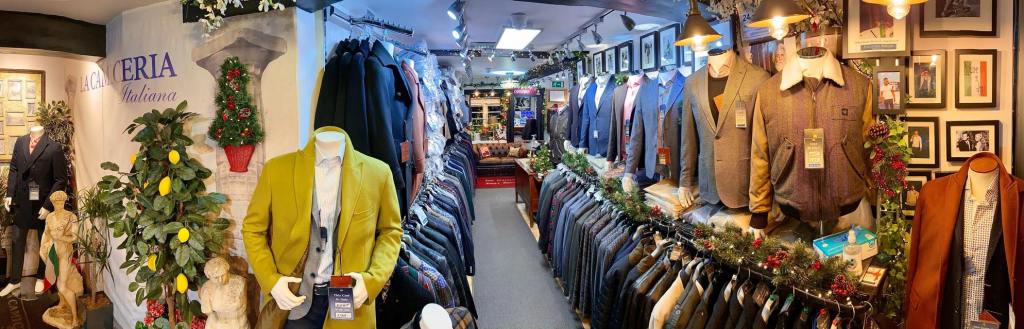
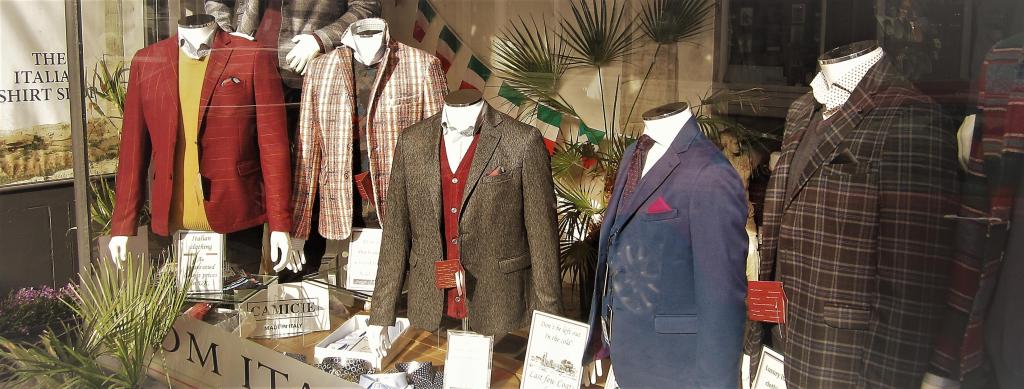
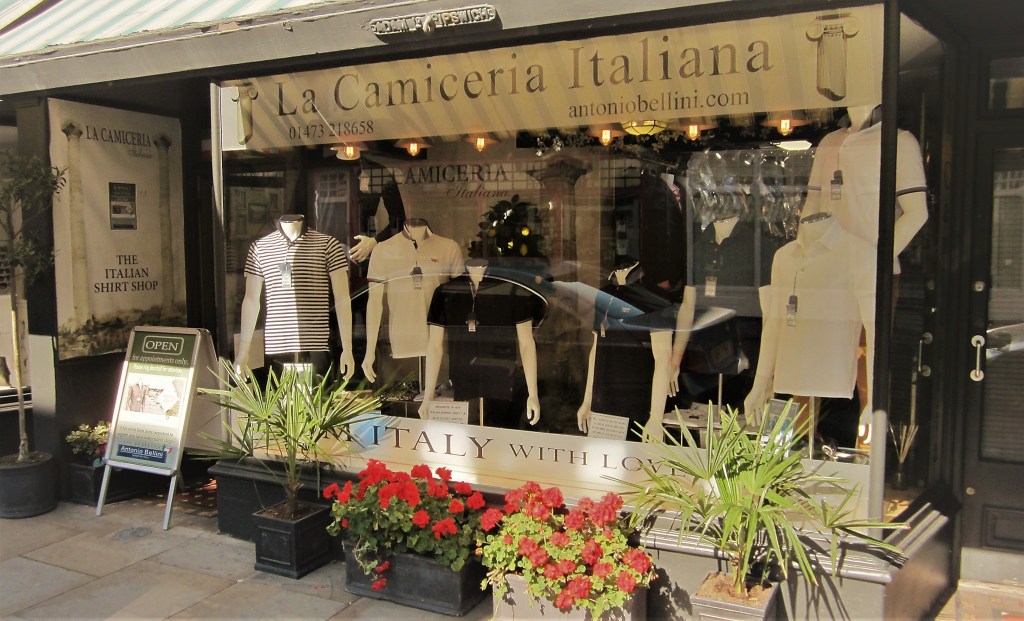
So when my searches landed me again at the virtual door of a relatively local business, I took the opportunity to investigate a small retailer whose website I had discovered at around the time of the first U.K. lockdown and whose shop I have been intending to visit ever since. The Italian Shirt Shop is situated in a rather nice ‘independent’ shopping street not far from the centre of Ipswich. As restrictions have now eased, I recently took the opportunity to make the thirty-mile trip and do some in-person shopping for a change.

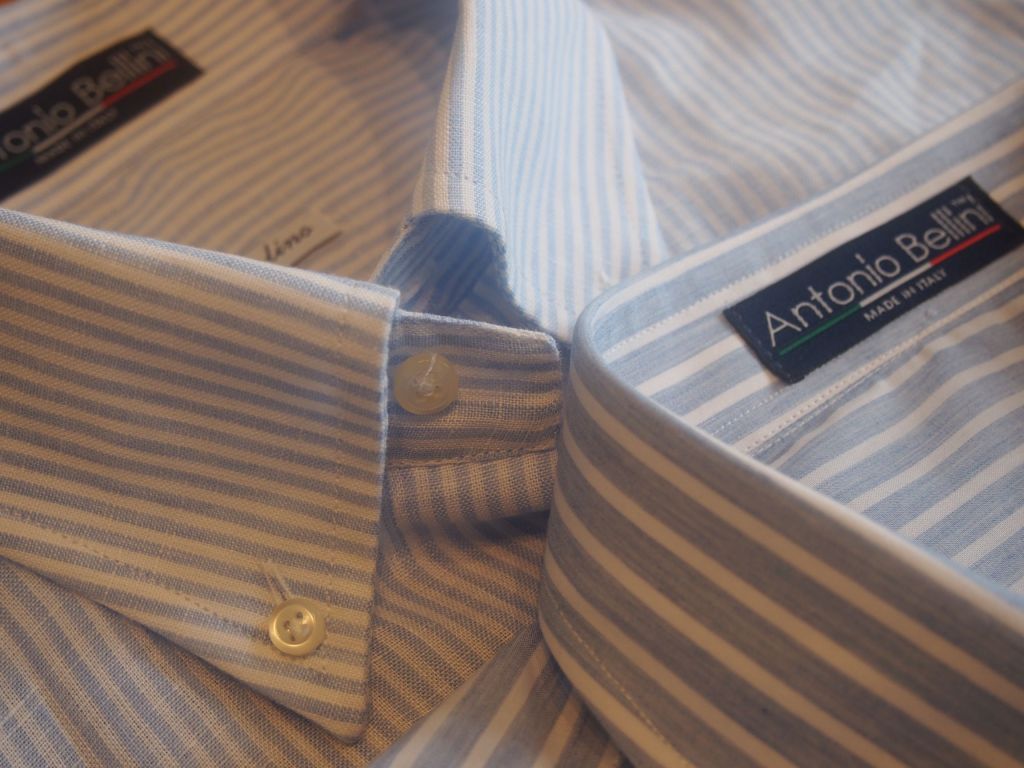
‘Antonio Bellini’ is on a mission to bring Italian style to the British Male – and he appreciates that cost can be an issue. His shop is lovely: a transplanted version of what every small independent Italian menswear shop still is – but without the hefty price tags. Antonio has arrangements with manufacturers in Italy that allows him to retail his own brand at something much more approachable, while still retaining a very pleasing quality. His customer service, too, is exactly what one would hope for from such a shop. He has now diversified beyond shirts – and is certainly a lot more visitable than anything south of the Alps right now.

At present, he only accepts one customer in his shop at a time – which was not a problem on a quiet Thursday morning – and so I had his undivided attention in helping me identify what was admittedly a limited number of items at the more generous end of his size range. This, he says, is a perennial problem with Italian producers, who are widely uninterested in broadening their appeal simply to address the mere inconvenience that customers everywhere are getting larger. He also confirmed that a huge proportion, perhaps 75%, of those vast prices can simply be a premium for having the ‘right’ label. There is much better value to be found elsewhere – including in Ipswich.

I came away with the couple of summer shirts that I had been seeking (and a rather dinky jacket that I hadn’t) – all for a price that would barely cover one shirt from some higher-profile sources. Time will be the ultimate test, of course, but I know a decent fabric when I feel one.

I stand by my comments from the previous post, concerning the opportunities afforded by supporting small businesses online, but I do not think it is incompatible with supporting in person local ones where they do exist. And it is certainly a very much more enjoyable experience to spend time in a real treasure chest like Antonio’s shop, than the virtual equivalent. You can’t stroke all those lovely fabrics online, for a start. Let alone chat with someone who knowledgeably shares your enthusiasm.

My brief splurge is now done – summer shirts and properly weatherproof shoes are once again to hand, their predecessors having been worn to destruction over the past five or ten years. (The shoes might have lasted longer had it been possible to reach a repairer more easily in the past eighteen covid-restricted months…) A couple of items ordered online are yet to arrive – but here’s to one British gent (for despite the name he is British) who has had the nerve to stick his neck out and retail what he loves. Long may he continue to do so – I shall be going back.

Shop photos taken from Antonio’s website with his permission. The views in this post are entirely my own.