 ijstock
There’s no shortage of coverage of the lives of the rich and famous. I’m thinking especially of the places where they live. As with everything these days, there is blanket coverage on YouTube of fantastically expensive real estate in places like Zurich and Barcelona.
I tend to see this simply as an electronic extension of voyeuristic tendencies that people have had since time immemorial. No doubt people always enjoyed peeking into lives of which they can only dream – but as always, there is the moralistic concern about the harm this might do. Seeing what privileged people have is a quick way to feel dissatisfied with less, for all that we might tell ourselves that we really don’t need two dishwashers and a walk-in wine cellar, and that those people’s live cannot possibly as perfect as they are made to appear. No doubt that is (sometimes) true.
At a global scale, the effects are also becoming marked. Now that internet connections and phone signals are increasingly widespread even in the world’s poorer countries, the ability to see what people have in more developed places is thought to be a significant driver of global migration. Once again, glamour – even if an illusion – attracts.
Idolisation of the super-rich lifestyle is also a reliable way to entrench excessively materialistic values, when one should surely be arguing that all lives are of equal value, no matter what the financial circumstances: a sentiment I heartily subscribe to. Perhaps reminding ourselves that wider good fortune is not strongly linked to material wealth is a helpful and necessary piece of schadenfreude…
My instinct is to reject shows of excessive wealth. For a start, there is certainly no guarantee that great wealth brings great taste, great likeability or great integrity. Being instinctively egalitarian, I find the over-the-top provision of many super-homes quite nauseating, and the aesthetic often gauche in the extreme. It certainly does not create an appealing impression of the occupants.
But there is one thing I cannot deny: those with seemingly infinite resources do happen to be the people who have what is needed to employ professional designers and architects and experiment with things that would be too costly for ordinary mortals. Ultimately, this is why their homes make it into the interiors magazines, while the likes of mine do not.
Again, it was ever thus. The artworks of renaissance Italy were largely created at the behest of wealthy patrons. A million Athena posters followed for the ordinary folks. Traditional British interiors derive from a mushy amalgam of formal Georgian and whimsical Victorian ideas of ‘good taste’, and how the lower orders furnished their homes was once again influenced by those further up the ladder. Part of the reason that the magazine features endure is undoubtedly that over time, ideas, fashions, trends and technological innovations (such as TVs and washing machines) do still trickle down to the mainstream.
Somewhere between reactionary indignation about this, and celeb-absorbed fawning, lies a sweet spot where the rest of us can use those good ideas without becoming fashion victims ourselves. Some high-fashion items do look absolutely stunning, and I don’t see that one shouldn’t appreciate the aesthetic. But one reason for that usually lies unmentioned: for example, in bespoke kitchens many multiple times the size of what most people can expect, and super-models with looks unknown to the average human. That is the deception – deliberately used, of course, to tempt people to part with large sums of cash in the pursuit of something they will never quite achieve.
But does that mean we should stop trying and settle for the mediocre? I would argue not. Quite apart from the historical precedent, some of these rarefied patronages do indeed result in works of great beauty – and a lack of wealth is no restriction on one’s ability to appreciate the sublime.
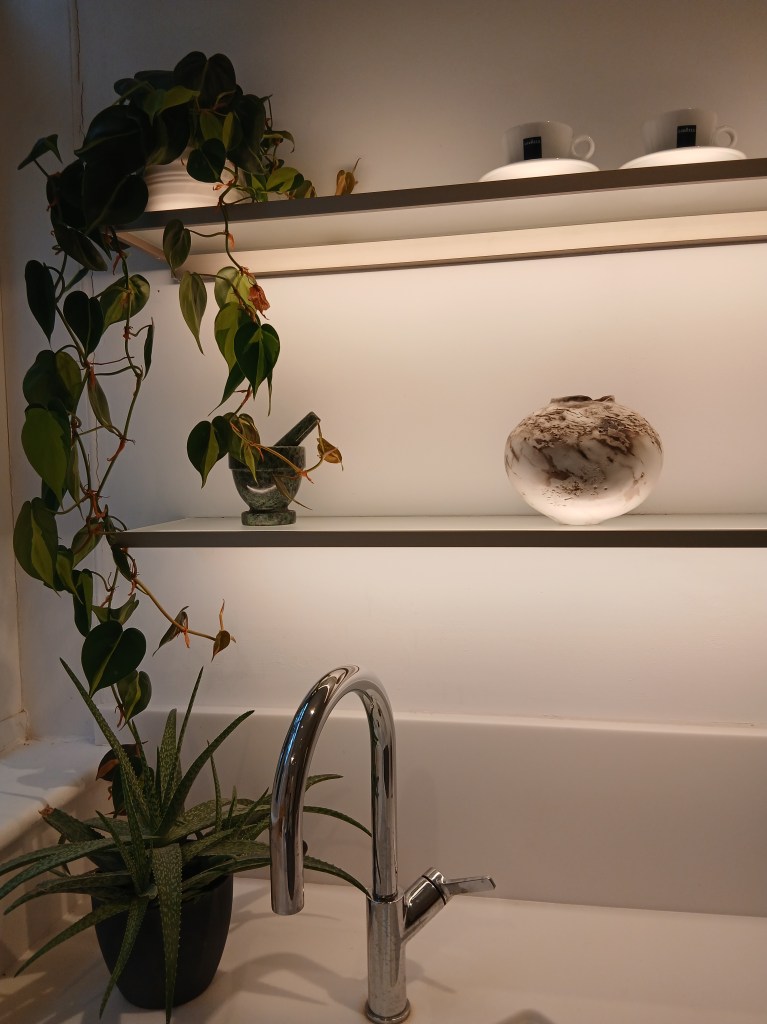
I think the answer for the rest of us lies in realistic and judicious use of the inspiration that dream-scenarios provide, while accepting their unrealism for ‘normal’ applications. A year ago, we replaced our 25-year-old kitchen with a new German one. Yes, we were seduced by a stunning display in a local showroom, and no, the end product does not look quite the same. But it is still far better than we would have achieved had we not allowed ourselves to be inspired by beautiful things that we could not afford. What was necessary was the acceptance that trying to copy the showroom was doomed to failure – and learning to use the most attractive elements in a way that worked in their own right, in the rather difficult space we had at our disposal.
Is this the sweet spot? And how to achieve it reliably? One thing is not to be completely intimidated by price. The maxim “Buy the best you can afford, not the cheapest you can find” is a good one – accepting that sometimes the two may in effect be the same. While generally speaking, it remains true that you get what you pay for, an eye for unexpected beauty costs nothing…
It is also worth saving for quality. While stunning objects mostly don’t come cheap, they are not always as far out of reach as may be thought. Sometimes spending on a single ‘centrepiece’ item and economising elsewhere can help.
Another non-obstacle is the social intimidation of up-market showrooms. But from our experience, most of the staff in such places are quite gracious (that’s what you’re paying for!) and sanguine about the colour of people’s money. Things that some people buy without a second thought and dispose of indecently quickly become for us once-in-a-lifetime signature purchases, and suppliers mostly seem entirely relaxed about this. Maybe they even prefer people who will treasure those products, over those who will throw them out without a backward look when trends change.
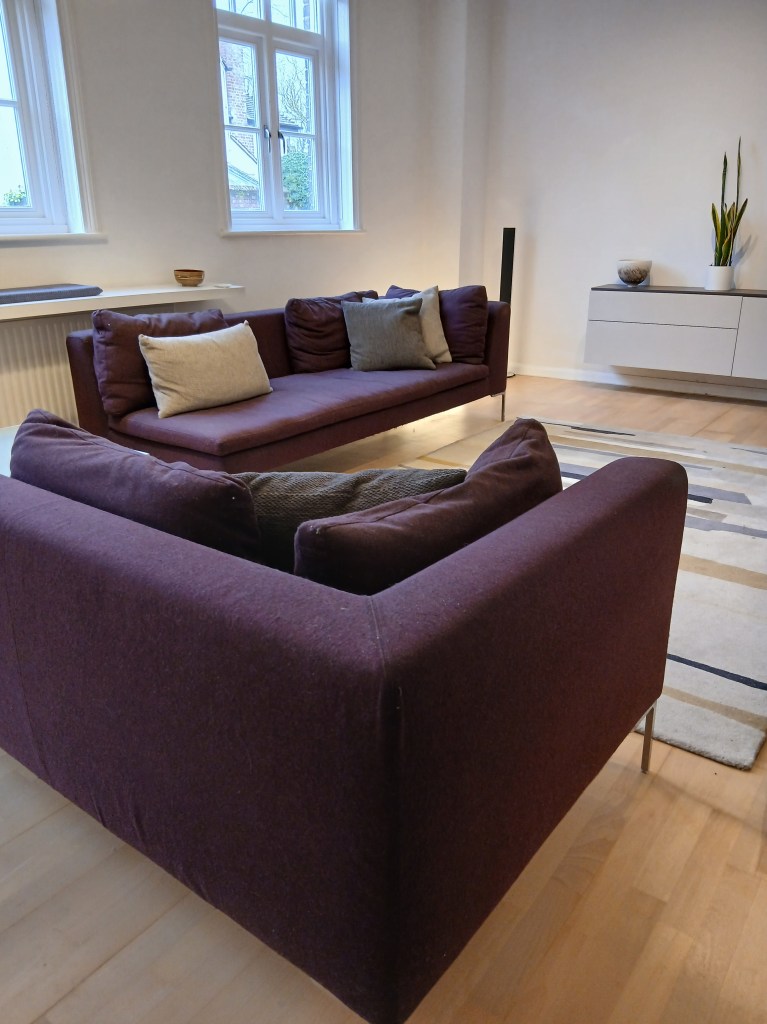
Normally, the quality one ends up with makes longevity a viable proposition. Our previous kitchen lasted nearly 25 years, more than double the norm for cheaper brands. B&B Italia is known as the epitome of modern Italian furniture. Its iconic Charles sofa is one of the most perfect seating designs I have ever seen. To say it doesn’t come cheap is an understatement – but the ones we once stretched for are now around 27 years old, still going strong, and still making our living room look (and feel) fabulous every single day. And with furniture of this type, now a classic, we can be pretty certain that we will, in due course, be able to buy replacement covers whenever needed.
If it weren’t for those for whom such items are everyday disposables, then some fabulous designs probably wouldn’t exist in the first place – not all high-end design is crass. But I think it is entirely possible for ordinary mortals to benefit from this, by the judicious deployment of resources and a determination to impose one’s own interpretation, rather than just becoming fashion victims seeking to ape – badly – the lives of those with whom they cannot possibly compete economically. The secret is to see the beauty, not the status, that such objects can bring.
By doing so, the norm shifts away from the illusions to the truly real: after all, the triumph of gorgeous design is not to make super-models look great: they do that anyway. It’s what it does for the rest of us. It’s not as frivolous as it might seem either: the mindful appreciation of beautiful objects is known as a route to wellbeing.
And in any case, there are more of us than there are of them.
 SPREZZATURA