Arts, Architecture & Design, Food, Travel

Leeds by example

The silence was noticeable. Several times, when I told people we were taking a holiday in Leeds, the response was slow coming. “Well, I’m sure you’ll have a lovely time… ”

We, however, were reasonably confident in expecting more from the city at the heart of Britain’s fourth-largest conurbation. We have been working our way through visits to all of the country’s big cities, to see what these places, still often despised in popular opinion, are really like today after several decades of urban renewal. In only one case were we disappointed – and Leeds was the last big place on the list. I think it is fair to say that after several decades in the doldrums, Britain’s city centres are now generally worthy of the nation’s civic pride.

It was about 25 years since I had last visited Leeds, briefly, for a friend’s wedding, so I had few recollections of the city – but I knew that it had stolen a march even on Manchester in being quick out of the blocks of urban renewal. Even some of the new waterside developments are nearing thirty years old. It is now the largest financial and legal centre in England, outside London. Its high productivity has generated income whose consequences have had time to bed in, and have had a lasting effect on the city. There is still quite a lot to do when it comes to the areas just outside the city centre – but we observed the early stages in the creation of a new city park, alongside which, in a decade or so, will eventually rise the new High Speed 2 rail station, thus extending the already impressive new districts to the south of the River Aire.

For once, I had been organised, and booked our visit several months in advance. As a result, we had a room in a 42 The Calls Hotel, an early conversion of a grain warehouse into an attractive hotel, even if its early-nineties decor is now in need of a lift (forthcoming, we gather). A room upgrade saw us installed with a river view, and the roof trusses and machinery of the former hoists to look up at in bed each evening. The rest of the building is an attractive blend of Victorian beams and pillars and modern interventions.

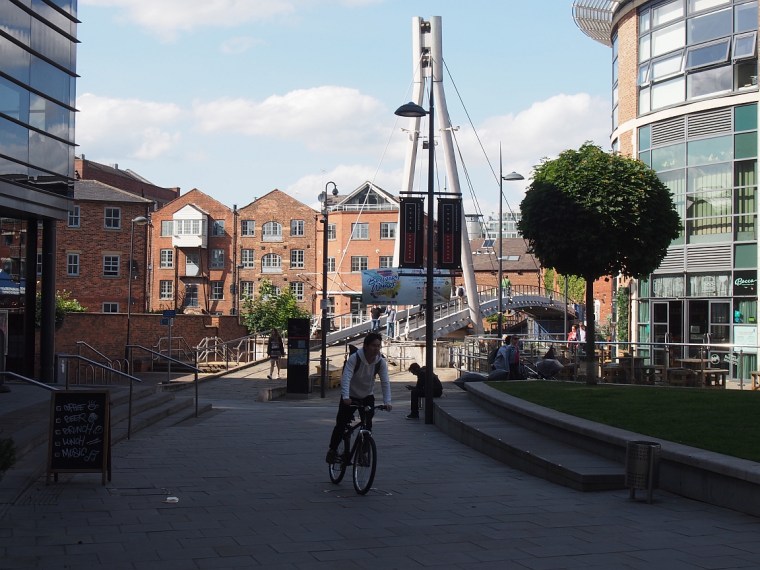
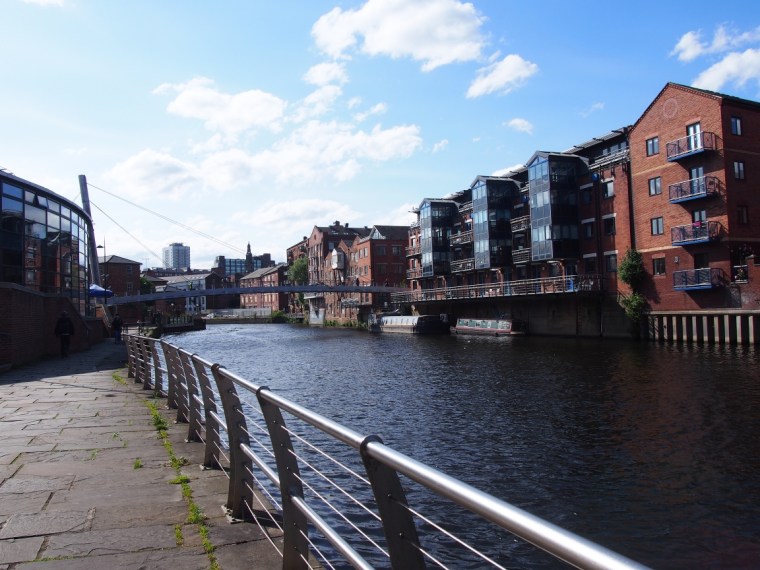
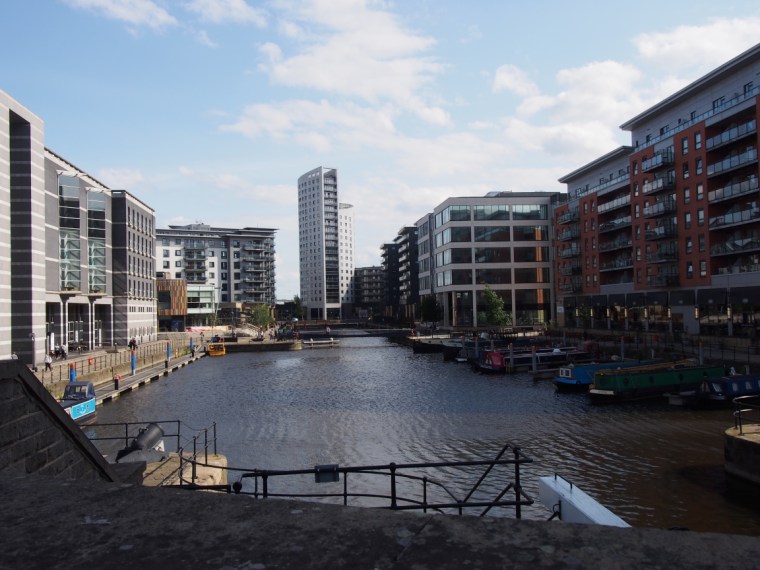
The area around the former wharves on the River Aire is now redolent of similar dockland-style schemes across the country, but no less interesting for that. The backstreets just to the north seem to be doing a good impression of Shoreditch or Hoxton in London, with many creative businesses and bearded types in evidence… Edgy – but just sufficiently so.

Above and below: mixed modern and restored architecture on the Aire waterfront.

OLYMPUS DIGITAL CAMERA

In fact, that is a good summary of the rest of the city, which has cleaned and restored many of its fine Victorian buildings, while making some appealing modern interventions and reinterpretations. The city has not been ‘over-cleaned’ – or perhaps the process has now been going on for long enough that the patina of reality is re-settling. Some rejuvenated places can feel just too pristine…

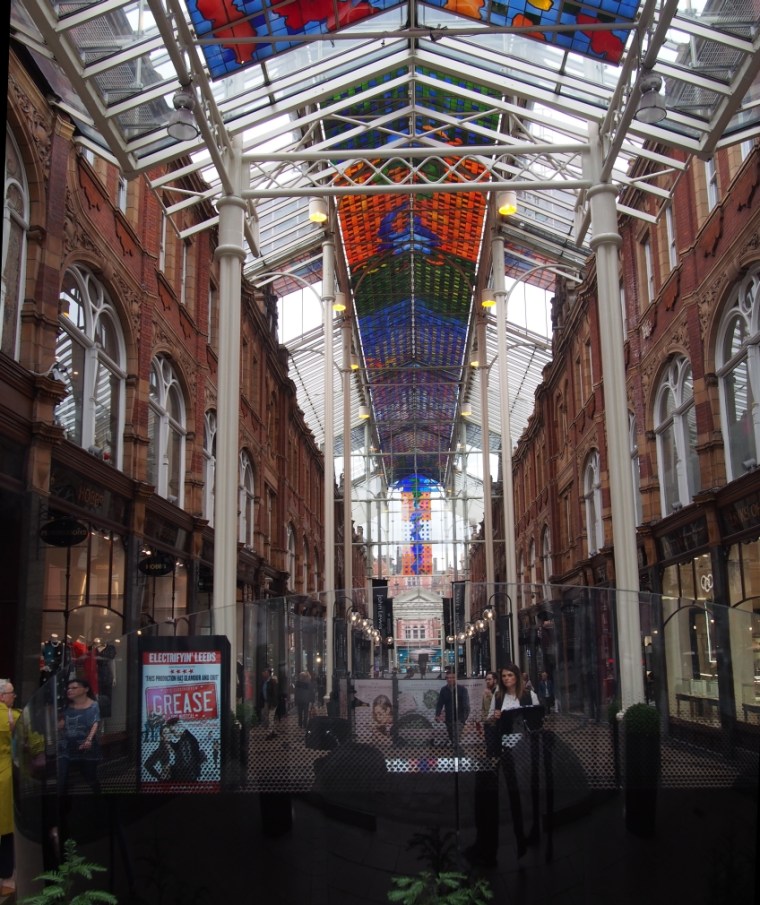
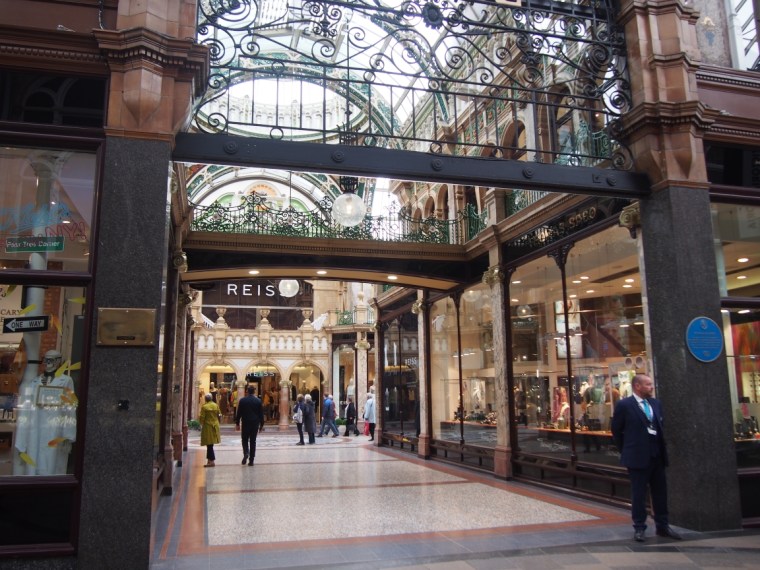
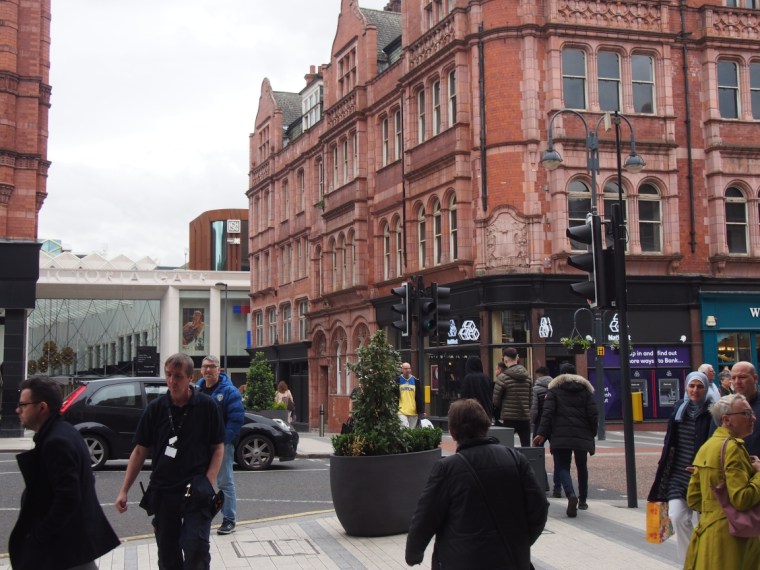
Much of the centre has been pedestrianised, with a number of new arcades being added to the very fine Victorian ones for which the city is known. As a retail centre, it now ranks with the best in the country, having Harvey Nichols as well as a large new ‘statement’ John Lewis. These have been the anchors around which many lesser known brands and a fair number of independents have clustered.

Above and below: Leeds’ famous arcades – old and new – in the Victoria Quarter.

OLYMPUS DIGITAL CAMERAOLYMPUS DIGITAL CAMERA

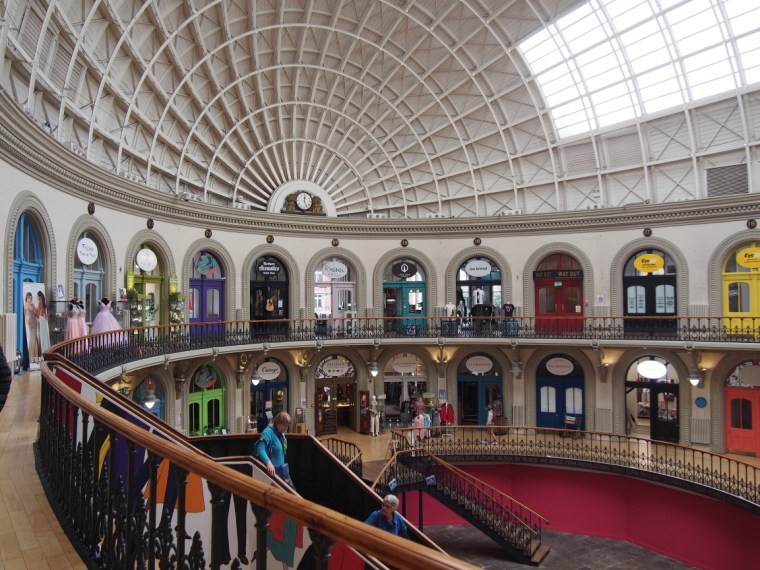
The city centre is a pleasant place to walk around, though I gather Friday evenings can still be “interesting”… There is an ornate Victorian indoor market, while the beautiful Corn Exchange now hosts a selection of esoteric independents.

The Corn Exchange

Leeds has a lot to offer culturally too, with Opera North being homed here, as well as the Yorkshire Playhouse repertory theatre. Unfortunately, there was a lull in the programme during the days of our stay. The visual arts are perhaps slightly less well represented; the city Art Gallery is not on the scale of that in Manchester or Birmingham, though it does hold a significant collection of 20th Century art. Unfortunately this too was largely closed in preparation for the forthcoming Yorkshire Sculpture Festival – as was the Tetley Contemporary Arts Centre. Sculpture is perhaps the one visual art that bucks the trend: West Yorkshire has become something of a centre for it, on the back of the area’s associations with Henry Moore and Barbara Hepworth (in nearby Wakefield), together with the well-regarded Yorkshire Sculpture Park.

We still find that many British towns and cities’ Achilles’ Heel is their eateries. Leeds does have Michelin starred restaurants – but for more ordinary mortals, the choice seems to be very largely restricted to the usual chain suspects. We try to escape these wherever we can. On our first night, we found a well-reviewed Italian not far from our hotel in another nicely-restored warehouse near the river. Unfortunately, the food was ordinary to say the least; we are not fastidious, but we do know our Italian food, and we can do better than this at home. More indicative, if this is considered locally to be outstanding, then expectations cannot be very high… Much renovation of British cities has found inspiration from the continent – and while there are now some very pleasing public spaces and architecture, it is a shame that the regular gastronomic offerings still mostly don’t come near our experiences of a place, for example, like Lille – let alone those further south.

We were able to see most of central Leeds in a day – it is fairly compact and easily walkable. The redeveloped areas along the river are extensive and attractive, though the main museum offering – the national Royal Armouries Museum was not really our cup of tea. Interesting building though.

Canal basin with the Royal Armouries Museum on the left.

On our second day, we travelled out of the city to some of the smaller places nearby – of which more another time.

As expected, Leeds proved to be a very successful choice for a short city break. It has a big-city feel without being overwhelming, and has made very successful use of its assets to emerge as another fine British city, whatever lagging public opinion might still be thinking. We’ll be back.

Opinion & Thought, Travel

The state of the nation – no – region.

Regionalism is a concept that is perhaps overlooked in much of England. While I can think of several parts of the country where people might immediately taker great exception to that claim, I still feel that as whole, English culture is not one that celebrates its regional diversity – and this has been all the more so as our capital city has grown in dominance over the rest of the country. I suspect that once again, the other nations of the British Isles perhaps have somewhat different perspectives on this, as my sense is they still root themselves in much more local identities even within their own national ones.

What makes a regional identity is perhaps open for debate. Matters like accent and food are inevitably strong – but I would add simple on-the-ground knowledge of one’s patch is important too. Having a sense of place about where one lives is important for feeling rooted. Much as I have an internationalist outlook, having a sense of regional identity is something I value, and I would like to see steps taken to strengthen England’s regionalism.

With this in mind, we took advantage of last week’s good weather to make a trip that I had been planning for some time: a circular tour of our own region of East Anglia. Despite having lived in the region for 33 years, there are still a few parts I haven’t visited – and there were a number of others where my last visit was quite some time ago. What’s more, the rail enthusiast in me wanted to complete my coverage of the region’s routes, and now seemed like a good time as major change is afoot on the region’s rail network in the next couple of years. A valedictory to some of the old order and an inspection of the current state of play of the region’s rail infrastructure seemed like a good excuse to take advantage of the Greater Anglia Day Ranger ticket, which gives unlimited travel for a day within the region for a very reasonable £24, or £18 with a railcard.

map

We started with a drive to Ipswich (GA cannily excludes the Essex commuter routes from the ticket) and thanks to the usual unpredictable state of the A12, we missed our planned train. Before the following hour’s train, we had time, therefore, to inspect the excellent job that has been made of the renovated facilities at Ipswich station, which presents a clean and modern impression to the traveller. It is good to see it being remembered that rail stations are important gateways to their communities, and being treated to some of the improvements we regularly see on the continent. The fact that GA is owned by Dutch Railways probably has something to do with it; I am a fan of what they have done during their tenure.

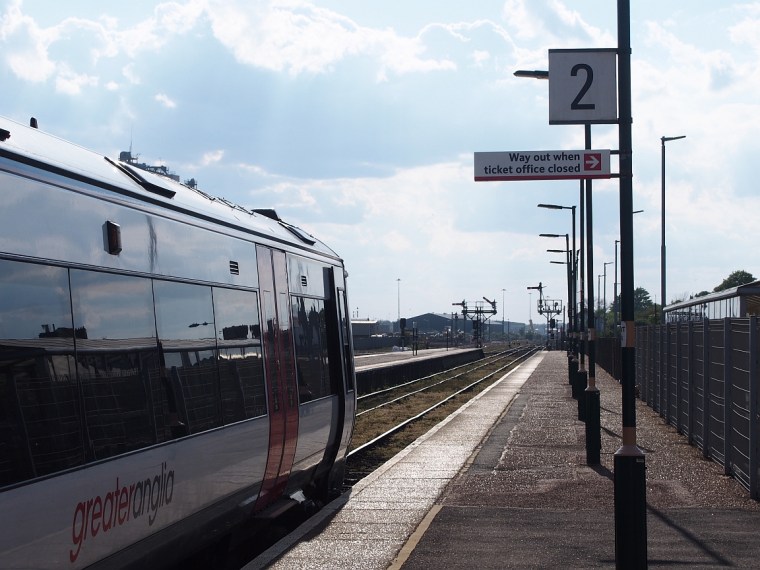
Inter-city and regional trains at Ipswich’s well-maintained station. Both are scheduled for replacement soon with new Swiss-built trains.

I had artfully concocted an itinerary that would both cover the lines I wanted, and take in pretty much the whole range of East Anglian landscapes – for while this region is entirely flat, it does not want for variety. It is by no means all wheat prairies, as people seem to think.

Our first train took us via Stowmarket, Bury St Edmunds and Newmarket to Cambridge. This a very pleasant 80-minute crossing of the gentle Suffolk countryside, seen at a green time of year. The short stretch through Newmarket, past the racing studs, to Cambridge was new to me.

Cambridge station is another that has benefitted from much investment, and now presents a crisp gateway to the city. Since my last rail visit perhaps 25 years ago, the whole of the station forecourt has been redeveloped with multiple office blocks and apartments. It has been a controversial scheme, but I found it impressive, having created a very pleasant public square in front of the station, as often seen on the continent. Morning refreshments were duly taken.

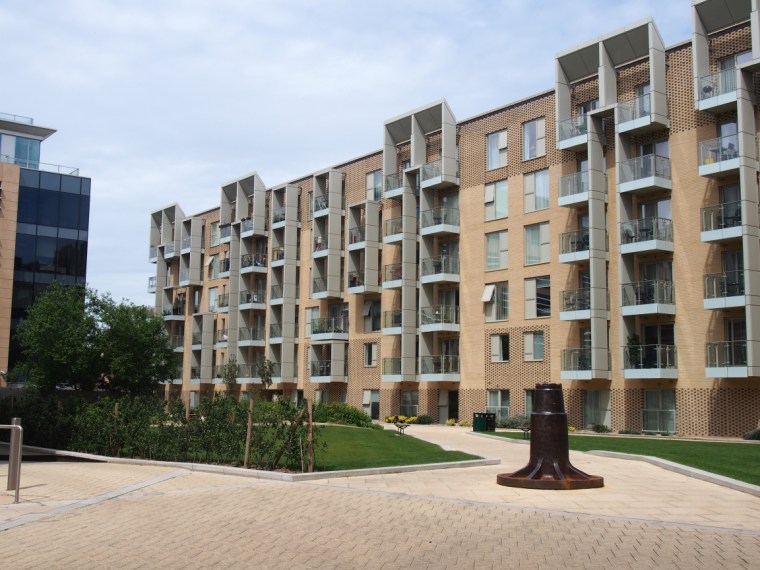
Above and below: modern developments on old railway lands adjacent to Cambridge station. The ‘sculpture’ is actually the central pivot from the old railway turntable, unearthed during redevelopment.

OLYMPUS DIGITAL CAMERA

Our next train required an add-on to the day ticket, for the unknown line to King’s Lynn. This journey is around an hour long, and heads out across the depths of the Cambridgeshire Fens. The main landmark is Ely Cathedral, before the line singles as it heads for the backwoods. The Fens can be bleak, but I find them an interesting landscape, with a large vistas and huge skies that are not common in Britain. There are few places in Britain where the trains actually rise to pass over the local rivers – the whole area was marshland, some below sea level, drained by Dutch engineers from the 15th Century, and now some of the nation’s most productive farmland. But dead flat.

King’s Lynn is a place we did not previously know. It has an attractive, small railway station that has been well maintained, though it gives onto what at first sight looks an unappealing town. Regrettably, modern retail developments have not exactly enhanced the impression – but if one perseveres, one can find a well-preserved Medieval town in its midst. There are some impressive buildings along its Ouse waterfront, dating from the time when it was a prosperous port. We had a little over an hour, which was enough to gain an impression and grab some lunch.

King’s Lynn’s well-preserved station. Perhaps on account of royal visits on the way to Sandringham?
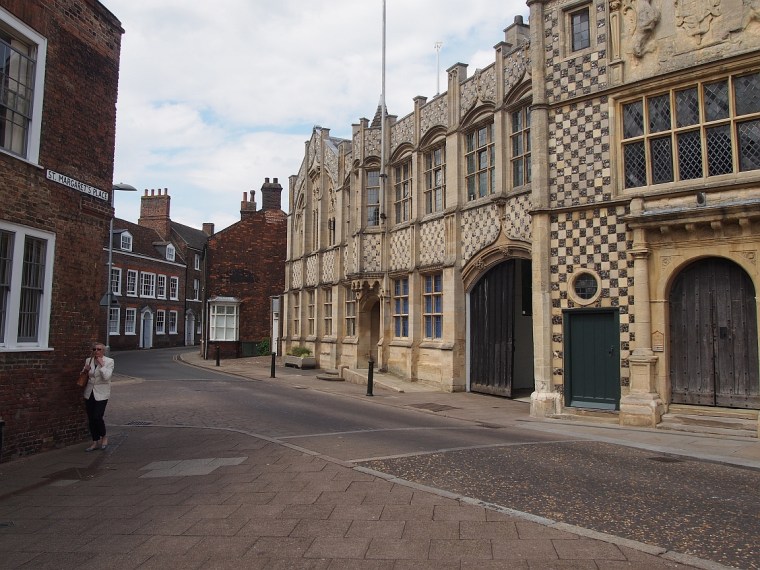
Medieval buildings in King’s Lynn. I suspect that were this town nearer to London, it would be very sought-after.
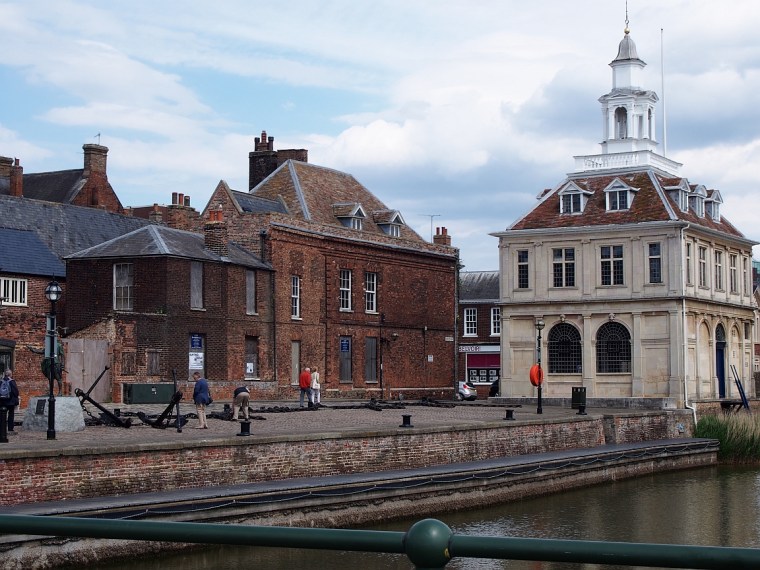
King’s Lynn waterfront, where the Great Ouse exits to The Wash.
The attractive Custom House.

We had to retrace our steps to Ely, where a quick change gave us a train over the Breckland Line to Norwich. My last traverse here was in 1987, and indeed was my first entry after University into the region that has since been my home. The Fens give way quite abruptly to the sandy heathland of Thetford Forest, a quite extensive area of uncultivated space and forestry plantations – a place of unexpected wildness, deer and dramatic sunlight. It is very appealing.

More quiet countryside follows, and then arrival in Norwich, along the valley of the Yare, and under the viaduct by which the main line from London soars in (well, by East Anglian standards) from the south. As expected, the railway sidings outside Norwich’s impressive station are now full of the new Swiss unit trains with which GA is replacing every train on its network over the coming two years.

I had been hoping that our train to Lowestoft would be formed from what is known locally as the Short Set – a few old coaches topped and tailed by two class 37 locomotives, some of the oldest remaining in service, and due to stand down in the coming months. The set was standing with engines running adjacent to the platforms – but it was not to be, as another unit set rolled into sight. The train to Lowestoft was packed, it being late afternoon. The journey is scenic in a different way, as it passes many of the southern Broads, former peat workings now flooded and full of attractive leisure boat activity. The East Norfolk countryside can be surprisingly remote, and shafts of sunlight lit it dramatically as we chuntered slowly past windmills and over the swing bridges that still characterise the route. The signalling is still mechanical, though its colour-light replacements are now installed, awaiting commissioning.

The ‘short set’ in its siding at Norwich station – where it stayed. These class 37 locomotives have been around since the early 1960’s.
Above: the most easterly bit or railway line in Britain at Lowestoft station. Below: signal set for the route home. All the old semaphore signals will disappear shortly too…

OLYMPUS DIGITAL CAMERA

Lowestoft is the most easterly point on the British rail network, indeed the most easterly town in the country. It still has some fishing activity, but otherwise looks to be struggling. But its station is clearly looked after by the local community rail partnership. Our final train was another bucolic 90 minutes via the East Suffolk line back to Ipswich. This single-track route nearly closed some years ago, but was saved by innovative radio signalling which allowed cost-savings to be made. It is a delightful ride though quiet, deep countryside and past the boatyards at Woodbridge, before it joins the line from Felixstowe – also single track – on the outskirts of Ipswich. I find it unbelievable that this is still the state of the route along which a major part of the nation’s imports flows from the deep-sea container port there – though enhancements are in hand.

We landed back at Ipswich some nine hours and 220 miles after we left. An excellent way to re-acquaint with the less visited parts of our home region. One gets a sense of integration – of how the various parts relate to the whole, and without the hassle of driving. It’s a pity that modern, sealed trains don’t easily allow photography on the move, but it was good to see all of the trains punctual, clean and well patronised, and the stations for the most part looking well kept. Something every region needs as part of a decent sense of self.

Arts, Architecture & Design

CONTEMPORARY HOUSING DEVELOPMENTS IN CAMBRIDGE 2: EDDINGTON AND GREAT KNEIGHTON

2. Eddington.

This is an entirely new urban quarter being developed initially by the University on land on the north-western edge of Cambridge. It is adjacent to a park-and-ride bus terminal, but has also been given additional transport links to the city in the form of cycle ways and a car sharing scheme. The site has been occupied for around 18 months but there is still much construction to be done.

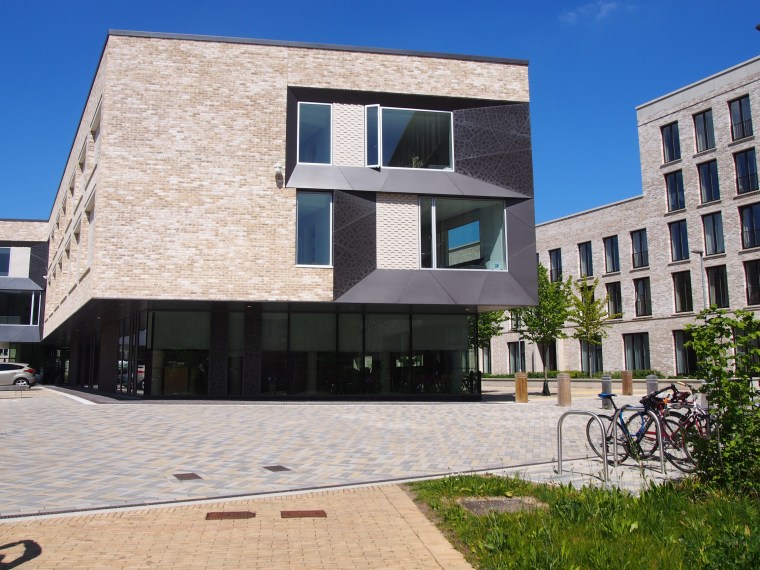
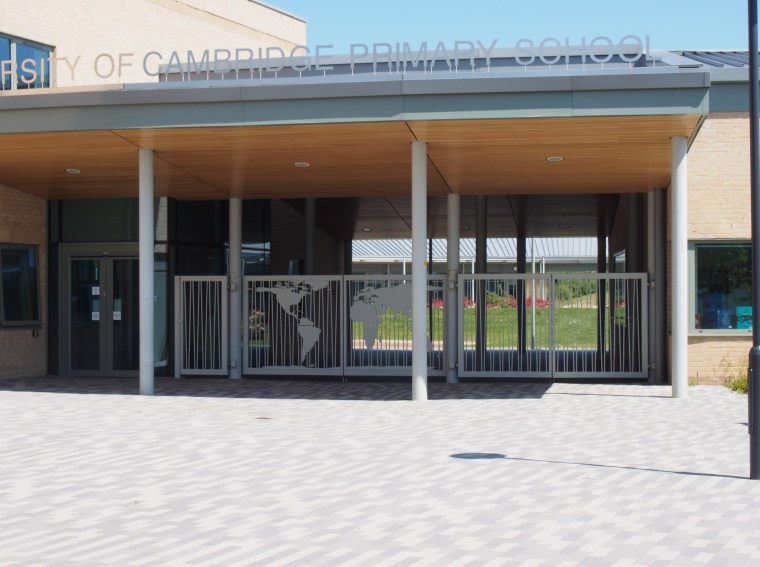
The newly designed primary school (overseen by the University) has attracted attention, and the community centre is a candidate for the Stirling Prize. A new supermarket has opened, and other shops will follow in the central ‘market place’ in the near future, along with a hotel.
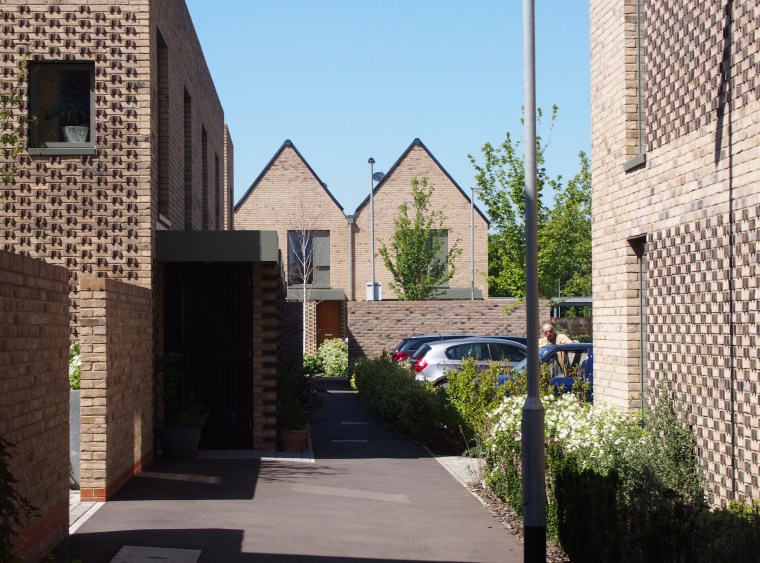
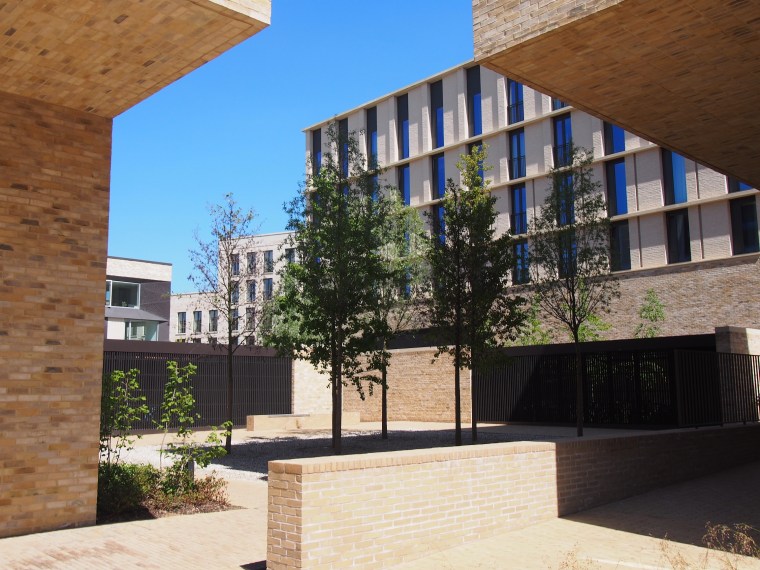
The quality of the architecture and construction is high, and perhaps unsurprisingly it has something of the feel of a university campus.

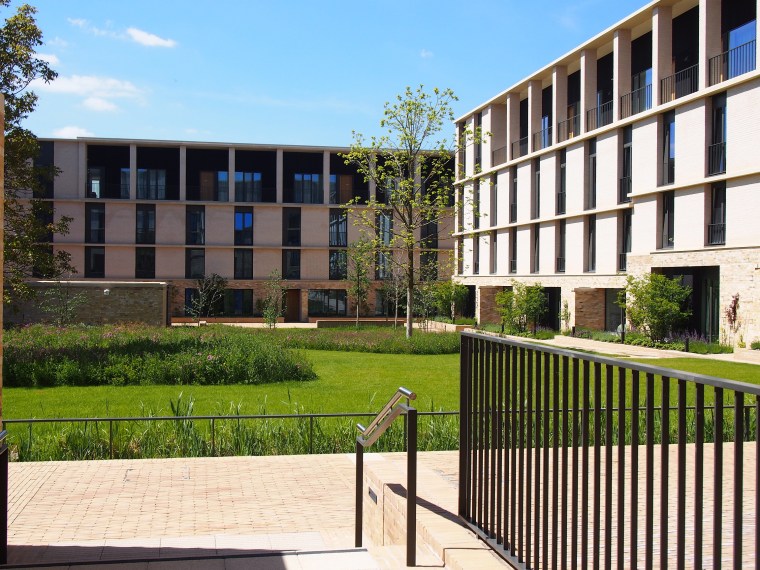
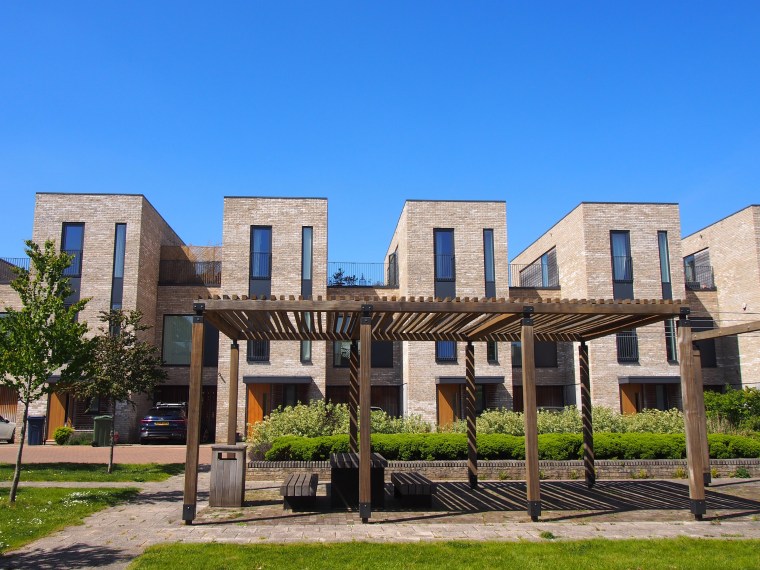
Once again, consideration has been given to the entire urban environment, with broad boulevards, numerous pedestrian routes on an engaging variety of scales and a sequence of open squares and courtyards. Mature trees have been widely imported and imaginative planting laid out, though it will of course take time for this to reach maturity.

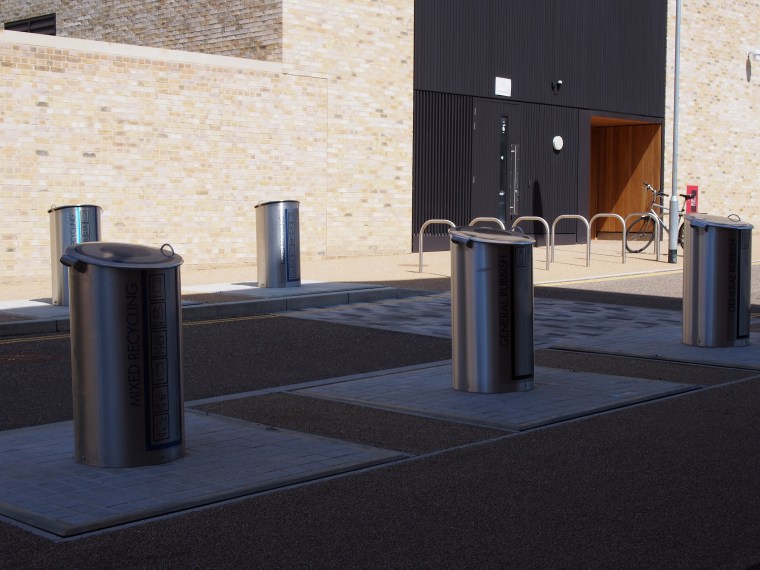
Sustainability is integral to the plan: for example, many buildings have high-quality communal bicycle parking and refuse is dealt with by banks of communal bins in the street. These appear small, but in fact empty onto large underground receptacles which are periodically lifted out and emptied by lorry. A very neat solution.

Build-quality appears high. Many of the buildings are in the form of terraces and apartment blocks, which while not to everyone’s taste, do make for very efficient use of space, and the retention of privacy while building at high density – unlike many more ordinary modern, high-density housing estates. Perhaps part of the matter here is challenging people’s preconceptions of these matters – probably somewhat easier in a relatively liberal place like Cambridge.

Some of the architecture has classical overtones, while some of the open spaces and avenues offer reminders of some of the spaces that many find attractive in continental towns, but which the traditional British model rarely produces.

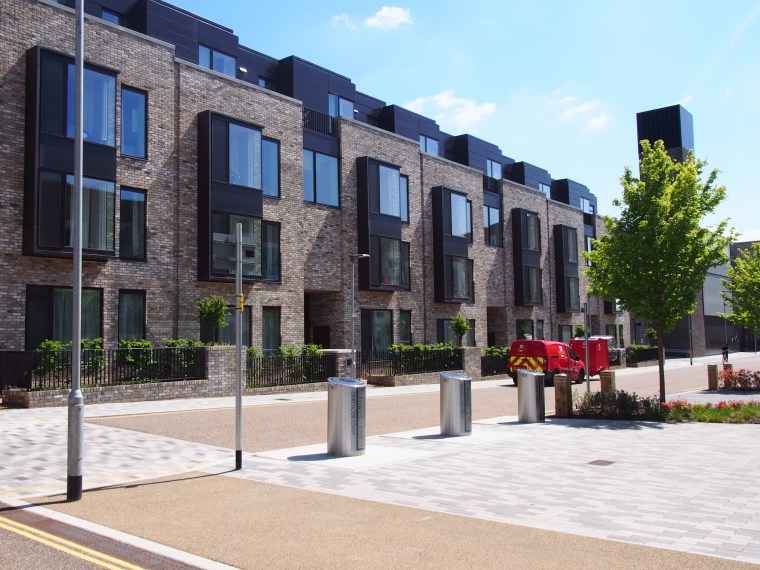
Eddington streetscape. Note the high quality of ground finishes. Something of a Georgian terrace here, too.
Above and following two: public spaces in Eddington. Varying scale. Once again, attention paid to materials and finishes. The dark coloured screens conceal segregated vehicle and cycle parking.

OLYMPUS DIGITAL CAMERAOLYMPUS DIGITAL CAMERA

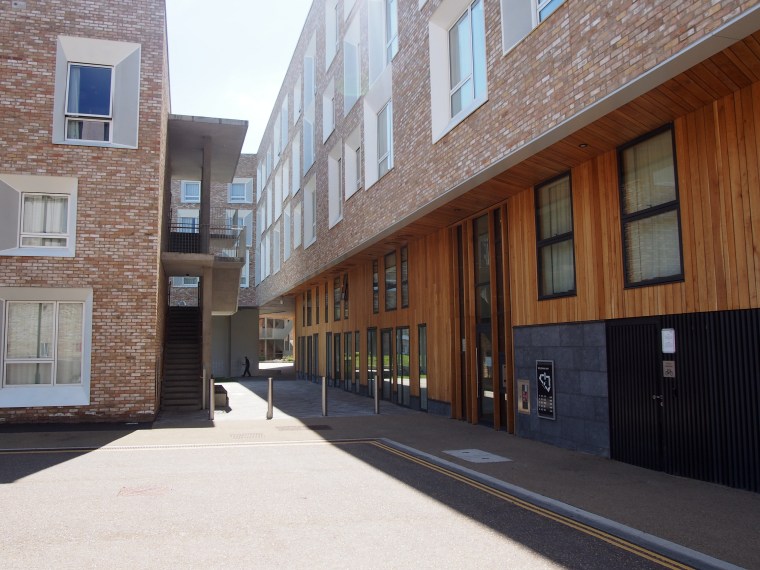
The provision of walking routes is good. Again there is a range of scales, and cut-throughs such as this offer something of the enticement to explore that is a characteristic of many appealing traditional towns.
Good to see design attention being paid to public buildings. The primary school is circular, around a central green space. The metal gate sculpture is an attractive touch.
Efficient recycling: the bins empty into underground receptacles, demarcated by the white squares on the ground. The whole thing lifts out to be emptied.
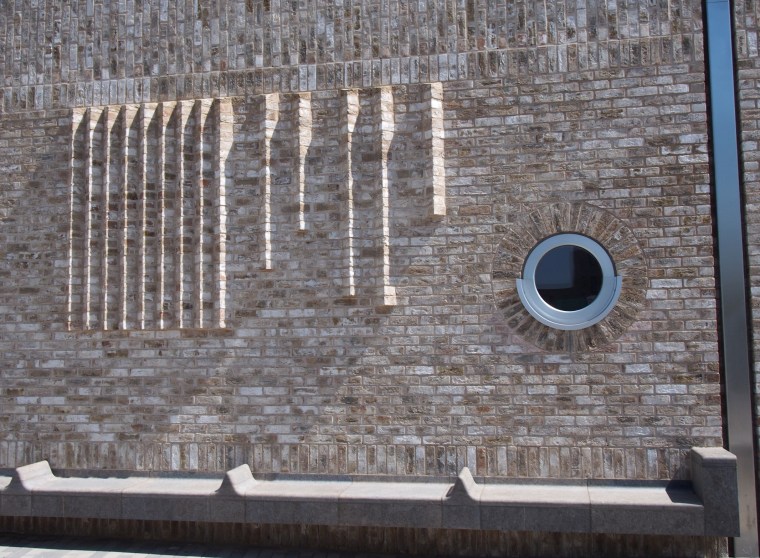
Brickwork detail on the community centre. Use of traditional materials in a new context ‘grounds’ the development in its locality.
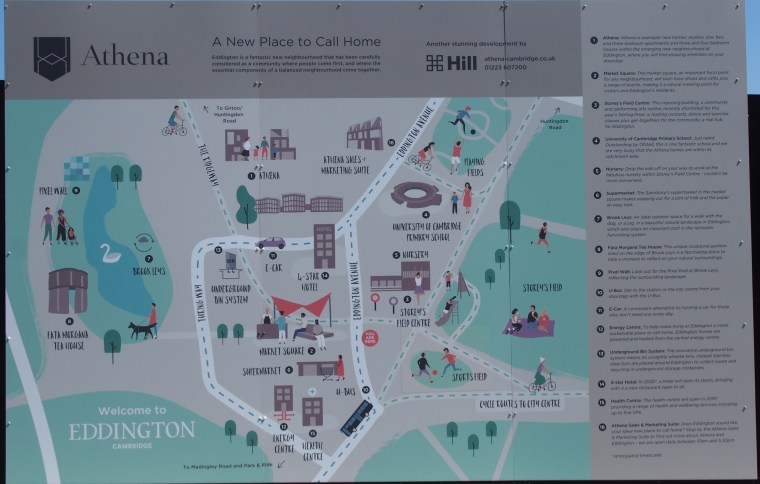
Poster detailing the scope of the development.

3. Great Kneighton

On the south side of Cambridge, a huge development is occurring near Addenbrookes Hospital. This has taken the Accordia concept several stages further, as mass-housing developers seek to cash in on the attractiveness of the model to the Cambridge market. Again this is on the edge of the city, but is served by another nearby park and ride terminus, while Cambridge’s malfunction-troubled guided busway penetrates the site.

I was expecting this site to be disappointing: the usual dilution of a great concept in the name of fast profit, but in the event I found it significantly better than that. There is a clear master-plan to the site, and its huge scale does not seem to detract greatly as a result. There are spine roads, but many discrete neighbourhoods, laid out on varying patterns but with frequent reference to the same principles of shared street space and the creation of an strong sense of place. This, to my mind, is successful, unlike the many anonymous clone-estates seen in much of the rest of the country.

Several bulk-builders are construction on the site, which has led to a variety of styles, though the quality is perhaps less consistent than in the previous two developments. Conversation with the representative of one company confirmed that it has tried to ‘raise its game’ in this location, which is encouraging – but it begs the question why there appears to be little intention of offering the same approach elsewhere in the country.

First impressions suggested a coarsening of the architecture, the usual fate of overtly commercial developments. But the public square and planting is well above average.
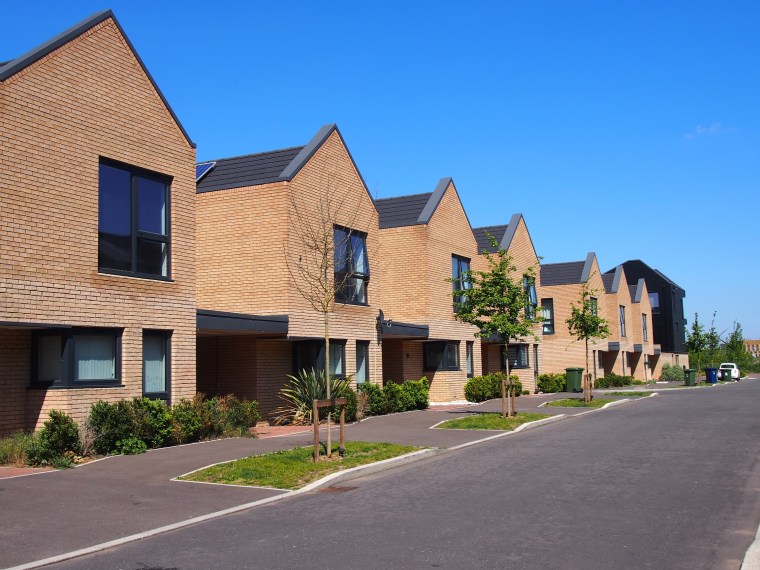
Above and below: enough of the spirit of Accordia remains to make this a successful development. The use of decorative brickwork is appealing without recourse to pastiche. There is again something of a Dutch overtone to the buildings below – the eastern counties of course have a long history of such influences.

GK03

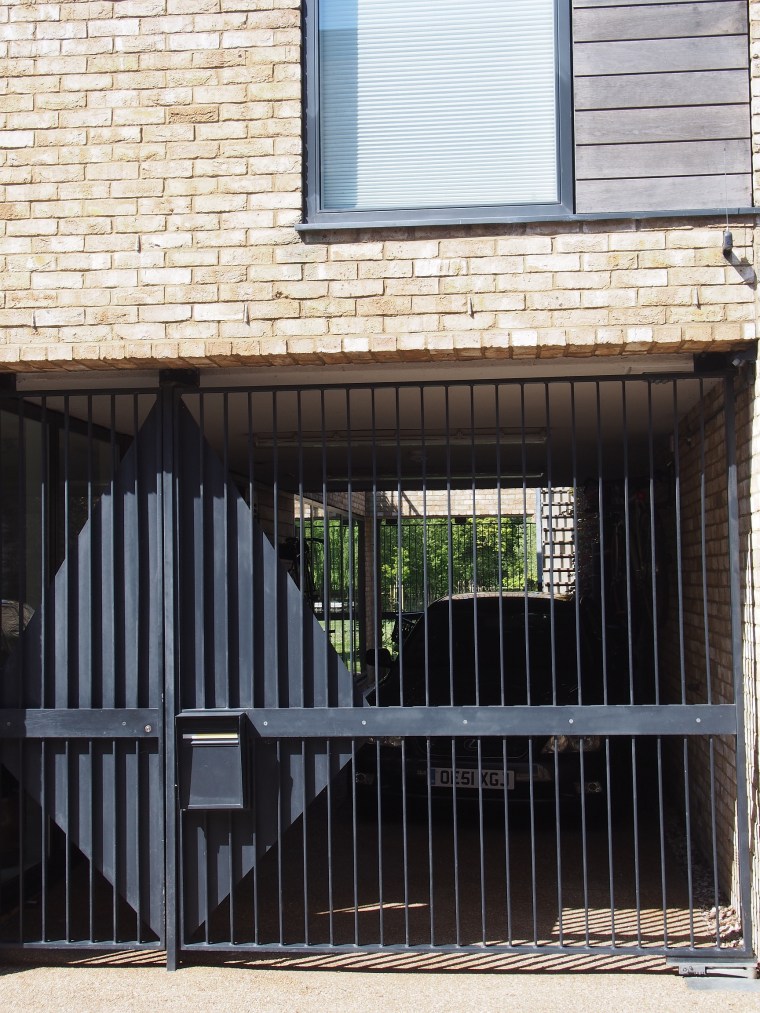
Efficient use of space in a high density development: garages are integrated, and the space over them used for living rooms and roof terraces. Planting is starting to mature nicely.
Culs-de-sac are kept short, and they mostly have pedestrian through-access (see below). This reduces the number of areas not publicly frequented. The use of dropped kerbs and varied paving creates a successful shared space.

OLYMPUS DIGITAL CAMERA

Terrace by Bovis. Attractive streetscape details, not dominated by roads. The use of high density makes this achievable. Again, space over garages well used.
This is aesthetically less successful, but it may mature. The spaces over the car ports could surely have been better used at minimal added expense.

Conclusions

All in all, this was an inspiring day. It shows that the potential exists for Britain to produce residential quarters significantly better than the usual bland Lego-box pastiche estates – and they will sell. Perhaps the most reassuring (and surprising) point was to see that even the quantity builders can use these principles without completely bastardising them.
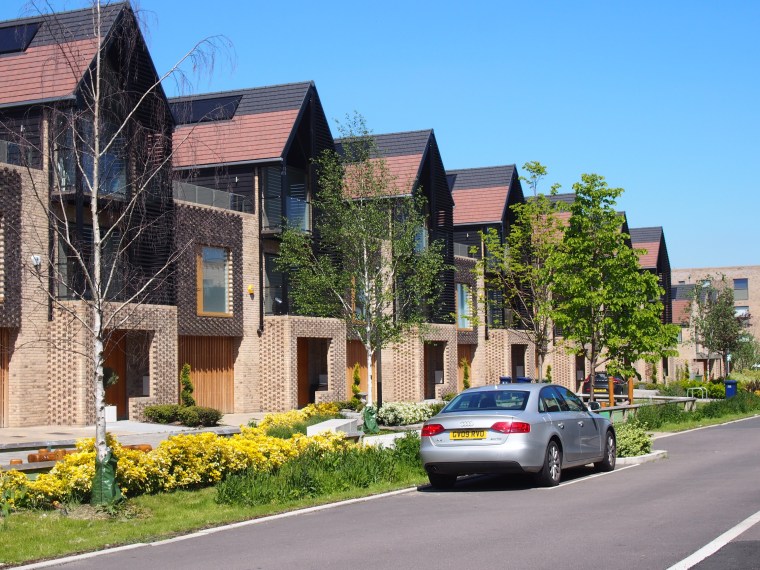
My county has long had design guidelines for new development – a reaction to its blitzing with low-grade suburban development in the twentieth century. The latest incarnation of the Essex Design Guide is not hostile to contemporary architecture, but it makes the very good point that great architecture is not only about landmark buildings. The quality of ordinary ones – and the streetscapes between them – makes a far more significant contribution to the quality of people’s lives, and it is encouraging to see that the country is not beyond getting this right.

We now just need to do it much more widely.

Arts, Architecture & Design

Contemporary housing developments in Cambridge 1: Accordia

I have long been envious of the quality of housing in continental countries such as Switzerland and Germany. As with many things, a more controlled construction sector, coupled with a greater discernment on the part of clients and perhaps less aversion to modernity has produced new housing stock of a quality far superior to that in this country.

It may seem mundane, but given the centrality of home in most people’s lives, the quality of fixtures and fittings, the sound-proofing of floors and walls, the adaptability and ease of maintenance of those spaces can make a significant impact on the quality of life. And that is before we consider the psychological effect of the spaces we inhabit.

Sick building syndrome was identified some decades ago, where large artificially-lit and poorly ventilated office buildings were literally making people unwell. I think this is evidence enough to support the theory that the quality of our built environment is of major significance for our well-being.

Perhaps a little more contentious is the aesthetic impact of such spaces. I find that having a home which is pared back and calming is beneficial to the state of mind – and the use of pleasing materials and forms brings a daily uplift to my state of mind. While many in Britain still apparently see modernism as bleak and unwelcoming, I find well done modern design hugely optimistic and buoying. The freedom it presents from out-dated social forms releases the designer to respond to the needs of the present day without being a slave to convention.

I recently spent a day touring some of the recent residential developments that have been built around Cambridge. This city has long been associated with architectural innovation, and still today it seems willing to entertain visions not welcomed elsewhere. The presence of a highly-educated population no doubt helps.

We toured three developments, which I describe in this and the subsequent post.

1. Accordia.

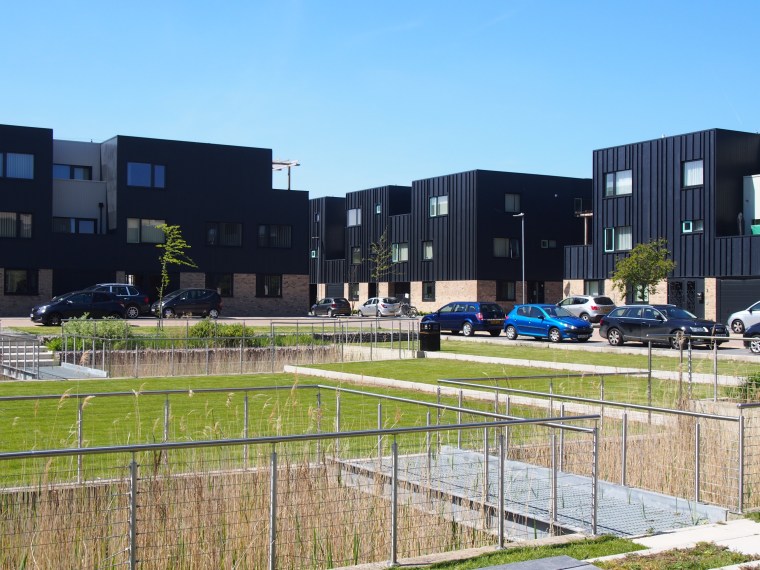
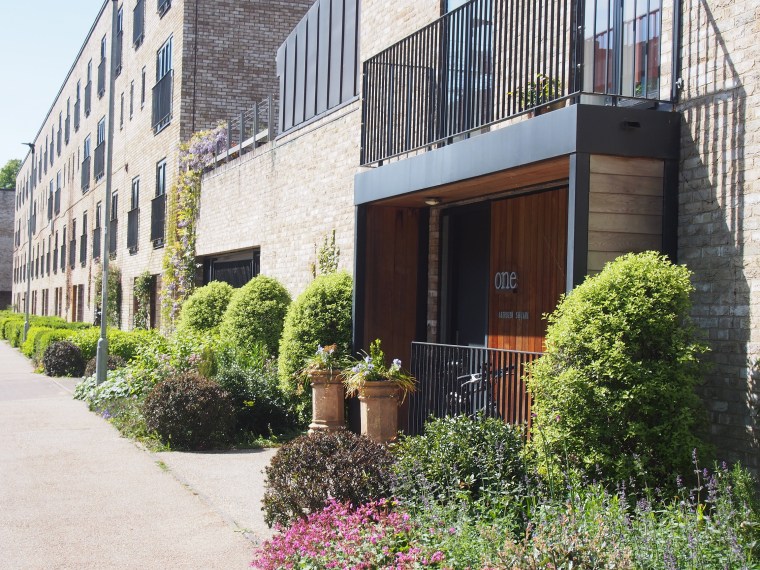
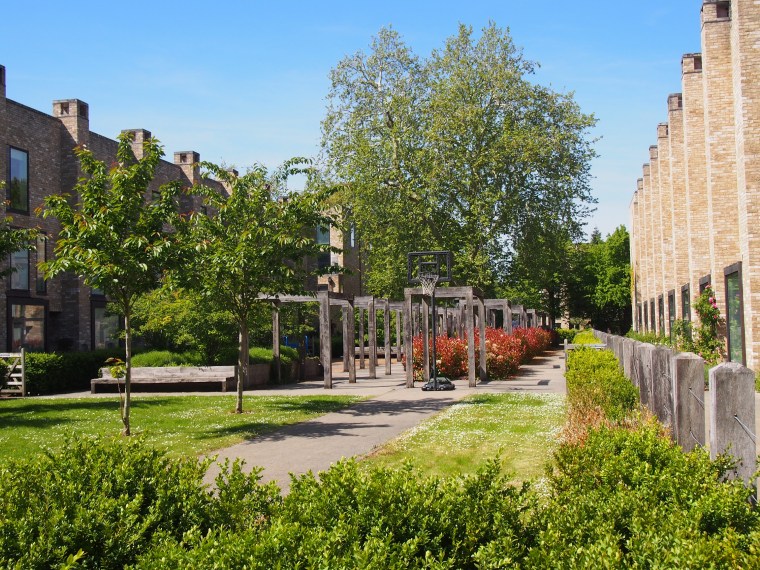
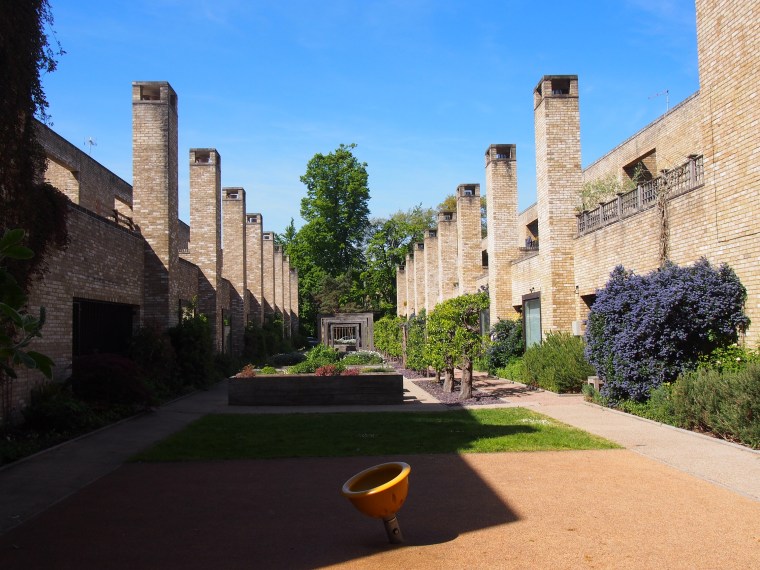
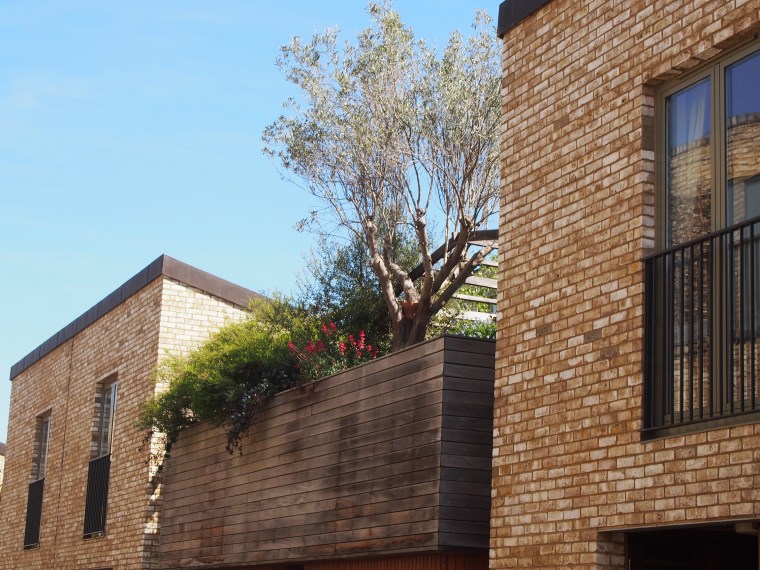
This development of 378 dwellings was completed in 2008 on a Ministry of Defence-owned site near the University Botanical Gardens. The master-plan was developed by Felden Clegg Bradley architects, and it won the RIBA Stirling Prize in 2008.

It includes a mix of types, both private and housing association properties in a range of contemporary styles. Much care was put into developing a pedestrian-friendly street plan, energy-efficient buildings, and well-landscaped grounds. The retention of a large number of mature trees helped in this respect.

The principal practice designed about 65% of the buildings, but several other architects were commissioned to provide an input, which has resulted in an eclectic range, mostly of terraces and apartments.

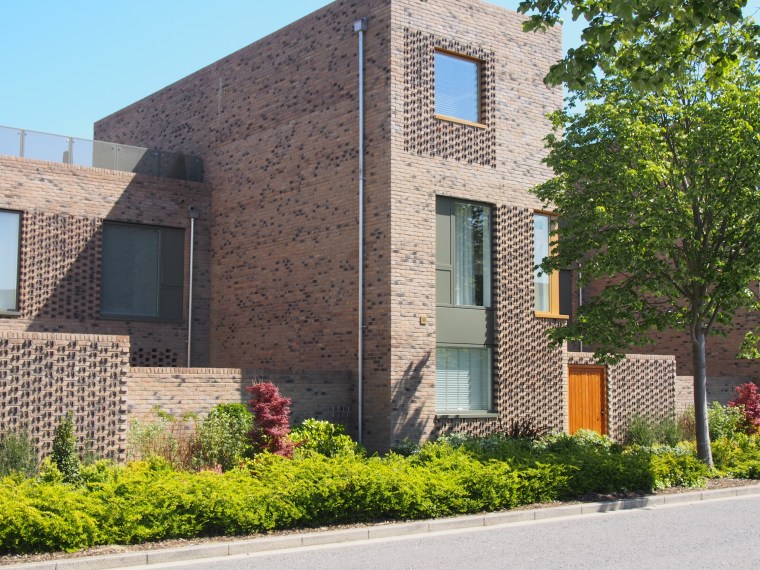
Inspiration was imported from the Netherlands, from where high-quality bricks were sourced, in a colour not dissimilar to the local brick colour. Much use was also made of shared street space communal facilities such a play areas for children, as widely seen in Dutch towns and cities.

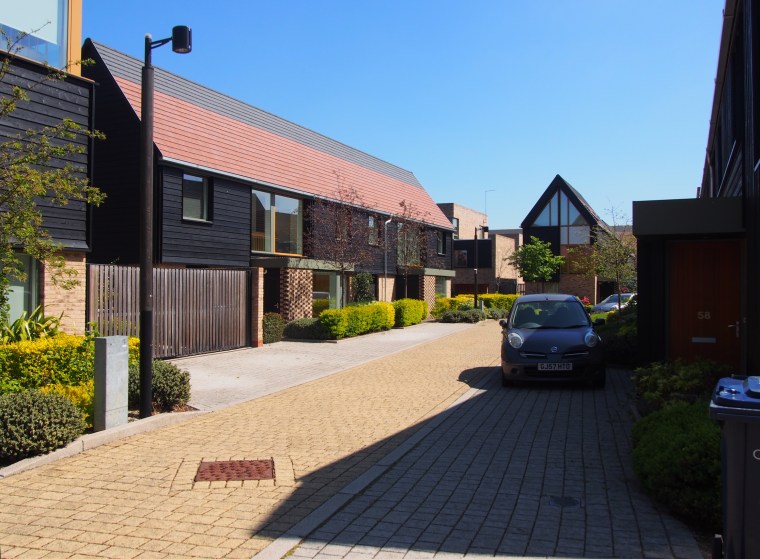
In contrast to many modern British developments, the houses are mostly positioned right on the street, thus providing strong street lines and a good ‘sense of place’. Roads are mainly straight, though with chicanes to slow traffic and provide dispersed parking spaces. The corners of many side roads are blind, which in effect forces drivers to proceed slowly. Street furniture is high quality, and the traffic management is subtly done.

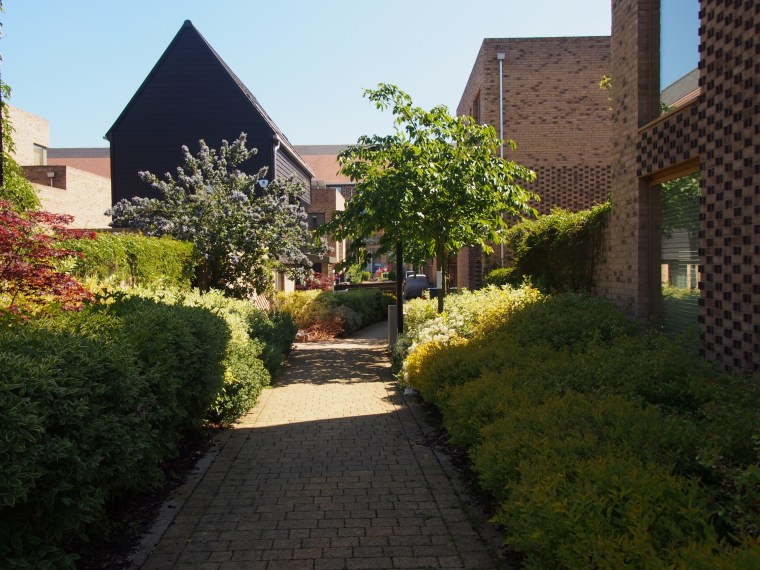
Cars in general are subordinated to pedestrians, with parking largely integrated within buildings, or beneath apartment blocks. Vehicular access is often at the rear of the properties, with the front doors giving onto well-planted pedestrian streets. There is a car-sharing club, which seems made for dense inner-urban developments like this. There is a range of street widths, from a generous main spine road to narrow mews-like off-shoots.

I have watched this development from its late construction stage as my sister in law has her home there. Ten years on, the development is well into the maturing stage, with the buildings increasingly softened by climbing plants. Accordia has been so successful that it spawned a number of other developments in the Cambridge area, all of which are apparently in great demand. These will be shown in the following post.

It is quite unnerving to see something of this quality in the U.K. I can’t pretend I like all of the individual buildings – but that is of course fine. The really impressive thing is the coherent master-plan for the site, which has successfully created a new residential quarter not far from the historically sensitive core of the city – in a style that is ‘of its time’ and yet which will hopefully enhance the city’s architectural inheritance rather than – as is so often the case with new-build  houses – the opposite.

OLYMPUS DIGITAL CAMERA
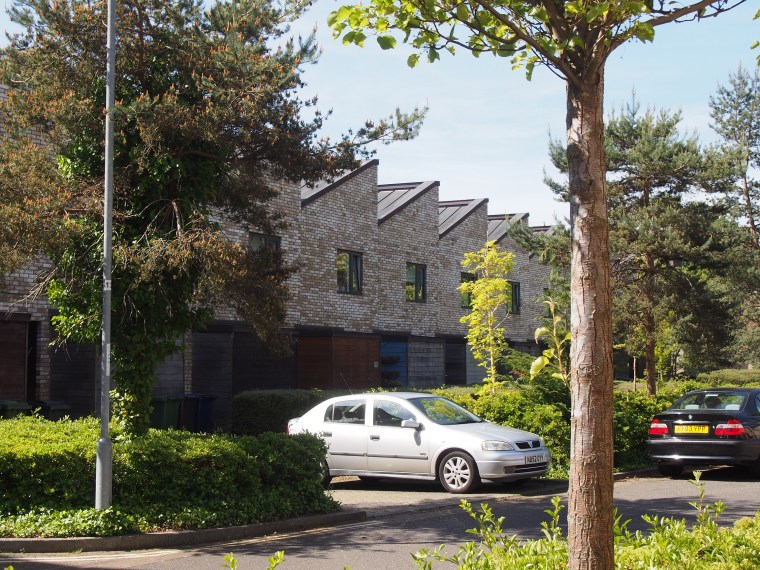
Above and below: a range of Accordia streetscapes.
OLYMPUS DIGITAL CAMERA
On-street parking is sensitively integrated
OLYMPUS DIGITAL CAMERA
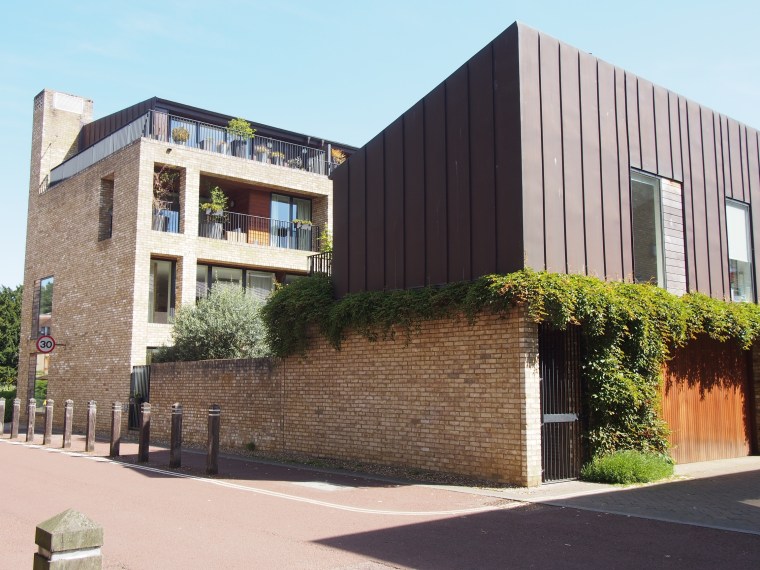
Signature building at the entrance to the development. Garage to rear, off mews side-street. Note blind exit which slows traffic successfully.
OLYMPUS DIGITAL CAMERA
Redolent of Georgian terraces, this building has duplexes on floors 1-2 and 3-4. The upper ones have roof terraces.
OLYMPUS DIGITAL CAMERA
Above and below: non-car streetscapes.

OLYMPUS DIGITAL CAMERA

OLYMPUS DIGITAL CAMERA
Much use is made of balconies and roof terraces to afford outdoor space to all.
OLYMPUS DIGITAL CAMERA
One of several children’s play areas – all overlooked for safety.
OLYMPUS DIGITAL CAMERA
Much car-parking is integrated into buildings thus decluttering the streets and avoiding compromise to the architecture.


Travel

Google-bombing Europe 6

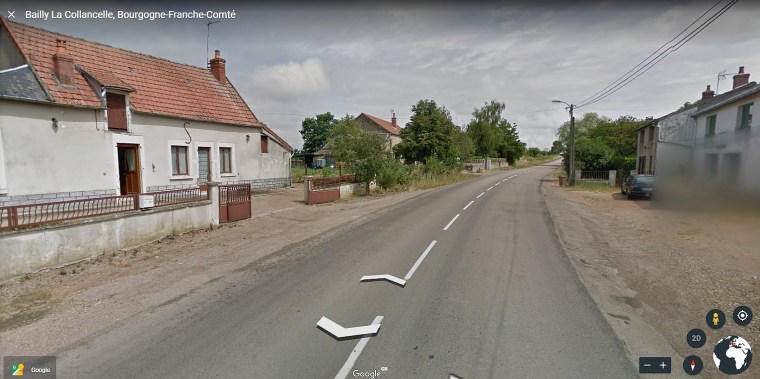
Returning after a short break to my random drop-ins on various parts of Europe, courtesy of Google Earth. The aim of the exercise was to re-calibrate my perception of Europe, which I suspect is, as for many people, disproportionately formed from  impressions of its highlights and other places I have personally visited. One thing that is becoming clear is that visited on a random basis, more often than not one lands in a the middle of fairly undistinguished ruralness. The cultural jewels of the big cities and towns are not much more than a pin-prick in their nations’ overall territories. Unsurprisingly, there is a great deal of ‘ordinary’ out there…

Today: Austria and France in ten pictures each.

Austria

AU01AU02AU03AU04AU05AU06AU07AU08AU09AU10

France

FR01FR02FR03FR04FR05FR06FR07FR08FR09FR10

Opinion & Thought, Politics and current affairs

Carpe Diem

gina-headshot-e1509375521711-600x404

A brief internet discussion with an Italian on social media a few days ago produced the following observation: “I think the British are just too afraid to go outside their comfort zone.” Well yes. But there is a back-story here: being on an island makes it harder for us to go outside our national comfort zone than for those on the continent (although southern Italians might disagree…) Even a committed European like me could only find the time and money to travel abroad a couple of times a year. Contrast that with my Swiss friend’s son – who went ‘abroad’ every day – to school. Even though that was only a matter of a few kilometres’ journey. It is so much easier to become internationalised when your geographical situation facilitates it.

And yet there more in that Italian guy’s comment than perhaps he knew. It has only ever been in the U.K. that I have heard people say such-and-such “is not for the likes of me”. I heard perfectly able students say it when I tried to encourage them to aim for the top universities. I heard a woman in my town say it the other day when I tried to encourage her to get involved with local decision-making.

I don’t want to fall into the trap of suggesting that a whole continent is uniform – and uniformly different from Britain – but it is nonetheless anecdotally true, as I have observed before, that people ‘over there’ seem less constrained by barriers not only of geography – but also in their own minds. It is one of the things I find attractive about continental culture: compared with Britain, anything – well, at least much more  – seems possible.

I think the reasons for this do come back to our sociopolitical situation. Everything about Britain is still predicated on competitive advantage. The aim in life seems to be to “get ahead” – but of what? The system? One’s fellow citizens? The purpose of ‘success’ in Britain seems to be to buy exclusivity – and I can only conclude that this is a hangover of a social system where rank was (still is?)  everything.

Another social media conversation a few days ago was quite enlivening – and then I checked the profile of my interlocutor. It turned out (since verified) that I had been talking, simply as one human to another, to the CEO of BMW. My perception in Britain is that the elite rarely talk to anyone except each other – and certainly not with the hoi polloi via unassuming Facebook threads.

It would of course be wrong to suggest that everyone is equal on the continent. They have their elites too – but experience suggests that while ambition in those countries may bring an enviable way of life,  it does not – at least to the same extent – bring snobbery. Over the years, I have met a fair number of influential continentals – from MEPs to the (Dutch) President of the UCI (International Cycling Federation ). I have observed and heard about the behaviour of others, from celebrated Swiss art dealers to executives in multinational companies.  Almost without exception, they seemed to lack the superiority complex of their British counterparts. (The principal exception was Juan Antonio Samaranch, the Spanish President of the IOC, who seemed to think he was the Emperor of the World; those others whose view was closer to the British seemed to come from countries which shared many of our social problems and attitudes).

Even in the European Parliament, it was very noticeable that it was the British (Conservative) MEPs who had the airs and graces; the rest, even in their own political grouping, seemed much more down-to-earth. I have also heard about the low esteem in which residual elites are held in those countries – they are figures for fun or pity, and they certainly do not possess the power to intimidate that they do in Britain.

I spy an irony here, in that those nations which shout loudest about ‘anything being possible’ – The USA and the UK – are actually those with some of the lowest social mobility. It seems that we have to keep shouting about it, because we know that it really isn’t true. When ‘opportunity’ is so much the monopoly of a few, the mentality amongst the rest, that much of life’s bounty really isn’t “for the likes of me”, seems inevitable. And that includes the ability to travel, to discover that it isn’t the same everywhere.

It is in those countries which are more equal to begin with, that perceived Opportunity really does present itself to more people. And what is more, the consequences and objectives of that opening seem different too. While the aspiration for a comfortable life is probably universal, the attaching of this to exclusivity seems not to be. Wealth and seniority do not automatically make one a superior person, simply a wealthier or more senior one. It is the conflation of wealth, elitism and power that have put Britain (and the US) in the positions in which they now find themselves.

In a sense, this blog Sprezzatura rails against this: beneath an apparently superficial preoccupation with the good things in life lies a more profound belief that they should not be the preserve of an elite, but be accessible to all who want them. That good life does not need to come – as many in Britain’s elite seem to think – at the expense of others. And in any case, the ‘good life’ is not only about material wealth or privilege: many of those good things are actually found in simplicity and attitude, rather than large bank balances and powerful connections.

What prevents more people from enjoying them is the conflation of good living with privilege – of things that are “not for the likes of me”. It is a barrier that seems to be at least much less strong in those nations that are not so persistently hierarchical in their mindset.

The antidote to this is indeed Carpe Diem. Seize The Day, no matter who you are – and make the most of it. And on this day of all – which was to have been Brexit day – I feel it essential to acknowledge the role played in our current reprieve by Gina Miller, without whose legal challenge we would now be having Brexit imposed on us by the most authoritarian, elitist government in recent British history. Even Parliament would not have had a look-in, had it not been for her.

It clearly took someone with wealth and connections like Miller to activate the necessary procedures to bring the legal challenge to May’s dictatorial instincts – but the striking thing about this woman is that she uses her wealth not just to bolster her own position, but for what she believes is the common good. She seized a day without which today would be our last in the EU. I hope she is eventually sainted for it.

While she is a British citizen, it is of course noticeable that she takes at least some of her cultural leads from her past, elsewhere in the world. We British have a lot still to learn.

Opinion & Thought, Politics and current affairs

Why should only some have prizes?

Mrs May today says she “shares British people’s frustration” that Brexit has not (yet) been completed. In doing so she illustrates perfectly the endemic problem with British politics that got us into this fix in the first place: she is quite at liberty utterly to disregard the opinions of the at-least-half of the population that disagrees with her. We simply don’t exist, let alone figure in her reckoning. She can claim she speaks for the nation when she clearly does not. Our fate, as a beaten (supposed) minority, need be of no interest to her.

This is the result of a system that is based on disagreement and confrontation rather than consensus-seeking. It is a system based on beating your opponents and then ignoring them. Both major parties are as bad as each other when the chips are down and they win power. This is no way to run a pluralistic modern nation.

This is the system that allows the Conservative Party to describe itself as “the natural party of government”. The fault in that is not the obvious one – but the implication that governing a country needs to be a zero-sum choice in the first place. It is also the system that then allows this party – true to its name – to resist modernising the nation and preserving the privileged classes upon which it has always heavily drawn.

This is why we urgently need electoral reform. While there is no perfect system, and it is true that most of the alternatives are both more complex and less certain, that actually reflects the realities of life, which is no longer as straightforwardly feudal-tribal as our antiquated system presupposes. The implications are far reaching: not only does consensual politics send an entirely different message to the populace, one of inclusiveness rather than monopoly, but I suggest that it eventually effects the very way in which people think about both politics and society more widely.

This nation is handicapped by a confrontational national model that goes far beyond politics – the mentality of winner takes all. It has done immense damage to the country over the decades, not least because of the sense of disenfranchisement and outrage that it fosters, and the frequent reversals of national policy that it causes. It takes a regressive view of life that says only some are entitled to opportunities and rewards – ironically quite the opposite of both right-wing views on ‘opportunity’. and the left-wing view of inclusiveness.

When it comes to Brexit, the argument is not symmetrical: within the EU, nobody is forced to acknowledge that organisation: people are free utterly to ignore it if they so choose. But outside the EU, the rights of pro-Europeans to exercise their wishes and loyalties will be prevented: another case of unnecessary zero-sum politics.

The view that life needs to be about ‘winners’ – and hence ‘losers’ – in my view has no place in a just modern society. Life is both more complex and more random than that, and when it comes to opportunity and fortune, ‘no man is an island’. Ultimately, we are all dependent on each other, and our systems should reflect that fact.

Whatever happens with Brexit, it is essential that this is changed in future. Unfortunately the very nature of the present system makes that, in my judgement, very unlikely, even after the present experience. What will it take to bring about change to a healthier national mindset?

Opinion & Thought

Citizens of Somewhere

I recently saw a comment by someone who said he had voted Remain “in order to get his country back”. At which point, I will hasten to say that this is not another post about Brexit. Well, not really: it’s about culture.

His point, though, was that Britain as he saw it was an open culture, that has always happily assimilated others into its own domestic life, from Jamaican music to Indian food and Italian coffee – and he saw Brexit as representing a return to an intolerant, mono-cultural past.

This set me thinking about the traditional cultures of Britain. I use the plural because even before the migrations of the Twentieth Century, these islands were always home to more than one, for all that Victorian paternalism might have tried to pretend otherwise.

I have always felt a tension in my own life between the progressive, modernist, internationalist outlook that this blog generally advocates, and my culturally more conservative side. Many of the good things I discuss here are in a cultural sense quite conservative. For example, I see no good reason to mess with traditional cuisines, when the original dishes are fine in their own right, and have stood the test of time. They did that for a reason – and more often than not, those who tamper with them rarely come up with anything as good as a finely-produced original. This applies to other cultural expressions from literacy to dress, too: fusion normally fails.

The same issue crops up in my musical tastes. In particular, the apparently conservative world of traditional music in which I’m active hardly sits well with internationalised modernist tastes. I find that conscious attempts to modernise the tradition are rarely as good as the original. Many traditional musicians these days are writing their own tunes, supposedly in the traditional idiom – but more often than not, they are little more than clever but instantly forgettable riffs, with none of the structure and character of ‘real’ traditional tunes. They derive from the blandness of pop music which is those people’s default cultural reference, rather than the inherited instincts of the traditional proper.

But the more I think about this, the less of a real conflict I see. The main point about tradition is not that it is old-fashioned, so much as timeless – and therefore there is no reason why it should not be as relevant in the present as any in past era.

While it is undoubtedly true that tradition changes over time, it tends to do so by a process of accretional, almost imperceptible evolution, rather than the attempts of radical individuals to turn things on their head. It is probably these characteristics, the perceived continuity and familiarity that give traditional things the comfort that appeals to many. (Maybe there is a lesson here for those who would push European integration too fast…) The problem is, it gets confused with a kind of stubborn, stuck-in-the-mud-ness that refuses ever to move forward. The Scots have the concept of the ‘carrying stream’: the cultural river that flows out of the past, through the present and into the future, linking the then, the now and the next into a continuum of shared identity.

Here is where the wider significance of this becomes apparent: I make a distinction between folk music (which I tend not to like) and traditional music (which I often do). This may seem to be splitting hairs – but the latter is a timeless musical form, whereas the former is a confection, an imagined past that was reconstructed from the 1960s onwards, to replace true traditions that had been allowed (or forced) to die out. One is deeply authentic, and the other is just an arcane form of popular commercial music. This is the difference between ‘real’ culture and a manufactured facsimile.

When it comes to “getting our country back”, it is not as simple as it sounds: for all that the British claim to love tradition, much of what they actually like is not, in my books, traditional at all: it, too was manufactured. We see new-build houses being described as traditional, when they are actually a facsimile collision of Victorian, Edwardian and even later references. In developer-speak, the brash little villas of the 1930s are now “traditional”. No they are not: traditional houses were not industrially constructed of mass-produced red brick and pebbledash for a start, let alone steel girders. Even if we go back further, much of what is perceived as English tradition was in fact the product of upper class Victorian imaginations. Many of our so-called traditions date no further back than that, even if they were in some ways romanticised re-interpretations of medieval times. Real traditions were not for the most part bourgeois, and were often crueller than the fey character of much modern ‘folk’ music . Proper traditional music is complex, sometimes dark and even raucous, far from the twee modern perception.

Here is the root of the English identity crisis: by sanitising and then annihilating true English traditions, bourgeois Victorians and their successors arguably severed the connection between the ordinary people of this country and their real identity. They imposed a ‘respectable’ replacement which required conformism rather than active participation, and which lost its emotional connection to the people and their terroir. Once that root had been cut, English culture lost its ability to stand up to outside influences. This is perhaps one of the reasons why, in the 20th Century, American culture made such inroads (obviously, the shared language was another). It perhaps explains why modern English culture has had to cast around so widely for other influences to give it some substance: it has lost all of its own. It may explain why a certain sort of English person is so in love with the cultures of the continent: it is a distinctiveness they perceive they lack themselves.

And it may also explain why, even in very recent times, the English in particular have struggled with the multiculturalism bought by both immigration and membership of the European Union. When one’s own culture is weak to the point of invisibility, the arrival of other, strong cultures might seem like more of a threat than it would otherwise be.

I am not by any means defending monoculturalism; I love the experience of other cultures. But I love their distinctiveness as well as their interface. Cultural exchange is fine, but finest of all if done on equal terms. And part of the English problem is perhaps that much of the population has no genuine ownership of, or even perception of, its own cultural identity. What is perceived as being English is largely imposed upper class mores of which they have little real possession; what most actually have instead is anonymous, transatlantic commercial pap.

I think it is no coincidence that those parts of Britain that are most pro-European are those with the strongest cultural identities of their own. In the case of our big cities, that is because multiculturalism already is the culture, while in Scotland and Ireland the culture is now so resurgent, that the perceived threat from in-comers is perhaps lessened. (It is also worth noting, however, that this situation was not achieved without a struggle to be free of the same bourgeois English impositions.)

And it is also no coincidence that these are British cultures that I identify most strongly with, even though I have no roots in those areas. They offer me a form of Britishness that is frankly more distinctive, dynamic and vibrant than my own invisible English one. It’s worth noting that Scottish and Irish music is hugely popular right across the continent, and further.

So I’m really not sure about the gent who wanted to “get his (multicultural) nation back”. I sympathise with his feelings – but I also believe that the whole experience would have been happier and less confrontational had the ordinary identity of these islands, and England in particular, not been diluted almost to the point of extinction in the first place.

The current prime minister described citizens of the world as being citizens of nowhere. The reason that she is wrong is that for many of them, internationalised modernity is quite capable of co-existing with a traditional identity that anchors their outward-looking present in a secure historical and geographical sense of self. What she missed about Europeanisation, as do Brexiters generally, is that it is not about the abolition of distinct cultural identities so much as their meeting, as equals, to celebrate their distinctiveness and their commonalities.

It is only people who have no secure identity of their own to begin with, who will feel threatened by this.

Opinion & Thought, Politics and current affairs

The Significance of Flags

maladiere

This is the Maladière roundabout in Lausanne, Switzerland. If you arrive in the city by motorway from the west, this is where you end up. I remember it clearly from my first visit over thirty years ago. Lausanne is, of course, global home of the International Olympic Committee, and so proud is the city of this fact, that it has adorned the roundabout with over thirty-five flagpoles, from each of which flutter white Olympic flags. On most days, this presents a joyous and animated gateway to the city: it is quite a sight. Unfortunately, I have no photos of the roundabout, for all that I have passed it many times – and on the day Google Earth was there, there was clearly no wind. But you get the idea.

The U.K. doesn’t really have a tradition of mass flag flying, which is a pity as it is one of the windiest countries in Europe. And while we do have a fondness for our rather garish flag itself, we perhaps underestimate the importance of such things in the symbolism of nation-building. In fact, that activity is something else that has never really been felt necessary in a democratic way either. Most of the ‘wind’ hitherto generated in this country was dedicated to bigging-up the Empire (and post-Empire), and the upper classes whom it most benefitted. It was rarely inclusive. And now that flag has been significantly misappropriated by the far Right anyway.

The Europhile introspection in Britain, about where it all went wrong, shows little sign of abating. It seems increasingly accepted that the case for Britain in Europe was not lost in spring 2016 – but over the forty preceding years in which absolutely no convincing case whatsoever was made to the British people at large, as to why they should begin to see themselves as part of a European whole. The cynic in me suspects that this was entirely deliberate on the part of the political classes – as one article I read recently suggested, the U.K. saw its relationship with the continent as solely mercantile. It still does.

The next photo perhaps underlines the importance of flags: those of all the nations flying outside the European Parliament in Strasbourg.

EU-Flags

As well as animating an otherwise rather dull open space, this sends a powerful message, one seen frequently all over the continent, where the EU flag routinely flies alongside national and regional ones on city halls and other public buildings.

It’s not that we don’t understand this significance in Britain: we are more than happy for the flags of Australia and New Zealand, for example, to incorporate the Union Jack. I wonder how we would feel, though, if it became a requirement to incorporate the gold stars into national flags in the same way. I suspect that might be a step too far for even the most communitaire of European Commissions. In the U.K., it was controversial enough to put the stars on car registration plates, prompting a backlash from the nationalists that one still doesn’t see anywhere else.

flags

My last photo shows the exterior of Essex County Hall in Chelmsford taken a couple of weeks ago. There are four flag poles by the main entrance – quite excessive by British standards. The Essex, England and UK flags are all present – and one empty pole. I don’t ever recall seeing this occupied by the logical next step in the sequence, in thirty years of living in the area, though I may have missed it…

It has always been unusual to see the EU flag flying in Britain – so much so that I normally stopped and double-took in pride when did I see it. I can’t remember the last time that happened.

In amongst all the media campaigns being organised to promote Remain, it might not have been a bad thing if, at some point in the past, there had been a concerted campaign to fly the EU flag across the country. I think the effect over those forty years would have been far more powerful.

Opinion & Thought

Peter Pan

bdcard

Another year recently added to the personal clock. A relative sent me the birthday card shown above.

It prompted a train of thought about how people behave in contemporary society – and what, if anything, constitutes the way they ‘should’ behave.  I feel I increasingly rejoice in what I suspect is the (sole?) benefit of ageing – greater experience and better judgment – but I suspect others just think I’m old before my time….

Etiquette maybe an old-fashioned word – but in many ways it is still relevant. There are just as many expectations around how people ‘should’ conduct themselves in society as ever there were – it is just that they are different ones. It is now expected that people will be ‘studiedly’ casual in everything they do. If you are not, you are at best un-cool, and at worst, out-cast. But this is just as much a ‘social pose’ as any other approach – one that involves playing the child.

At the risk of taking the birthday card too seriously, the caption claims that we are forever children inside. When I was a child, my mother taught me, “If in trouble, go to an adult for help”. Having now been an adult for far longer than I was a child, I can appreciate both the sense and the naivety in that comment: one might expect adults to have more control and a clearer perspective on the world, and to know how to sort out its difficulties. In truth, it is often not so.

There is no point at which we suddenly start feeling ‘grown up’. In fact, that sensation is probably more often experienced by those who aren’t. If there is a definable watershed, it perhaps comes in one’s mid-twenties, at which point one’s brain is finally biologically mature – but even then, there is no sensation of crossing a Rubicon, more of a gradual consolidation of one’s sense of self. And all too often, biological maturity seems to precipitate an urge to act the child once again, even before second childhood arrives…

We are confronted by a society that widely seems to want us to deny our adulthood. Everything from the way the media communicates to the way retailers promote their products now aims at our ‘inner child’. Much advertising targets an immature inability to resist gratification, to spoil ourselves, to give in to temptation in a way that one might have hoped a fully-formed adult would be able to override. Real adults exercise discrimination and restraint – don’t they?

The media too, seems to treat people as though they are inexpert, narcissistic children, endlessly seeking the next infotainment buzz. It tends to assume powers of understanding, analysis and attention that are more childlike than adult. Hence the term ‘kidult’ has become an important moniker of our time.

Some years ago, I took a party of colleagues to meet their counterparts in our partner-school in Switzerland. The Swiss head teacher treated us to lunch at a rather chic riverside restaurant in Basel. The Swiss turned up in their habitual understated, smart-casual wear for what was a partly-professional occasion, and some of the British managed to look not totally dishevelled too. But one character from our party appeared wearing open sandals, shabby cargo shorts, and an un-tucked, un-ironed lightweight check shirt that barely concealed his more-than-ample midriff.

He and I both chose a first-course that looked appealing: scallops. But when they arrived, they proved unexpectedly challenging, as they were raw. In order to maintain ‘form’, I struggled through a dish that was undoubtedly fashionable, but not actually to my liking – but my colleague turned his nose up, pushed the plate aside in the way a child might do – and ordered yet another beer. In the following days, the same individual also proved inept at engaging with the other social aspects of the visit in the grown-up way that is still the norm in Switzerland. The impression that this individual created, I later learned, was somewhat incredulous. It might not have been a big deal – except he was our headmaster.

You might be wondering what on earth this has with a blog called Sprezzatura about living well.

When it comes to good living, beauty can only be in the eye of the beholder – and yet a degree of wider social consensus still forms around what is desirable and what is not. Living well is, to some extent, about ‘form’.

This goes for personal behaviour as much as anything else. Some of this is social pressure, some of it genuine aesthetics at work. It is also true, I believe, that maturity brings with it the ability to appreciate things that one found inaccessible as a child; wine and classical music are examples that come to mind. Many of the ‘good things in life’ demand a degree of experience that allows one to refine one’s taste, a maturity of judgement that children simply don’t have. The ability to scrutinise and assess requires both a perspective born of experience and a level of objectivity that also hopefully comes with maturity. That consensus around the ‘good things’ might be deemed to be an unwanted social imposition – but I believe the things that comprise it are there for a reason: they are indeed widely found to be good.

It is no doubt true, however, that expectations are not the same everywhere: my boss’ error was in part his misjudgement of the differences between Swiss and British norms – though why he failed to get this right when others had done so might be more complex. Likewise, dressing the ‘full Italian’ in Britain is likely to attract unhelpful attention simply because the norms are different, and peer-pressure still counts.

Where the ‘truth’ might lie on this is even more difficult. On the one hand, I think that claiming that modern British society is a free-for-all for self-expression is disingenuous. It is just that the conventions are now those of kidults who have never in their heads actually got beyond twelve years of age. Expertise has been rejected in favour of ignorance in everything from dining to national politics; childishness has trumped mature judgment.

On the other hand, I think that birthday card is correct: inside, we are still the same people we have always been, it’s just that we adapt to society’s rules. In that sense, one could argue that allowing our inner child to escape is actually social progress: it frees people from the straight-jacket of needless, imposed social convention. But the pressures to conform are still there, only the criteria are now turned on their heads: anyone who chooses to behave differently risks being seen, however harmlessly, as stodgy, old-fashioned, eccentric, or ‘taking themselves too seriously’. The effort required to learn to speak and write well, think well, eat well, dress well – and generally live well – is something to mock, rather than admire.

What has actually happened is that one social convention has been replaced by another. Moreover, those influencing this have good reasons for doing so: by definition, kidults lack the developed critical faculties of fully-formed adults. They are more egocentric, less able to defer gratification, more prone to emotional outbursts – and less likely to have fully-formed views of their own. They are also more easily manipulated by others.

All of which suits those in society who have most to gain from keeping the bulk of the population in the state of uncritical self-indulgence in which they will spend the most and vote for who and what they are told.

Michael Bywater once wrote that caring for one’s outward presentation (and inner substance) is not vain; it is a form of respect for the others whom one encounters – to which I might add also for oneself – and the diverse situations and roles that we assume as adults. It acknowledges that this world is capable of delivering sublime experiences that require effort to appreciate – but it also presents us with difficulties and challenges, the best response to which is not a childish hissy-fit. What may seem to be fundamentally a trivial matter does have more serious implications – as my boss showed when he blew his credibility at that Swiss restaurant.

More worryingly, hissy-fits seem increasingly to be the way in which our serious matters are conducted too. I experienced this myself in the workplace, in the juvenile way those who discredited me resorted to dirty, childish tricks to get their way. A relative of mine is currently experiencing the same spiteful, childish treatment – because she had the professional maturity report some blatant malpractice. The same has infected our politics – from the inability of those in Parliament to make adult decisions (they seem to think that running the nation is just some sort of game for the uber-privileged) to the sheer spite in the behaviour of some throwing their toys out of the pram – and never was an analogy more apt – on both sides of the Brexit debate.

Whatever happened to the ability to run our affairs in a measured, mature way?

I doubt there is a simple answer to this; it is surely true that people should be able to live (within reason) as they choose. If that involves kidding themselves that they are Peter Pan, then so be it. When it comes to dealing with the life in the round, the ability to connect with one’s inner child may not be a problem – but an inability to connect with one’s inner adult most definitely is.