Opinion & Thought

Perfect?

rug

Have nothing in your house that you do not know to be useful, or believe to be beautiful.

William Morris

Matters of opinion are difficult; what can feel like a self-evident truth to one person is nothing more than unsupportable bias to another, and none more so in matters of culture and taste. It doesn’t matter: in one sense we are all alone in this world. No one but us can experience what we experience and so insofar as that is true, it doesn’t unduly matter whether others agree. This blog takes as its premise the belief that an innocent appreciation of the qualities and details of things and experiences can enrich our daily lives, a form of creative mindfulness, the opposite of taking life for granted.

But that in itself is nothing more than an opinion, albeit one borne out by repeated personal experience, not only mine. Day-to-day life would suggest, however, that it is a minority view with anything that makes life instant, easy and undemanding generally commanding far more popularity (and profit). You can live life deeply, or in the shallows; if we accept for a moment the possibility that you get out of life what you put into it, then that raises quite fundamental questions about the world-views and the value attached to life by many of our fellow humans. Too busy to see the wood for the trees?

The psychologist Mihaly Csikszentmihalyi researched this issue in depth, through tens of thousands of individual studies across cultural boundaries. He found that people reported their greatest life-satisfaction when having to strive, but not so much that they failed. The complete absorption that people experience under those conditions, he named Flow. I am greatly persuaded by this concept: my secular view is that in the (probable) absence of an afterlife, the best thing we can do with our time is to live to the full and help others to do the same. That is entirely independent of any personal preferences that are implied: the only arbiter need be oneself.

This might sound like the ultimate self-indulgence, but it is not necessarily so: I don’t mean just being hedonistic. True, one can become grossly narcissistic in one’s indulgence, but equally one can simply enjoy for what it is, an uncomplicated appreciation of the more pleasurable aspects of life. Even where status and perceived luxury muddy the waters, this can still cut through. The supposedly finer things can be consumed for the status they are perceived to confer (label on the outside) – but they can equally be appreciated simply for what they are (label on the inside).

Oliver James and others have reported higher life-satisfaction amongst those of the world’s (economically) poorest people who (provided they did not lack the basics) were able to meet their expectations and enjoy simple pleasures, than amongst the ultra-rich whose motive was often competitive ostentation. Things that are done for show or to impress are far less likely to achieve Flow than things done for their intrinsic personal reward, even when the results superficially look the same. There is a lesson for us all in there.

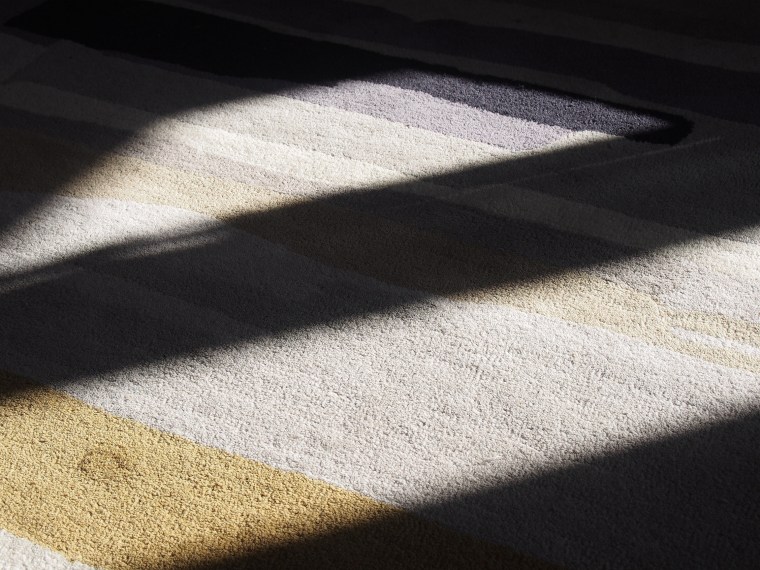
Satisfaction is not only found from big achievements; the appreciation of the niceties of anything can contribute at least as much to the sense of a life well lived: even learning to appreciate the quality of sunlight falling on woollen rug or wooden floor. The concept of mastery is very important to one’s sense of self-efficacy and fulfilment, but it is more about one’s powers of observation as the size of one’s wallet. That is why the notion of sprezzatura is attractive: understood non-judgmentally it implies a refined knowledge of a subject in a way that glories in the detail, without taking itself too seriously. I would also argue that those who revel in the fulfilment of the Mind but neglect their physical worlds miss out on as much as those who do the opposite.

But aiming at perfection brings a problem, and I don’t mean the likelihood that it is unachievable: kept in proportion, precisely therein lies the challenge. More problematic is defining it in the first place. I’m not sure what society at large makes of the matter; common wisdom seems to have decided that it is better to lower your expectations and not to aim at the seemingly-unattainable (except with your credit card), but that very word can only be defined by having tried and failed. I think the secret lies in accepting that one will never entirely succeed before one starts, but still being prepared to value what one can achieve for itself.

Perfection implies the acceptance of a gold-standard, and gold appears to be out of fashion. Fusion food, for instance, relies on blending – some might say bastardising – traditional recipes. One may read this as the worst thing to do if one is aiming for perfection; another may argue that it is the way new forms of perfection are created. The same can be applied to pretty much any creative endeavour, at any level of competence. Who is right?

Personally, I take a gentle pleasure from attempting to appreciate the niceties; a fortunate side-effect of my new, non-employed status is the time to do this, and I am happily making up for lost time. Sometimes that means mastering established forms, though I am not so conservative as to reject everything new. But if there is no accepted standard, there is no way of even attempting to agree on how good something really is, new or old alike.

Many of the benchmarks of perfection are arguably little more than the preferences of those who claimed to know enough to lay down the law. Or is there more to it than that? The only way to know something to try it.

There is pleasure in learning to appreciate the finer points of things – most things – even accepting that judgements are, ultimately, arbitrary. This is why some people embark on personal quests to ‘perfect’ their musical, sporting, linguistic or practical abilities. Part of that is learning the time-honoured practices that have been found to contribute to excellent results; arbitrary perhaps, but validated by longevity and consensus. Even if one then chooses to break the rules, one really needs to know what they were to begin with, otherwise one is simply left with ignorance.

Even when one falls short it permits an appreciation of the expertise of others, that one simply cannot attain if one has never bothered to try.

Floor

Arts, Architecture & Design, Opinion & Thought

The White-Knicker argument


Meet ‘The Trafalgar’ and ‘The Mayfair’. Together with their nostalgically-named counterparts they make up an arcadian-sounding housing development on the outskirts of a large town in eastern England. They are not cheap: even a two-bedroom semi in the Trafalgar costs in excess of ¼ million pounds. And for that money, you get a master bedroom a mere three metres square or so.

Stanway

The picture above was taken this morning of the development under construction. This unmitigated monstrosity is currently being thrown up at a rate of knots – and my reaction to seeing it made me want to do something similar. What was admittedly fairly indifferent open land until a few months ago is rapidly being buried under bricks and asphalt, presumably to stay that way for a century or two – that is assuming these meretricious little hovels last that long. And it’s not only a few houses: in total there are, I should think, several square kilometres of the stuff. The mediocrity is only matched by the romanticised hyperbole with which the development is being promoted. I would suggest this verges on misrepresentation.

I know people need somewhere to live (but would you really trust the building industry to tell you how many new houses are needed?) and I know that not everyone can afford something glamorous – but this is a disgrace. Mass housing is not easy to get right, on account of its sheer volume – but is this really the best we can do?

The white-knicker argument was supposedly used by Marks & Spencer to justify only selling white underwear – because that was all their customers ever bought… The fact that people buy these things is not the reflection of positive choice that the developers would have us believe – while this is all that is provided in people’s price ranges. The U.K. has a record of building shoddy, architecturally catastrophic mass housing, but there have been enough instances of poor construction and soulless non-communities being created that you would have hoped we would have learned by now.

Wellbeing comes in many forms, but the homes we live in have to rate as one of the most significant. Actions speak louder than words, and it is not stretching the point too far to read some very antisocial attitudes into the people who allow these things to be built – namely the opinion that any old rubbish is good enough for ‘ordinary people’.

What is more, having been staggered recently at the complexity of the British planning process, and the near-paralysis it can induce, the fact that these slums of the future are still being built suggests that it is not fit for purpose. When the debates only centre on quantities and locations and virtually neglect the essential qualities that make or break new houses, what on earth is it actually achieving? The answer seems to be the utter bastardisation of this country’s natural environments and architectural heritage.

I have acquaintances ‘inside’ the planning process who overflow with stories of the abuses perpetrated by developers, from the ‘accidental’ destruction of protected trees to the social amenities that were somehow overlooked. Yet they rarely seem to be prosecuted for their failures. Then there is the widespread failure to develop infrastructure to accompany the developments; before I stopped work, my journey was becoming increasingly delayed as more and more housing developments were constructed alongside the main road, clearly on the assumption that the commuter traffic would pour out onto it every morning. Yet nothing was done to upgrade the road; while the developers are no doubt sunning themselves in their Spanish haciendas, the rest of us pay the daily price for their corner-cutting.

There have been numerous reports in the press recently about the shoddy quality of mass-produced homes – hardly surprising when one notes the unseemly haste with which they are constructed –  whereas Grand Designs’ Kevin McCloud, who is now venturing into mass home-building of a more enlightened sort, reports overwhelming demand for his products.

HAB
HAB plans for Bristol


Much better developments are being built – but they are still in the minority.

CBM
Carrowbreck Meadow, a Passivhaus development near Norwich


It is not as though people do not want better than these Disney-esque, quasi-nostalgic theme-parks to live in. It has to be admitted, though, that the British pre-occupation with ‘heritage’ (seemingly even of the fake sort) probably prevents some more innovative, contemporary solutions from getting off the ground.

It makes me extremely angry that it is still apparently acceptable to fob off much of our populace with such shoddy living spaces; experience suggests that it is not the case everywhere in Europe.

Unfortunately, the bottom line of the construction companies is still the dominant factor in determining the environments in which millions of British people live.

Food

La Dolce Vita in a dish

Tiramisu

If it seems as though there is an Italian ‘thing’ going on here, you’re probably right (the title is a bit of a giveaway…). Periodically, I experience severe withdrawal symptoms from that country, and now is one such time. Unfortunately the planned antidote in the form of a visit to Bologna later this month has had to be postponed.

I certainly don’t look to Italy for its reliability or organisation – but if it’s an aesthetic boost you’re in need of, there really is no better inspiration than The Boot. In a sense, it’s the idea of Italy – La Dolce Vita – that is important. Taken at face value, it is languidly, decadently glorious; look too closely and you might find rather dark depths…

Of course, no one who is not Italian will ever be able to do it like the natives, but that’s not the point. We can appreciate the style (without ever fully trusting their delivery times) and adapt to our own needs. That said, there is also an almost perverse pleasure in seeing how close you can get.

One’s best chances are in the kitchen, where language and body shape cease to matter. I have spent frustratingly enjoyable years trying to get close to my conception of perfection with certain Italian dishes. I say conception because there is no one such thing as the objective ideal, of course. However, one learns certain secrets in the process, and the ‘research’ is by no means a hardship…

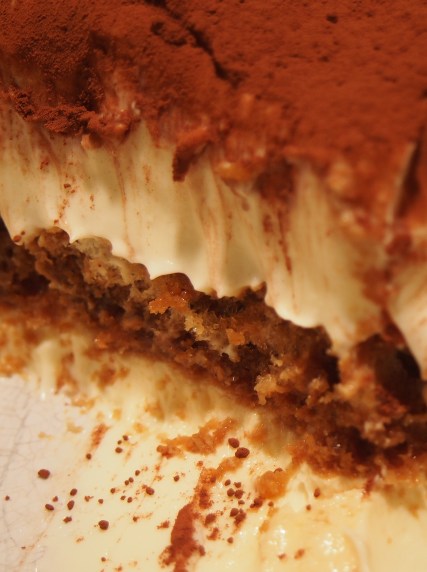
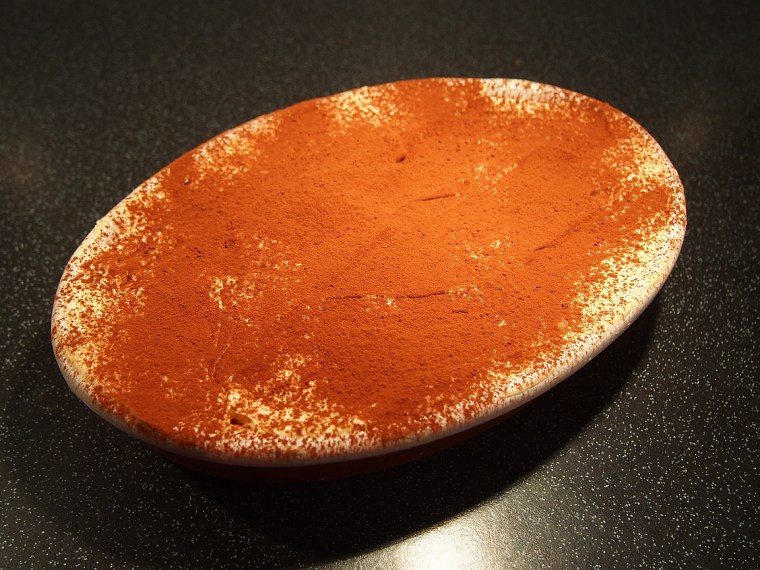
So here is one such dish, that I have started making again this summer after several years without; I am immediately wondering why I stopped, apart from the impact on the waistline. Tiramisu can be bought in any supermarket, but there is no substitute for making one’s own; so long as you have the means to make decent espresso and think ahead a few hours, it is ridiculously easy.

Ingredients (serves 4-6)

  • Three egg yolks
  • 500 g mascarpone
  • 100ml single cream
  • 100g caster sugar
  • 1tsp vanilla extract
  • 6 (espresso) cups of cold espresso coffee
  • 4 tbsp coffee liquer such as Kahlua
  • 15 (approx) savoiardi biscuits (ladies/sponge fingers)
  • Cocoa powder for dusting.

Method

Make the coffee and leave to cool.

Beat the egg yolks with the caster sugar and vanilla essence until thick and smooth.

Beat the cream into the mascarpone to loosen it, then carefully fold in the egg mixture.

Spread half the mixture over a shallow dish; briefly dip the savoiardi biscuits in the coffee, and lay over the mascarpone.

Once a complete layer is achieved, spread the rest of the mascarpone mixture on top, to cover completely; chill for some hours.

Before serving, dust the tiramisu generously with cocoa power.

(from Antonio Carluccio’s Complete Italian Food)

OLYMPUS DIGITAL CAMERA
Virginal tiramisu
Arts, Architecture & Design

Happy Birthday Charles

02_Sofa_Charles_CH228_CITTERIO_Fabric_1

How must if feel to walk into your office one morning, sit down at your drawing board – and come up with a design classic? I wonder if you get a sense that this is something special, perhaps your best ever work – or whether that comes later, after the acclaim.

I am simplifying, of course: the creation of a significant item is not the work of one day, even though the initial concept can perhaps come remarkably quickly. There is a great deal of research and development, material testing and more that goes into the realisation of a top-quality product.

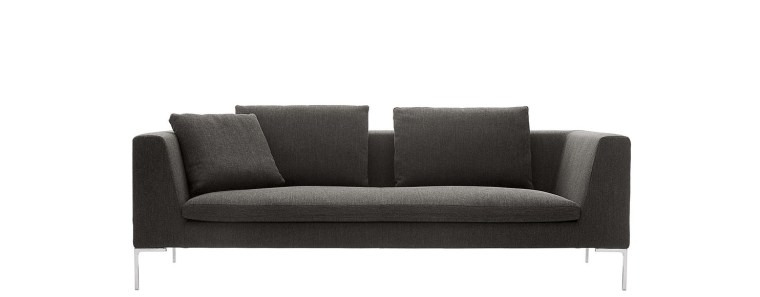
It is twenty years since Antonio Citterio, the Italian architect-designer did just that with what has since become the iconic piece that made his name around the world: the Charles sofa for renowned furnishing company B&B Italia. It has done the same trick for the company, becoming by far their best-selling piece.

63--03-BEB_ITALIA-CHARLES-03

Inspired by the designs of the Sixties and named after Charles Eames, this has become an icon of contemporary design, the symbol of modernist-minimalism par excellence. Put one of these in a room and it will immediately set the agenda. This is a piece that has been copied a thousand times: If you have ever seen a sofa that is low, deep with spindly metal legs, then the chances are it is a derivative of the original Charles.

Having admired from afar, I first encountered one ‘in the flesh’ at Geoffrey Drayton’s showroom in Hampstead Road, London. My wife and I were at the stage of establishing our first home together, and seating was naturally high on the agenda.

There is something about this piece that is so close to modern perfection that it utterly deserves the recognition it has received. The fifteen-degree angle at which the sides slope is exactly right, as are the proportions of the inverted-L aluminium legs and the slimness of the base. The combination of rich fabric and polished metal, of tightly-tailored base and loose, movable cushions is another sensory feast. The raised base frees-up floor creating a sense of spaciousness, and the reflectivity of the legs creates a floating effect the seat itself. To my eye, this is a piece of design perfection that even Citterio’s other designs don’t get near.

Testing it after walking around half of London was probably not the best move; some British and American commentators have found it too firm for their liking – but firm support is actually our preference, over the traditionally squishy British alternatives. It’s interesting to realise that even notions such as comfort are to some extent culturally-defined.

Charles is a modular concept: there are numerous shapes; it has also spawned an extra-large range (as it if were not big enough already…), a bed, low tables and an outdoor version. It is not something, however, that is easily accommodated in the average tiny British sitting room – it needs space to breathe.

63--05-BEB_ITALIA-CHARLES-05

Unsurprisingly, such pieces do not come cheap; this is best considered a once-in-a-lifetime investment. At least it has more mileage left in it than the average used car… Beneath the slim profile is a welded steel frame, and a high-density moulded foam carcase: they should last forever. The same cannot be said, however about the fabrics, which are more beautiful than durable. At least the covers are removable…

Charles is not a sensible financial investment, but it is certainly an aesthetic one: it creates a stylistic agenda for the rest of the home; in that sense, it is worth cutting corners elsewhere for. It has visual qualities that succeed in numerous different environments and its character and proportions are so perfect that it will lift whatever space it is placed in.

This is one piece of design of which I simply never grow tired.

Antonio Citterio
Antonio Citterio
Arts, Architecture & Design

Ancient & Modern


Historically speaking, the U.K. was slow to embrace the tenets of modernism; even when modernist buildings were made in early part of the last century, they often used traditional construction techniques, with rather mixed results. Recently however, Britain has produced some superb contemporary architects and work.

The marriage of the modern with ancient always presents opportunities for intriguing and imaginative work; in my opinion, courageous approaches like the one seen here re-interpret traditional architecture in far superior way to attempting a fake-traditional approach which not only ends up looking pastiche, but often perpetuates many of the inconveniences of old styles.

This renovated farmhouse is situated on Dartmoor, a harsh, stony landscape of surprising bleakness. Minimalism has a perhaps-unexpected sympathy with the very old; the key to both in this case is simplicity. The bareness of the ancient stone contrasts deliciously both inside and out with the simple purity of the modern finishes, and the insertion of a modern space between the two older buildings is an excellent way of uniting them into a spacious whole without detracting from their integrity.

It’s pleasing to see this kind of work being produced in provincial Britain – I just wish that the volume house-builders would take note and provide something more inspiring for the many people who lack the resources needed to undertake this kind of project.

More can be seen at http://freshome.com/sustainable-family-home/ a website that regularly features superb contemporary architecture from around the world.

Sartoria

Diamonds on the soles…

Diamonds

What’s a ‘poor’ boy to do? Ain’t no overtime will add diamonds to the soles of his shoes…

But the fact that you weren’t born wealthy, and never landed a job with a telephone-number salary, won’t stop you appreciating fine things, if that’s your inclination. You can write it off as class- or money-envy, but it needn’t be. Neither need it be about fashion-victim-hood or the desire to show off. Fine things are considered fine for a reason, and that is often more to do with their aesthetic (and sometimes practical) qualities than the social snobberies that come to be attached to them. The possession of money is not a prerequisite for the appreciation of such things.

It’s true that desirable objects often command high prices, simply through the mechanism of supply and demand – but there are still plenty of ways to exercise reasonable discrimination in how one parts with one’s cash without trashing one’s credit-rating.

Before I get lectured at, I am well aware that poverty can be crushing, in ways that those who do not experience it rarely appreciate; but my purpose here is to debunk the myth that stylish menswear is only accessible to those who are so wealthy they take it for granted that everyone else is too. I acknowledge that am fortunate enough that the the approach outlined here brings some such items just-about into range; what can I say that would placate those still enraged by my attitude? I can only explain that my own work and (former) income as a teacher hardly put me in the super-rich category…

It’s worth remembering for a start that while wealth might make style affordable, it doesn’t guarantee it. I would guess that the majority of the world’s wealthy (starting with The Donald) spend their money demonstrating their grotesque lack of taste, not the converse. Good judgement is more or less free, if you choose to develop it.

And yet it is all too easy to fall prey to the mindset of buying on price rather than quality, something that I think British culture is still remarkably prone to.

Then there is the long-standing advice to buy the best you can afford rather than the cheapest you can find, and to buy less but better. It has stood the test of time for a reason – as more likely will things that you acquire using that maxim. On a cost-per-use basis, cheap stuff may be a false economy; we are considering things here that ought to last a decade or more.

Flashy labels add a premium to not always superior products. But this is not a competition (which you will never win anyway) nor about impressing others, but principally about pleasing yourself by looking and feeling good. If others happen to appreciate your efforts, then that’s a bonus. So while big labels are worth considering, so are others that may be much less well-known. Indeed, part of the pleasure in working on one’s dress comes from the chase and the knowledge and judgement that it requires. The appreciation of good clothing is no different from that of good food, wine, art, music or any other aspect of aesthetic craftsmanship. In some ways it’s too easy just to resort to the best-known brands.

I’ve pretty much given up on the British High Street. Unless you want jeans, chinos and sports-wear, the rewards are generally not worth the effort. It seems to me that unlike in many continental countries, what is deemed adequate by and for the average Brit is too dull to be very pleasing. Sad to say, for anyone even moderately choosy there is far better quality and choice available elsewhere.

Neither do I see the point in the fake brands that mainstream chains use to differentiate their better lines. Even House of Fraser is guilty of having a fake Italian ‘name’ – though to be fair at least the clothes are Italian-made. Why not just stock the real thing (the prices are not always so much different, though the quality often is) – or better still simply produce good-quality clothes that can be sold for what they are? Anyone who is seeking quality is not going to be fooled by such compromises, particularly on fabrics: synthetic fibres will never substitute for good naturals.

Another way of saving is to eschew the service of the boutiques. While there is inherent pleasure in the attention of a knowledgeable tailor, if price is a big issue it is something worth forgoing. You can find the same clothes elsewhere, cheaper. Although some brands now manufacture lower-spec goods specifically for factory outlets, the quality may still be acceptable if you are careful – and this practice is by no means universal. There are some great savings to be made by discerning shopping in such factory outlets – and no one will be any the wiser over where you obtained your clothes, even if that matters to you.

And above all, the internet means you can now shop wherever in the world you choose. One substitutes time for money, both in terms of rooting out the bargains, and in waiting for deliveries (and returning unsuitable items) – but it means you can effectively access desirable clothing no matter where you live, even if your local shops can’t be bothered to cater for you.

In either case, one needs to alter the approach a little. Instead of aiming to purchase a particular item as needed, one needs to be more opportunistic. Buying items that fit and that you like when you see them becomes more important than buying for immediate use; buying them end of- or out of season also makes them cheaper. I would not generally recommend the use of credit as interest can push costs back up, quite apart from the other risks involved – but the ability to draw on extra resources does make this approach easier. PayPal’s four-month interest-free credit works for me on the odd occasion when a particularly desirable item appears at the wrong end of the month…

So here, to conclude is a directory of some of the best sources I have found on my virtual (and real) travels; the list is inevitably Italy-weighted, but you can shop electronically in France or any other country equally well. I do feel a tinge of guilt about what this is doing to British retail, but I can hardly go naked just because it doesn’t deign to cater for my tastes…

If it is quality that matters, continental retailers tend to be better further down the price range than in Britain, where I suspect manufacturers cut corners safe in the knowledge that the average punter will be none the wiser.

I realise that the prices will still draw gasps from some: if you really are into bargain-basement-wear, this is not for you. But for good dressing on a relatively small budget, careful use of these resources works.

https://www.yoox.com/uk/men Possibly the largest online outlet of all. Yoox seems to have access to old-season stock from a vast range of suppliers, including some that one cannot buy over-the-counter in the U.K. I gather the founder is well-connected… It is necessary to keep a close eye on what is on offer as stock changes frequently. Ignore the terrible photos in which the clothes often don’t fit the models, and remember that shipping and returns are often free. Yoox has had some bad press but apart from the odd sizing error, I have never found it to be less than efficient. If you are prepared to sift and/or wait for their ‘action’ offers, there are some stunning savings to be made, with some items from top-notch manufacturers being reduced by 70% or more.

I would recommend looking at Pal Zileri, Armani Collezioni, Caruso, Canali and Corneliani; if you chose your moment, the prices are little different from what one can easily pay on the High Street for much-inferior goods. Zegna and Loro Piana are there too, but still at a hefty price. There are plenty of attractive items by makers not known to most in the U.K.

https://www.kamiceria.com/gb/  A vast range of shirts and other clothes from respected Italian manufacturers such as Bagutta and Xacus. Typical reductions from around £90 to nearer £40 but some nicely-designed cheaper marques too. Sale prices not infrequently dip below the £20 mark. Classic shirts most likely to fit the average British figure. Free postage and returns.

Kamic

https://camiceriaolga.it/en I have already reviewed the made-to-measure shirt I ordered from this company – excellent quality for the price of €55 for their standard fabrics; higher priced fabrics also offered. I shall be returning.

https://www.boggi.com/en_GB/home Beautiful clothing, but not often found in bargain outlets. Much of their range is tailored in slim and very slim cuts, but their accessories are well-worth the money during their extended sale periods.

http://www.scarosso.com/en/men/shoes Hand-made shoes that retail around the £190- £220 mark. While that is hardly cheap, the quality is excellent for the price. 10% discount if you are prepared to be bombarded with emails and other substantial markdowns on a regular basis, bringing them nearer High Street prices. Sharper than British designs, but hardly avant-guard.

https://www.loding.fr/en/ French company which has a small chain of lovely shops in most cities there. Their socks are excellent value for money with a wide range of colours and three sizes rather than the now-dominant two (currently £8 a pair, Aug 2017). Good quality shoes as well; I am not familiar with the shirts. They do not have sales, but all products in a given category are priced identically all year round.

https://www.meschaussettesrouges.com/en/ Another way to lift one’s dress without vast expenditure is to focus on accessories, in this case socks. One can purchase high-quality, distinctive socks without breaking the bank (around £8-20); again there is a world of difference between the dull/comic/overtly branded socks that dominate the mainstream British market and something much more interesting. Bresciani are especially worth a look.

https://www.julesb.co.uk Newcastle-based clothier which offers a wide range of labels. Markdowns are often not huge, but good items can be found in their sales.

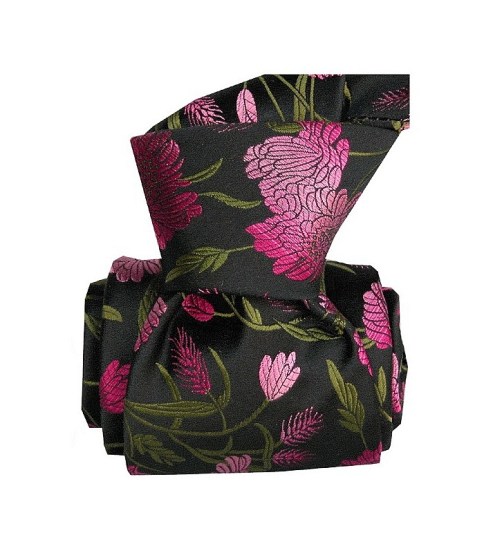
https://www.amazon.co.uk/Segni-et-Disegni Excellent, high-quality ties from a little-known manufacturer in Como. They don’t have their own website, but products can be obtained from Amazon Marketplace, in reality Cravatte Avenue in Lyon, France, which also has its own website https://www.cravate-avenue.com/   £30-£40 for excellent quality without a ‘label’ premium; wider range on C.A.’s website, but slightly higher prices.
S&D2https://www.tresanti.co.uk   Dutch company that sources most of its products in Italy. Slightly off-beat range at less than sky-high prices.

http://www.angelico.it Not quite my taste so I have not shopped there, but mid-range Italian styles with some good markdowns in sale periods.

https://www.puntomaglia.it/index-en  Made-in-Italy knitwear. I have yet to investigate but they look very promising. Gran Sasso is a brand that is well worth buying.

http://www.maestripellettieri.it/ Good quality leather goods at not-extortionate prices. I have only purchased a wallet, but it is very acceptable with good workmanship.

http://www.rionefontana.com/en/ Small chain based in the Veneto; rather too trendy for me as a rule, but I have had some lovely cashmere knitwear from them at sale times, with tremendous mark-downs.

https://maisoncashmere.co.uk Another retailer I have yet to shop from, but think I will have to investigate next winter. They operate batch-manufacture as and when they reach a threshold of orders, so there may be a wait for delivery.

MC01

http://boutique.franck-michel.com/en/ Interesting-looking shirts and accessories from Paris boutique.

https://www.fatherandsons.fr/fr_fr/ Mid-range French chain, with shops in most cities. A little sharper than their English counterparts. Will deliver to the U.K., even though the website is currently monolingual.

http://www.houseofbruar.com/mens/knitwear/merino/ Perhaps a surprising addition, but the quality of their knitwear is excellent, and comparable to others of higher price. Irritatingly low on stock for much of the time, but you might get lucky.

http://www.chesterbarrie.co.uk/ Probably my favourite British brand at the moment; one of the few British tailors to be rivalling the Italians for style.  It is by no means cheap, though selective shopping on their website can occasionally reveal good reductions, and they are stocked by House of Fraser, likewise. If you are within striking distance of their outlet shop at Freeport Braintree (Essex), it is an absolute treasure-trove. The fact that it is within easy striking distance of my home is not good for the bank balance… https://www.freeport-braintree.com/stores/chester-barrie/

https://www.ctshirts.com/uk/home I wrote to Tyrwhitt some years ago asking them to produce a sharper, more modern range. They have eventually obliged, even though, annoyingly, some of the results are only available in slim fits. Nonetheless good quality shirts though fabrics tend to be thicker, in the English tradition. Prices are good during sales, down to the lower £ twenties. Their knitwear is acceptable, but the quality of their other goods tends not to live up to their shirts. I see that certain other Jermyn Street firms seem to be following their business model.

This list will be archived and I may well make additions from time to time.


Food

Pasta pomodoro al forno

OLYMPUS DIGITAL CAMERA

The latter part of the summer usually brings a glut of tomatoes, indeed in my humble opinion, it is about the only time in the U.K. when it is worth eating them; I’ve never been a fan of the hard, sharp British or Dutch offerings. This year though, our own crop has unfortunately been written off  by blight which has hit the allotment as a result of the recent damp weather…

So here is a dish that Italians use when tomatoes are so plentiful that they don’t know what to do with them all. It’s not fast food, but it most certainly is comfort food, and is now an established favourite at this time of the year in our household. The dish as described makes two to three generous portions.

I’m not sure what its proper name is, even assuming it has one – so the title is my own suggestion.

Ingredients:

  • Lots of very ripe or even over-ripe tomatoes – at least three or four per person. As always, San Marzano or similar are desirable, but even British tomatoes are usable with a little help (see below).
  • Clove of garlic, finely chopped.
  • A little sugar to judgement – if the tomatoes could be riper.
  • salt and black pepper to taste.
  • Two or three tablespoons of passata – more if the tomatoes are less than fully ripe. Quality makes all the difference – Cirio is the best; the sweetness of the tomatoes is needed for this sauce.
  • Two tbsp olive oil
  • Handful of torn basil leaves
  • Penne pasta at about 50g per person. De Cecco recommended.
  • Butter, milk and plain flour to make a béchamel sauce.
  • One ball mozzarella.
  • Parmesan for grating.

Method:

Pre-heat the oven to about 210°C.

Prepare the tomato sauce. To do this properly, skin and deseed the tomatoes (the former can be done easily by blanching them in boiling water for a couple of minutes, and then peeling). Chop them coarsely. (Tinned tomatoes can probably be used but at the cost of some texture freshness of taste; again Cirio are the best).

Put the oil, passata, sugar, salt, pepper, garlic, tomatoes and torn basil in a saucepan and place on a moderate heat. Simmer gently for perhaps 30 minutes until the sauce starts to reduce. Stick your head over the pan and inhale.

Towards the end of this time, par-boil the pasta – about 8 minutes is about right for 13-minute penne. Drain and mix with the tomato sauce.

While the pasta is cooking, prepare the béchamel sauce – enough will be needed to cover the oven pot being used. This will probably be about 100g butter, 2 tbsp. flour and enough milk to make a fairly loose sauce. Season as necessary.

Drain and chop the mozzarella into bite-sized cubes.

Assemble in an oven-proof dish: first pour in the pasta/tomato mix and spread out. Cover this with a layer of béchamel sauce. Scatter the cubes of mozzarella on top, add a few more basil leaves and grate parmesan cheese liberally over the top.

Cook in the oven for around 20 minutes, or until the top of the dish is nicely browned. It is worth allowing the dish to cool a little after removing from the oven, as the flavours come out better as a result.

OLYMPUS DIGITAL CAMERA

Food, Opinion & Thought, Sartoria

The not-so-bare necessities

I have been looking at some architectural impressions of various new developments. I always find architects’ sketches an attractive source of optimism, a promise of a better future. But notice how the human representations within are always stylishly dressed: people who, one could imagine working in glamorous creative industries or finance.

When these creations get built, many do bear passing resemblance to the designers’ dreams of a corporate Utopia – but those who populate them most definitely don’t look the same. I’ve recently spent time in a few such places: the enormous development that is the Stratford Olympic site for one. For all the lustrous finishes of the Westfield Shopping Centre, for all the stylish shops that occupy it, the majority of the clientele actually sports jeans and T-shirts or branded leesure-wear; stylish they aren’t. Truly well-dressed people are few and far between: one wonders who actually buys the clothes on show in the windows – maybe it’s just foreign tourists? Snobbery might resort to the fact that this is East London – but the same was pretty much true of the Grand Arcade in Cambridge, Chapelfield in Norwich, the Highcross Centre in Leicester, central Manchester and Birmingham, not to mention the glamorous alien that has landed in distinctly humdrum Chelmsford – Bond Street.

Truly stylish people have become almost an extinct species in Britain. It’s not as though we don’t have a time-honoured reputation for sartorial quality – even the Italians have a soft spot for traditional British style, menswear in particular. But who wears it any more, except possibly City bankers and Sloanes in Kensington? And even there, I suspect standards are slipping – the workplace is the last bastion of formal dress in Britain, but  that too is going increasingly casual.

Having done a little delving, there seem to be two issues that might be to blame: long working hours and a Protestant Anglo-American history.

Having recently suspended my own full-time employment, I can well appreciate the effect that it can have on one’s mind; when the attention is fully on the career, there is little mental space or energy left for the other aspects of life, let alone something so supposedly trivial as dressing artfully. And that’s where the second element kicks in: for all our supposed modernity, there remains a stubborn distrust of ‘show’ in British culture. A puritanical understatement is preferred, whether people are aware of it or not. I was inclined to blame America, the source of so many cultural evils, but there actually seems to be more interest with dressing well in the States than there is in Britain, if a quick web-trawl is anything to go by.

In fact, perhaps the mistrust is less spiritual and more societal: traditional British style still has strong associations with Class. People who choose to dress smartly are ‘probably’ either Hooray Henries, Toffs or other upper-class twits, and it isn’t cool to be identified as one of them. Much better to affect the inverted snobbery of wearing extortionately-priced sportswear and bling that make you look as though you’ve come straight from The Bronx.

Or maybe it isn’t even that: I suspect the majority of modern Britain either simply never thinks about how it looks, or doesn’t care, to the point of neglect. A concern for such issues only shows how shallow you are anyway, doesn’t it?

Well, I beg to disagree. True, taking care of one’s self may be unimportant when compared to huge global issues, but if every life is precious, then why waste it through neglect? Effort expended on small niceties adds colour and artistry to everyday life; it has a cumulative effect on the quality of that life and is a sign of self-respect.  I challenge anyone not to feel better if they eat well, live in cared-for surroundings, and take care of their personal standards in general. Conversely, what does it say not to care about these things? That life is trivial, unimportant, not worth taking care with? It may be that your priorities in life lie elsewhere – but somehow I suspect that they actually just took their leave some time ago. I think it was the designer Tom Ford who said that dressing well is a courtesy to others; if he is right, then it cannot say much about one’s care for other people either, to deprive them of that small pleasure.

What is true of clothes is also true of food, standards of speech and conversation and all other aspects of social intercourse. Collectively, these things create a context and tone for social interaction. In Britain, we supposedly had a food revolution. It’s true, the quality on offer has vastly improved, but eating well is still for the special occasion rather than the quotidien, and I suspect that most foodie books and programmes are consumed vicariously. When one listens to what people actually say about their lives, casual junk and supposed convenience seem to reign supreme.

It takes courage to maintain personal standards when everyone around you is dropping theirs, but I suspect there is a sneaking respect for people who do. In the small town where I live, there is one gent, probably in his early seventies, who regularly steps out in tweeds, plus-fours, waistcoats and a natty line in caps. He is clearly untroubled by the fact that he stands out.

But, in a very positive sense, everyone knows who he is.

Food, Opinion & Thought

Chain unchained


caffe-concerto

When living within striking-distance of London was still more novelty than nuisance, I used to travel into the city frequently. A favourite pause came to be the Costa Coffee bar at Liverpool Street Station. It was tucked away almost under the stairs by the entrance to the underground station. It was only small, with a glass frontage and polished granite counter piled high with all sorts of Italian goodies. Mostly, one perched on stools at a high counter in the window; as a place to pause for an espresso, it was just like a snippet of Italy dropped into the station.

Fast-forward three decades, and Costa is of course massive. It was bought from the original Italian family by Whitbread and rolled out ad nauseam across the country. To be fair, the coffee is still pretty good, but the décor was rapidly watered down into something more anodyne and cheaper to mass-produce. What we gained in ubiquity, we lost in style. The food is acceptable, but has again become less distinctive rather international-bland; various types of themed drink that have never been anywhere near Italy have been introduced. It’s pretty much a standard chain now.

Last Saturday, we travelled to Stratford to meet family who were visiting the World Athletics Championships. Hunting around a packed Westfield Centre, we couldn’t find anywhere to eat that didn’t have an hour’s queue. After running out of ideas, I eventually spotted a cafe that also had the word pasticceria over the door. Hmm: I guess not many chains – or their punters – know what one of those is. Maybe this is worth checking out – and thus we landed in Caffé Concerto.

For a new building, the fitters have done a very passable job of conjuring up a dark-wood and marble Torinese-style interior. The materials seem to be real, and the place felt right. Many of the touches that one would see in Italy, but the average theme restaurant would ignore or filter out, were there. It was no surprise that there had been at least some Italian input into the place; the Maître d’ was clearly Italian, even if most of the other (properly-attired) staff were Easterners. They appeared to have had proper training – or at least they were working somewhere where their likely exposure to proper ‘waitering’ from back home could be applied. All very impressive; and what’s more, despite the queues, there was no hustling people to move on quickly.

As for the food: my expectations always fall when one is given a laminated menu – although to be fair this happens very often on the continent too, these days. The fare was a slightly strange mix of English and Italian, with some notable omissions – no pizzas, and no pannacotta on the desert list. But there was an excellent choice of risotto and pasta dishes, much for veggies, and some correct-looking meat and fish. And one or two give-aways that these people know what they are doing, such as Bellini on the cocktail list.

Sure enough, when the food arrived, it was excellent and clearly prepared by someone who knew what they were doing. I opted somewhat hesitantly for a spaghetti carbonara – risky when unknown, as it can be turned into a solid lump of pasta and congealed cream all too easily. But this was light and in moderate portion, with decent pieces of what looked like hand-cut pancetta giving an excellent smoky-salty hit. My wife’s aubergine rigatone siciliana was equally excellent.

I pined due to the lack of pannacotta on the desert menu, as this is always an acid test of an Italian eatery – but a piece of tiramisu gateau was a reasonable substitute, even if it lacked totally in liqueur content. The follow-up espresso was of a good size, though somewhere up Mont Blanc in terms of strength, not quite fully Italian and missing the accompanying glass of water. But these are minor niggles in what was otherwise a surprisingly good experience. What pleased me too, was the fact that the place felt right.

It was only when I got home that I discovered that Concerto is a chain – at least within the bounds of London, there being about a dozen more dotted around the capital – plus one in Birmingham. But I think it shows that control has been retained by people who know what they are doing, by which I mean serving up a good Italian experience rather than making money for some anonymous venture capital company. My other favourite, Carluccio’s is just about managing the same trick, even though Antonio relinquished day-to-day control some time ago. That said, a look at the website shows the full corporate infrastructure behind the thing. Perhaps it shows that chains do not have to be dumbed down and characterless.

So on the one hand, it would be nice to see Caffé Concerto spreading to places that did not involve hauling into the capital, but on the other, what risk that it would do a Costa, be bought out by big business and turned into a shadow of its former self, whence everyone except the investors lose out? Quite a dilemma.


Opinion & Thought, Sartoria

Chasing the wrong rainbow

When your professional life takes as its raw material human beings themselves, it is difficult not to become curious about what makes them tick: why some people take one course while others take a different one, why some people respond well to a particular stimulus while others do the opposite. Then there is the whole issue of what constitutes ‘success’ in life – something the education world is almost obsessed with.

I don’t intend to delve into nature versus nurture here, but the choices individuals make do seem to be governed in part by the prevalent cultures within which they live. When I ran a partnership with a school in Switzerland, the differences were pronounced: before pairing students up, I used to ask for a written self-portrait from each participant. Year upon year, it was remarkable how the Swiss came back with long lists of favourite authors, musical instruments played, sports and hobbies pursued, languages spoken and more – while many of my own British students struggled to write much at all, even when prompted. Shopping and ‘socialising’ were the main two; there were exceptions on both sides, of course – but the pattern was too marked over too many years to be mere chance.

Long acquaintance with both countries does suggest that this reflects a wider pattern: it’s hard to substantiate such things, but my lasting impression is that the Swiss lead active lives, wherein they themselves are the main instigator of their chosen path, whereas the typical Briton is more passive and herd-like, perhaps feeling less able to assert their own direction and individuality, and more content for (and dependent on) third parties to provide the stuff of life.

The reasons for this are too complex to explore in depth here, but I suspect that they go well beyond the respective wealth (and therefore means) of the countries concerned; perhaps British passivity is rooted in history, in a strongly hierarchical society where people knew their often-suppressed place, and have never really shaken it off. The Swiss, by contrast, have a strongly egalitarian streak, and despite the immense wealth of some people in that country, it rarely seems to express itself in the kind of (anti)social snobberies that are rife in Britain.

This concerns me especially at the moment, given the current flux in relations between Britain and the continent. My own hopes of European union were always primarily cultural – but it seems that, as a nation, we really haven’t learned very much from our close relations with our neighbours – and now it appears we are about to pull up the drawbridge again.

What has always inspired me most about the continent might be summed up in its relative resistance to the ultra-liberalism of the Anglo-Saxon economic model, where just about everything in life is becomes a commercial opportunity to be exploited – and much thereby loses its authenticity. Ironically, this comes out strongly in the respective ways of life: unlike the British, there does not seem to be the same chasing of material status Switzerland, though that is absolutely not to suggest they don’t appreciate substance; things are appreciated for their quality and style, not their trendiness, branding or opportunity to flash ostentatious wealth. People seem to be less taken in by commercial manipulation, in the way one sees plenty of people in the U.K. spending their cash on armfuls of ephemeral trendiness irrespective of the fact that the quality may be poor.

It seems to me that in their rush to prove (mostly to themselves) that they are not the poor relations, many Britons fail to appreciate the things – material and otherwise – that really add up to a good life. I will develop this idea in another post in due course – but as a culture we often scoff at the things that really can improve one’s quality of life while expending huge effort on doomed attempts to be cool or trendy. The main reason is this: we don’t seem to realise that a well-lived life comes from self-respect and self-knowledge, not from the contents of your shopping bags.