Opinion & Thought, Politics and current affairs

Beware of the sharks.

They say some species of shark can never stop swimming. They require forward movement to force water through their gills and hence breathe. Even if apocryphal, the story has some useful applications.

Around five years ago, our local independent garden centre closed, leaving a large, increasingly derelict space on the edge of our small town, about half a mile from the centre. It was not long before pinstripe-clad fins were spotted in the area.

At about the same time, a group of local residents was coming together to create a Neighbourhood Plan under the then-government’s localism agenda. The aim of these things is to build local control (shark nets?) into the statutory planning procedure.

It was a long and complex job, that took several years to complete, and this week it appears that it has cleared its final hurdle before going out to local referendum. This is quite a coincidence, because it is the very same week when a building company has launched its marketing campaign for the fifty or so Noddy houses that it is currently building on the site of the former garden centre.

Throughout the intervening period, the Neighbourhood Plan team put considerable effort into engaging with first the land agents promoting the site, and then the building company that bought it. Their aspiration was to produce an architecturally innovative, environmentally-sustainable development which would steer the emphasis away from car-reliance and create a model for the area.

I had several meetings with one of the pinstripe sharks as part of this process, and to begin with, the noises were smoothly consensual. But then the site was sold on, and the building company that bought it refused to engage with the local group. The excuses why certain things “couldn’t be done” mounted.  As a result, we have been left with just another cloned housing estate, planned entirely around the car with, apparently, the blessing of the local authority’s planners who still require major consideration for multiple car-use in all new designs.

So much for localism; the Big Fish have been fed again – and will now go off to prey on some other unsuspecting community. It makes the glossy sales blurb for the development all the more infuriating since it trades heavily (and sometimes inaccurately) on the beauty, strong community and local amenities of our town, while at the same time having made no effort whatsoever to preserve or enhance or them, to say the very least.

Businesses are like sharks; it seems they must move ever onwards, otherwise they perish. They have no sense of fair play; once they have eaten the minnows, they move onto other fish. They have no sense of restraint; cash is their oxygen, and they care not how they acquire it, or how much damage they do in the process. Cynicism is just part of the plan; I doubt they appreciate irony, either.

Decades ago, this nation was seduced by the shark-like charms of private business. We had a succession of Prime Ministers who championed it over the allegedly hopeless public sector. We were encouraged to become shareholders as the nation’s assets were sold off.  I remember, even as a teenager, having reservations about this – but I could see that a nation in which the proceeds of such enterprises were returned to the populace through widespread, small dividends might just work, and accountability to such large numbers of shareholders could even be argued to be democracy of a sort.

It didn’t last. The sharks quickly ate all the smaller fish; today the small private shareholder is a rarity. Privatisation has turned out not to be a form of democratisation, but the opposite. Most of the fodder is funnelled towards, and then circulated amongst, the large financial predators that constitute the majority shareholders. It’s that – and the fact the successive governments have done little to restrain their appetites – that causes market cynicism such as that shown by the building company mentioned above.

We have another one circling; at least in this case, it did engage, and has made some nods towards local wishes. But it was still immediately apparent that it would ultimately do largely what it wanted, while perhaps throwing a minnows a sweetener or two. It only shifts it swim-forward focus, we were told, to the extent that the Law requires it to do so. Which is Not Much. Again, the democratic wishes of the local population will be over-ridden by the profit-lust of the corporate sharks.

This pattern repeats itself throughout businesses and across the nation; it is how they survive. But it is an inherently selfish motive, always seeking to tip the scales decisively in its own favour, while never letting the fixed grin shown to customers slip for a moment. Even small businesses do it – they will (nearly) always sell you more than you really want if they think they can get away with it. Caveat Emptor! Beware the teeth!

Covid 19 has stirred the water. The placid shoals of consumers on whom companies feed have largely fled to safer places. Yet “The Economy” has been enough of a consideration to compromise – for some, fatally – the health measures that needed to have been taken much sooner. Those sharks need to keep swimming, come what may.

But where there is no food, the sharks will eventually starve and fade. That is what is happening to many businesses right now. I find it hard to sympathise; during the plentiful years of consumerism, those sharks grew fat predating on the rest of us. They relentlessly championed their right to do so, both politically and through that bewitching consumer grin. They were the real consumers, not us.  Now that times are hard, I see no reason why we should listen to their new tune. If the sharks really want markets to be so Free, then they can’t complain when they make businesses fail, as they are doing in large numbers at present. That’s the Quid pro Quo.

The more adaptable will find new ways of surviving anyway, and those that can’t probably are no longer needed. Not that many don’t have a good amount of body fat to survive on for a while yet.

Others are doing much better from the new habits of the shoals: those who provide entertainment or hobby supplies; many in the shoals have themselves discovered resourcefulness that they never knew they had. All sorts of amazing, innovative and sometimes downright crazy things are becoming popular in the virtual universe. The small fish are coming back into their own.

So let’s play the Free Marketeers at their own game: those who can adapt should survive in this new world where the gratuitous consumption needed to feed their endless appetites is no longer society’s main preoccupation. Those who can’t, we just don’t need any more. No need to shed any more tears than they did as they relieved us of our hard-earned cash often in return for little of much value, while despoiling our communities and environments in the process. Things referred to euphemistically as “externalities”.

There is, however, one problem: those businesses also employ the majority of the shoals of worker-consumers. The lost companies do also represent lost livelihoods and careers, often shed in the most cursory of ways – and potentially much hardship. Unemployment is rising – but many are also finding new directions that they would never have expected only a year ago. We need to nourish these new enterprises – the online artists and musicians, the writers, comics and posters of amusing memes, the small online craft community, the 3D printers and the hobby-orientated suppliers. We need to find a way of remunerating them for their new and creative communal activities – and encourage many more to join them.

The point of an economy is to serve people’s needs, not the other way round. Those needs are now different.

So forget the whinges of the airlines – what use are bulk-fliers when few people need or want to fly? What use the huge stores that have struggled to maintain their supply chains when we most needed them? Let them wither; if demand returns in the future, rest assured, someone will spot a business opportunity and things will re-start. We just need to find a cost-effective way of cold-storing the assets in the meantime, if we can. Those bits of the old economy that are still needed will be re-born in a way dead people can’t be.

Free Markets are an ideological luxury: created not, as claimed, to benefit the many, but to allow a few to grow very rich minimally servicing them. If that were not so, they would engage in fewer anti-competitive practices where they feel they can get away with it. That is the nature of business: it is self-interested – and we are now living in a less self-interested age.

The problem is the incomes of those who lose their jobs. Yet we already have something of an answer: despite years of denial, it turns out that the government can, when the need arises, conjure almost limitless amounts of money out of thin air. It is only a construct after all – and one whose day is past. The need for income to support people in living reasonable lives is vastly out of kilter with the ability of any economy to generate and distribute the cash to provide it. That is why so many are in permanent deficit. And unrestrained markets actively funnel it in the wrong direction.

It has always struck me that expecting so many people to depend on the relentless swimming of what is in effect a glorified, unequal bartering system for their survival in the modern age is both primitive and insecure, not to mention environmentally unsustainable. Similar could be said for universal public services, whose quasi-commercial models are now also facing economic and behavioural contradictions that might not have existed under alternative models. Once again, the State has stepped in, because you simply cannot allow hospitals, schools and public transport not to operate just because they have become commercially unviable. There is a lesson there.

I don’t claim to have “The Answer” – but somehow, we need to decouple the supply of income to those who need it, from the shark-like behaviour of their (former) employers, swimming ever forward, irrespective of the damage they do with their huge income disparities, poor products, and social and environmental damage. There is supposedly a matter of balancing the books – but maybe that is a concept whose time has finally passed too? When companies are able, through technology, to make the mega-profits that many do, perhaps national debt is less of a problem than it might seem. We simply need to divert those flows to where they should arguably have been going all along. Perhaps the time of the Universal Basic Income has also come.

This not a call for a command-style economy, whose shortcomings are all too real (though the Chinese have perhaps shown to be less so than western mythology would believe). But traumatic events such as pandemics have prompted fundamental change in the past, and there is no reason why they should not do so again. Perhaps we simply need to accept that the sharks’ natural environment is gone forever – and put something more equitable in its place.

Opinion & Thought, Politics and current affairs

A parcel of rogues

English gold has been our bane:
Such a parcel of rogues in a nation!

I wonder how history will judge the current time.

Maybe the song whose title has been circulating in my head will have something to do with it.

I know it a little from The Dubliners, and had always assumed that it was Irish, but a closer look shows that it is Scottish, attributed to Burns. The song excoriates those who signed the Act of Union in 1707, and the loss of Scottish independence that followed it. Plus ça change.

The Brexit experience seems to have sparked a bout of national soul-searching that shows little sign of abating; in effect, the arrival of Covid has done little more than divert the main channel of its expression, and perhaps blur the boundaries somewhat.

Quite where this will lead is anyone’s guess. No matter what the outcome of the UK-EU negotiations, a cultural chasm has been opened and it shows no sign of closing again. While those who have always had an outward-looking view seem to have doubled down on their Europeanism, the debate is not restricted to them. I think this is a good thing: as the Dunning-Kruger Effect shows, the worst thing about ignorance is your ignorance of your own. There’s only one way to change that.

The D-K Effect has a geographical expression too: people who are raised in insular places risk not only remaining insular, but also unaware of how insular they are. They tend to do it by over-estimating their own centrality and importance. That, to my mind, sums up the story of this nation, probably ever since sea levels rose 10,000 years ago.

The causes of Brexit go far deeper than the matters of the past decade and lie in the simple geographical fact the Britain is not part of a continent. How little this past-clinging nation has really changed was shown in the belief of a fair proportion of its population in its right and ability to ignore the rest of the world – except to the extent that it can contribute to further reinforcement of its own self-delusions. Such conservatism is another expression of insularity – in our case, turbo-charged by certain events in our past two centuries.

A feature of isolated groups around the world is that they tend to be inward-looking and self-referential. When the outside world does intrude, the reaction is typically one of suspicion, hostility, or disdain. It’s no different from an English speaker walking into a Welsh-language pub. A bombastic, passive-aggressive culture is often the result: a superiority-inferiority complex that wallows in its own failings, while simultaneously twisting them into virtues and thereby itself back into the Promised Land that it believed all along. We in all these islands excel at that. That, I think, is where Britain’s dark humour comes from: the hard-bitten cynicism of a place that deep down knows its reality is not a patch on its self-image.

Much of this nation’s historic relationship with the wider world can be easily read through this prism. The love-hate relationship with its neighbours that stretches back centuries may be more complex than popular opinion believes – but it is still an expression of a relationship that was founded on limited knowledge, just as it is now. People with literally and figuratively limited horizons simply find it more difficult to know how life might be different elsewhere. They have more difficulty just going to see what happens elsewhere – and Elsewhere finds it more difficult to bring itself to them. It was not unsurprising, when that outside world did intrude – during the Nineteenth Century when internationalism took root, the World Wars, and again with EU membership and its consequent migrations – that the national reaction would be inconsistent, unstable and extreme. Insularity and reactionary conservatism go together. When you are unused to dealing with people from Elsewhere you are not equipped to do so, and the line of least resistance is to dismiss them in one way or another.

And then we come to the Insularity Squared of Dunning-Kruger: worst of all, the insular nation was not able to see that the insularity was by definition its own, not the rest of the world’s. The 1950s headline Fog in Channel; Continent Cut Off may be apocryphal, but it still betrays the traditional view of an insular nation. I suspect many in the UK remain in ignorance of the extent to which life elsewhere has become internationalised and globalised. International families and nation-hopping careers are no longer unusual. We, meanwhile, still largely see Abroad just as a place to holiday with better weather.

The more I think about it, the more I believe that this problematic worldview has been embedded in our national mindset to a depth that even those who consider themselves liberal might be duped by. I remember my own parents – who were hardly apologists for the British Establishment – expressing attitudes towards “continentals” and their countries that appear mildly shocking now. It was not meant to be incendiary; that was simply how the British views of the continent were, even in the 1970s, when memories of the War were fresher. But despite the emergence of an internationalised so-called “elite” in the country, I think far less has changed than such people are inclined to believe.

In my own case, it was only the opportunity to experience other European countries ‘differently’ that came from having useful language skills and friends who had moved abroad, that changed this beginning in the late 1980s – but even then I found it a long and difficult struggle to stop being intimidated by those places and their ways, even as I enjoyed discovering them. Had this chance not arisen, I suspect I would have continued with my childhood perspectives, as others in my family have done.

Whatever one’s conclusions, I think it is good that questions are at last being asked. If nothing else, Covid has made it harder to avoid comparisons between the nations of Europe and indeed elsewhere – just at the time when many Britons might have wanted to be doing just that. The raw statistics have made it harder than ever to argue that national differences are not significant, or to persist in the belief of the UK’s innate superiority: the same superiority that informed Boris Johnson’s early claim that the nation had a “world-class” response at the ready, and would survive virtually unscathed, as it always supposedly did.

World Class – the perpetual refrain of a nation that is now very often anything but; those that are, don’t need to keep reminding themselves. A natural disaster such as a virus can demolish the vanities of national exceptionalism like little else can.

My own objections to Brexit were born from a genuine belief in the commonality of people, most immediately within a shared Europe, where history and geography have always made it inevitable that we need to rub along somehow. But it was also born from my growing realisation of just how backward and inward looking this country still was, and a patriotic desire that Europeanism might change that. But for years, my views met most commonly with blankness, as though people simply didn’t know what I was going on about. The idea that Britain might no longer actually be Top Dog simply did not compute for those whose entire lives were still based around the contrary assumption.

Or maybe they just didn’t want to think about it. It is a view that many Brexiters still seem to struggle with, despite the tribulations of the last nine months.

If anything, my view has shifted more towards resignation. The one thing that might have made me accept Brexit would have been concrete evidence that this country is indeed building such a strong and enlightened future for itself that membership of the EU would clearly have been a handicap. That would not be impossible: see Switzerland. But I just can’t see it here. The hype is nothing more than that; the repressive undercurrents run just too deep to see, let alone change.

First amongst them is the received wisdom that society is inevitably hierarchical. I have gradually come to see that this assumption is, if not absent, then significantly weaker on the continent wherever stronger social democracy prevails. In fact, I suspect that the UK is one of the last developed nations to have such an entrenched, subconscious and hypercompetitive preoccupation with Status and Pecking-Order as it still does; many others now define themselves absolutely to the contrary.

It is so entrenched that even now most don’t see it; but it is socially destructive all the same. It is there in the promotion of high-end goods on their “exclusivity” and the emphasis on the status that wealth supposedly brings. And in the notion that getting ‘one up’ is both acceptable and desirable. You don’t need to worry so much about social mobility if society is reasonably equal in the first place.

I see it on my regular cycle rides into the Essex countryside, which have revealed any number of luxury modernised farmhouses and former barns tucked away in the glacial folds, where the Very Wealthy are buying themselves seclusion, away from the towns and villages that are fighting a losing battle against swamping by the future-slums of the volume Noddy-house builders. I wonder at the lives lived in such places: a mere 50 miles from London, perhaps simply second homes, the children neatly tucked away in private schools. No need to interact with the plebs of Regular Britain at all.

But it’s only what the higher orders have done in this country for centuries. In a way, I almost don’t blame them – for Regular British life is a pretty crass affair, not something to aspire to. “Civilising” forces – such as a respect for learning, and access to higher culture, are largely absent from mainstream British life, drowned out by the lowbrow, the cheap and the blatantly commercial to an extent that I don’t think I’ve seen elsewhere.

Historically, this country produced few cultural giants of the stature of the French painters, Italian sculptors, or German composers; only in literature do we come close. We have never valued abstraction or philosophical thought – the basis of idealism for a higher life. (Such as we produced was, ironically, mostly Scottish). We hark back to the Victorians – yet much of their legacy, while grand, is largely derivative and backward looking, a manifestation in stone of that same social authoritarianism that has kept so much of the nation down. It took French abstraction and German/Scandinavian modernism to produce genuinely new templates for the present age – and once again, Britain struggled to cope with change. Its elites made sure of that.

It can be argued that there has been a renaissance in Art, Food, Architecture and Fashion in the past few decades, but it has largely (once again) been cornered by the new-generation elite – educated and affluent; just a new way of demarcating social status rather than anything genuinely democratising. There are precious few signs of its widely enriching the towns and lives of provincial Britain, let alone the poorer parts. Except where the new rich in-comers are pricing many locals out of their own homes. It became symbolic of a way of life that is alien to the majority of British people.

Why wouldn’t those of more discriminating tastes want to distance themselves from such a morass? There seems little alternative – but this is part of the problem, not the solution. By monopolising the best, all you do is coarsen the rest. I see less to flee from in more equal countries.

You only need look at the political climate, or the responses to Covid to see that different values and perspectives are at work in different places. In this country’s case, it is the desire of those at the top of that still-enduring hierarchy to wash their hands of the rest (or at least, patronise them) – as their breeding suggests they are entitled to do – that actually perpetuates the wider crassness. It is by democratising the nation’s assets that people can be levelled up – to use the Prime Minister’s favourite phrase. And yet that is the last thing instinct makes him and his kind able to understand, let along implement. They just can’t get over their traditional sense of entitlement – and over generations, institutionalised deference has polluted the entire nation’s view of itself.

Brexit and Covid are pushing this nation further into a mire of its own making. We still seem unable to see that the only workable ways forward are communal and egalitarian: new models, not clinging to the old. Shameless individualism can be exploited by the virus as well as the political system. We still don’t ‘get’ that the underlying problem is the way this country is fundamentally configured.

Its solutions to both are largely predicated on the values and worldviews of its past; just as was the way it has functioned for decades. It is there in the way its adversarial political system dismisses any other than a single dominant world-view; in the condescension of its leaders, and their failure to cope with the consensual pluralism of the EU27, which even now is more concerned with finding an accommodation than rattling sabres. Its only answers are “more of the same” – the criticism I first made of this country’s inability to become truly forward- and outward-looking several decades ago.

Alternative models that have successfully addressed at least some of these issues have been available just a few tens of miles offshore for the past fifty years. But we have only ever been intent on seeing the wideness of the Channel, not the opposite. And so intent were – and are – we in our belief that there is no other way, even an ocean-crossing virus has yet to make us think again.

It’s easy to blame the nation’s current predicament on this or that sub-group. But in truth it is the whole culture – all of us – that is the problem. From the coarsened urban masses, through the newly-affluent in their barns, to the old elites (whose influence is still stronger than many realise – only less visible) – to our new generation of bombastic, wealth-obsessed ‘leaders’ with their empty nationalism. The Scots (who once made common cause with the French) might sense a particular irony – and the continentals themselves I suspect now see it in a clearer way that we still can’t, now that we have shattered the stereotypes.

In reality, we’re all part of it: such a parcel of rogues in a nation.

Opinion & Thought, Sartoria

Crocodile tears

Chester Barrie was a British men’s tailoring company founded in 1935. It produced semi-bespoke clothing with a shop on Savile Row. I first encountered the brand via its concession in Manchester’s House of Fraser in 2014. While I’m not keen on starchy, traditional British menswear, I was pleased to see that the brand was innovative, clearly taking some of its lead from Italy and turning out several seasons of nicely styled, modern clothes. At last, I felt, here is a company that is doing something other than rest on its traditional laurels, which might even hold a light to what is still done so well in Italy. It did well enough to become official dresser to, for example, Leicester Tigers rugby team.

CB’s usual offerings were well out of my price range – but I was delighted when it opened an outlet shop a mere handful of miles from my home a year or two later. Given the precipice off which my income fell in 2016, that shop has done a sterling job of keeping me dressed for minimal outlay – and deflected the need to fall back on the dullness of the usual High Street stores, whose men’s department heave with piles of over-priced, low quality cloned jeans, chinos and trainers.

And then it disappeared. It turns out that CB was bought and sold several times, before being acquired by the Japanese Itochu Corporation in 2017. In early 2020, the decision was made to close the brand, including its concessions, outlet shops, and the Savile Row flagship store. A piece of recent British tailoring history summarily executed, to suit the accounting bottom line of a distant corporation. I struggle to imagine this happening in Italy, where I suspect veneration of such a company’s heritage would overridden short term profitability issues. It would probably still be family-owned in the first place.

This has become the story of much of the British economy, particularly that of the ‘High Street’. For decades, a process has been underway whereby profitable smaller companies were absorbed by larger ones, until huge corporations came to own vast swathes of retail and other activity. Delve into the ownership of almost any well-known British brand, and you are likely to find that it ultimately funnels money towards one or other of the large corporations, most insidiously of all, Venture Capital companies and hedge funds, whose speciality is the aggressive acquisition of companies which are often asset stripped and disposed of, making a (very) few – and mostly anonymous – individuals very rich in the process.

Another classic example was Costa Coffee, which began as a small concern in London in 1971, before being bought out by Whitbread in 1995, and being being sold again in 2019 to the Coca Cola Corporation for £3.9 billion. In the meantime, its character has changed out of all recognition, from the small Italian-style coffee bar I first visited at Liverpool St station in the late 1980s, to just another themed chain, albeit one whose coffee still isn’t bad.

We can add other venerables to the list – such as Pizza Express, Carluccio’s – not to mention the other sectors that such corporations now operate in, perhaps most controversially private care home provision.

I suppose one could argue that this is just the way in which advanced economies are developing. It is clearly not just a British phenomenon – and I might be just about willing to accept that this happens, were it not for the effects on the companies – and the rest of us – in the meantime.

Those large corporations do not buy smaller outfits out of sentiment: their one and only concern is maximising their profit, often only in the short term. We tend to see a change of direction – almost always towards the dumbed-down mass market, because that is where maximum revenue lies. Products are homogenised and mass-production processes ramped up – nearly always at the expense of distinctiveness and quality – while at the same time, tried and tested favourites are jettisoned in favour of trendy gimmicks. There is no quality, and there is no continuity.

And where this is not possible, as in the case of Chester Barrie, it seems that the bones are picked clean, and the company jettisoned – with no concern for history, employees or long-standing customers – let alone the loss of diversity in the market place.

In the process, our towns and cities have become standardised clones, their streets filled with the same old chains pumping out retail therapy, but whose real purpose is to channel income from the very many, towards the very few who stand at the top of such corporations. Let’s not pretend that the employees of such chains benefit very greatly from their presence – they are often unskilled and low-paid – and eminently disposable, unlike those who worked in more specialist trades.

As I said, this is certainly not just a British phenomenon – but it still seems that the impact of the trend varies from place to place. There seem to be, for example, far fewer national or international chains on the streets of Italy or France – even, I think, Germany. Clothing retail in particular seems still in the hands of many small boutiques, and there are many individual restaurants, even though the small eateries of France are known to be under threat.

There has been much wailing and gnashing of teeth in recent months, at the impact of CV19 on towns’ economies. Having ventured into my nearest town for the first time in months a week or so ago, I did not notice much change – but it is possible that the worst is still to come. I even read someone recently, bewailing the loss of the “traditional British chain store”. What was very noticeable, however, from the branding on the Covid health notices, was just how much of the town centre is now privately owned.

For several decades, these giants have bled local businesses dry, and turned our towns from civic centres into semi-privatised conveyor belts for shovelling cash from the not-very-well-off many, to the very-well-off few. They have taken aggressive advantage of a neo-liberal economic climate, whereby the government of the country failed to intervene in the market despite the inequalities that were being created. So far as I am concerned, they should not squeal when liberal free market conditions, whether Covid-related or otherwise, turn against them. What we do need, however, is protection from the adverse consequences of their behaviour, which our government mostly declines to provide.

I am of course concerned for those whose jobs will be just more collateral damage as the corporations pull in their belts – and there is clearly a job to be done to figure out how to fill what may end up as  a vast over-provision of urban retail space. But I am much more concerned about how the small and local businesses are faring – those who offer personal service, often distinctive and better-quality products, and earnings that flow back into local economies rather than distant HQs.

So forgive me if I fail to pass anything more than crocodile tears for the passing of these ‘household names’, the majority of which have not, and do not, serve us anywhere near as well as they claim, but which have been a major cause of damage to both local distinctiveness and real choice for consumers. Companies like Chester Barrie are a real loss, though – but largely avoidable. In the meantime, internet shopping provides an escape from the tyranny of the high street giants, and for this reason I use it shamelessly, to support small, distinctive and independent retailers wherever they may be. We can do better in future.

Opinion & Thought

Prizes for all?

exam

The fuss over this year’s exam results was probably inevitable. I suspect that those with political axes to grind spotted a sitting target a long time ago, and they were not about to give up the opportunity to horsewhip the government over it lightly.

I have no desire whatsoever to provide excuses for the shower that currently passes for the British government – but their biggest error in this case is probably yet to come – by performing a U-turn on the grades just issued.

There was never going to be an easy way of accurately replicating the outcomes of the exam hall. It seems to me that using an algorithm that considered:

• a school’s past performance profile
• students’ previous work
• as well as their teachers’ predictions

was about as good a mix as was likely to be possible. The fact that it has not delivered prizes for all should be seen as a strength not a weakness – because the normal exam system does not do that either. That is not intended to suggest that it was perfect, nor that there are no errors.

Many of those shouting loudest at the moment seem to be claiming that teacher predictions should have been pretty much the sole determinant of outcomes. Yet these are notoriously unreliable, as has been shown over many years. Mine often were. It may be true that teachers know their students’ potential better than anyone else – but that has never been the only factor affecting exam outcomes, and so if the aim is consistency with past years, it should not be the case now either. Potential is prone to wishful thinking.

It is not as though teachers or schools these days have no vested interest in talking-up their students’ exam results – both individual and institutional reputations rest on them. (Indeed, it was my insistence on reporting the truth about an apparently under-achieving class rather than the unsubstantiated grades that my superiors wanted to see, that contributed to my premature exit from the profession some years ago). I know enough about pressures on teachers elsewhere for this not just to be an exception; therefore, I am wary about heavy reliance on teacher predictions, and I think the exam boards were wise to be so too. The pressures to talk grades up are just too great.

But there are bigger issues here.

There is an enduring belief in large parts of the teaching profession that the testing system should deliver ‘prizes for all’ – without any apparent recognition that doing so would simply devalue them, as all forms of inflation tend to do. Focusing on positive achievement is all very laudable – but success is meaningless without the possibility of failure.

That is part of life’s lesson that education really needs to deliver. Talk about what our “young people deserve” is often based very little on reasoning about what that really means (especially for people who have not lived long enough to “deserve” much at all) – and much more on indulgent wishful thinking by adults whose own supposed success depends vicariously upon it. Being charitable, people often arrive at this world-view from a genuine desire to rectify the legacy of social disadvantage – but dispensing extra-cheap prizes for all is not the way to do it.

Young people “deserve” to learn that we do not always win in life – and that they cannot expect all of life’s goodies to drop into their laps just for breathing fresh air. That, I suspect, is by far a more widespread – and more insidious – delusion than the opposite.

I should qualify that by saying that I do support trying to find the best in all people – but that is not the same as giving them all high academic qualifications. The fact that the system we have largely focuses on this at the expense of all else, is the problem here. But trying to use the exam system (and indeed education as a whole) primarily as a form of social engineering has always seemed to me a Pandora’s Box of the worst kind. Not least, it has led to the widespread conflation of “education” with the process and outcomes of prepping children to jump though a certain sort of performance hoop; their chances of success at that is what those having hysterics right now are really worried about, not the wider educational impact.

The only way to escape this minefield is to keep the examining system rigorously independent: assess all purely on their academic potential if you will, and do not be swayed by any other considerations. But also providing much better routes for the non-academic to excel in other fields.

The biggest problem of all, however, is the own goal that we will score by the way this issue is repeatedly covered in society more widely. The cries of indignation are also just another expression of the entitlement complex that causes people not to wear masks or socially distance if they think they don’t want to, those who habitually claim they have been hard done-by. The same complex that cries “it’s not fair” and stamps its foot every time it doesn’t get what it (thinks it) wants.

I am heartily sick of hearing that the exam issue – and indeed Covid 19 – has “destroyed” young people’s lives. There are certain educational problems that it has created, most importantly for those who were at the critical stage of basic skills such as literacy, for whose early-years development time does not wait. Likewise, the logistical problems for those about to enter a new phase of education are real – but they are just that – logistical, not intellectual. For almost everyone else, this has been a brief disruption that amounts to no more than a few percent of even young lives.

The most hysterical shouting has been about “wrecking young people’s mental health”. This from a society that, until it became a buzz-topic, cared almost not at all about that issue; this from a system that as I have seen at first hand, does plenty itself to damage young people’s mental health, through the pressure that comes from the anxiety-inducing hype that I mentioned earlier. I have seen far too many young people whose pleasure in learning was destroyed by the endless targets and pressure to “perform”; the latest is my talented niece. I have seen even high achievers rendered nervous wrecks by the stakes the felt they were playing for – all of which is the product of the system that our societal attitudes – not its young people, nor the ‘crisis’ – have created.

The peak of this stupidity is the hysteria with which the adult world – particularly the media, but many others too (including teachers) – rushes around discussing the matter. If there is one thing pretty much guaranteed to give young people anxiety, it is adults telling them just how “damaged” they now are, and just how “ruined” their lives will now be as a result of six months’ disruption.

If there is one thing that young people do not “deserve”, it is being the unwitting grist in the mill of the endlessly churning political-media-educational machine or becoming the focus of indulgent adult insecurities. It is why I instinctively felt that for many, a break from it might be at least as beneficial to their well-being as harmful. And we risk adding to the complex by insisting that they now need “intensive care” catch-up courses for all of that damage that must have been done.

I am certainly not advocating neglect of genuine mental health problems: I know more than well enough from personal experience just how destructive they can be. But I also know that a serious risk in mental illness is the power of auto-suggestion – of talking oneself unnecessarily into a damaged mindset, thereby creating problems where none might otherwise have existed.

And at the root of all of this is – yet again – the commoditised, zero-sum view of education that now rules this country. It just isn’t like that: I have seen plenty of young people who have made very good lives for themselves despite not having been academically successful, and I have seen plenty who have made little of having some of the best educational opportunities of all.

In 1982, I got on my bike and rode to school to collect my ‘A’ level results. I felt a mild pleasure when finding out that they were better than I had feared. Both the anticipation and the event had a small impact on what would now be called my ‘mental health’ – but it did not damage me for life. And the one thing that was completely absent was the societal hype about the whole thing. It is still like that in at least some other European countries, where education is still seen more holistically – and where they seem to be treating the same current problem much more calmly.

Yes, this year has been one like no other when it comes to the exam season. Those who never sat their exams are entitled to be feeling somewhat cheated by the lost opportunity to show their worth. But they would be feeling less not more cheated, were the whole of their educational experience not focussed to the point of obsession on what happens in the exam hall.

For most, there will be other exam seasons during their careers, and for those at the upper end – doing Finals – these exams mostly took place anyway. For others currently sitting on critical performance thresholds, it would seem reasonable to implement an enhanced appeals procedure – though that should still not mean caving in to “prizes for all”.

The biggest disservice we can do to young people at present is to hype the supposed “damage” that has been done, and to play down the benefits from wider activities of which plenty have availed themselves, let alone the benefits of a break from the grind of the formal educational conveyor belt. If we lead them to believe they are irreparably harmed, then they are likely to believe it; they will feel “aggrieved” if we tell them they should be.

At very least, any harm should be considered against the benefits for plenty from wider educational activities, more time spent with parents and families, the enhanced sense of community that has resulted, and simply a break from the unremitting conveyor belt that is the modern educational experience.

But that is not something about which many claiming to be standing up for the pupils – while hastening to make all the political or professional capital they can from the situation – will be probably be too concerned.

(This post also appears on my professional blog).

Opinion & Thought

It’s your civic duty…

shopping

A few days ago, I received a circular from one of a small but growing band of companies taking a certain approach:

“We see from our records that you haven’t made a purchase from us for some time. Here is a voucher for 10% reduction”.

With a deadline of about two weeks.

I suppose this is a natural consequence of a data-rich world where companies can (relatively) effortlessly track our behaviour. I’m not very keen on it, though I can see that it could have benefits to the customer too.

What really jars is the implication that it is somehow an expectation that I will regularly spend money with a business whether I really need to or not. To me, it speaks loudly about what buying and selling is supposed to be for. Certainly, companies need sales to survive – but the implication almost seems to be that I am somehow failing in my civic duty if I fail regularly to provide chunks of my relatively small income to the shareholders of large businesses.

It’s another example of how I increasingly feel like an alien in my own country; I have no information whether companies elsewhere behave in the same way. It seems likely that this is not only a British matter, though there is always a cultural filter, and there is no reason either to assume that companies behave the same everywhere. Not all nations are equally brash and gung-ho in their attitude to consumerism. This does, however, feel like a very particular example of the extent to which British society is now controlled by and for commerce.

There have been other recent examples that reinforce this: the government’s recent “Welcome back” campaign to get people back into shops and restaurants ran under the caption “Welcome back to the shops you love” – with a relatively small reminder about safe behaviour as part of it.

The implication is, again, that shopping is not a practical matter but is (as a number of surveys have shown) the nation’s favourite leisure activity. It is no longer a means of acquiring what we need, but an engine of the economy, part of what we exist for. That may also explain a well-intentioned question posted a few weeks ago by a social media contact: “Do we live in a Society or an Economy?” It is a question to which I suspect many would find the answer less obvious than it seems to me. It may also explain why some people are prepared to risk public health for the economy.

There are very few shops I “love” – and those that I do, more because they are cultural institutions than anything economic. They include a delicatessen in Edinburgh and a model shop in Chelmsford. The former because it is a superbly well-stocked and atmospheric national institution, and the latter for old time’s sake, having been one of the original customers over thirty years ago, where I can always have a chat and am generally treated very well.

I can find very little to ‘love’ about the average chain store (or cafe etc), most of which peddle identikit stuff in identikit surroundings the length and breadth of the nation, whose staff know little and care less about what they are selling so long as they hit their targets. I recently saw such shops described as “the traditional British chain store” – as though the dominance of our high streets by huge, anonymous conglomerates is not a relatively recent phenomenon, and indeed something to be loved. It certainly seemed to be such shops that the government was referring to.

As with everything, Covid has thrown a different light. The “rediscovery” of local shops is apparently a resultant phenomenon – though not to those of us who never stopped valuing individual, local shops in the first place. But my incredulity was capped by an article in The Guardian about How to Stop Buying Cheap Clothes – with the admission that “we all” have wardrobes full of such items that are never worn.

Some of us don’t.

New clothes can be a great pleasure – but not because of the quantity in which they are bought; that tends to be highly ephemeral. I am prepared to spend a fair amount on items of clothing, though I like a genuine bargain as much as the next person. However, cheap rags produced in sweat shops are not a bargain. The article’s suggested remedy – try to wear an item thirty times before discarding it – was where the incredulity came. I have items in my wardrobe that are still good after perhaps hundreds of wearings, over many years. What’s more, I still like them very much, as with many other things I have spent good money on over the years.

That is what comes from the careful purchase of well-made items – and from not being a slave to ephemeral trends, whose only purpose is to keep people performing their civic duty of parting with yet more cash. Neither is it a matter of wealth: while there is an issue of initial outlay, the one or two items I buy in the average year certainly cost less in total than the dozens of cheap items that people apparently struggle to wear a handful of times. And they certainly last a lot longer.

And the same goes for all other aspects of consumption: it is a necessary action in order to equip ourselves with what we need – and given that, we might as well make it pleasurable. Done carefully, the acquisition of any new possession can be a moment of some significance. But the mindless mass-consumption of recreational shopping is not, in my opinion, a meaningful action – and that is shown by the rapid fading of any satisfaction, which in turn drives the need for a new ‘hit’.  Nor is it a wise or sustainable basis for running a national economy, particularly one that is a large net importer and has just ditched its major trading partners. If nothing else, it runs directly contrary to our environmental obligations and needs.

It certainly does not equate with the disingenuous implication that I somehow have a duty to keep spending with certain companies, whether I really need their services at a given moment or not. In fact, it could be seen as rather insulting to the “valued customers” to imply that they need reminders of how to behave. If the products and service are good, customer loyalty normally follows. At least if the customers are using their brains.

On further reflection, however, perhaps we could employ the same harrying data-techniques for rather more useful purposes: maybe we should start sending people reminders that they haven’t met their monthly recycling targets, been considerate enough to their neighbours, given enough to charity or looked after their children or elderly parents properly. Maybe they haven’t exercised or eaten well enough in the past month.

Strangely, successive governments have seemed much more reticent about getting equally heavy with such messaging, let alone enforcing pandemic restrictions – yet that is arguably where real civic duty lies; I wonder how it would go down.

Opinion & Thought

Charming

Morges 5

I once had a colleague who was able to bring the most feral of pupils instantly into line, without so much as a raised eyebrow. No one knew how he did it. It was generally agreed on the staff that Mr J- had something – but no one could say what. In many ways he appeared just an ordinary type, quietly spoken, though he did have piercing blue eyes. I watched him with pupils on many occasions, and I still could not figure out how he brought instant docility over every single one. He never raised his voice; he was always unflappably calm, yet alongside the laid-back approach, there was a certain intensity. He certainly had no obvious ‘trick’ or ‘side’ to him – and yet it seemed to work every time. The staff joke was that he was probably unspeakably threatening when no one else was watching; we couldn’t think of anything else that enabled him to have the effect he did.
It seemed that the pupils noticed too – the matter arose from time to time – and it was generally accepted that you didn’t mess Mr J. around, though again no one knew quite why.

When questioned, he gave nothing away. Talking to Mr J- was a somewhat hypnotic experience, but while he didn’t deny the situation, it was never entirely clear whether he realised or understood it fully himself. Maybe that slight air of mystery was part of the secret – but perhaps in reality he was as puzzled as the rest. There was somehow something about this apparently ordinary guy that I can only call Charisma.

I can only think of maybe two or three people whom I have known who had it. One was a former university friend, in whose company life somehow took on an extra shine. In some ways he was not even a particularly nice person, certainly something of an egotist. And yet it worked perfectly. It helped when he landed a plum job in Lausanne, which enabled him to have a lifestyle that he felt appropriate – and yet he somehow managed to work the same trick on the year we shared together in a student digs in a rather mundane British Midlands city. No matter how ordinary the day, somehow it gained extra vitality when J- was around. We both had temporary work after university – but while I was working as a hospital porter, J- somehow landed a job in one of the city’s smarter jewellers…

J- could on occasions be infuriating, and one was often left trailing in his wake, and yet my wife noticed the same thing when they met, as it seems did the many women he captivated, even though he didn’t always treat them well. The last time I heard, he was on his third wife.

At university J- had not been popular, indeed something of a figure for mockery – but I suspect that even some of that was jealousy. He had what I considered a good sense of style; he was his own man – and he carried it off beautifully. He tended towards classic style, had a great sense of propriety, and eschewed the froth of popular fads; yet he was resolutely modern. Indeed, charismatics somehow have a golden touch: like me, J- was also a railway enthusiast – yet there was never a hint of the usual stereotype to be seen. Once again, he set his own terms. I suspect that it was this sense of self-belief, which seemed to be something of a family trait, that was part of the secret: living life on one’s own terms – but still doing it well.

J- and I have not spoken for many years, yet he somehow remains a significant influence on how I live. But once again, J- himself rarely showed much self-awareness of what he had, or how it worked.

Today, I struggle to think of anyone I know who is in that league. That’s no offence to the many good people I know – and in any case I would not want to single out individuals – because I suspect that most of us will only ever encounter a few such individuals in their lifetime; the rest of us are left to trail in their wake. Sometimes it only takes a fleeting instant to identify charisma: I was once briefly in the same room as Nelson Mandela – and was once again left with a strong impression of someone who had some kind of rare personal magnetism. Sadly one is far more often left with an impression of the lack of it, even amongst those in society whose positions might require otherwise: Charisma (and the lack of it) is no respecter of rank.

I’m aware that I have only described charismatic males – which is not to imply that there have been no similar females – just that it is in some ways all the harder quality for a heterosexual to discuss in the opposite sex, thanks to all the other issues that can compound the matter! But the allure of charisma is something entirely different from sexual attraction.

More recently, I have been pondering whether it is only people who have charisma, or whether certain places are somehow charmed too. It is something that seems to be in many peoples’ minds at present, in the case of the British most notably with respect to various bits of the continent that we cannot easily visit at present. Interestingly – sadly – there seems to be much less of the same feeling for our own country.

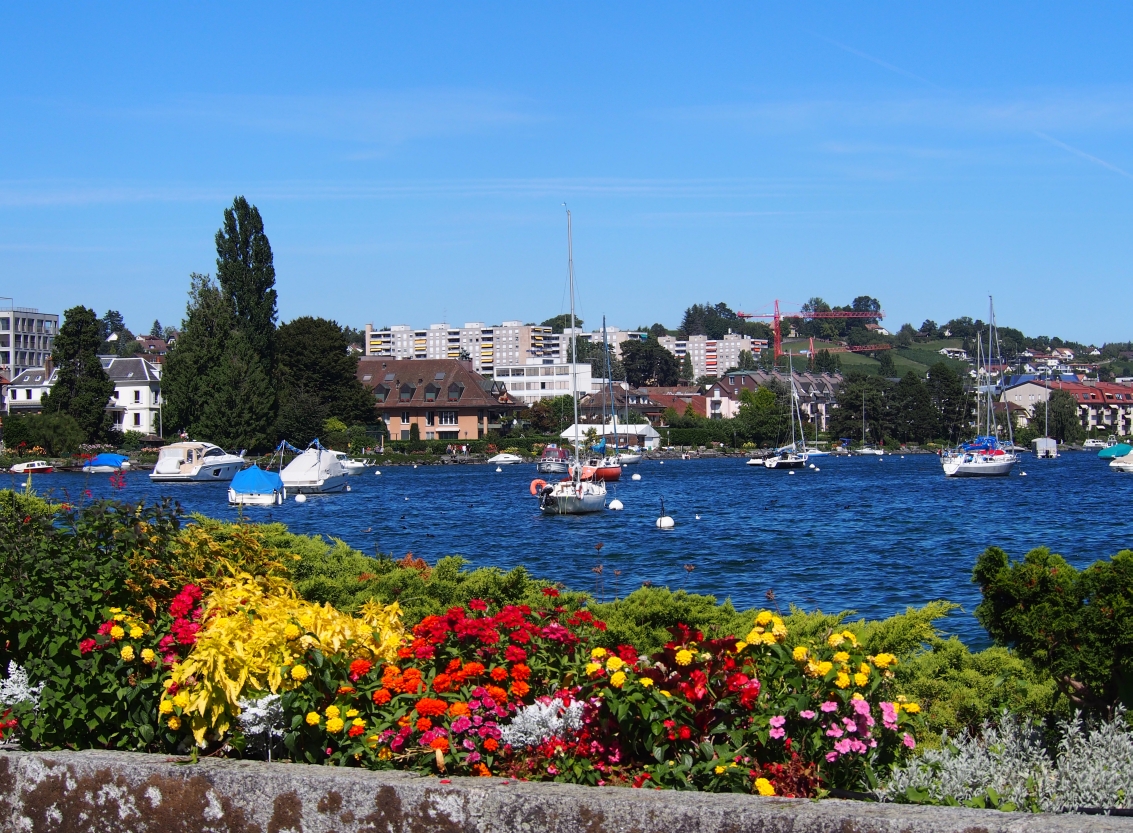
In my own experience, the best example is indeed the Swiss Riviera – the side of Lake Geneva, where J- lived. Even when I go there these days, it somehow strikes me as being in possession of something that makes you regret that you have to live anywhere else. It is a kind of self-possession, but clearly not the product of a single masterplan, more the happy product of natural blessing and its having capitalised on that. Certainly not anything that in any way rubs you up the wrong way or makes you feel excluded. Despite its wealth and the many celebrities who live there, there are plenty of ordinary folk who were just blessed with having been born on the Lake’s shores. Strangely, the French shore of the Lake just doesn’t have it. Wistfully glancing through the websites of hotels in Morges, my favourite small town on The Lake the other day, I was struck by the same sense of something, that one just doesn’t get looking at hotels in Manchester – or even (perhaps a better parallel) somewhere like Bournemouth or Torquay.

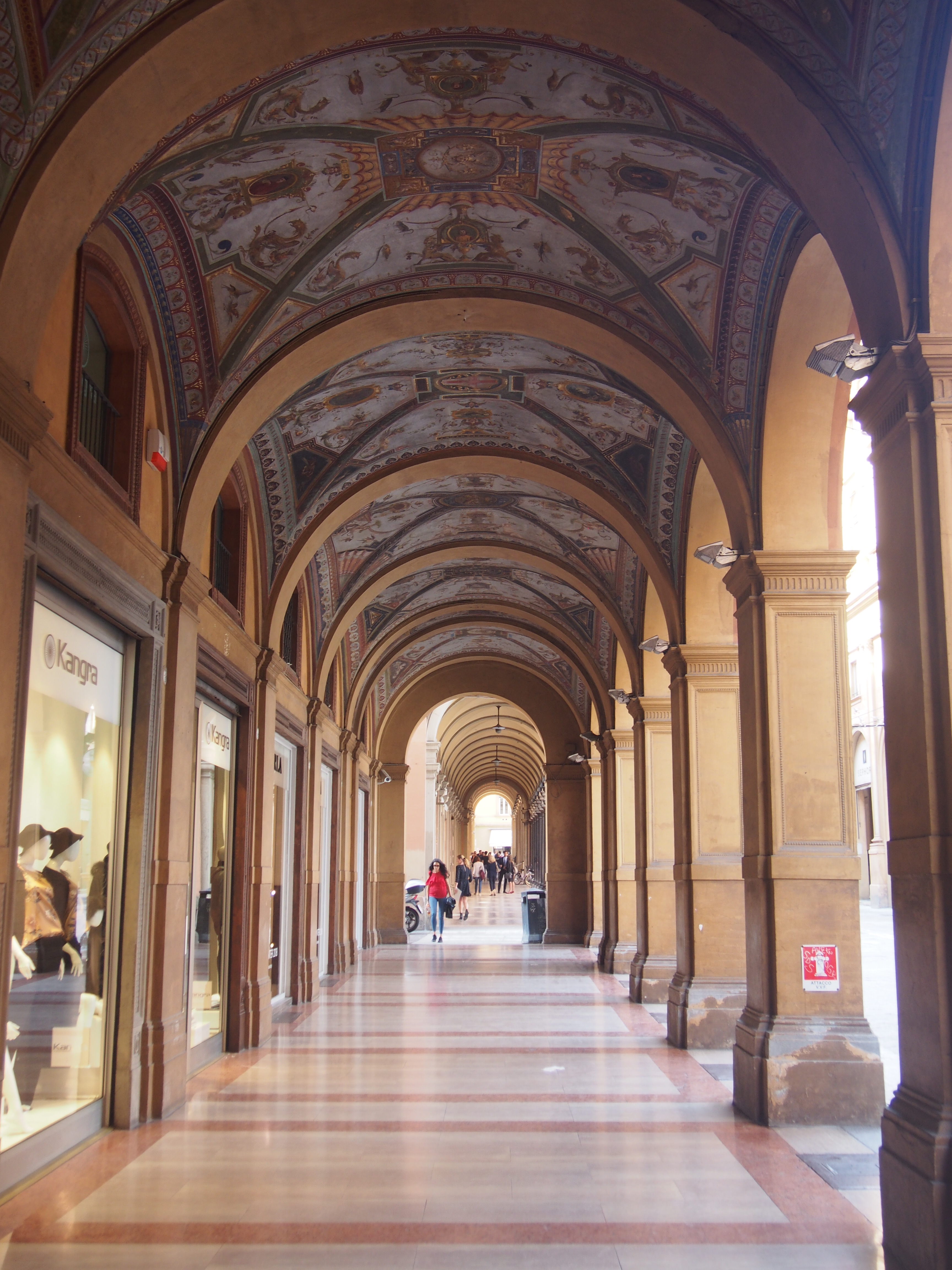
Certain places in Italy seem to have ‘it’ too. Not necessarily the obvious ones, but often less-known places. Bologna is one example – but so is the smaller town of Cremona, and the even smaller one of Barga. It would be tempting to dismiss this as ‘just Italy’ – but I have equally seen plenty of places in that country that don’t have it, too. And it is also to be found, albeit perhaps less frequently, in some of the less obvious candidate countries. It seems to be a quality that transcends individual cultures.

Then there are the individual premises that just seem to ‘work’ – individual shops, cafes and the like that somehow have hit a sweet-spot where others didn’t. Sometimes they depend on capturing the zeitgeist, but the best become lasting institutions.

Oddly, it is sometimes possible to identify specific “ingredients” that sweep one up: and yet somehow one still fails to capture the sum of the parts and attempting to recreate (dare I say “copy”) it is doomed to failure. When it comes to places, lakesides seem to be one of the key ingredients of a charismatic place: the same goes for those in Italy and elsewhere. Even the few big lakes in the UK make a stab at it, though they mostly fail: too self-conscious again, to do it properly.

I’m not sure what the rest of us can do about it. There must be something about those places and people that make them what they are. And yet I wonder whether it is even any more than chance. I guess the whole nature of Sprezzatura is that sense of effortless style that can somehow put an everyday encounter onto another plane – and yet I wonder whether it is actually any more than a happy accident. By no means all of those who attempt Sprezzatura pull it off; in fact perhaps only a few do. In recent years, the rise of Pitti Uomo Peacocks has shown that Sprezzatura overdone rapidly just degenerates into vanity, and loses its appeal. Maybe the whole thing about charisma is that it is unconscious. As soon as you try to have it, or become aware that others think you do, then you instantly lose it. Because the instant killer for charisma is trying too hard.

I think this is where Britain fails. The majority of people in the U.K. seem content to live down-beat existences. Most homes seem to be little more than spaces where people exist; most food for most people is still just fuel – and while I saw a comment some days ago to the effect that the great effect of lock-down is that “nobody had to think about what they wear any more” I must admit that I laboured under the belief that that was, in any case, the norm in this country of shabby dressers. If what I encounter on the streets passes for what this nation considers to be good wear, then I despair…

Where in Britain it is otherwise, we tend to go to the other extreme and try too hard. That is the problem with the smarter residences, shops and eateries: they are far too self-consciously trying to be smart – and as I said, that is pretty much enough to guarantee they fail. Besides, smartness in Britain often carries too many class connotations of exclusivity to be truly charming – and is regrettably why too many people seem to do it. I struggle to think of much true charisma in Britain; even where one might have expected to find it, it is too often absent. Chelsea and Notting Hill are, at the end of the day, just more parts of over-built London, at least unless you have to odd billion or two to splash around. Same bad roads, same poor air.

The problem with smartness in Britain is that it is not the norm – and one feels that it is only done for reasons of snobbery or over-charging. Too often, one senses that noses will be looked down on entering such places without a Rolex and an Amex Platinum. Which is definitely not part of charisma; quite the opposite.

The difficulty here is that real charisma exists purely on its own intrinsic terms. The moment it is done to impress, to make money, or just for show, it degenerates into mere pretentiousness, even churlish one-upmanship. People and places that are truly charismatic carry on doing it even when no one is looking – for they are just being what they are. This may also explain how very ordinary things can be charismatic: a coffee served in a stylish cup is, to my mind, infinitely more appealing than the same coffee served in a chipped mug; all the better if it is properly made, rather than instant blend (though I suspect a true charismatic would get away with serving the latter…) But as soon as you know it is just being done for show, it too is ruined.

I don’t know what we mere mortals can do. Perhaps the answer is nothing, except perhaps bathe in reflected glory. The moment we try, by definition, we will fail. And yet, the wisdom of Sprezzatura also knows that the nonchalance requires (unseen) work. It is a fact that those stylish places need to be maintained; decisions need to be made about how things are done there. The same goes for individual lifestyles: given that we are not really talking about the financial constraints here, people make decisions about how they do things, some do one way, others the opposite. Often in Britain, the default seems to be downbeat, as though everyday life just isn’t worth it – and then people vainly try to dress things up for ‘special occasions’ – and all too often end up just looking crass. Perhaps they should try looking at the whole of life as a special occasion and stop worrying about whether anyone is watching or not.

On the other hand, if it remains true that real charisma is effortless and unconscious, does this really mean that the rest of us can’t work at our own? Ultimately it depends on attitude, and what perhaps puts many people off is the suspicion that charisma is egotism. While that can be the case (self-confidence can be beguiling), I think the words of Michael Bywater are significant: he dismissed it by saying that in effect it is a courtesy to others: a sign that you consider people and life – others, as well as yourself – worth the effort.

Here we have again the contradiction, that charisma just is what it is – and yet it is largely experienced by others. Maybe it is simply impossible for people to experience their own charisma – which may make you question why bother – and perhaps the whole construct in the first place. The same with places: while they exist on their own terms, you come away somehow feeling that they have done you a good turn, but you can still wonder whether life there would really be as good as it seems.

Yet that seems like a perfectly legitimate and affirmative worldview to me, one that says that any life can be made charming, if only you take the trouble. The same goes for charismatic places: it ought to be possible for charming places to exist anywhere – if only we make them so. There are plenty of humdrum places that have been given a lift; what is less certain is how well conscious effort works, and whether it successfully takes on its own life in the longer term.

In the end, it is perhaps just a mindset that makes the difference. And as for me, the very fact that I feel the need to ponder and write these things probably means that I’ve lost before I’ve begun…

Opinion & Thought, Politics and current affairs

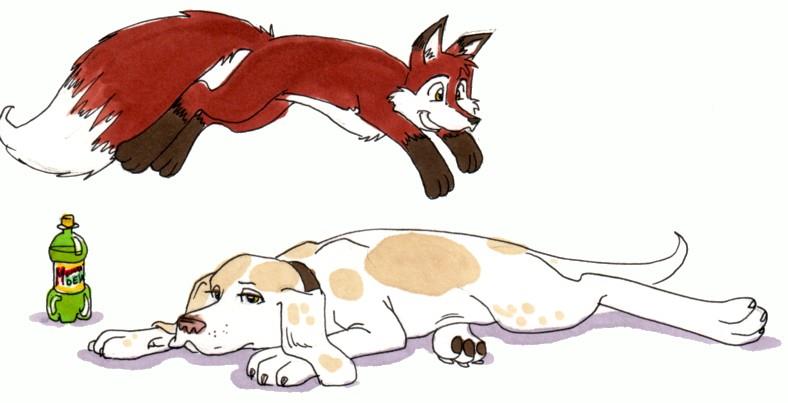
The quick brown fox jumped over the lazy dog.

the-quick-brown-fox-jumps-over-the-lazy-dog-is-an-example-of-what

It took a little while for us here to start wearing masks. While we were locked away at home, it wasn’t really an issue – but we now have them and hopefully wear them intelligently – i.e. when in enclosed public spaces or where proximity with others is likely. It has become apparent that wearing one also works quite effectively to remind others to keep a distance. It is not a major imposition, apart from the problem of foggy glasses.

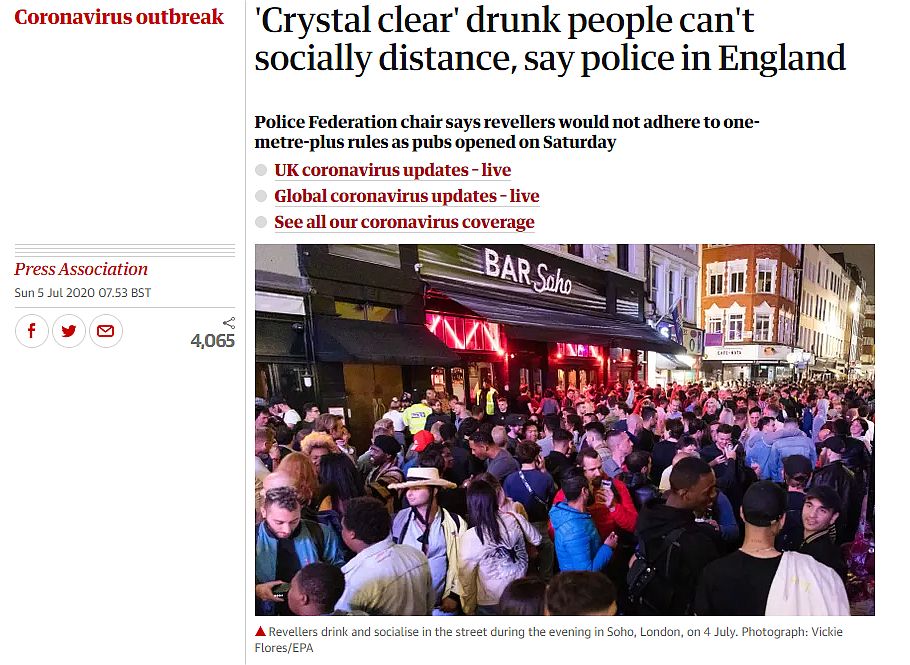
So quite what is one supposed to make of reports that fewer than 25% of the British population is wearing masks? Experience here suggests that it may well be much less than that, and comments from friends suggest that even the legal requirement to wear one on public transport is being widely flouted.

By comparison, it is reported that around 84% of Italians and 65% of Spanish and (even) Americans are routinely wearing them.

Assuming the figures are correct, in my eyes this comes close to the indefensible. Even if there is disagreement over the impact of masks (which seems in any case to be diminishing) the precautionary principle surely applies. And the degree of difference in these figures is surely big enough to be significant about something. The question is what.

It is easy to put the hat of indignation back on; I do it easily – but then, I am a teacher. Teachers are paid by society to stick their noses into other people’s lives and behaviours and try to improve them – and I have been a teacher for a long time. Besides, when that behaviour potentially affects my well being, I believe it becomes my legitimate concern. That notwithstanding, it is still an objective fact that different societies in different places and times exhibit differing behaviours, and it is hard not to conclude that there must – somewhere – be reasons for this, given that human beings are in biological terms fundamentally the same everywhere.

Indignant or otherwise, it is easy to read this as an explicit statement of how a lot of individuals in Britain regard the wider society of which they (fail to see they) are a part. The purpose of wearing a mask is primarily to protect other people, and when widely observed, the situation becomes mutual. The impact on infection rates is becoming much clearer. There may well be widespread misunderstanding about this fact – but that raises questions of its own, both about how much attention people are paying, and the effectiveness of official communications.

Equally, it may be an expression of very low levels of concern that people have in what is left of civil society in Britain, for each other: so low that even a trivial but important obligation is too much of a personal infringement to be seen as worth making. This in turn might cause one to wonder at how it came to be like this here, when it is clearly not a universal habit.

The difficulty is, it is almost impossible to pin such things down objectively – and therefore one is left scrabbling for explanations that are all too easily distorted by confirmation bias.

As I said, the most charitable explanation is a low level of understanding – though this still does not reflect well on the country. Worse is low levels of concern, which fly in the face of much of this country’s self-image as a place of civilised values and courteous behaviours.

Somewhere in the mix this may reflect on the nation’s seeming inability to organise itself properly. Even arch-patriots seem to accept that good organisation is at best touch-and-go in this country, even if they turn the regular muddles and short-sightedness into a strange kind of virtue even as others (including me) are tearing their hair.

I suspect another facet is an in-bred tendency to look backwards: in general the British are not good as early adopters, since that involves looking positively at the future, and as a nation we are still far more in love with our past.

It seems to be true at both an individual and collective level: I saw a first-hand report yesterday from a British woman flying in from Germany, of sanitising facilities at Heathrow that had not been replenished, and of people milling around in the airport without any observance whatsoever of suitable distancing. Surely it is not beyond us to get these very practical things right? At very least, this is not the image we as a nation – and certainly not the present government – like to have of ourselves – and yet ironically such débacles are depressingly common. They are not everywhere – as many Brits seem to assume. As one commentator put it some weeks ago: “Even when all we need to do is copy the Germans, how come we still get it wrong?”

Still trying to be charitable, the only other conclusion that I can see for the traditional British cock-up (which seems to be more common than the alternative) is that there is something in the British culture or mindset that is so ingrained that we cannot collectively overcome it – even when we know we need to. It seems to be something that afflicts our ability to construct effective institutions and guide individual behaviour almost equally. I hesitate to call it a blind spot because some of us at least are aware it is there, though trying to overcome it is by no means as easy as might be thought.

What is the common trait that leads British planning law to be impenetrable, that causes so many mega cost-overruns on projects that end up being abandoned, that leaves us dithering over high-speed rail half a century after our neighbours started build theirs; that leads us to persist with outdated forms of government even though there are many examples of how they are dysfunctional – and which leads so many to neglect or even fight against basic individual responsibilities in the face of a resolutely apolitical virus? That makes it so difficult for people in this country to “do the right thing” even when they know they should, to take the easy way out even when we know it is doing us all harm?

Education might be a likely culprit. And in some ways plausibly so – but I think that any failings in that respect are more a symptom than a cause. Why is it that this country has taken such a myopic, market-driven view of education when many other countries seem to see perfectly clearly that developing minds and societies does not and cannot work in that way? That education needs to be about far more than just preparation for the workplace; that “qualifications” are meaningless if not backed by real knowledge and understanding? Arguably it is a shortsightedness that fails to cause it to be otherwise.

“The Market” might be another culprit – again reasonably so, because in reality, free markets like nothing more than large numbers of docile, compliant, identikit producer-consumers. And it is certainly not averse to trying to shape people’s behaviour (not least through flattery and the deception that people are freer than they actually are) to make them so. It seems to me that those countries that exhibit the kind of aggressive/defensive behavioural complexes that perhaps explain people’s unwillingness to take part in collective actions are more likely to have aggressively neoliberal governments and deregulated commercial sectors. But it is still not easy to say which is the cause and which the effect: in a sense people choose their economic models through the ballot box.

But I suspect that the real shapers of national mindsets are actually deeper and less obvious. For a start, I doubt that very many non-mask-wearers are actively going out to cause harm to others. The failure to make the right decision is probably less conscious than that: something that simply causes insufficient awareness of such issues in the first place, though a retail-indulged “all about me” is no doubt part of it.

Another common factor in self-harming libertarian cultures seems to be strong hierarchies. In the case of the UK this was, and in part still is, down to ancestry and social status. In the USA it is linked more directly with wealth – though the UK is treading that path too. I suspect that the resultant inequalities do not only do physical harm but also considerably wider psychological damage. The whole notion of a pecking order informs one’s sense of self; the restrictions imposed by one’s (many) superiors can be limiting and denigrating – and may well lead to a sense of powerlessness and an aggressive defence of what little remains of one’s autonomy and self-respect. Could this explain the shows of aggression seen when non-conformers were asked to comply with lock-down, sanitising or now mask-wearing?

I sense that something is different in those countries where mask-wearing rates seem to be higher (the US seems to be an anomaly here, though it reported varies massively between states – and correlates with their political allegiances). Lengthy acquaintance with some people in continental Europe suggests to me that on the one hand they are more assertively individualistic as citizens – and their socio-politico-economic systems reflect that – but perhaps as a result, they are also less aggressive when challenged or required to pool their sovereignty with others. Compared with places where there is a more overt or overbearing elite, there is perhaps a greater sense of real individual sovereignty – but also more respect for the same of others: in other words a greater sense of commonality.

It’s not an easy thing to describe – but a useful analogy might be driving styles. The UK has one of the lowest road fatality rates in Europe; this might correlate with its self-image as a polite and rather cautious nation. But it also has plenty of overt, daily aggression, often originating from those who drive the most expensive and powerful vehicles. In Germany, Switzerland and Italy, by contrast, experience suggests that driving is often more assertive – you will certainly know if a faster driver wants to pass – but there is somehow less overt aggression behind it; that assertive driver will still normally wait without hassling until you choose to pull over. Behind that, there is an implied acceptance that both have equal right to be on the road – something that road-rage denies.

I increasingly suspect that the supposed modesty that underpins the British self-image is actually nothing of the sort; it is actually harmful passivity: a kind of indifference or complacency born of the fact that in this country all the important decisions are made, and responsibility born, by Someone Else; that for many, their little lives are not felt to be as consequential as those of Important People. Such places often seem to have a strong culture of celebrity veneration, a kind of vicarious living, as though ordinary lives are not good enough.

I think it is symptomatic that here, the perceived solution to the mask problem is for the government to tell people to do it; it should not need to: they have minds of their own. And the failure of our government to do so is in any case part of the problem since governments elsewhere have done precisely that, supported by public expectations.

Somewhere in the mix persists the belief that we live in a promised land in which nothing really bad ever happens – even as it is killing more of our compatriots than almost any comparable nation. And therefore we never need to give any serious attention to our actions, because they are mostly inconsequential. Even when they are not. It is a kind of communal paralysis that is in so many ways perpetuated by the small-mindedness and belief that muddling through is still sufficient, even when we can see that it is not. It is the absence of a profound democratic belief that every life really does matter – not only those of the ruling and economic elites.

But it also allows those in the nation who are alert and ambitious (but not necessarily benign) – and not only viruses – to run rings round the lazy brown dogs of everyone else, thus perpetuating the situation and indeed making it worse.

Another objective truth about societies (as individuals) is that they are quite capable of self-harm, even knowing self-harm. Brexit is one example; the failure of civic duty in the face of the virus is another.

Britain is certainly not the only country where such phenomena exist, or where antisocial behaviours are manifest – but the disparities in mask wearing are surely significant enough to show that it is one of them. In that respect we come close to being objectively inferior to those who are getting it more right. Will we learn from them?

The belief that we are immune to national blind-spots is our national blind-spot. The problem is that the pathology seems so deep that we still simply can’t see it – let alone escape it.


Opinion & Thought, Politics and current affairs

Sowing seeds

preparing-seedlings-1200x800

Being a teacher is a strange job. You rarely see the results of your work – and even if you encounter former pupils in later life, it is almost impossible to identify with much confidence any specific effect that you had in them. The whole job of a teacher is predicated on the hope that you will have some helpful effect on the individuals you teach, even if you will never know what.

This is probably why ideology plays such a strong part in the educational profession: in the absence of anything more concrete, there is little else to fall back on to provide shape to our actions.

It is this problem that also leaves the profession exposed to so much idiocy. When it is almost impossible to prove anything much at all, anyone who claims otherwise can get in on the act without difficulty. So we are continually beset by the claims of ‘gurus’ bringing magical solutions, even though it means that education tosses and turns on a perpetual tide of contrary solutions, such is its yearning for answers to the unanswerable.

It is the same lack of agreed, provable outcomes that has made it all too easy for politicians to appropriate education for their agendas. It has been too easy for them to point the finger at teachers for being wrong-headed, unproductive, pointless. It has made it easy for them to impose conditions on education that attempted to twist it into paradigms derived from sectors where it is much easier to measure output. In doing so, they have turned education into a conveyor-belt industry, whose output is not educated individuals, but statistics published and boxes ticked; numbers of certificates handed out, no matter how little the real intellectual effect on the minds of those who received them.

You can’t be a teacher without having some faith in humanity – that it is possible to turn thoughts and behaviours to the good. You cannot function in a classroom without that unprovable belief that what you are doing is in some way important and beneficial. That is true everywhere: the very fact that to educate someone is to anticipate their future means that it cannot be otherwise. But the fact that education’s benefit is unprovable does not make it undemonstrable. Some countries seem to find systems that equip their citizens better for their future lives than others.

As with everything else, the pandemic has highlighted this. The responses by individuals from the most powerful to the most ordinary are the product of their thought processes – or lack of them. To some extent, that in turn is a product of the sum of the education they received, both formally and otherwise. How they reacted to CV-19 is an expression of that.

I have worked for many years in education in the same hope that I was helping to equip British people to be effective thinkers, to be able to take their opportunities and respond intelligently to their difficulties. I hoped I was helping to create a nation of thoughtful, responsible, cultivated citizens.

I always believed that education does have an effect, and that it was a positive and definite force, even if its specifics for any particular individual were unknowable. I never even considered that it was actually an exercise in damage limitation to contain the worst of human idiocy; this was just too cynical an interpretation for any teacher to entertain and still function. But the past few years have shifted my view on this out of all recognition.

In a national political plebiscite that required knowledge and informed thought, despite their so-called education, a majority of the British Public opted to side with prejudice, rumour-mongering or just ignorance. Or they abdicated their responsibilities entirely.

In the face of a known epidemiological threat, this was the response of a significant part of the British public yesterday:

4july

It is no good just blaming the politicians: all of those people have brains of their own. It is what they (fail to) do with them that is the tragedy.

It’s not only what happens in formal education that affects such behaviour: much of the national attitudinal landscape is the product of home life, the national media and peer pressure. But the same is true in all countries, and yet responses – and responsibility – in similar circumstances have not been the same everywhere. The role of formal education is to equip people to know better.

It seems that in Britain life is so cheap that it is worth risking the death of oneself and many others for the sake of a pint.

Educating the British public: how did we get it so wrong?

Opinion & Thought, Politics and current affairs

Workers! You have nothing to lose but your chain stores…

chains-web

I once saw work defined as ‘doing something you would rather not’. That seems about right: I have been pretty constantly productive during the lock-down months, and yet almost nothing felt like ‘work’ ; in fact the same could be said for the last three-and-a-half years since I stopped  full-time employment and was largely confined to quarters. Now that the ill health that caused this situation has mostly receded, the revised life-balance has been very largely beneficial.

Yet the cultural wisdom of recent times has been that work should be central to our lives, that it is the most important aspect of our existence, our most significant activity. By extension, this suggests that disliking our work is the last thing we should do. In fact, we are expected to love it. (One might have another discussion entirely about what we would rather do or not, and why…)

People seemed to lap this up: in the teaching profession, I encountered many people who admitted that they lived for their work. While teaching is a rather unique vocation, I suspect that the sentiment is much more widespread, though how much of this is actually just virtue-signalling is open to question. I often wondered both what such required devotion did to the quality of the rest of their lives (I knew what it threatened to do to my own) – and what messages it sent to the up-coming generations.

The cynic in me suspects that things are not this simple though – and as with almost everything else, the Corona-virus emergency has cast a harsh light on our assumptions and choices. I wonder whether there will be substantial change in this respect – or whether we will in fact return to the good-old-bad-old days as soon as restrictions are fully lifted.

Work is not absolute: it is a cultural phenomenon – in Britain’s case a legacy of the “Protestant Work Ethic”;  it is also a complex matter that goes to the heart of existential issues that I rather doubt the average commuter gave much attention to in normal times. From birth, we are in effect programmed to expect that after schooling, we will spend most of our lives in employment, before being put out to grass at some point when the going starts to get tough. Modern reality may not be quite so predictable, but that is still the normal, if dated template.

The existential matter comes from considering what we would do if we were not at work: part of the fear of lock-down for many people seemed to come from not knowing how they would fill all those extra hours. Many seemed to go looking for alternative forms of work. And yet we have no more hours to fill in a day than people ever did. There is plenty of evidence that even at subsistence level, people in the past rarely filled all their days with work – they did what was necessary, but no more, even though that involved much more than in developed societies today. The same seems to be true in subsistence cultures today – and it can be informative to look at other species, who face the same existential issues when it comes to filling time: what is one to do between birth and death? While lower species do seem to fill almost all their time with basic survival, the same is not true for the higher ones such as big cats or other primates – nor many domesticated animals.

There is certainly a psychological aspect to work, or the lack of it. Unemployment is known for being a scourge, and yet I wonder whether it is the lack of work per se that is the real difficulty, or simply the lack of resources that it brings for doing other things instead. After all, the affluent classes whose income derives from rentier activities do not always seek work – being leisured was (is?) seen as their good fortune. I suspect that many of the problems of unemployment actually derive from the wider situations of those who are most likely to face it: lower income, less educated and with few other ways of finding meaning.

Therein lies another issue: it is undoubtedly true that work bestows purpose and identity. One of the most unexpected difficulties of losing my own job was the lost ability to say to people “I am a teacher”. Ergo, anything much at all. Again, this is probably particularly important for occupations that have a strong vocational element but it may be more widely significant too. But I also suspect it is a stronger male trait than female, which may suggest it has other underpinnings.

We might consider how attitudes to work differ between cultures. I’ve seen enough of southern Europe to know that the mañana culture is by no means dead and this is unsurprising, not least for climatic reasons – but it is also a lazy stereotype to believe that southern Europeans never work hard. There is, for example, a strong work culture in northern Italy, even if one might suspect that it may be a way in which it seeks to assert its parity with the ‘efficient’ countries further north. But that country is also famous for the imagination and richness it devotes to its wider way of life – and that to me seems to be to be a worthwhile trade-off.

One might look at the Germanic countries where there is supposedly a much stronger work-ethic. Except that it may not be all it seems. My experience of those countries suggests that while quality, efficiency and skill are very important, work is not the end in itself that one might expect. Law in those countries has established the social purpose of work – for example, providing employment is seen as equally important as generating shareholder wealth; the requirement to have employee representation at board level has embedded that. A more important question is perhaps why Germany created such laws in the first place when they would be highly contentious in the much less efficient U.K.

The division between work and not-work seems much more flexible – even blurred – than it does in the U.K. Taking sabbaticals is rather more possible – and provision for issues such as paternity/maternity leave and childcare more generally, famously more generous. Perhaps this is the future: where a highly-skilled and autonomous population checks in and out of work as required, as one activity amongst several in an average week? Once again, Britain seems to be behind the curve.

Relationships in the workplace seem more equitable and less hierarchical there, and it seems to me that less importance is attached to work as a wider social signifier than it is in the U.K. It also seems to me that there is a much more visible level of active non-work life in those countries, be that from the numbers one sees doing outdoor activities, eating out or attending cultural events. So much for the Germanic worship of work: I think their attitude is simply a manifestation of a widely more proactive culture.

The pandemic has thrown new light on our attitudes in the U.K. – and it seems that the government is increasingly prioritising the economy over public health. A recent encounter with a former Conservative councillor confirmed his view, at least, that the economy is “far more important than….” He didn’t finish his sentence. I wanted to suggest, “than the lives of little people?”.

For several decades, we have been told that work is indeed the most important thing we do. Most other aspects of life – including education – have been subordinated to getting people into the workplace. But that has not implied becoming an entrepreneur; the emphasis has been on being a ‘good employee’, working harder than you are asked, “going the extra mile” and not rocking the boat. Is it a coincidence that such a relatively poor workplace “settlement” seems to be a feature of those hawkish countries that retain neo-liberal ideologies and hierarchical societies? Is work really as essential as they would have us believe – or is it just very convenient propaganda to keep us toiling to keep them in the lives they seem to expect?

It seems to me that successive generations have accepted this largely unquestioningly; on more than one occasion in my own working life I was lectured by colleagues that I needed to “learn to play the game”. But it increasingly seemed to me that it was less of a “game” and more of a racket. Or at least an excessively hierarchical, quasi-feudal, exploitative set-up that was increasingly tilted in favour of those at the top – and those who gained their favour. My not “playing the game” was simply an attempt to be a reflective professional – one who was prepared to entertain difficult truths in the interests of doing an excellent job – and ironically, trying to help develop the institution for which I worked. But it proved unacceptable to those who ran the place.

It is quite difficult not to come back to the cynic’s interpretation. At present, it seems that health-protection measures are increasingly being compromised in order to get people working. While we hear that many have experienced hardship in lock-down, very many from whom I hear have actually found it a positive experience. They have discovered a new way of life that does not revolve entirely around the rat-race – and also that they can survive without the 24/7 conspicuous consumption melée that our country has become.

This may be the real agenda: making people work so hard they have no time to think is in reality a form of social control: over our place as consumers who keep the economy churning, who provide often-expendable work-units that are needed by the owners of businesses who in recent times have taken more and more of the proceeds of our work for themselves, and who have eroded employment rights in order to keep it thus.  And because the political class fears a population that actually has time to stop and think, and perhaps to find a way of life that does not involve compliance with a status quo than disproportionately benefits them rather than us?

Work is certainly important for many reasons, not only keeping food on the table. The sense of purpose and accomplishment it can provide can be good for mental well-being; it also provides social contacts and structure to our days; it of course creates wealth and innovation and gets things done that society needs done; it is perhaps even reasonable to accept that it does involve a degree of societal control, because there are still many who seem not to know how to use their non-work time constructively.

But the prioritising of work above all else has actually made those problems worse. It has eroded civil and communal life, it has made family life more difficult – and it has removed from people the autonomy to know how to rely on their own resources and to find other aspects of life by which to define themselves. Reducing the long hours of my own work and taking more control has been a significantly good thing. The small town where I live is noticeably different now too: quiet – but inhabited – not emptied-out, as it feels in a normal working week after the commuters have left. The endless (and often needless) consumption and the income to afford it, which is the quid pro quo for the long hours – (and which actually feeds our income back to those who own the organisations that employ us in the first place) – is having a disastrous environmental impact.

In other words, excessive work is actually the cause of many of our other dysfunctions, not the solution.

If the pandemic has made people question these things, it can only be good. The pendulum may have swung too far to sustain – there will always be a trade-off between time and money, though new technologies may be part of the solution here, as indeed electronic technologies have shown in recent months.

Giving people the freedom to choose how to balance their lives seems to me to be an inherent component of a good quality of life – and it already exists to some extent in similar countries; it should be up to people to choose how to spend their lives most fruitfully, not the nation’s patricians to dictate.

That is entirely consistent with the nature of Sprezzatura: the scope to run your life rather than it running you. And I suspect that is the real reason that the powerful in Britain are concerned that it does not go on much longer.

Opinion & Thought, Politics and current affairs

The Ref.

ref


Twenty-five people strode out onto the grass. Several of them were carrying balls, which ever-shifting groups proceeded to kick about among themselves.

As time wore on, an air of uncertainty seemed to descend, as though they were waiting for something. Eventually, one of them decided to make off up the grass with one of the balls, towards a goal post. There was a cheer from the spectators. But some of the others on the grass seemed not to have noticed; they were still occupied with different balls.

Gradually, however, a few more started to join in a repeat of the above movement, even passing the ball from one to another as they went. Others tried to stop them. But it wasn’t easy to tell who was on which team, since there were ten different colour schemes visible on the field.

After about ten minutes, one of the people deliberately tripped up another who had a ball, and then dribbled it around behind the spectators before coming round the end of the field and through a goalpost that had, in the meantime, mysteriously been replaced with one four times as wide as that at the other end of the field.

Some on the field protested vigorously, at which point they were set upon by the others, and a full-scale brawl ensured. Some of the spectators gladly joined in, while others lost interest and sauntered off home. The ‘game’ was eventually won by those who were able to punch the hardest, at a score of 13-0 and five dead.


Times of emergency often provoke people to face issues that they would rather not. Currently, that includes some pretty fundamental questions, such as whether it is possible to run a country under conditions where close interaction between its residents is potentially fatal.

One might also ponder the importance, or otherwise, of Trade in a situation where matters of mutual survival are suddenly of much more immediate significance. Public Opinion in the U.K. apparently still supports an extended lockdown until the risks of infection have fallen much further. When it’s a choice between cash and life, most people don’t hesitate to choose the latter.

But another rather existential question concerns the nature of human interaction. Since the time that there was first more than one person alive on this planet, there has been a need for some kind of accommodation of the possibly-conflicting interests of multiple sentient beings. It is evident, too, that by virtue of existing, those individuals cannot help but have an effect on everything around them, including other beings. The question is, what type of effect. It also apparent that individuals’ good can be furthered by interaction, thereby achieving things that neither could alone. It is not as simple as just allowing the economy to perish, since people do need to interact for all sorts of things, while isolating people totally is potentially to leave them to perish from all sort of other causes. This is the argument being made by some for ending the lock-down.

How to reconcile these two grossly conflicting needs is the conundrum that Covid-19 presents. It is also the subject of social and economic theory down the ages.

There can be few who would advocate running Premier League football along the lines described at the top of this post – and yet there seem to have been plenty over the past decades who thought it was a good way to run society more generally.

They are the ones who describe taxation as theft, who claim that there is “no such thing as society”, and that “the invisible hand of the market” is the best mechanism for running things. They tend to claim that competition is the natural dynamic of society, as of Nature itself – competition which they evidently intend to win. They are the ones whose attitude towards the State is hostile, who portray the organs of the state as either megalomaniac or lumpenly jobsworth, intent on depriving them of their “rightful” freedom to act as they alone choose.

These attitudes may reflect more on those who express them than anyone else: on what grounds might one really object to the presence of any form rules – except because one wishes to flout them? Most of the “bureaucracy” that such people wish to hack away exists to protect the many from predation by a few. Why else would one wish to loosen safety standards or conditions of employment?

Yet a version of such market-dominated views is prevalent in the U.K., to the extent that even the more thoughtful among the younger generations who have never known it otherwise, seem to find it very difficult even to conceive of society being run any other way. This is probably no surprise, since in that time, even the State itself has been run by those who held such views, and whose overriding aim was seemingly to remove its influence from as many areas of national life as possible. They argued that the State was inefficient and inept. At what, one might ask. Selling burgers – or saving lives?


I’m old enough to have been brought up with a different view, no doubt reinforced by the fact that most of my family has worked in various state enterprises. I grew up with a view of a benign State as the guarantor of basic standards and needs. It was the State that provided electricity and water, and co-ordinated train and bus services. It oversaw the provision of universal standards of healthcare and education. It underwrote those things that are necessary, but where profit is not the most important or viable consideration.

It might have been a bit dull, but it nonetheless had a showroom on every High Street rather than a call-centre in cyber-space, and you knew that the prices it charged were not fuelling the mega-profits of a few private individuals living in tax havens or the zero-hours contracts of unfortunate operatives. You knew that the head teacher was answerable to the County Council rather than his own pension fund. You knew that train fares would be consistent, not run by “yield management” techniques designed to maximise income for the operator.

You had some faith that the State would take a long-term strategic view of the needs of society as a whole, and plan accordingly, that it could act where there was no profit to be made. In short, the State was arbiter, the provider of the social goods that underwrite the basic needs of society, which it provided without fear or favour irrespective of people’s private interests.

I’m not naïve enough to believe that the State got everything right, or that the divide was always in the right place. It was probably never a good idea for the NHS to be the sole provider of spectacles. The consequences were visible on the face of every citizen with less than perfect eyesight. I also know that innovation can be messy and unpredictable, while self-interest is a strong (but not the only) motivator. The important thing is to balance conflicting interests.

I suspect that the shortcomings of the State peddled by free-marketeers since the 1980s were less inherent, and more to do with poor practice. The State is not inevitably bad: just look at the German, Swiss, Scandinavian or New Zealand ones. It is just that the British State has been badly run – not least because it was perpetually starved of funds by those who were able to avoid contributing, and often run (with little accountability, but plenty of condescension and entitlement) by those who had few personal interests in its working well, since they had already bought themselves out of it.

It is not as though the free market does any better. The myth of market efficiency  has been exposed: what private companies crave is not competition, but monopoly: a private monolith instead of a public one. A situation where they have the rest of society over the barrel of their own corporate interests – and these they  will conspire to create when the State is too weak – or negligent – to prevent it.

The pandemic response is simply the latest, most extreme demonstration of what happens when you try to run civil society without the impartial, logical, consistent organisation that only a disinterested entity can provide.

It is the “lean and efficient” commercial sector that largely replaced such an entity in the U.K. which has been exposed as having neglected investment and strategic planning. It should come as no surprise that when one promotes profit-seeking, it is entirely predictable that that is how many people will behave, both individually and in groups. It is inevitable when such organisations tend to be run by self-selecting, profit-seeking individuals whose personal perspectives align with that worldview.

The Coronavirus pandemic has put the shortcomings of this approach up there in huge, illuminated letters for all to see. When it came to the crunch, it was the large corporations who struggled to keep supplies rolling, who were ill-equipped to cater for a suddenly-much-wider range of needs – not that it stopped them propagandising as vigorously as any State, telling us how they were “here for us” and were “looking after the nation”. No: they just knew the alternative was oblivion.

It was quasi-commercial policies that deprived the NHS of the strategic reserves it needed to respond fully to the emergency – and the altruism of its ordinary employees that largely saved the day while the executives were struggling to work out what to do.

The same could be said of the government: at a time when the guiding principle has needed to be social solidarity and welfare, grass-roots society has largely risen to the need. But the libertarian free-marketeers in charge have found themselves bereft of the insight for far-sighted decision-making. Even now, their approach is more public-opinion than public-service. And as if that wasn’t enough, the experience is being daily rubbed in by the very different situation in those nations that never lost sight of the need for an effective social contract in the first place.

Perhaps the most ironic sight is now the self-same private sector that has spent the last decades demeaning the State and profiteering from its neglect, now coming cap-in-hand to the State for support, supposedly in the interests of its vital social function. So much for the “invisible hand of the market”: when the chips are down, it is the very visible hand of the State that is needed to save the day, just as ever.

Those who advocate competition fail to notice that in even nature, co-operation is at least as effective a survival strategy. When individuals compete, the strongest normally wins; when disparate individuals compete with an effective team, the team does.

Because those existential questions dictate that, whether it is a game of football or the functioning of a complex society, few things can operate properly and equitably without logical, consistent and fair rules – and their enforcement by an impartial Referee.