Opinion & Thought, Politics and current affairs

The Significance of Flags

maladiere

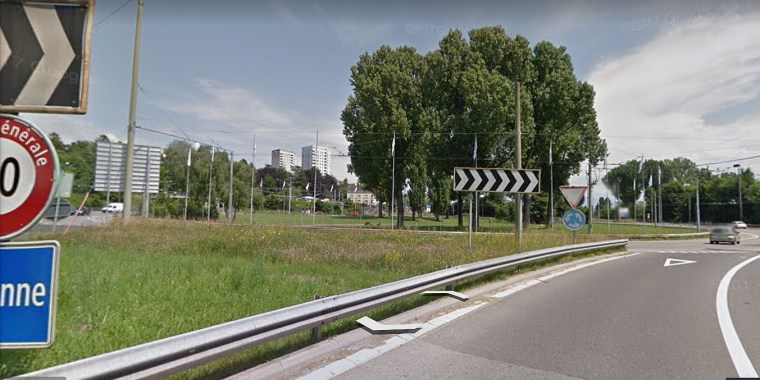
This is the Maladière roundabout in Lausanne, Switzerland. If you arrive in the city by motorway from the west, this is where you end up. I remember it clearly from my first visit over thirty years ago. Lausanne is, of course, global home of the International Olympic Committee, and so proud is the city of this fact, that it has adorned the roundabout with over thirty-five flagpoles, from each of which flutter white Olympic flags. On most days, this presents a joyous and animated gateway to the city: it is quite a sight. Unfortunately, I have no photos of the roundabout, for all that I have passed it many times – and on the day Google Earth was there, there was clearly no wind. But you get the idea.

The U.K. doesn’t really have a tradition of mass flag flying, which is a pity as it is one of the windiest countries in Europe. And while we do have a fondness for our rather garish flag itself, we perhaps underestimate the importance of such things in the symbolism of nation-building. In fact, that activity is something else that has never really been felt necessary in a democratic way either. Most of the ‘wind’ hitherto generated in this country was dedicated to bigging-up the Empire (and post-Empire), and the upper classes whom it most benefitted. It was rarely inclusive. And now that flag has been significantly misappropriated by the far Right anyway.

The Europhile introspection in Britain, about where it all went wrong, shows little sign of abating. It seems increasingly accepted that the case for Britain in Europe was not lost in spring 2016 – but over the forty preceding years in which absolutely no convincing case whatsoever was made to the British people at large, as to why they should begin to see themselves as part of a European whole. The cynic in me suspects that this was entirely deliberate on the part of the political classes – as one article I read recently suggested, the U.K. saw its relationship with the continent as solely mercantile. It still does.

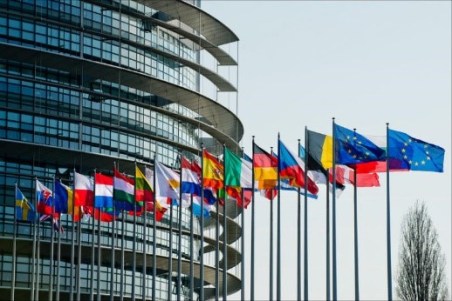
The next photo perhaps underlines the importance of flags: those of all the nations flying outside the European Parliament in Strasbourg.

EU-Flags

As well as animating an otherwise rather dull open space, this sends a powerful message, one seen frequently all over the continent, where the EU flag routinely flies alongside national and regional ones on city halls and other public buildings.

It’s not that we don’t understand this significance in Britain: we are more than happy for the flags of Australia and New Zealand, for example, to incorporate the Union Jack. I wonder how we would feel, though, if it became a requirement to incorporate the gold stars into national flags in the same way. I suspect that might be a step too far for even the most communitaire of European Commissions. In the U.K., it was controversial enough to put the stars on car registration plates, prompting a backlash from the nationalists that one still doesn’t see anywhere else.

flags

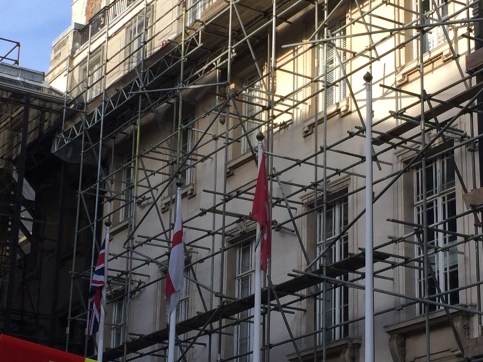
My last photo shows the exterior of Essex County Hall in Chelmsford taken a couple of weeks ago. There are four flag poles by the main entrance – quite excessive by British standards. The Essex, England and UK flags are all present – and one empty pole. I don’t ever recall seeing this occupied by the logical next step in the sequence, in thirty years of living in the area, though I may have missed it…

It has always been unusual to see the EU flag flying in Britain – so much so that I normally stopped and double-took in pride when did I see it. I can’t remember the last time that happened.

In amongst all the media campaigns being organised to promote Remain, it might not have been a bad thing if, at some point in the past, there had been a concerted campaign to fly the EU flag across the country. I think the effect over those forty years would have been far more powerful.

Opinion & Thought

Peter Pan

bdcard

Another year recently added to the personal clock. A relative sent me the birthday card shown above.

It prompted a train of thought about how people behave in contemporary society – and what, if anything, constitutes the way they ‘should’ behave.  I feel I increasingly rejoice in what I suspect is the (sole?) benefit of ageing – greater experience and better judgment – but I suspect others just think I’m old before my time….

Etiquette maybe an old-fashioned word – but in many ways it is still relevant. There are just as many expectations around how people ‘should’ conduct themselves in society as ever there were – it is just that they are different ones. It is now expected that people will be ‘studiedly’ casual in everything they do. If you are not, you are at best un-cool, and at worst, out-cast. But this is just as much a ‘social pose’ as any other approach – one that involves playing the child.

At the risk of taking the birthday card too seriously, the caption claims that we are forever children inside. When I was a child, my mother taught me, “If in trouble, go to an adult for help”. Having now been an adult for far longer than I was a child, I can appreciate both the sense and the naivety in that comment: one might expect adults to have more control and a clearer perspective on the world, and to know how to sort out its difficulties. In truth, it is often not so.

There is no point at which we suddenly start feeling ‘grown up’. In fact, that sensation is probably more often experienced by those who aren’t. If there is a definable watershed, it perhaps comes in one’s mid-twenties, at which point one’s brain is finally biologically mature – but even then, there is no sensation of crossing a Rubicon, more of a gradual consolidation of one’s sense of self. And all too often, biological maturity seems to precipitate an urge to act the child once again, even before second childhood arrives…

We are confronted by a society that widely seems to want us to deny our adulthood. Everything from the way the media communicates to the way retailers promote their products now aims at our ‘inner child’. Much advertising targets an immature inability to resist gratification, to spoil ourselves, to give in to temptation in a way that one might have hoped a fully-formed adult would be able to override. Real adults exercise discrimination and restraint – don’t they?

The media too, seems to treat people as though they are inexpert, narcissistic children, endlessly seeking the next infotainment buzz. It tends to assume powers of understanding, analysis and attention that are more childlike than adult. Hence the term ‘kidult’ has become an important moniker of our time.

Some years ago, I took a party of colleagues to meet their counterparts in our partner-school in Switzerland. The Swiss head teacher treated us to lunch at a rather chic riverside restaurant in Basel. The Swiss turned up in their habitual understated, smart-casual wear for what was a partly-professional occasion, and some of the British managed to look not totally dishevelled too. But one character from our party appeared wearing open sandals, shabby cargo shorts, and an un-tucked, un-ironed lightweight check shirt that barely concealed his more-than-ample midriff.

He and I both chose a first-course that looked appealing: scallops. But when they arrived, they proved unexpectedly challenging, as they were raw. In order to maintain ‘form’, I struggled through a dish that was undoubtedly fashionable, but not actually to my liking – but my colleague turned his nose up, pushed the plate aside in the way a child might do – and ordered yet another beer. In the following days, the same individual also proved inept at engaging with the other social aspects of the visit in the grown-up way that is still the norm in Switzerland. The impression that this individual created, I later learned, was somewhat incredulous. It might not have been a big deal – except he was our headmaster.

You might be wondering what on earth this has with a blog called Sprezzatura about living well.

When it comes to good living, beauty can only be in the eye of the beholder – and yet a degree of wider social consensus still forms around what is desirable and what is not. Living well is, to some extent, about ‘form’.

This goes for personal behaviour as much as anything else. Some of this is social pressure, some of it genuine aesthetics at work. It is also true, I believe, that maturity brings with it the ability to appreciate things that one found inaccessible as a child; wine and classical music are examples that come to mind. Many of the ‘good things in life’ demand a degree of experience that allows one to refine one’s taste, a maturity of judgement that children simply don’t have. The ability to scrutinise and assess requires both a perspective born of experience and a level of objectivity that also hopefully comes with maturity. That consensus around the ‘good things’ might be deemed to be an unwanted social imposition – but I believe the things that comprise it are there for a reason: they are indeed widely found to be good.

It is no doubt true, however, that expectations are not the same everywhere: my boss’ error was in part his misjudgement of the differences between Swiss and British norms – though why he failed to get this right when others had done so might be more complex. Likewise, dressing the ‘full Italian’ in Britain is likely to attract unhelpful attention simply because the norms are different, and peer-pressure still counts.

Where the ‘truth’ might lie on this is even more difficult. On the one hand, I think that claiming that modern British society is a free-for-all for self-expression is disingenuous. It is just that the conventions are now those of kidults who have never in their heads actually got beyond twelve years of age. Expertise has been rejected in favour of ignorance in everything from dining to national politics; childishness has trumped mature judgment.

On the other hand, I think that birthday card is correct: inside, we are still the same people we have always been, it’s just that we adapt to society’s rules. In that sense, one could argue that allowing our inner child to escape is actually social progress: it frees people from the straight-jacket of needless, imposed social convention. But the pressures to conform are still there, only the criteria are now turned on their heads: anyone who chooses to behave differently risks being seen, however harmlessly, as stodgy, old-fashioned, eccentric, or ‘taking themselves too seriously’. The effort required to learn to speak and write well, think well, eat well, dress well – and generally live well – is something to mock, rather than admire.

What has actually happened is that one social convention has been replaced by another. Moreover, those influencing this have good reasons for doing so: by definition, kidults lack the developed critical faculties of fully-formed adults. They are more egocentric, less able to defer gratification, more prone to emotional outbursts – and less likely to have fully-formed views of their own. They are also more easily manipulated by others.

All of which suits those in society who have most to gain from keeping the bulk of the population in the state of uncritical self-indulgence in which they will spend the most and vote for who and what they are told.

Michael Bywater once wrote that caring for one’s outward presentation (and inner substance) is not vain; it is a form of respect for the others whom one encounters – to which I might add also for oneself – and the diverse situations and roles that we assume as adults. It acknowledges that this world is capable of delivering sublime experiences that require effort to appreciate – but it also presents us with difficulties and challenges, the best response to which is not a childish hissy-fit. What may seem to be fundamentally a trivial matter does have more serious implications – as my boss showed when he blew his credibility at that Swiss restaurant.

More worryingly, hissy-fits seem increasingly to be the way in which our serious matters are conducted too. I experienced this myself in the workplace, in the juvenile way those who discredited me resorted to dirty, childish tricks to get their way. A relative of mine is currently experiencing the same spiteful, childish treatment – because she had the professional maturity report some blatant malpractice. The same has infected our politics – from the inability of those in Parliament to make adult decisions (they seem to think that running the nation is just some sort of game for the uber-privileged) to the sheer spite in the behaviour of some throwing their toys out of the pram – and never was an analogy more apt – on both sides of the Brexit debate.

Whatever happened to the ability to run our affairs in a measured, mature way?

I doubt there is a simple answer to this; it is surely true that people should be able to live (within reason) as they choose. If that involves kidding themselves that they are Peter Pan, then so be it. When it comes to dealing with the life in the round, the ability to connect with one’s inner child may not be a problem – but an inability to connect with one’s inner adult most definitely is.

Opinion & Thought, Politics and current affairs

“Why would I need to?”

Donald Rumsfeld probably deserved flak for a lot of things. But not the one that he took most for. His 2002 speech about Unknown Unknowns was entirely logical, if a little hard on the ear. In it, he identified a critical issue in human understanding – the problem that we don’t know what we don’t know. It is an issue that is repeatedly underplayed, because it seems like too much of an admission of the limits of human capabilities.

I don’t want to revisit the political aspects of Brexit again here – because I think that, if anything, the cultural aspects of the matter are more interesting, if more intractable. Even if the U.K. manages to find a political resolution to its current difficulties, the other aspects of our relationship with the continent will endure. Brexit has sparked a massive bout of introspection on the part of this nation, but for all of it, I can’t help thinking that we are still a long way from getting to the root of the problem: that requires a depth of insight that is simply not within the experience of most Britons. For the vast majority, the rest of Europe remains either the source of original evil, or a kind of cultural theme park where we take our holidays. Most of the resolution to this lies within the realm of what we don’t know we don’t know, within layers of cultural conditioning so deep that we don’t even know they’re there.

I remember the first time I met a French person who had never been to the U.K. I asked why. “Why would I need to?” was the answer. And in that single reply lies the whole problem for British understanding. It prompted in me a moment of introspection that I doubt many Britons have had. For the simple fact is, for the majority of Europeans, Britain is not the exceptional place that those who live here still believe it is. It is certainly not central to the functioning of their lives.

And yet many in Britain even today still struggle with the idea that their island is not ‘normal’ – nor the centre of the world as they have always believed.

Arrive in Dublin from Holyhead, and you will encounter a very functional working port, and it is immediately obvious that the whole of Ireland is, by virtue of its geography, heavily dependent on imports. Arrival in Dover from Calais doesn’t have quite the same impact, because private vehicles appear to make up the dominant flow – but one only needs to consider the fact that some 10,000 lorries pass through it each day to remember that Britain’s island nature makes us equally dependent on the outside world: in purely physical terms, we live in a place relatively apart from the bulk of human activity. And yet this is so ‘normal’ to Britons that the perceptual distortions that it causes remain for many, unknown unknowns. One might ponder the real reasons why many Britons say they prefer it this way.

One of main consequences of island-living is a very real inability to see what happens elsewhere – and this has the effect of making island cultures habitually inward-looking and self-referential. It is not only the British: the Japanese are in some ways our best comparator here, and they exhibit a rather similar bi-polar attitude to the wider world. What’s more, that very inward-lookingness means we often fail to notice potentially useful parallels even on our doorstep: the British have historically considered the Irish to be provincial and inward-looking, without seeing that the same could be said about them, when seen from the continent. “Why would I need to?” could just as easily be an English response to the prospect of visiting Ireland.

History shows us a thing or two about how the British treat other places: as Nesrine Malik pointed out in The Guardian recently, the British state has been a “machine for running and exploring the world” – but that obsession has left it not much good at modern state-building on the home front. Most of the effort went into building belief in a national brand whose main focus was external – except to the extent that it benefitted the ruling classes. It was largely blind to the need to build an efficient and equitable society at home, which is why even today much of the country suffers from poor infrastructure compared to our neighbours. Britain’s historic treatment of Ireland is also informative here: under British rule, Ireland was impoverished and neglected (unless you were part of the imported aristocracy); under the auspices of the EU, it has received investment and infrastructure, and has thrived – at least in relative terms. No wonder the Irish are Remainers.

The problem boils down to one of pluralism: an island state like Britain has a very different conception of itself from a continental one. When your national frontiers largely correspond with the limits of your land mass, the nation-state assumes a significance that it can never quite achieve on a continent, where one is ever-mindful that one’s nation is indisputably but one part of a larger whole. In Britain, one is rarely forced to accept such pluralities – and where we have to, in Ireland – we have not dealt with them well, even as recently as 2016, where it scarcely featured in the Brexit debate.

It is simply impossible in Britain to do the equivalent of what I have done many times in Switzerland: to sit in a tower-block in the Novartis Campus in Basel and look down on everyday life continuing quite normally in three countries, complete with language and cultural differences – all within a radius of a few tens of metres. It’s not true that everything is sweetness and light: the Swiss-German border seems more porous than the Swiss-French one, not least because of cultural affinities, but it is also possible to detect more antipathy towards the French than the Germans in that part of Switzerland. But above and beyond such sentiments – or perhaps because of them – one is daily reminded that one’s nation-state is not all there is to it. History only serves to reinforce that fact.

It takes a long time to appreciate the perceptual differences that this can foster. I have visited Switzerland perhaps thirty times in as many years, and have got to know local people well. I have had similar, if less protracted contact with others in several other countries. You need to spend serious time, and get to know them as individuals (as you would at home) before these things become visible. You need to reach the point where nationality as an issue becomes almost invisible.

The most obvious is the fact that continentals’ mindset operates at a supra-national scale: going to another country is ‘normal’, not novel. For quite a few, it is just a short drive away. They think little more of it than a Briton does when moving between Scotland, Wales and England. It means that co-operation across those borders is natural to the point of itself being an ‘unknown unknown’ issue – it is just taken for granted that that is the way the world is. Understanding this also rams home just what a tragedy Twentieth Century history was for those nations, in a way that, yet again, Britain could only observe from a semi-detached position.

Yet the basic facts of Geography mean that such interaction does not happen so naturally with respect to the British Isles. I suspect that the vast majority of British people even today have no regular contact with people on the continent – and probably vice versa. Where it does happen, it is most likely to be with ex-pats, who are by definition not locals. Going on holiday for a week or two simply will not do it: you need to sit in locals’ homes, socialise with them, visit their work places, live their daily lives with them before it even starts to soak in. You need to see them no differently from how you would see people who live in a different county.

And then you start to realise that they are indeed operating rather different software. They do not have the same deference to hierarchy; wealth is less directly linked to social status and particularly in republics, the sense that the People (rather than the monarchy) are the State, I believe makes a tangible difference to how they live their lives, the sense of ownership they exhibit towards their countries, the sense that their nations are collective, joint endeavours, rather than being run largely for the benefit of a small elite as is still the case in Britain.

It works the other way too, of course. Britain is just as remote to continentals, indeed more so, because if you have no business there, “why would you need” to visit? It is the same attitude that many British manifest towards Ireland – a remote, offshore place whose habits we don’t quite understand.

But the continentals, too, made one fundamental mistake in their relationship with Britain which they are only now discovering: they assumed that Britain was just another European nation, just like their own. They failed to comprehend the issues of island-hood just as we fail to comprehend their continental-ness. Our inability to explain them ourselves, did not help.

Their inability to see daily life here led them to conclude that the British Establishment’s projections of life in the higher echelons (as encountered through, for example, the diplomatic service) were an accurate representation of the true nature and mentality of the nation – which of course, they are not. To this day, I am often surprised by the strength of the upper-class stereotypes some continentals hold about the British.

They failed to appreciate the complexity of these islands – as some of their politicians admitted when they belatedly took a visit to the border lands of Ireland. The easy assumption that “we are all Europeans now” failed to allow for the superstitions of those who geographically can never be fully part of the continental project – but whose more significant frontiers are in the mind. They don’t understand the exceptionalism that insular geography creates – and they don’t know how to interact with it, because all their normal continental assumptions about the need for international co-operation, co-habitation and the Greater Good simply don’t work with a self-contained island race.

It has always been thus, even to the highest levels: British policy documents over the decades reveal repeated references to Britain’s ‘national interest’ in its European dealings. Well, all countries have national interests, of course – but in Britain’s case, the tone clearly presupposes a conflict between national and international interests; it is one of aggressive competitiveness, very rarely of the General European Good. One is left with the sense that such notions are unknown unknowns.

My repeated visits to the continent gradually shifted my perception; my default mental map is now that of Europe – with Britain stuck in its marginal position in the top left-hand corner. But in reaching this position, I also started to glimpse the different assumptions that operate on the continent as a result: the emphasis of nations there on the common societal good – a term one rarely hears convincingly expressed in Britain, where ‘Society’ is either insignificant – or a never-ending class struggle. It is shown in the way many continental countries are innovating in everything from social rights to environmental good practice – while at the same moment in time, Britain is discussing rolling back Human Rights post Brexit. What greater contrast does one need?

My experiences of the continent repeatedly suggest that those countries – under the umbrella of the EU – are making far more progress in terms of building good societies than is Britain. While there are always exceptions, people there generally live in better homes, more pleasant towns, they drive on better roads, travel in better trains, have more workplace and democratic rights, have less atomised communities, take their environmental responsibilities more seriously, they have less corrupted legislatures, and they generally have a more optimistic, positive view of life, than is common in this country. What’s more, fewer of them seem obsessed with wealth and celebrity and overt competitiveness – simply because getting on with normal life is not the trial for most, which it has increasingly become in Britain as the elite has sucked in more and more of our nation’s resources for itself.

And yet, the conversation in Britain, for all the soul-searching, betrays little evidence that these things are really known. Until we start to tackle these things, our chances of really addressing those highly significant differences in world-view between us and our neighbours will remain – Unknown.

I explored the issues discussed here in more detail in my book ‘It’s a Bit Late for that Now!’  available in paperback and e-book on Amazon.

Food, Opinion & Thought, Politics and current affairs

pv

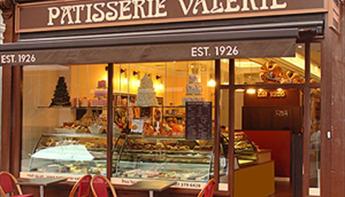
One perhaps might have expected Sprezzatura to be mourning the loss of Patisserie Valerie – but I can’t. It occurred to me that the company’s recent difficulties are symptomatic of the bigger issues swilling around in British civil life at present.

What started out in 1926 as a single, much-loved cafe founded by the eponymous Belgian émigrée spawned several other branches in London without losing too much of its historic character. I only visited once, but it was like walking off a London street straight into a small corner of northern France. But then it was taken over by an ‘entrepreneur’. Eventually a large share was sold to venture capitalists, and it was rolled out as a chain of some 200 outlets. It became a shadow of what it had been, little more than a themed pastiche of the original. As David Mitchell wrote in The Observer, like all chains, the original cafe’s identity became little more than a watered-down ‘front’ for yet another cash-conveyer for big business.

As I have bemoaned before, the same fate befell Costa Coffee a couple of decades ago. What had been characterful, family-run Italian coffee bars beamed down in London was acquired by Whitbread, and turned into the clone empire that we see today. To be fair, in both cases the quality of the product has not suffered too much, though I have always bemoaned the lack of alcohol in some of Valerie’s offerings: Black Forest gateau is just not the same without (expensive) kirsch. Costa’s coffee remains markedly better than its competitors, despite its susceptibility for the usual marketing-led seasonal gimmicks. (Drive-through Costa, on the other hand, is just too far removed from the real culture of coffee not to be an abomination).

The intangible character of both institutions, which played an essential if indefinable part in making them what they were, has been utterly obliterated beneath the disposable stage-dressing of the corporate shop-fit. As Mitchell says, the identity of chain outlets is essentially interchangeable; in aesthetic terms, there is nothing to stop a Valerie becoming a Pizza Hut next week and a McDonald’s the week after. It is all just window-dressing; the honest, unique character has gone forever, as have the eccentricities that corporate-land just doesn’t understand and can’t tolerate. With what’s left, Established 1926 is now close to being just another corporate lie.

It is perhaps no surprise, too, that with the growth of the organisation far beyond the original family business, it took on corporate individuals who turned out to be fully prepared to bankrupt it in pursuit of their own wealth. Large conglomerates rarely command the loyalty that begets the integrity needed to cultivate such business in the long term.

But how is this representative of the nation’s wider woes? It seems pretty generally accepted that Brexit was motivated by the disaffection of the ‘left-behind’ classes in their hollowed-out out provincial towns. The spread of Patisserie Valerie may have brought a little panache to such places, a shallow semblance of national cohesion and democratisation – but its likely and equally summary departure will leave behind yet more empty premises.

The real problem runs deeper than that, though: by their presence in such places, chains contributed to the siphoning-off of local wealth and its transfer to large corporations. And as with Starbucks before them, they may well have killed off local businesses which, while possibly not as glossy, at least had local roots, and ploughed their income back into their communities. Being small, they also often had the character and quirkiness that no mass-produced chain can ever replicate. And by being so, they also contributed to a local sense of place. In their stead, one senses lost local autonomy – these ‘outlets’ are run by and for people a long way away, with no local knowledge or concern, each place they land on just another ‘retail opportunity’ to add to the corporate bottom line.

It has to be admitted that small businesses in France are also retreating – but the Italians seem largely to be holding out. One might also ponder the amount of employment that hundreds of small, local cafes and restaurants create – I suspect rather more, and for different people, than the chains that ousted them.

One might have welcomed the arrival of cafe culture in this country – and with it the glories of the traditional French patisserie. But in typical British style, what we actually got was large conglomerates selling watered-down facsimiles of the real thing on an industrial scale. Not at all the same thing as the multitude of such places that still give towns in France and Italy their appeal. How do they get away with it? Why will the British populace accept this, in a way which their peers in France or Italy just would not? (And come to think of it why, as Mitchell also observes, is the British mainstay not the millefeuille but the iced bun? Maybe that explains a lot…)

The emergence of these chains is explained solely by a political culture in this country that embraces big corporations with little thought for their impact on communities or local economies. That they suck wealth out of provincial centres and into metropolitan corporations is no problem for governments in thrall to The City. But it feels very different from the other end of the line: the turning of our regional centres into clone towns, dominated by large extractive businesses, feels wrong. And while even a Starbucks may be preferable to an empty building, the blighting effect of large chains on local businesses is not imaginary.

It has contributed to a very immediate, local sense that the whole country is being run by, and for the exclusive benefit of, big business – absorbing and bastardising any good concept from which it can make a buck, sweeping all before its own selfish interests, be that the quality of the Black Forest gateau or the proper employment and training of local staff. One only has to enter an independent cafe or restaurant to notice that the whole character and ethos of such places is different: somehow more authentic, more distinctive, closer to those on the continent.

To be fair, Luke Johnson (still the majority owner of Valerie) has tried to do the honourable thing, ploughing in his own wealth to save the company and its employees. But big business simply does not work in the same way as small – investors are anonymous and impersonal, and care about little other than their dividends. And with a staff of thousands, there is simply no way one can retain the personal touch.

I can’t help but feel that this corporatisation of Britain and the sterilisation of the social function of places like cafes, bars and restaurants, have contributed to the wider disaffection. Unlike the pride that a good, proprietor-owned cafe often takes in its products and its relationship with customers, chains are impersonal, transient and lacking in any real character. They could, by definition, be anywhere. People are served mass-produced, dumbed-down ‘product’ whose main purpose is to minimise corporate overheads, in bland surroundings whose main purpose is to be cheaply replicable anywhere – and easily disposable when the time comes for a corporate re-brand.

People have been given the choice between no services and corporate giants, and to anyone concerned about local distinctiveness – let alone the quality of the cake – it does all feel very wrong. It’s not surprising that people feel alienated. But we can’t absolve the wider population either: for all that the choices may have been limited, these chains have only flourished because of the indiscriminate willingness of the population to be served cheap, conveyor-belt food and drink in cardboard cut-out surroundings, when they could have been supporting authentic local alternatives.

To that extent, the nation has once again got what it deserves: a whole country that is little more than a dumbed-down clone of itself, largely run for the benefit of a few shareholders.  A rootless Anywheresville of non-communities which makes life itself feel fake – and only now, when it may be too late, is it realising the cost of its obsession with cheapness, gimmickry and its acceptance of bland uniformity.

Like the Brexit decision which resulted, it could all have been so different.

Opinion & Thought

Some people…

Last Saturday saw the death of my aunt. It was not unexpected, as she was unwell and 92 years old. This post is not a eulogy to her, for which family matter I feel such a public place is not appropriate.

But she was one of several people who have figured in my life, some for longer than others, who in their own way epitomised sprezzatura.

I am thinking about that very indefinable ‘something’ that some people just seem to have, which makes it good to be in their company. The only catch-all word that I can arrive at that sums it up is ‘charisma’. I think that the notion of sprezzatura must also somehow be about living a charismatic life.

It needs to be said at the start that I doubt very much that this is something that can be consciously acquired. While attention can be drawn to things that I think are charismatic through the medium of a blog like this, I rather suspect that those people who have charisma actually don’t realise it – at least not in any focussed, intentional way. They won’t particularly know what it is that they do that gives them charisma, and I suspect that if they did, they would be well on the way to losing it. Anything as calculated as self-conscious charisma is by definition not what it sets out to be.

As Douglas Adams might have said, like flying (best done by knowing how to throw yourself at the ground and miss), charisma has to ‘just happen’.

What’s more infuriating, there doesn’t seem to be any recipe for it: those charismatic people whom I have known or met appeared to have little in common. They certainly gave no outward appearance of doing anything that the rest of us don’t – just being who we are. And yet there are some people whom it is somehow very affirmative – exciting even – to be around.

It is not as though they are even all outstandingly nice people. They have the same imperfections as everyone else, but somehow they seem to wear them differently. Some of those people behaved in not especially good ways at times, and they certainly have had their share of life’s set-backs – just like anyone else. Neither was it just the allure of privilege: some of the people I’m thinking of were neither wealthy nor especially educated. So it’s not a matter of living a charmed life. Yet, a bit like the way in which an item of clothing can somehow look better on one person than another even when the fit is equally good for both, some people somehow manage to ‘carry’ their lives more appealingly than others.

Perhaps a degree of self-belief comes into it – and yet I know that some of those people were privately quite insecure and uncertain of themselves; I suspect one or two would have been embarrassed if someone had told them they were charismatic. Yet that is not to suggest that they were putting on a charade. Personal manner might come into it too – and yet there is little in common between the people I am thinking of either: they ranged from the quite arrogant to the almost naively ‘nice’. It even seems possible to ‘grade’ people by degrees of this – and yet it is still not clear what the criteria are.

I met a few well-known people who even from a distance exuded something simply from their manner; in their cases they had become famous, and I guess their charisma had helped. Griff Rhys Jones has an entirely natural wicked laugh that just makes people crack up. Nelson Mandela instantly (if briefly) came across as a very charming man. Another who comes to mind (whom I never met) was Audrey Hepburn. Some people suggest Stephen Fry too. All very different people – and yet all possessed of something.

From time to time, one encounters people who are clearly highly talented in a particular field; it is not the case that charismatic people are particularly that either – nor that the highly talented are necessarily charismatic. And yet some people are somehow just good to be around.

The more obvious manifestations of this might come from a positivity of outlook and a particularly fair and optimistic temperament, and perhaps that most nebulous of things, personal style. It may somehow be to do with a sense of conviction or a determination always to do things ‘properly’:

It’s not what you do, it’s the way that you do it – could be a good maxim.

But strangely, people often seem able to reach consensus about charismatic people, so it is not simply that they appeal to your own confirmation bias.

My aunt was one such person: she seemed to have inherited a large percentage of the family’s share of sunny temperament, and the fact that she remained optimistic and positive no matter what her own difficulties may have been part. When I was young, she was always fun to be with – being a primary school teacher probably helped. Perhaps imagination is key: I know her life was heavily inspired by her visits to Italy, particularly those of her young adulthood in the 1950s. She was inspired by things that also inspire me. But even this doesn’t explain how everyday life somehow gains a sense of occasion when one is with such people.

As for the rest of us, one thing is clear: there’s no point in trying to ‘have’ charisma; that can only end in failure. We can only make best use of what we have – which in itself takes effort (perhaps too much so)  – and hope that a little sprezzatura will rub off.

Opinion & Thought, Politics and current affairs

All Britain’s problems in one afternoon

I attended an event yesterday that unintentionally illustrated a lot that is fundamentally wrong with this country. I hasten to add that that is no criticism of the organisers, who did an excellent job, and whose idea to run the event was in itself good.

My locality is facing the by far the largest expansion of housing stock in the country, double that of the next largest. Some people are claiming it is the biggest green-field development since Milton Keynes. It entails three ‘garden settlements’ in close proximity, strung along the A120 in north Essex. It will eventually total some 40,000 houses in what are now predominantly very rural areas.

The event was a conference called to created dialogue and share opinion. But…

…as I walked in, it became apparent (in the way it only really can to a native Briton) that those gathered were…err… not exactly socio-economically representative of the local population. The preponderance of country-wear, and the audibly plummy accents suggested that by far the majority of the audience of perhaps a couple of hundred were older members of the entitled tiers of society. Who else could find three hours on a regular Friday afternoon to attend such an event? Most of them seemed to know each other.

I have nothing at all against such people – except that they are, by default, representatives of that sector of society that has run this country as its own private club for at least a couple of centuries too long. They have as much right to their share of the nation and its activities as anyone else – but no more than that. And they most certainly are not representative of the nation as a whole.

They are, however, the people who have tended to do best for themselves out of this country’s extremely un-level playing field – and even by default they clearly intend to keep it that way. This does not make them nasty individuals – but they and their nnforebears are nonetheless collectively responsible for many of the gross inequalities that exist in this country. They were out in their masses primarily to defend their own, often-considerable demesnes.

It was also very noticeable that these are not the people whom one tends to encounter in the streets and shops of this area. Accent alone betrays that; I recognised very few, though I knew ‘of’ some by reputation. I suspect that they keep themselves very much to themselves in the many large rural piles that dot this area, networking amongst their kind, and they tend to go ‘up to Town’ for most of their needs. They represent the fact that this country’s privileged have never disappeared: they just went underground. Integrated into the local community they are not – but they still tend to be that portion that turns out to make its voice known at such events, and to get elected to district councils and the like, where they are well-represented.

They had certainly turned out in droves to object to the destruction of their own little patch of Arcadia.

Speaking to us were a range of planners, businessmen and politicians, including prominent Brexiter, Bernard Jenkin MP who to be fair, managed to squeeze out a relatively non-partisan introduction. The chair of a local district council made a speech. He explained rather abruptly that he has to do what the national government tells him – and that means building lots of houses. He did not explain why we need to have more than anyone else. He also seemed totally unaware that part of his function might be to listen to grass-roots views and convey them in the opposite direction. Local democracy seems not to think it needs to listen to local views, let alone defend local concerns, any more.

A number of competent planners and others spoke, who generally did a good job of explaining both the official and alternative planning policies. But most seemed to agree that the only way it is possible to extract any public benefit at all from developers is to agglomerate to a massive scale, otherwise they simply wriggle through the system’s many convenient loopholes. As much as 90% of the land value uplift from development (which might be used to fund improved amenities etc.) goes nowhere near the public domain of the areas that have such developments imposed on them.

The (new) head of the development consortium spoke authoritatively on his brief, in which he conceded that consultation has hitherto been woeful. One might wonder why. He sounded every inch the developer-magnate who has large schemes on the go all over the place. But the tenor of his speech was very much that the affair was wrapped up between central government, developers and land owners. He grudging conceded that “sometimes things do come out of consultation…” – and I wish his expression of the importance of the ‘collective interest’ had sounded more convincing…

There was absolutely no discussion of the actual nature and quality of what might eventually get built. For ‘ordinary people’ this is actually the prime concern: will the houses be affordable and make good, well-built homes? Will services and infrastructure be adequate? Will a good life be possible in those places? For them it will not be a merely technical exercise of provision. The consensus seemed to judge that there might be an outside chance of making it so, if only the developers could be reined in. Otherwise probably not.

The objection to building in this rural area is easy to understand. The past of record of this Home County sets a very poor precedent in terms of quality, location, infrastructure and architectural merit. What continues to be built on the edge of local towns is the worst kind of dislocated concrete (well, brick) jungle – the slums of the future. Developers latch onto what they believe to be attractive, saleable locations – and proceed to wreck them. Why should we believe that what what comes next will be any different?

There was a sense of futility about the proceedings – plenty of people with good ideas for improvements or alternative solutions – all of which will quite clearly be totally ignored by those who have already decided what will happen.

For me, the meeting was torpedoed at the outset by the chairman, who opined that there was no point in discussing what we could learn from good practice from other countries “since this is Britain”. It would have been much more worthwhile to spend the time dealing with that point alone.

And I came away with a saddeningly familiar sense of being a foreigner in my own country. No doubt they are all lovely people – but many were so obviously from a privileged clique, whose very enduring existence damages the wider social fabric of this nation. I could probably ‘assimilate’ if I wanted to – but I don’t. On the other hand, I feel just as disconnected from the voiceless and often coarsened ‘masses’ who were barely represented yesterday afternoon, and who would no doubt have perceived me as part of the ‘County’ clan. I will be against that wall just as quickly as the rest, should the revolution come.

I actually take my lead from the relatively classless, social-democratic societies of the near-continent – and there is no home for that, even today, in this country.

The conference was well worth attending – but I came away with the strong impression that between the entitled stake-holders (some of whom were known to be ‘interested’ land-owners), the technocracy of the professional developers – and the jungle of impenetrable procedure and legislation that they have created, the whole thing was one great stitch-up. Pretty much a good summary, when seen from a lay-person’s point of view, of the whole of this country.

Opinion & Thought, Politics and current affairs

Thinking European

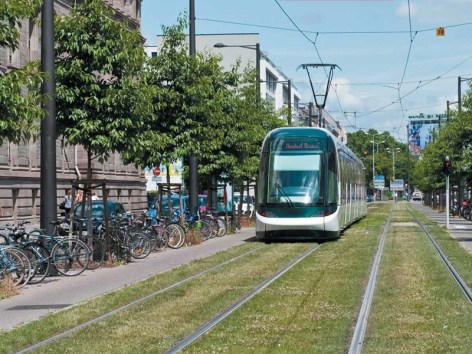
tn_fr-strasbourg_tram_extension_grass_track

How do you change a culture?

Chris Boardman, the Olympic cyclist, is charged with doing just that: reducing Manchester’s chronic traffic congestion and turning the city into Britain’s cycling capital. As he realised, the problem is only partly practical: what is really needed is a change of mindset:

“Three hundred miles from here, 50% of the kids ride to school every day, 30% of all journeys are by bike – in The Netherlands, parts of Germany, in Denmark. Take anyone from here and stand them there and they’ll say, “I prefer this”, he said. When people see, they understand.

Recent reports suggest that while the government is proposing new legislation on air pollution post-Brexit, its track record is dismal, and it was one (admittedly of several) taken to court for missing reduction targets.

Nottingham recently received a £5 million grant from the EU with which it employed a Dutch company to improve domestic insulation and cut energy bills for the recipients by 50%, much to their satisfaction. There is no equivalent national programme in the U.K., except for those in receipt of benefits. You are reading this correctly – there is absolutely no programme to improve the performance of some of the worst-insulated mass-housing stock in Europe – simply because our government has not deemed it important enough.

Such neglect is all too frequent in Britain: in too many cases, domestic provisions for even such essentials as workplace rights are half-hearted in the extreme – as are assurances for the future. This is not a nation that takes the lives of its ordinary citizens particularly seriously – and it is having seen superior approaches – and mindsets – on the continent, that persuaded me that European governance is on balance preferable to our domestic alternative. The evidence suggests that collectively, other countries are doing many of these things better.

An inability to see is, I suspect a major problem. For those struggling in difficult circumstances, horizons narrow; the cause of the problems may not be visible, and attention is focused on the pressing need to survive.

Yet as Boardman points out, when people are shown alternatives, they do not reject them. The problem in Britain is that this rarely happens. It is relatively difficult for people here to observe ‘ordinary life’ elsewhere. The cost and hassle of leaving the country mean that it only happens on special occasions – and both the nature and context of the typical holiday mean they are unlikely to provide much insight into the daily-lived reality of other places. The linguistic/cultural divide (whether perceived or real) makes it worse.

Yet my experiences suggest that Boardman is right. On several occasions I instantly destroyed my students’ prejudices against public transport simply by putting them on that symbol of European urbanism, a (Strasbourg) tram. I achieved a similar effect by ‘parking’ others in ordinary homes and school life in Switzerland for a week. And yet others came to more understanding by virtue of my taking them to the European Parliament and talking to people there. It works: there were rapid shifts of perspective.

But the real shift needed in Britain is far bigger. This nation has come to the point of Brexit because 150 years of a national mindset have ‘taught’ it that it is both superior to the rest of the world and apart from it. Reading Simon Jenkins’ A Short History of Europe recently showed how inaccurate this perception is, seen from a longer perspective – and how damaging it can be.

Continental nations’ bloody histories have given them a greater appreciation of the importance of European stability, while Britain’s apartness has given it both a failure of such understanding and a complacency that has led to the lengthy and profound neglect of its domestic affairs. Not to mention an enduring, cynical temptation to profit from continental disunity.

The venom accompanying Brexit is out of all proportion to any adverse impact that the EU has really had on many people’s lives – but not out of proportion to the genuine problems they are encountering. These problems are home-grown – and they are not simply practical: the biggest of all is the mindset that for so long said that Britain didn’t need to evolve or adapt, that it was simply entitled to the best, and that nothing really needed to change.

We only have ourselves to blame for the breakdown of the social contract in Britain. While national elites are primarily responsible for the neglect, the rest of the nation repeatedly endorsed their policies at the ballot box. We failed to maintain the national vehicle, and the British charabanc now sits smoking on the hard shoulder, from where we can watch the modern vehicles of more careful countries speeding past.

For Britain, change is a concept so difficult that it is to be resisted at all costs. Small-c conservatism is so deeply embedded in the psyche that we mostly don’t even notice it is there – at least until we are put in a context where people clearly think differently. That was my experience on the continent – and I repeatedly came back to Britain feeling I was returning to a tired, dull backwater. At the time I was criticised for my supposed lack of patriotism – but all I was doing was observing problems that the nation was choosing to ignore.

It is no surprise that those who are struggling tend to look backward rather than forward. But ironically, by voting for the status quo, they stymie the one thing that might help them: genuine, enlightened change. They are too set in their ways, believing what they have been told, that this is the natural way of things. They rarely question why it is like this, or how the system actually works, that keeps it so.

It is part of the reason why the country’s workforce failed to adapt to economic change: it was trapped in a regressive mindset which expected opportunities to be handed down from its betters as they always had been – which of course largely failed to materialise from governments that simply did not care enough to put meaningful support in place. The result has been whole communities still hollowed out of any economic purpose, three decades after that process happened.

The culture of despondency and dependence is embedded – and the only perceived antidote is exclusivity, of aspiring to buy oneself out of the masses, rather than improving mainstream life. There seems incomprehension that if so much of the nation’s wealth were not in the hands of so few, it would be very possible to improve the mean standard of living for everyone. And yet the tax rises that could address this are – we are told – political dynamite. All despite the abundant evidence from Scandinavia and elsewhere that higher general taxation results in better welfare provision and more just, contented societies.

Britain’s entire mindset is so ensnared in webs of hierarchy, elitism and privilege that it simply does not ‘get’ the notion of social democratic egalitarianism that, while far from perfect, is much more established on the near-continent. It seems congenitally unable to take meaningful steps towards enlightened empowerment such as those Chris Boardman referenced in The Netherlands.

Getting people out of traffic jams and onto functioning public transport is just one example. But it seems that this is just too demanding a position for most Britons, who continue to support domestic policies that opt for the minimum-effort approach of pandering to the vested interests that got us into this mess in the first place.

If the EU is responsible for any part of Brexit, it is a long-term failure to appreciate that Britain is less like the continent than it seemed to think. It should have made greater efforts to give people from outlying parts easy access to the rest. Subsidising Channel crossings would have helped, as would a greater programme of cultural exchange. In fairness, this would have been mediated via domestic governments – and the likely reaction of the British one to such intervention does not require much imagination. British governments have had too much vested interest in preventing British people from ‘thinking European’.

Likewise, such programmes can only work if the intended recipients are receptive in the first place – and therein lies the real problem for Britain: it is trapped in a loop of self-referential self-justification that no amount of outside influence seems able to dent – and the nation is about to dive head-first back into another cycle, rather than grasp its best opportunity ever to lay such shortcomings once and for all to rest.

Opinion & Thought, Politics and current affairs

A new solution for Brexit?

At the risk of bogging down this blog (blogging down???) – which is meant to be about the quality of life – in repeated political discussions, I want to offer one more observation about the UK’s current Brexit predicament. I am ‘justifying’ it on the grounds that the political climate is a determinant of the quality of life that its recipients enjoy.

This is to propose an alternative resolution to Brexit, which as far as I am aware has not been discussed elsewhere.

I have no doubt that it will be criticised as being biased from the start, so I had better concede that it is a Remainer’s solution – but I defy critics to come up with a more sustainable one, that does not poison the longer-term climate in this country with perhaps-dire consequences.

My starting point is that the pro/anti EU argument is not symmetrical.

The present situation is that the U.K. is a member of the EU. While sceptics might not be happy with this situation, it nonetheless means that this country can influence EU policy: that is an undeniable fact, and it is now clear that it would end with Brexit. This is why Brexiters oppose May’s settlement. Ity is also fact that EU actions will still affect Britain after Brexit, at least if we want to trade with, or travel within it. It is also worth remembering that the U.K. historically has not opposed the vast majority of EU legislation, and has initiated quite a lot.

One might ask objectors what material negative impact EU membership has on their lives. No doubt they would come up with a long list, from the imposition of ‘foreign’ laws through to the use of metric measurements – and of course immigration. While one should not dismiss such objections, it is necessary to separate those which have some traction from those which are mere myth, the genuinely practical from the ‘merely’ ideological – and attempt to address the former. One might expect (though without much hope) that in the interests of national reconciliation, Brexiters would accept this. If they don’t, they should be ignored with the same compunction that Remainers have so far been.

But what of the practical negative impact EU membership has on the daily lives of euro-sceptic Britons? Apart from minor irritations, I suspect the real answer is ‘very little’ – particularly when offset against demonstrable benefits which even many leavers accept, such as free trade, ease of travel or reduction in mobile phone roaming charges etc, which arguably benefit everyone irrespective of their political viewpoint.

This is not to deny that there are certain groups on whom specific legislation has had an impact, such as certain types of farmer or fisher. But it is necessary to balance the impact (loss of freedom for unrestrained fishing) against the long-term benefits – let alone ecological imperative – from preserving fish stocks. People do not always take a bigger view even when it comes to self-interest.

The reality is that people who do not like their European citizenship are largely free to ignore it in their daily lives – and the fact that this is so gives the lie to the claim that the EU is overbearing.

On the other hand, if the UK leaves the EU, the wishes and rights of the 48% (plus) who are pro-Europeans will be materially affected. Their daily lives will be impaired by the loss of the practical advantages mentioned above, which they choose to value using exactly the same rights as Brexiters use to ignore them – not to mention the matters of identity and citizenship which Brexiters are free to ignore, which will be forcibly removed from Remainers. This is not something that any Brexiter who truly values the integrity of their home nation can afford to dismiss. Reconciliation will not be possible unless a resolution can be found to which Remainers can also subscribe – which is why the call to “get over it” is so objectionable.

There is only one solution that can come close to keeping nearly everyone reasonably content (as most were before the accursed referendum) – and that is something close to the status quo. This might appear to be a non-solution – but remaining in the EU is the only way to provide pro-European Britons with the status they desire. However, this is not to deny that around half of the nation is unhappy with that status, even if they overstate its real impact. Therefore, within any proposal to remain need to be concrete proposals to limit the EU’s role in Britain: in effect to create formal ‘special status’ within the EU for the UK, somewhat similar to the special status that Northern Ireland has within the UK in recognition of the divided loyalties of its inhabitants.

The basis for this could of course be the existing opt-outs. But the possibility should also be explored for formalising the process by which these are preserved or even extended in future. The most obvious of these concerns freedom of movement. The U.K. already has derogation from the process of ‘ever closer union’ – and this probably needs to be beefed-up for the sake of sceptics.

This is not my personally-preferred solution: I have never seen why the U.K. should expect to belong to the club on terms any different from the others, and I tend to believe that had it signed up properly at the start, more of the full benefits of membership would have been apparent in this country. But I have to recognise that many would see mine as an extreme position; it is necessary to compromise. The foregoing is a position which even I as a strong pro-European could live with for the sake of the key elements which I hold especially dear: retention of European citizenship, freedom to travel, the single market, perpetuation of peace in Ireland and the ability to be involved and represented at European level.

As before, sceptics would remain free to ignore the existence of much or all of this at anything other than an ideological level. Indeed such freedom might be bulwarked by the guarantees of special status.

While the EU might also be unhappy at the prospects of special status for the UK, it too needs to accept the reality of British public opinion, and concede that its best hope for longer-term reconciliation is to accommodate the present crisis, while stopping the UK from drifting off into isolationism. Brexit has indeed made a special case of this country.

Whether this is a compromise that Brexiters would accept remains to be seen. But if they won’t, it would blow a further hole in their claims to be defending democracy, let alone the preservation of their beloved nation.