Food, Opinion & Thought

It’s a scoop!

“I thought you were a kept man!” my musical friend teased, at the news of my end-of-year workload. Well, I suppose in some ways I am, given that it is my wife who has the more successful career and who still works full time, albeit now remotely from home.

After a full-on career of my own, over more than three decades, it is a frustrating fact that the experiences of the past five years seem to have left me with limits to amount I can take on – not that I don’t keep trying…

But I have inadvertently had the opportunity to learn an important lesson, as discussed in a previous post: the capacity of work to rob you of many of life’s other experiences. Working only part-time, I have discovered what happens when you simply have sufficient time to live appreciatively: when one is no longer forced to rush from one end of the day to the other, one can savour each experience more fully. Were it not for the periods when the dark clouds still descend, it is a big improvement.

This, I think, is what the much-discussed Mindfulness is really about – the ability to appreciate time as it unfolds, rather than being constantly engaged in the fuzzy anticipation of what will happen next, which has the propensity to make you less aware of what is actually happening now. It is certainly easier done when you are not constantly rushing from pillar to post.

Time can be a luxury in itself, and one that I have come to appreciate greatly. I’m well aware that this could easily slip over into mere self-indulgence, hence work and other commitments definitely have their place in order to keep the general perspective outward-looking – but as for the balance, then maybe there is still something to be learned more generally.

It may seem a large leap from such thoughts to the simple matter of serving coffee – but it is precisely in such details that the benefits can be found. We are now in the fortunate position of being able to have our mid-morning break together – and this has come to mean a cappuccino made on our trusty old Gaggia and drunk from proper china cups rather than a chipped mug or disposable paper carton. It is possible to source decent coffee easily in the UK now – we tend to rely on Illy.

I think ritual is an important part of marking life’s rhythm, and our morning cappuccino, taken whenever possible outside, is a valuable moment in the day. I’ve had time to work on my barista technique – a minor art in its own right – and most days a decent frothy coffee results, no chocolate powder or other pollutants allowed. Just a lovely, aromatic crema, followed by that big swoosh of frothed milk that leaves a beautiful tan-coloured swirl on the top. Not bad, given that it isn’t possible to be sitting at a café in Rome right now…

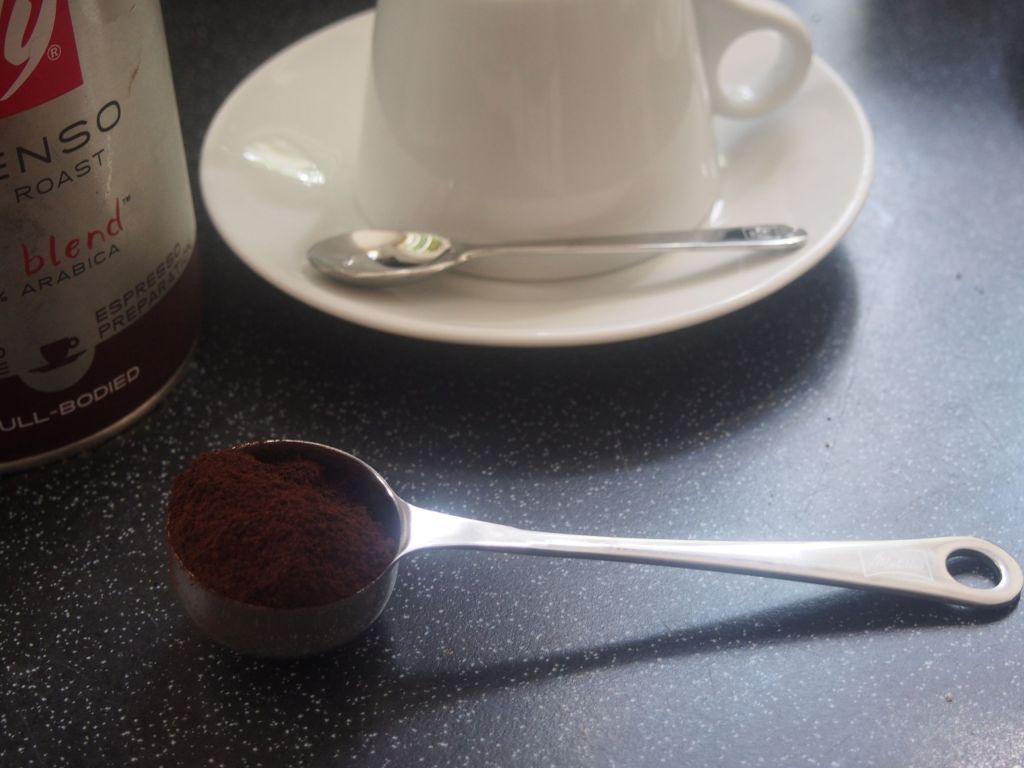
There was one thing that needed improvement. I used to rely on a cheap plastic scoop for moving the ground coffee around – but this split and snapped ages ago. I then fell back on a general kitchen measure, which just about did the job – at the cost of being too shallow and too wide for the coffee machine head. As a result, it often left a liberal heap of coffee on the worktop.

I have finally got round to addressing this matter of global significance. A brief online search turned up a decent stainless-steel scoop from Melitta, the German coffee brand. It only cost a few quid, turned up in a couple of days – and has made a pleasing difference. Not only does the coffee go where it is meant to, but the item is reasonably aesthetic, has a pleasing weight and does its job much more precisely than the old one.

This is hardly going to solve the major problems of the world, but in a small way, it has made a significant improvement to our daily ritual. As any craftsman knows, tools are important; not only for the job they do, but as items of sensory satisfaction, even beauty, in their own right. There is much gentle, mindful pleasure to be had from using good ones, that poorly designed ones rarely match. It was not a matter of anything other than a minor effort, minimal expense and just a little time. I wonder how many other daily irritations we tend to put up with, particularly when time-pressured, where just a little more ‘room’ to tackle them could make a useful difference. It’s not only the big things in life that matter…

Food, Travel

Baby Biarritz?

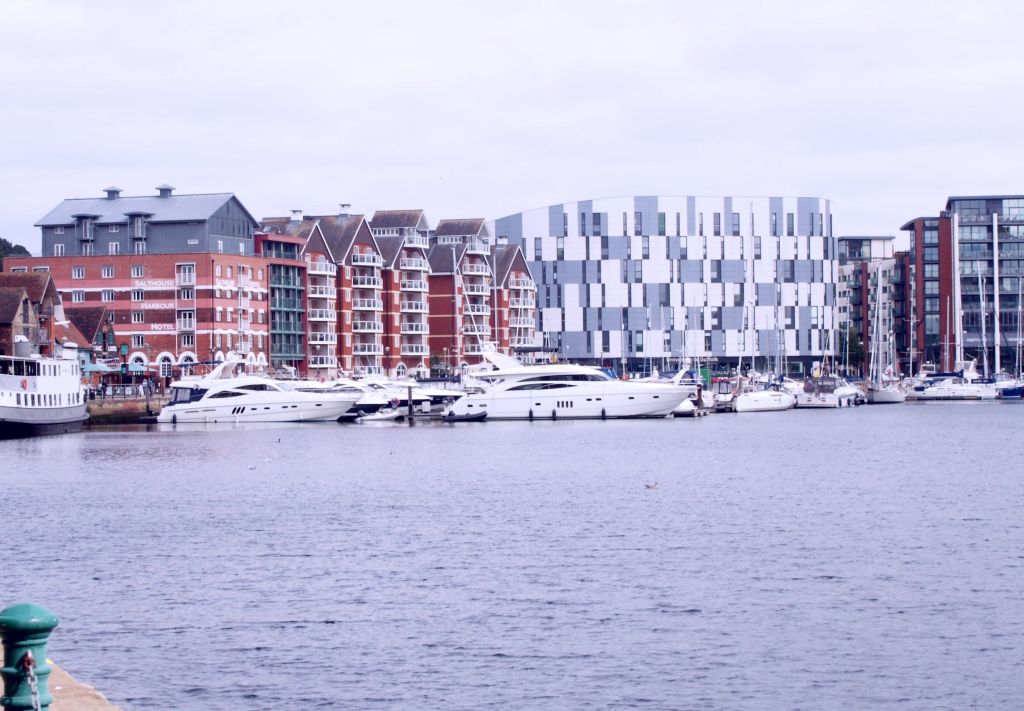
After the somewhat underwhelming experience of Nottingham, we were still feeling the urge to be out and about and indulging in a little café life. So, on the spur of the moment, we hit the road last weekend and found it in…. Felixstowe.

Felixstowe is not a place you go to by accident; what’s more, its main reputation as the U.K.’s principal deep-sea container port quite possibly makes it not the kind of place you would expect to go to on purpose either. I had passed quickly through once a number of years ago – but more recently, my hairdresser, who is one of the cooler men I know, had commended it. Coming from a natty dresser who likes a glass of something chilled with his jazz, there had to be a reason why…

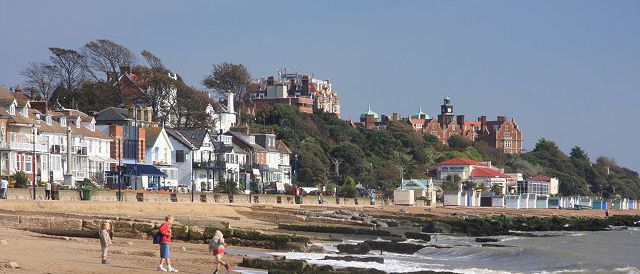
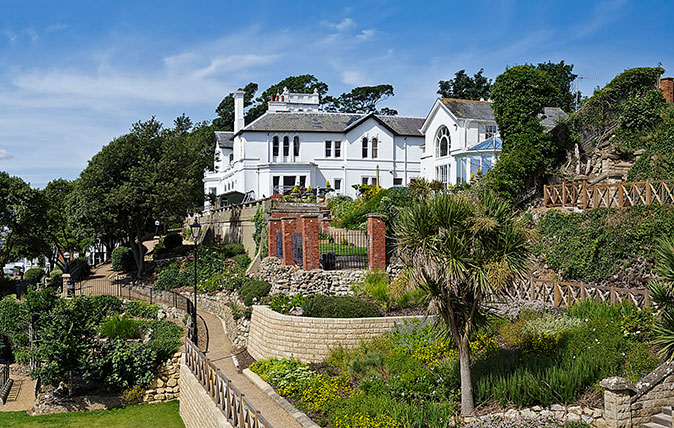
And so we discovered Baby Biarritz. Well, perhaps that’s a bit optimistic; Baby Bournemouth more like. I think it was the large villas on the clifftop that put both resorts in mind. It has the same restrained, slightly faded charm of the more tasteful better-known seaside resorts, today infused with a gentle hint of continent.

A little research revealed that Felixstowe indeed had form; it developed as an upmarket Edwardian coastal spa town complete with a steamer service from London – and thus it retains a legacy of rather grand old villas that have mostly withstood the redevelopment pressures of the larger resorts. Biarritz is known as the also-slightly-faded seaside hang-out of deposed European aristocracy: so much more discrete than Saint Tropez… Felixstowe had Wallis Simpson, who lay low here for some months in 1936 in a mansion she considered far too small, awaiting the divorce that would allow her to marry the abdicating Edward VIII. And in 1891, Empress Augusta Viktoria of Germany spent most of the summer here, in between visiting her mother-in-law the Queen in London. I said it had form…

Based on my first visit’s impressions, we had not expected to do more than cruise through on the way somewhere more interesting. But in the event, we felt the urge to park up and look closer. I find myself increasingly attracted to the laid-back atmosphere of the coast; someone once said that it is the only place where the British ever even marginally relax their buttoned-upness. You find slightly less prim, more exotic planting, a greater prevalence of picture windows and balconies than elsewhere – and despite the general coolness of the climate, the coastal light and vistas do lend something to this most understated of countries… But I am still repelled by typical kiss-me-quick bucket-and-spadeness, much preferring the style of French and Italian resorts. We loved Viareggio when we visited – and I have fond memories of Dieppe on the Cote d’Opale – whose northern French climate is not so markedly better than ours. But what they do with their resorts most definitely is…

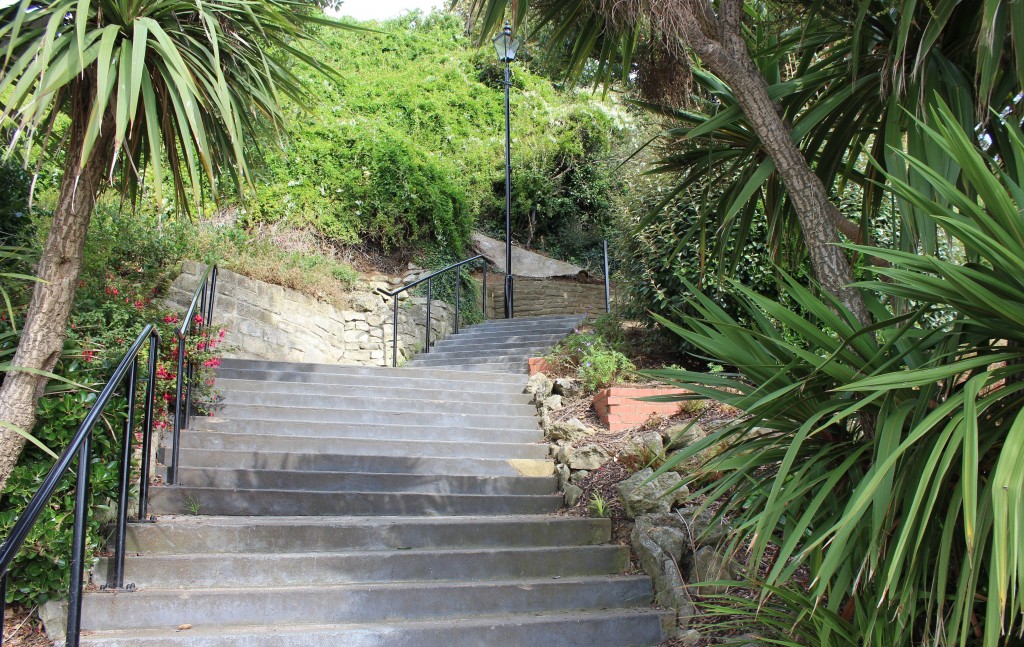
In Felixstowe’s case, it has the distinct advantage of being the only East Anglian resort to face south. Combined with a sloping cliff that relieves it of the flatness of most of its neighbours, it has a microclimate that the Edwardians exploited to create some appealing coastal gardens, recently restored. On a distinctly cool early August day, it was enough to lend a warmth that could have been somewhere distinctly more balmy…

British seaside resorts have had a rough half-century – ever since the Brits discovered they could go to Spain. But there are signs that some are rising to the challenge, no doubt helped this year by the travel restrictions. While there is not much we can do about the climate except wait for global warming, there are signs that Felixstowe at least is raising its game. Perhaps the very fact that it lies below the radar of the masses helps, as no doubt does the presence a little further up the coast of the much more chichi Suffolk towns of Aldeburgh and Southwold. Unlike those, however, which are very much pebbles, fishing boats and hearty doses of Benjamin Britten with everything, Felixstowe has rather more of that faded Riviera feel; at least enough to make it worth the thirty-five-mile drive, bypassing the distinctly mixed delights of Clacton and Frinton on the way…

The container port at the mouth of the Orwell is dredged to 15 metres, which allows it to accommodate the largest container carriers in the world; it’s the eight busiest port in Europe and nearly half all UK containerised imports pass through it. Facing Rotterdam across the southern North Sea probably helps. As a result, it has excellent transport connections. The southern horizon is dominated by a dozen gantry cranes, which are impressive enough not to be the complete eyesore that one might expect. The coming and going of the huge ships, not to mention the passenger service from nearby Harwich to Hook of Holland, adds interest.

The town itself is a mixed bag of low-end chains but with some more interesting independents sprinkled in; it seems to be making efforts, as I said, to raise its game – the main street is well enough cared for compared with many of its peers. It does have the expected amusement arcades and other trashiness, but the north end of the town is a rather different matter, with the cliff gardens, and the more imposing villas. What’s more, some pleasing eateries have moved in, with more on the way, thus addressing one of the regular downsides of the British seaside experience. That, and a shipload of imported palm trees, made for a pleasing, escapist afternoon, all the more so for being unexpected.

Alba Chiara

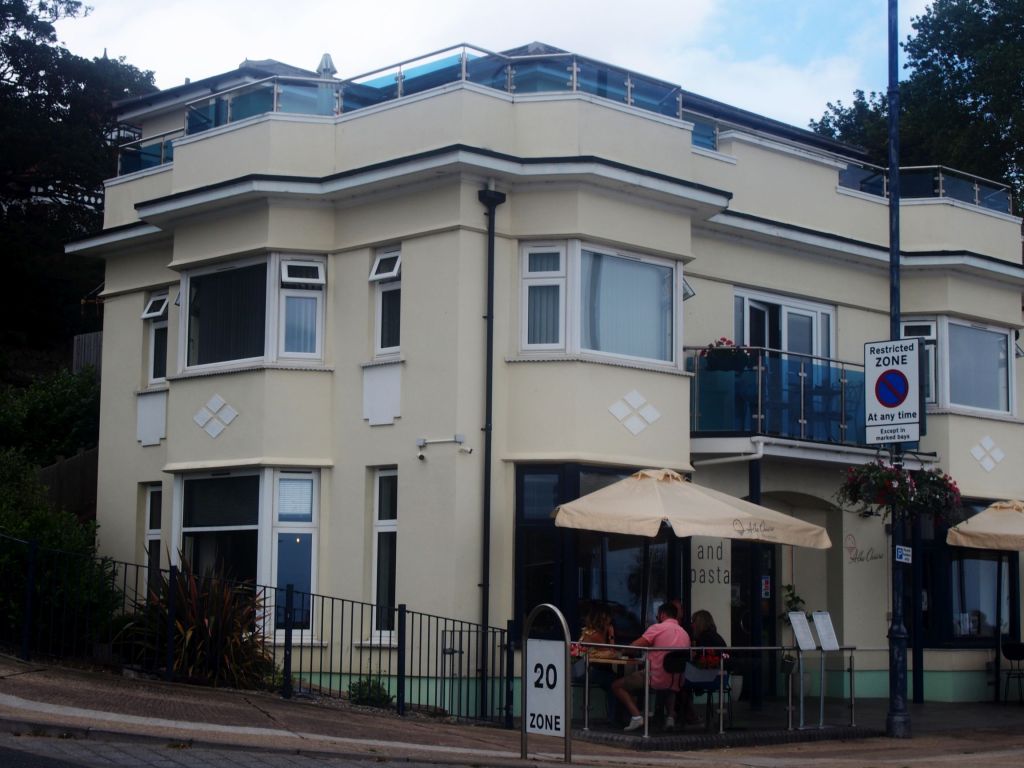
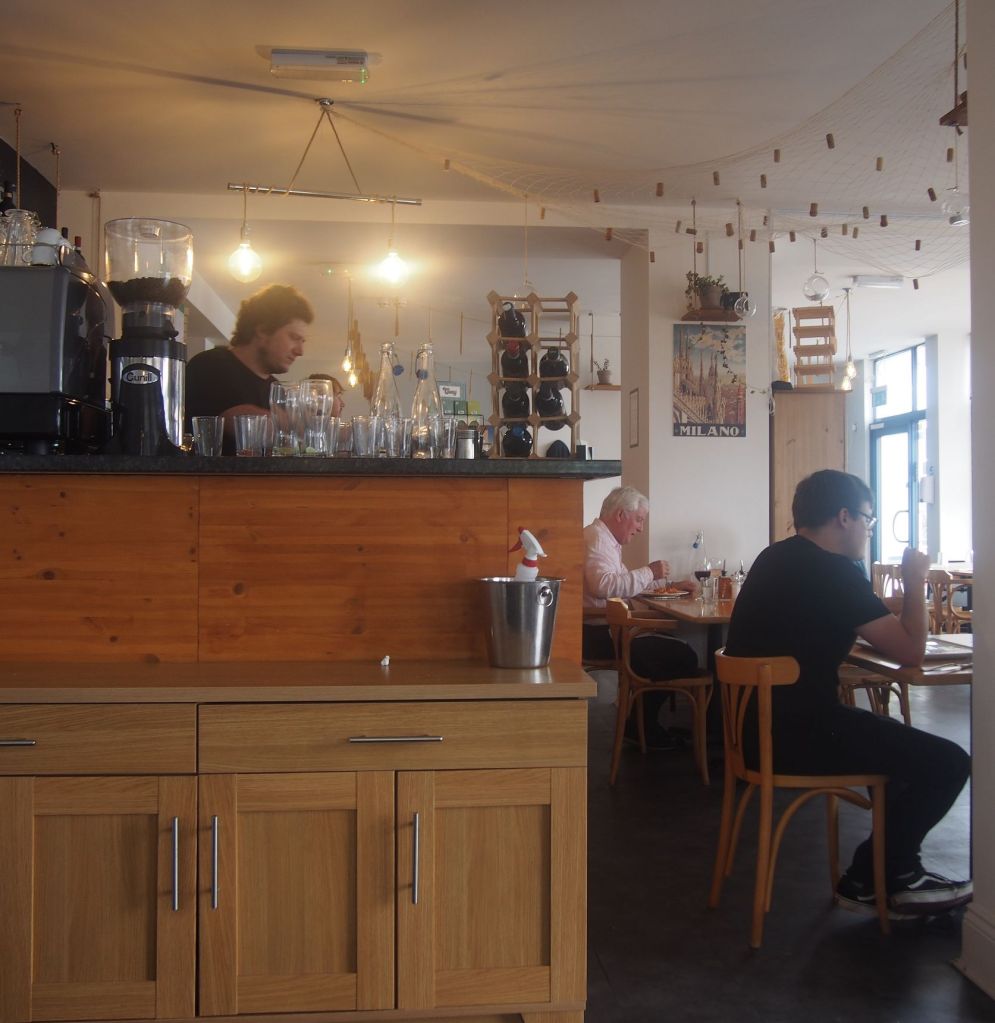
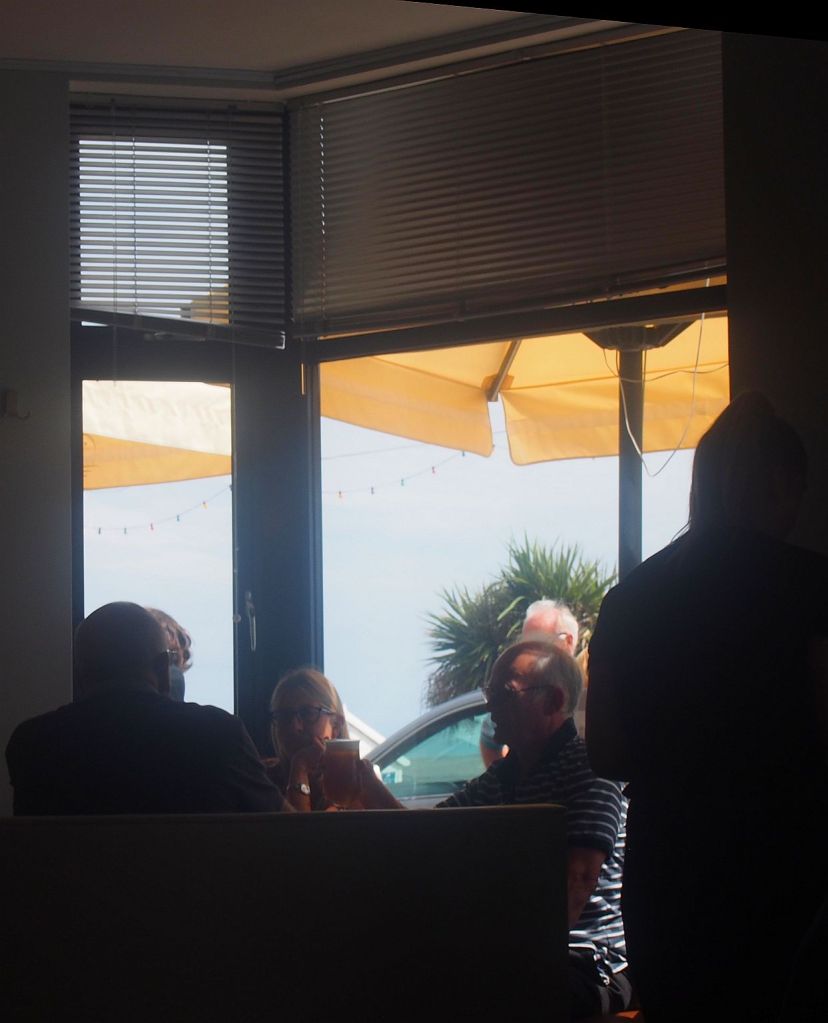
The renowned East Anglian brewers Adnams have opened a brasserie on the sea front; another similar venture is due to open soon. But we opted for Alba Chiara, a surprisingly good Italian restaurant, also a new arrival, and set up in an appealing building that had seen a previous life as a chips and burger bar. We got the better deal: anywhere that makes its carbonara with guanciale and pecorino knows what it is doing; nicely seaside-y and without being overly themed, it is a pleasant spot with great sea views. Later, we discovered that the owners are indeed Italian and escapees from one of our favourite restaurants elsewhere in the region. Full marks.

Alba Chiara
Serious espresso at last…

The promenade is worth a stroll; the beach is partly sandy, and a definite rise in the quality of kiosks is visible – several were selling “gelato” from proper scoop-chillers; a big improvement on the traditional lolly-on-a-stick. And then, joy of joys, we found one that was selling Mövenpick ice-cream: quite a rarity anywhere in the U.K., let alone at a lesser-known small resort like this. At the south end of the town, Beach Street Felixstowe is another recent addition: a Camden-style collection of independent traders, all housed in redundant shipping containers. We didn’t get far enough to check this in person, but it looks intriguing.

We rounded the afternoon off with a prowl around some of the cliff-top residential streets: a mix of villa and apartment blocks, several which have been recently renovated and (later research showed) commanding quite steep figures… And a couple of newly built contemporary additions, with some attractive looking balconies.

It’s not unusual to overlook the attractions of one’s near-region. Daily life tends to get in the way of exploring as thoroughly as one should – particularly when prejudice gets in the way. In this case, it was a good decision to take the risk; some of my family roots are in Dorset, and Bournemouth has always been – climatically, topographically and architecturally – my benchmark for the British seaside. But now we know that we at least have Baby Bournemouth, if not Baby Biarritz, much closer at hand…

Arts, Architecture & Design, Travel

Flânerie in Notts

Promising buildings; shame about the occupants.

Cities, according to Ben Wilson in Metropolis, his impressive new book, are humanity’s greatest invention. The close interaction between many thousands of human lives, and their messy, continuous cycle of decline and renewal are the heartbeat of human civilisation. Cities are where the heights of human sophistication are found – and also the depths of its failure.

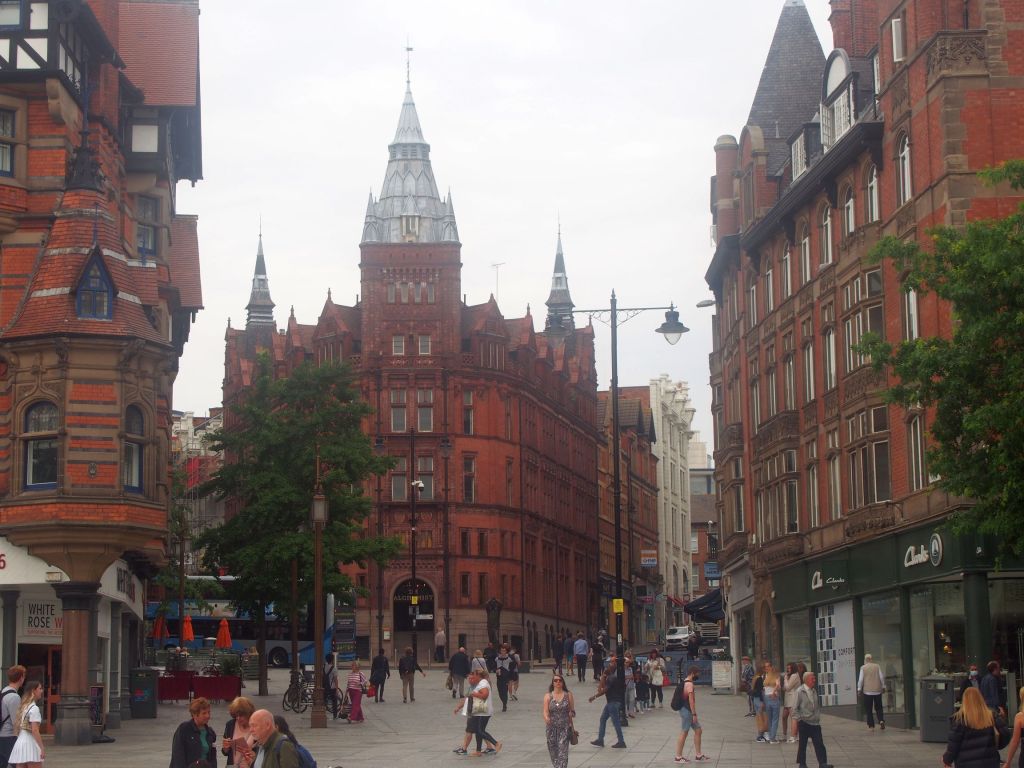
A day’s flânerie in Nottingham recently provided ample evidence of this. Almost eighteen months after our last city trip, we finally took another. My wife’s new employer is based in the city, and she needed to show her face; I mostly went along as chauffeur to take the strain of the 270-mile round car trip.  But it also gave me the chance of a day walking a city I last visited as a student in 1986.

The point of flânerie is as much the thinking one does as the shoe leather one wears through – and in about 13km around the city centre, there was plenty of both. It’s about observing city life in all its aspects from a slightly detached, even philosophical viewpoint; no surprise that it’s a French invention rather than a British. My academic interest in urban geography lends itself too, and always provides another reason to investigate and ponder, even (or perhaps especially) the nuts-and-bolts of the city that visitors and shoppers are not supposed to see. Wilson contends, as do I, that the British (and Americans) don’t really ‘do’ urbanism – not in the way continental Europeans do. Their instinct is to head for the cleaner air, quiet and privacy of the suburbs, which size-for-size sprawl far further in this country than in their continental equivalents where higher-density living does not only have extreme social connotations of penthouses and slums that it does here.

All three East Midlands cities (Leicester, Nottingham and Derby) are largely products of the rapid industrial expansion of pre-Victorian market towns through textiles and engineering. All three have signs of the decaying aftermath of their boom times: swathes of red-brick Victoriana of varying quality, areas of post-industrial dereliction, and vast tracts of terraces and bland, early 20th Century suburbs. But they never quite managed to acquire the full, high Victorian civic and cultural grandeur of their larger equivalents further north and west, let alone rival those of the continent, and conventionally are thought of as, well, rather dull.

Sadly, despite my best efforts, I still struggled to like Nottingham; despite its claim to be the principal of the three cities (population 330,000; metropolitan area 770,000), it feels to me like a missed opportunity. Leicester, for my money, is making far more of its modest assets.

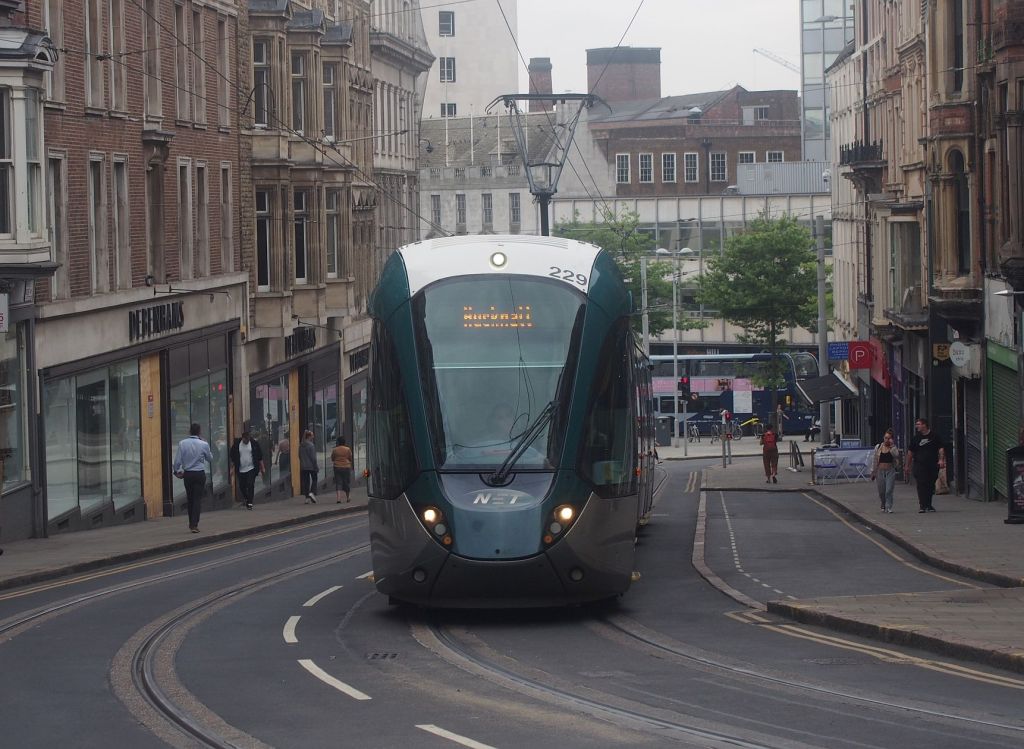
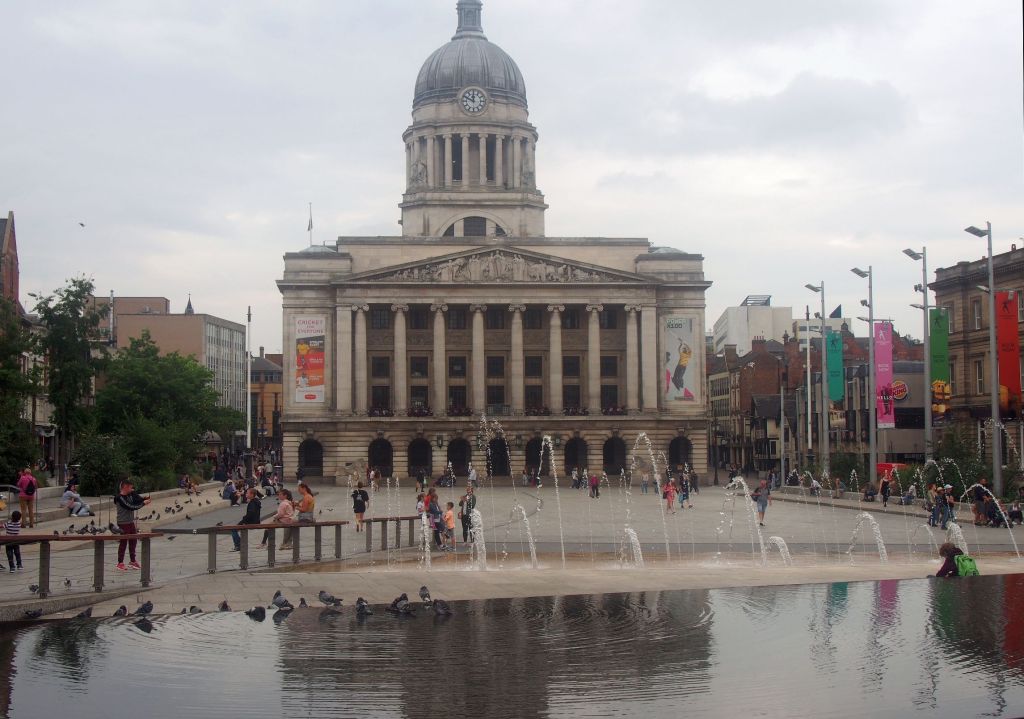
Having left my wife at her workplace, I headed for the city centre; it was pleasant to stroll down a wide, tree-lined pavement for the first time in a while, as the city began its day. Unsurprisingly, there have been significant interventions in the time since I was last there; the most successful by far is the introduction of a tram system that both carries large numbers and lends animation to some of the streets. I wonder whether transport planners give consideration to the theatrical potential of their proposed networks; they should. Nottingham has got this right: the trams descent a steep hill before sweeping dramatically around into the main market square, in front of the imposing City Hall.

Trams good; state of the built environment, less so.

The square itself has been given new paving and fountains, and ought to be a grand civic space with few equals in provincial Britain. But it somehow misses the mark. I suppose I need to allow for the impact of Covid: all day long, the city had a slightly under-populated feel. While this made proceedings more comfortable, it also meant the absence of ‘buzz’. There are many empty premises, proportionately far more that in my local town, which seems to have survived lockdown relatively unscathed. The closure of Debenhams department stores has left holes in town centres across the country, but I would still have thought that the larger cities had more resilience to weather the storm than smaller centres. In Nottingham’s case, the boarded-up prime site is a large hole indeed.

A missed opportunity to create a really splendid piazza…

I suppose I shouldn’t completely blame the city either, for the grubbiness. Local authorities in the U.K. have been so starved of funds that I suspect they simply can’t afford the daily cleaning that one sees in, for example, French cities. But it makes a noticeable difference when the dressed stone is not covered in the stains of takeaway food spills and worse…

A greater ‘miss’ is the lack of imaginative planting: at the height of an admittedly cool summer, the flowers should have been at their best – but the square mostly contained a selection of rather unkempt shrubs, only the display of cannas along the balcony of the city hall really making the grade. It could all have so much more flair…

The geographer in me seeks to assess the underlying socio-economic health of places I visit. Again, Covid may well be affecting the balance: the well-healed professional types are the most likely to be safely working from home, while the low-paid and less-fortunate were perhaps more likely still to be frequenting the city in person; it certainly seemed this way in the first part of the day. The numerous police patrols did not augur well, and I witnessed two altercations in the streets that morning…

For all my appreciation of life’s niceties, I am not an elitist. While the presence of a ‘top end’ is perhaps the most visible indicator of a city’s economic health, I dislike the exclusivity that it can create; cities need to be a mix, and good quality environments and opportunities should be available to all. But it is a two-way street: I am equally bemused by Britons’ inability to ‘inhabit’ their cities in the way the continentals do. This is not a product of wealth, so much as civic attitudes – and for all there were children splashing in the fountains, sadly I saw many people who seemed not to be treating their city centre particularly well, let alone with joy or pride. For many Britons, the city is a purely functional thing…

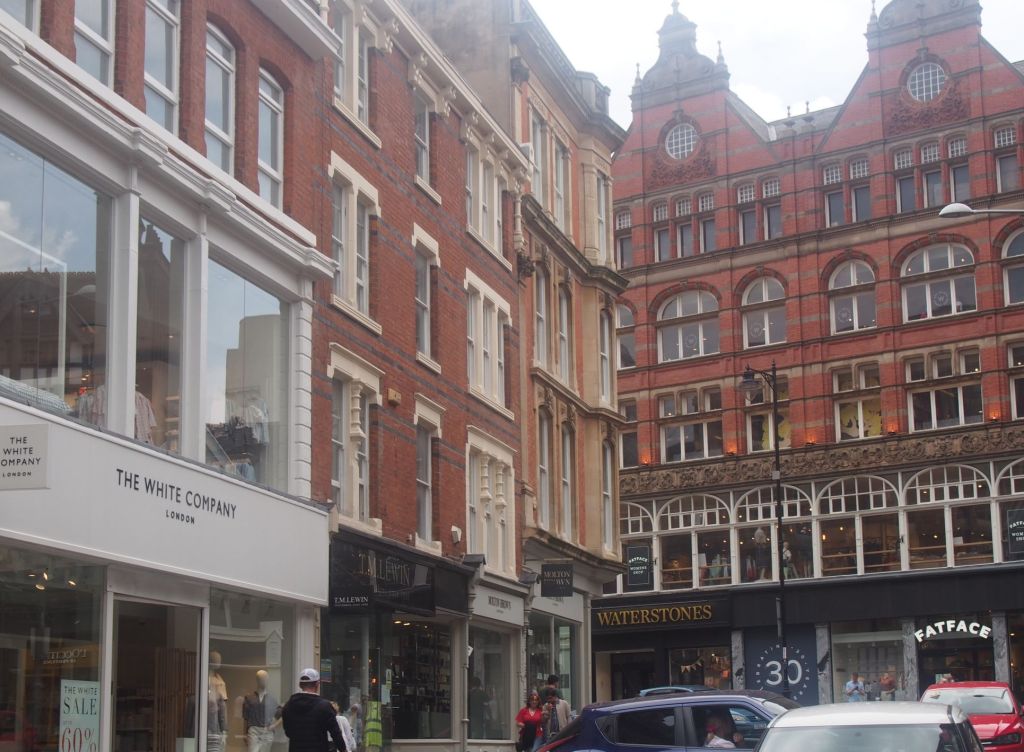
Once again, I suspect that this is partly a matter bigger than individuals: opportunity and conditioning matter. Like nearly every British town and city, Nottingham has become little more than a huge retail machine for the benefit of the same mainstream chains found across the nation. Meanwhile, I look for the presence and variety of independent shops; in most of the city centre, there were few of note. Nottingham has a reputation as a great shopping destination; I suppose it might be – if your idea of ‘great’ is large branches of all the predictable chains and fast-food outlets that appear everywhere… Expectations and perspectives also matter; the sense of the city as a proud, civic entity seems lacking.

One of the few really distinctive shops that I found in Notts

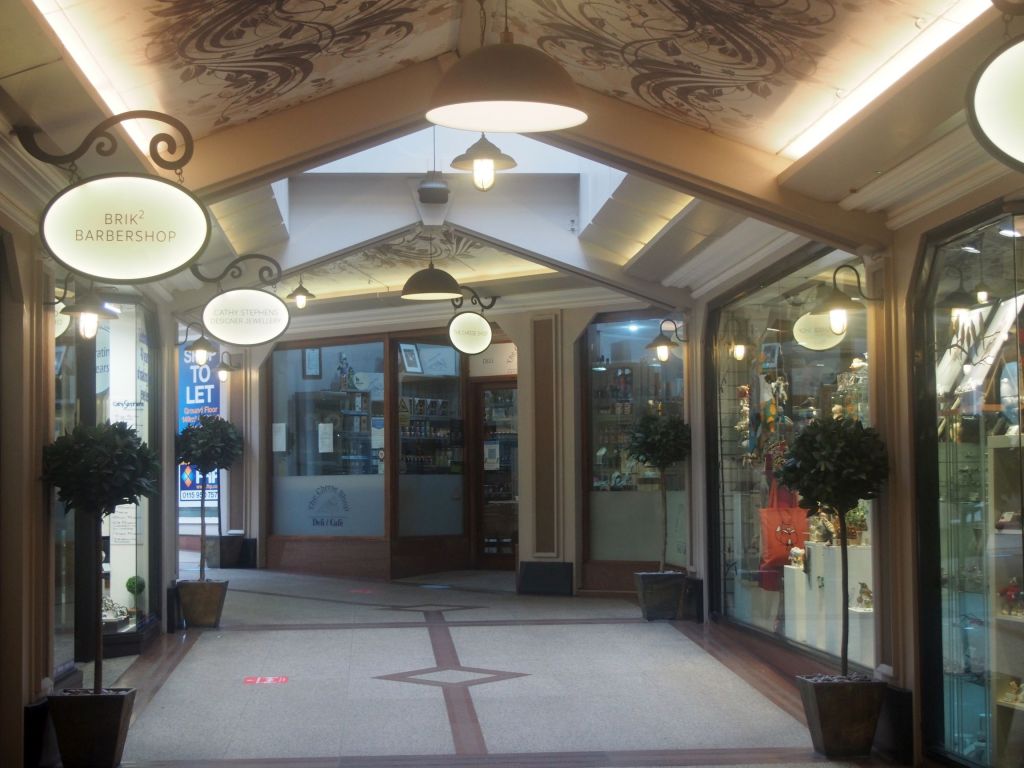
Feeling rather dejected, I pushed on into the more peripheral parts of the centre, and here, things started to improve somewhat. Having done my homework, I knew where I was going – but the experience was still underwhelming: the billed “bijou cafés” in the city’s finest arcade, where I had planned to find an espresso, turned out to be a branch of Patisserie Valerie; alright as far as it goes – but hardly outstanding or distinctive. Again, it all depends on expectations – and mine have been tuned over the years by the superior experience of too many continental cities…

The Lace Market area is somewhat more successful: tucked away in the older part of the centre, it is home to the National Justice Museum, slightly more choice shops, numerous professional services and buildings of indeterminate use, some rather fine. There I found a few more interesting premises, not to mention a rather different type of inhabitant – but still relatively few of the really interesting outlets one might expect in a large city. Precious little, for example, by way of independent food or clothes shops – or even evidence of where they might previously have been.

The high end?

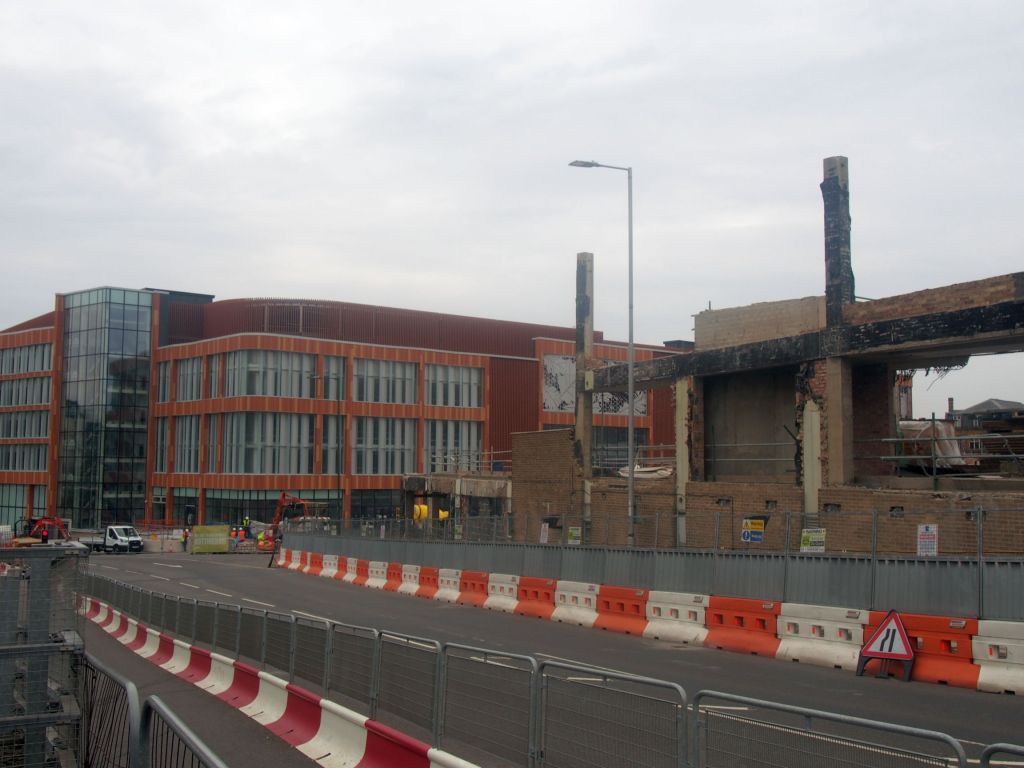
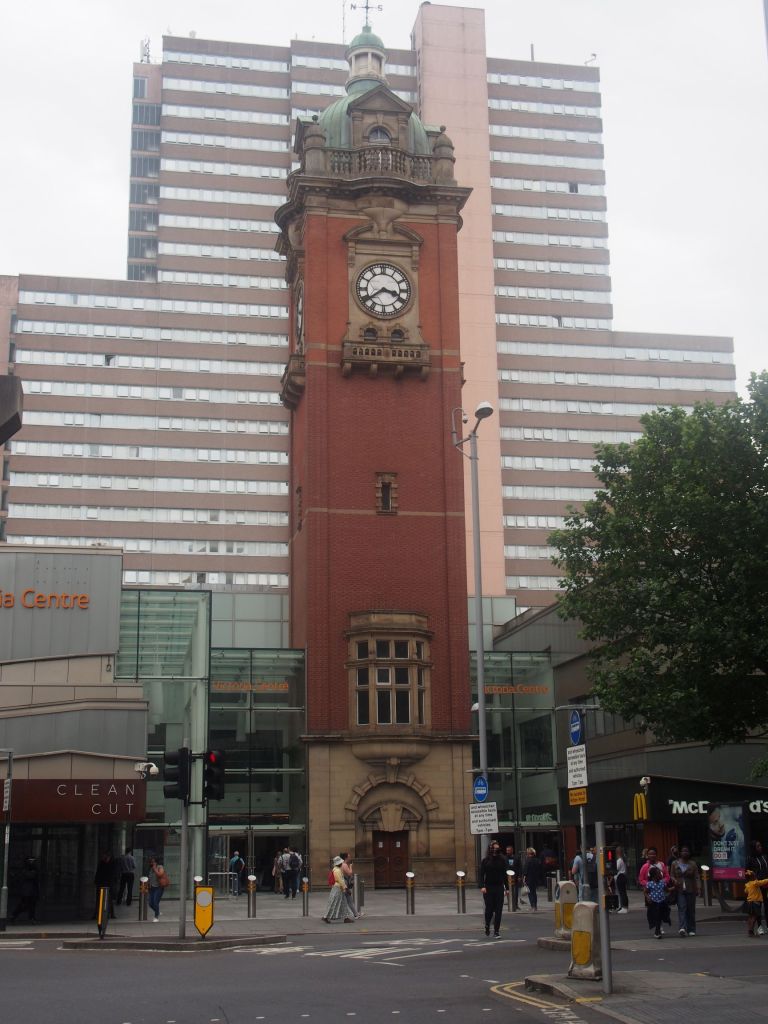
In the early Seventies, Nottingham received some of this country’s earliest indoor shopping malls: the Victoria Centre, built on the remains of one of the country’s most atmospheric Victorian railway stations – but it is the other, the Broadmarsh Centre – which has recently made headlines. A vast, brutalist bunker between the remaining railway station and the centre, pre-pandemic it was being bulldozed – when the developer went bankrupt. It has been left, part-replaced, part ruin and work has only just resumed.

Out with the old, in with the new… But is it much of an improvement?
Victoria: An unhappy marriage. The clock tower is all that remains of a fine railway station.
The whole area to the south of the centre is being rebuilt; the billboards suggest a much-improved environment will result, but still dominated by large-scale retail and commerce. The addition of a new central library and bus station is laudable – but whether this new generation of comprehensive redevelopment will prove superior to its predecessor, only time will tell. Trying again to be charitable, we perhaps take too much for granted in a long storyline here: the lifetimes of city buildings are measured in decades or centuries. We are only just getting round to replacing the disasters that too often were thrown up in the Sixties and Seventies just to fill the bomb sites created in the Forties… Many cities right across Europe suffered the same fate – though the success of the recovery was most certainly not the same everywhere…

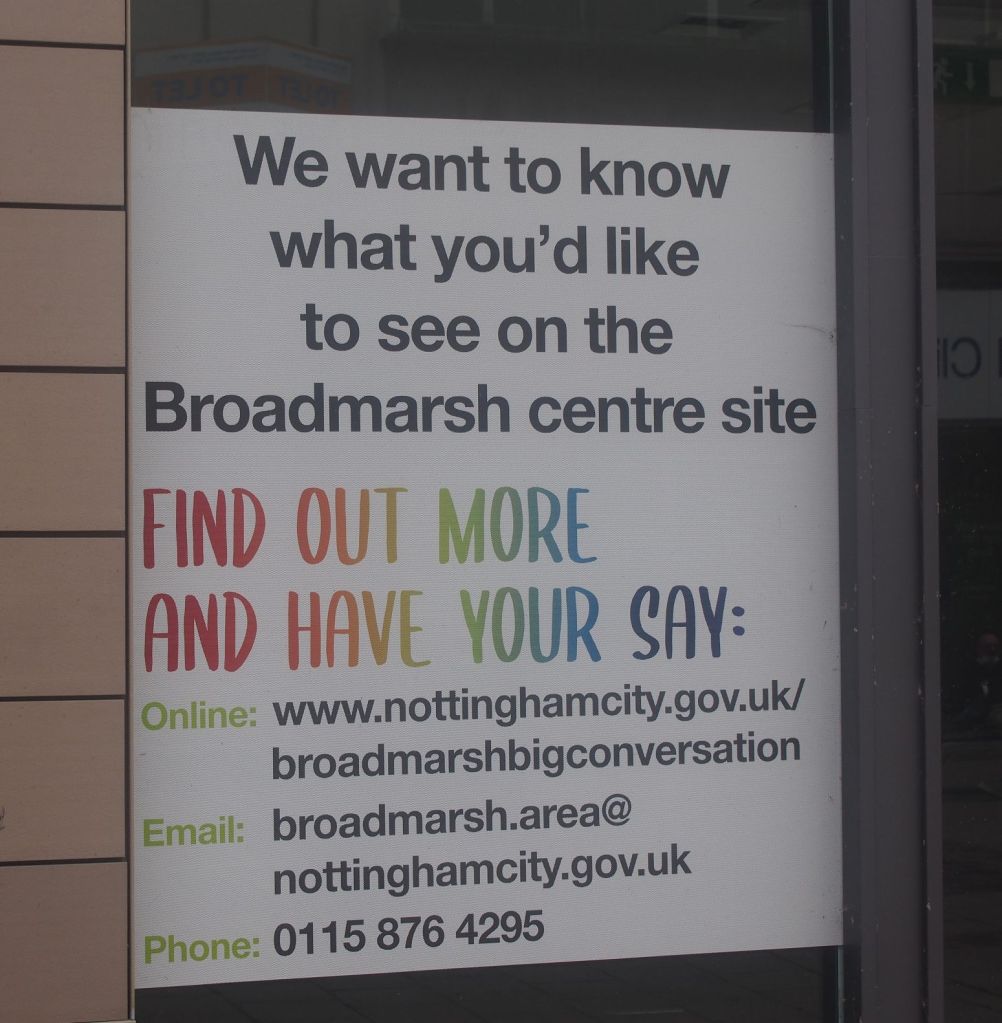
Full marks for consultation.

Post-Covid, there is a debate in the city as to whether more retail capacity is still the best use for this site. The outcome is awaited, with a new city park having been mooted as an alternative. Again, time will tell, but loosening the dominance of big retail in the urban mix need not inevitably be a bad thing.

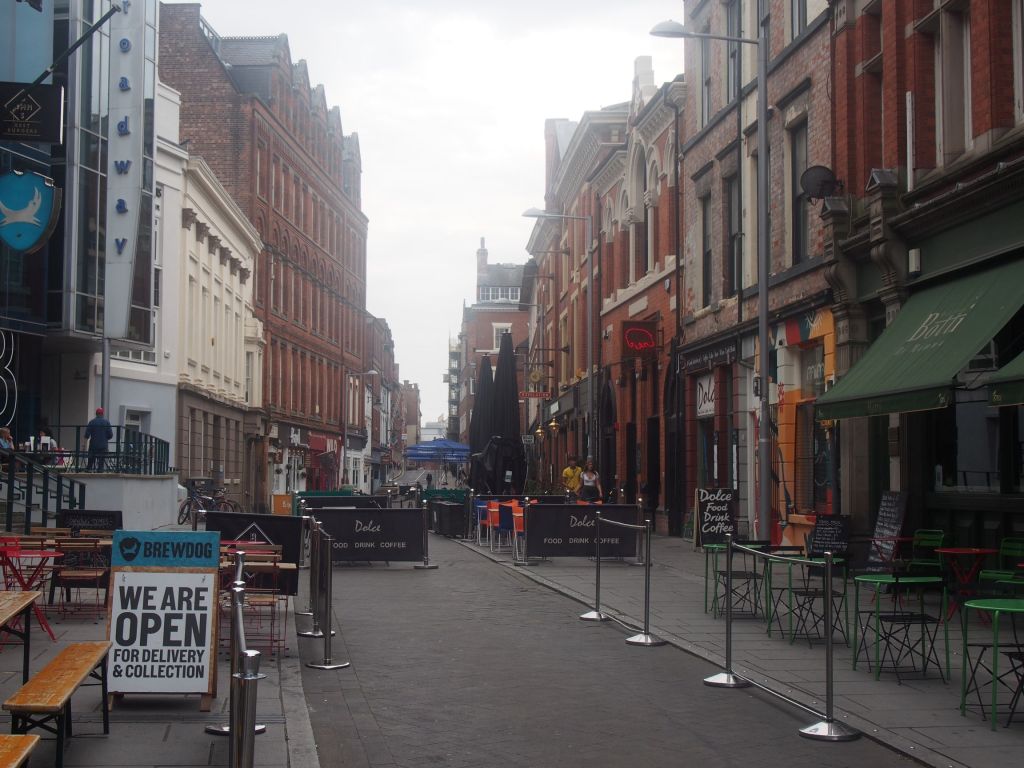
I eventually came upon two areas that proved the point: Hockley lies to the east of the city centre and is described as the city’s bohemian quarter. Well, I’ve certainly seen substantially more bohemian than this, but the narrow streets of this area are nonetheless occupied by precisely the independent shops and cafes that are so conspicuously absent in the rest of the city centre – and the vitality of the area did indeed prove the point.

Hockley

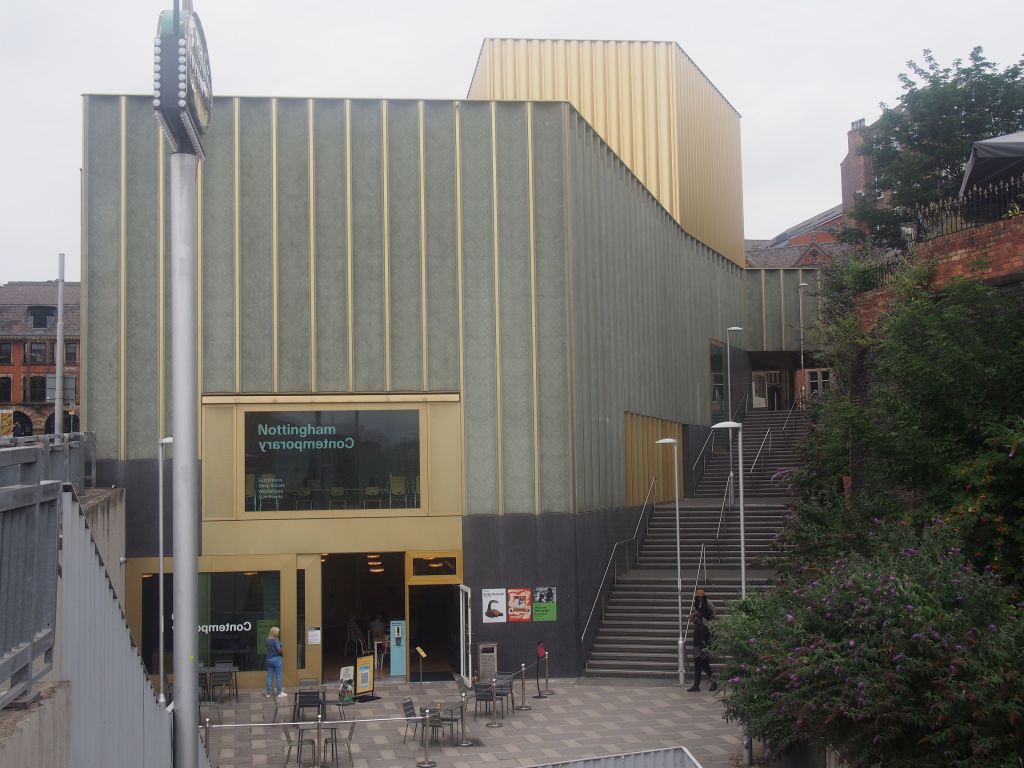
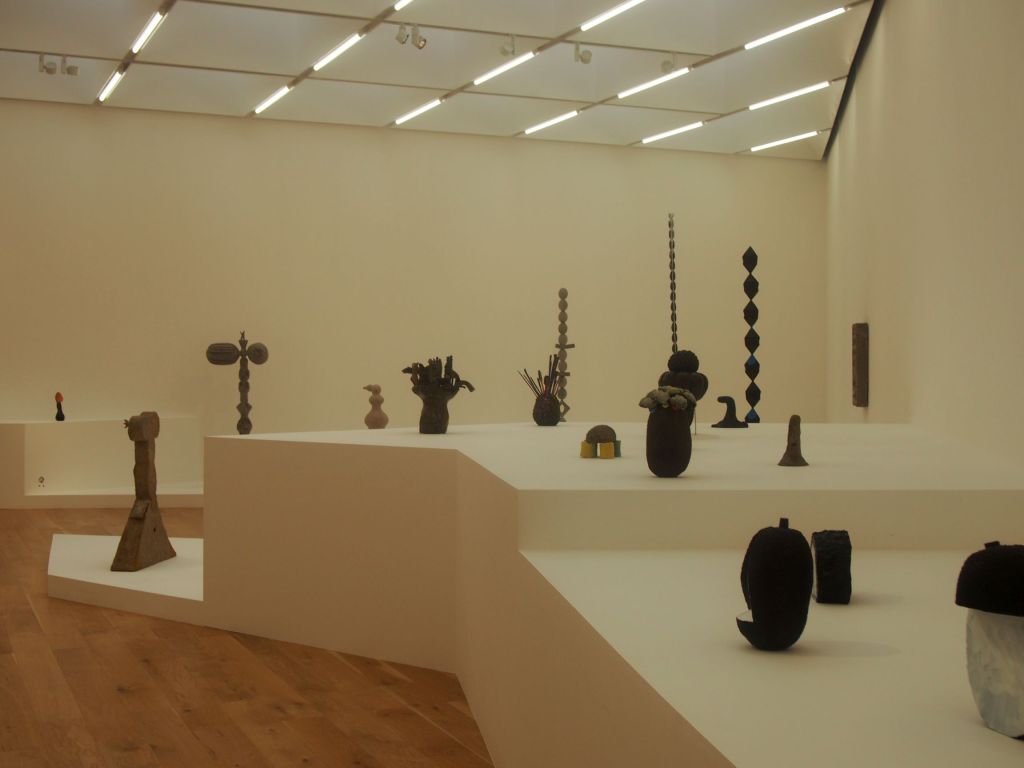
After lunch with my wife’s new colleagues, I headed for the second: Nottingham Contemporary, an externally unprepossessing but nonetheless internally convincing modern art gallery. A pleasant hour was spent mooching around its three exhibitions and sitting out a passing rainstorm with a hot chocolate in an attractive (and once again in-house) café. I dwelt on the fact that five decades ago, express trains ran through this very spot on their way into the now-vanished Victoria Station: another building that the city would have done well to keep, rather than replace with a concrete bunker. Hopefully, we know better these days. One of my fellow rain-refugees was thinking the same, and a good conversation followed…

Nottingham Contemporary

As I said, I wanted to like Nottingham; there is little that pleases me more than time spent in a lively and attractive city centre. But even allowing for Covid, Nottingham just isn’t there yet. There is a lot of redevelopment going on – but even more needed to the fabric of the historic city, much of which is still rather shabby compared with that in other city centres. Maybe it will be better in another decade, but what has taken so long? I can accept that Manchester, Liverpool and Glasgow’s needs were more pressing – but there is in any case, only so much that physical renewal can do, no matter how much money is available. What is needed is ambition, imagination and flair – things that can lift rather predictable urban renewal into a genuinely vibrant and characterful place. It’s needed not only from the city leaders, but also by the regular citizens who populate the city day in day out. The clone-shopping experience does not encourage this, but nor does the willing complicity of the junk-food-and-trainers majority, which the architects’ drawings never show.

About as chi-chi as Nottingham gets…

It wouldn’t be fair to compare Nottingham with the greatest European cities – but I have seen plenty of second-division equivalents on the continent that far outstrip it – Montpellier in France, for example is a similar size, even if its enviable climate gives it a head start… The problem, I suspect, is that really successful cities are cosmopolitan and even sophisticated – things the British, instinctively, as a nation are not.

Even at their Victorian height, British cities were about imperial bombast – but also mass squalor, the legacy of which is still with us. Nottingham is trying – but I’m still not sure most British cities really ‘get’ vibrant, spontaneous, democratic urbanism any more than they ever did, which is why so many of their more self-conscious efforts never really come off. It will be interesting to see what future visits reveal…

Opinion & Thought

Filling the void

I guess it’s my professional background that is to blame – you can’t really function as a teacher without thinking of the issue of ‘life chances’. When you do a job that largely lacks a clear relationship between inputs and outputs, it is necessary to understand one’s purpose in the longer term. But I’m far from certain that the notion enjoys wide currency amongst those about whom teachers spend so much time thinking. I wonder how many people would consider themselves to be living a life which is mostly of their own determining.

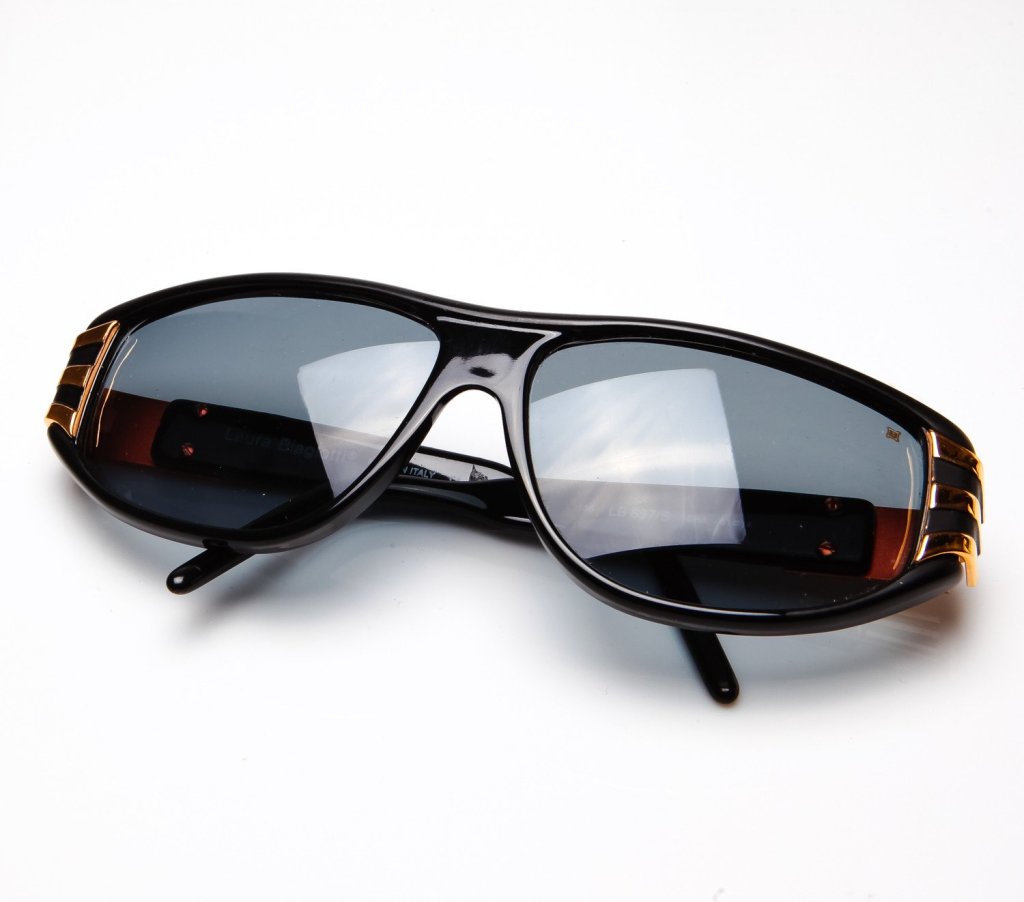
I have recently been trying to help a long-standing friend deal with mental health difficulties, who seems to have had just such a problem. Having “been there” myself, I feel that only those who have been, can really understand it. But it doesn’t make being helpful much easier; the essence of such difficulties is that they distort one’s perception of everything else. Unlike, say, a stomach-ache, where at least one can identify the source of the distress, mental pain projects itself onto everything else, and conceals its true self behind that. It is like wearing a pair of grey glasses: they make the whole world look grey – but it is all too easy to forget that the problem lies with the glasses, not the rest of the world. Hence part of the problem with mental health can be identifying its true source – which may not lie where you think it does. And in turn, this can make it all the more difficult to identify what needs to be done: the temptation is to aim at the smoke rather than the flame…

Such difficulties may be a mixture of inheritance and background. There may not be much we can do about the former – but I suspect that we do nowhere near enough about the latter. As with physical health, we need to set up good habits early in life. But for all the talk about mental health, I wonder how much is being done to make that possible. Prime amongst these should come encouraging people to understand that they can act positively to develop their own selves, where they can cultivate all aspects of their personal identity and needs.

The neglect starts young: many young people are supervised by ‘helicopter’ adults for every moment of their waking lives. My friend seems to have had an early experience of this: she attended a minor public school which, by virtue of its boarders, operated a seven-day week, and made almost as many demands on the day-pupils (of which she was one) as those who lived ‘in’. From an early age, her life was dominated by the externally imposed demands of not only academic work, but sporting and musical life. Combined with high parental expectations, this perhaps leaves little opportunity for young people just to be alone with their thoughts, to learn to understand themselves, and to explore their own tastes and priorities. I suspect that the relief from the treadmill that many say they experienced during lockdown tells an important story here.

My friend was successful, eventually gaining an Oxford degree, and entering a demanding profession in which she has worked ever since. Even from a distance, I could see that her work dominated her life (not that mine as a teacher did not try to, as well…). She admits that her work came to be her main, even only, source of personal validation. In my case, I refused point-blank to let that be the case. There is just too much living to be done to allow that – and I never did see the point of living to work. After all, our masters, who urge us to do so often do not practise what they preach…

The problem with living to work is that those “life chances” become externally-defined – the meeting of targets, the acquisition of wealth and status, the progression of one’s career – or at very least, the pinning of one’s self-esteem solely on the competence with which one does one’s job. As with schooling, the modern workplace leaves precious little time for people to create their own meaning of Self.

Perhaps it doesn’t matter too much, if one is content to live one’s life on others’ terms. Be they inherited from one’s family, or the work-ethic inherited from one’s schooling or workplace, if you narrow your horizons and close off your curiosity, it may provide an adequate if pedestrian life, so long as you Play The Game.

But sometimes, The Game plays you. In both my friend’s case and my own, we found ourselves in workplaces whose toxic culture knew no limits, that ate people whole, chewed them up and if they resisted, spat the remains back out again. The stress of this experience is enough to endanger anyone’s mental health – and that, in both of our cases, it did.
The day when one can no longer do one’s job, a huge hole opens up in life; not only the loss of direction or a defined “role”, but also a large amount of time that needs to be filled. Particularly if one is struggling mentally, this can be difficult; as some found during lockdown, it is frightening how willingly the underoccupied mind fills that void with all sorts of terrors.

This is where the lack of prior thinking can be problematic. If you have become a live-to-work type, you risk having invested so much in that aspect of life that you neglected the rest of it. Who and what are you – really – when you are not at work? When work fills the day (and the mind) you can avoid this question for years, but when work stops, it can be hard to ignore.

My friend thinks that it began early in her life; even during school holidays, the conditioning made her struggle to cope with the absence of ready-made, work-orientated routine. Even her musical and other activities assumed the status of quasi-work – a mad rush to fulfil a large number of commitments that she had felt she had to accept. Listening to her some years ago, even non-work had started to sound like an extension of her job.

Perhaps many people live their entire lives like this: on autopilot. Filling their lives with busy-ness to avoid ever having to address the existential questions about their own meaning. Leisure sounds good, but in reality, can be a problem, unless you take active charge of what you do with it. I suspect that the British psyche adds problems: it is all too easy in this country to conflate positive living with social climbing or the precious pampering of the celebs. Outwith a certain privileged and self-obsessed minority, it is just not done to be too upbeat about how one lives. As a nation, we seem obsessed with the perceived grandeur of superior lives, and yet we often take little care with our own.

But I think there is a difference between self-indulgence and simply making an active decision to try to live well. It can equally be argued that to neglect active thinking about our lives is to waste the most precious asset that we have: life itself. Somewhere in there lies the contradictory legacy of a guilty, Puritan past in which pleasure was a sin… I suspect it lies in neither the entitlement of privilege nor the mindlessness of the herds that many seek to lose themselves in even when not at work; both are the antithesis of the balanced, authentic individual.

We cannot avoid having to dress, to eat, needing homes, interacting with our fellows, even consuming at some level. So we might as well do them well, gratefully, carefully and with enjoyment (however we define it). The mindful pleasure of doing something well generally far exceeds the saved hassle from not bothering. The problem is that this requires more effort than many seem either prepared to make, or to have time and energy left for. Somewhere, this appreciation needs an awokennness to the physical sensations of the world, which again exhaustion or distraction – or that protestant denial – so easily blunts in us.

My go-to psychologist, Mihaly Csikszentmihalyi concluded that the principal source of human fulfilment is the self-challenge that leads to increasing competence and complexity of being. This is why it is worth taking almost any aspect of life beyond the basic. The problem in Britain is that the connoisseurs or cognoscenti who do so are regarded with inverted snobbery, rather than respected for their insight. True, affectation can reinforce a certain impression, but once again we confuse genuine expertise with social display. Yet such insight is open to anyone who makes the effort.

There are, of course, plenty of individuals who do take mindful care of their lives – but I suspect they are still vastly outnumbered by those who don’t. What is more, neglect seems to have become the definition of normality. The overwhelming message is “convenience” – for which read “anything that requires only the minimum of thought or effort”. Don’t try hard. (But let’s not forget that real sprezzatura requires effort….)

I feel thankful now that over the years I found I had to reject this thinking. It meant heading into fields that were, in terms of my upbringing, quite unfamiliar territory; drawing lines around my working life and sometimes stepping outside the norms of my peers. It is undeniable that this set up conflicts that eventually gave me problems. But I remain adamant that a balanced and thoughtfully fulfilled life is both a reasonable aspiration, and in fact makes for a more contented and productive working life as well. In the longer term, it served me well when my own working life collapsed and threatened to take my sanity and sense of self with it.

I pointed this out to my suffering friend; sadly, I got the impression that she rejects it as a kind of vanity – a form of fake “lifestyle” whose purpose is social display or furtherment.

I see it as a matter of authenticity. However, it is true that the similar calculations are done by some simply to impress and can indeed be inauthentic. They may superficially appear the same, but I think there are two differences. One is in the mind: a simple matter of personal honesty about one’s motives, whether other people understand or not. The second is consistency; a sure sign of inauthenticity is tastes that change with the winds of social status and fashion. They are likely to be characterised by superficiality, whereas true passions are ones that encourage you to delve deeper, to find greater complexity and discernment. Passing fads never achieve that.

An excellent example of this is male dress, from which this blog takes its title. There is a world of difference between a man who genuinely appreciates a fine, timeless aesthetic no matter what his means, and those who seemingly do the same things, but just to exhibit their wealth and status. The same can be said for food, travel, homes and almost any aspect of what for some is “lifestyle” but for others, just Life.

I consider myself lucky that I had somehow figured a lot of this out by the time my own zero-hour arrived. It didn’t protect me entirely from the demands of over-work; my professional life (and mental health) came crashing down about five years ago as a result of overwhelming workplace stress. But through all the difficulties that followed, I am certain that all the other elements of the life I have built were my safety net: the things that remained constant even as other things lurched all over the place. They anchored my sense of who and what I am and have continued to do so as I recovered. What’s more, my appetite for that life filled the hours that suddenly opened up in the space where Work had been.

This is not about specifying any particular way of life, but about settling who we are to our own satisfaction and fulfilment, rather than living to please or impress others, or just to keep them off our backs. In the end, it is a matter of being true to oneself; that includes drawing the line at those things in life that seek to take us over, to define us solely in their own terms, to the neglect of who we really are. It is not narcissistic to try to find a stable balance between our obligations to others and a delimitation of our own rightful individuality. All the more so when those others believe they can invade so much of our lives that there is nothing left for ourselves – and most of all at times of need.

Teachers spend inordinate amounts of time thinking about their students’ life chances; in reality, we might achieve better results by helping and encouraging more people to think harder about their own – and hopefully redefining them as something more than the live-to-work outlook that can do such harm.  I hope my friend is reading.

Sartoria

From Italy with Love…

Having sung the praises of online shopping in my previous post, I was immediately reminded of its limitations when a repeatedly used clothing retailer in Italy informed me that it has suspended shipments to the U.K. due to Brexit.

As I have rather neglectfully managed to reach a point where several necessary renewals have coincided, the search for new sources has been more focused than usual. I refuse to give up: the dearth of easy solutions to the problem of what I consider the lack of appealing men’s clothing in the U.K. is not about to make me part with my hard-earned for things I do not really like simply because they are readily available. And that especially holds true when significant outlay may be involved.

When it comes to browsing (even virtually) in Italy the supply problem rapidly disappears (as would my savings, if I let them), only to be replaced by a partly cultural one: despite my appreciation of the work of their fine tailors, I do struggle to get my inhibited English mind round the kind of figures that Italian men seem willing to spend on their clothes. While the difference between rubbish and well-made items is readily apparent to anyone who cares to look, I retain a suspicion that the law of diminishing marginal returns must set in after a point. How much better than a £300 jacket can a £2000 one really be? Beautiful materials and superb craftsmanship do not (and should not) come cheap – but even so, there are surely limits to what is justifiable purely on grounds of superior quality. I found myself wondering just how much of a premium some of those renowned brands command just for their name…

Or am I just showing my ignorance? It is certainly true that having pushed upscale somewhat in the past, it is much harder to accept going back down it again – so maybe there is more to it than meets the eye. On the other hand, is it wise – or even necessary – to keep trading up the ladder of connoisseurship? At what point do we reach good enough? And of course, even were one willing, the capacity of one’s wallet does present a constraint that no amount of canny purchasing can entirely wish away…

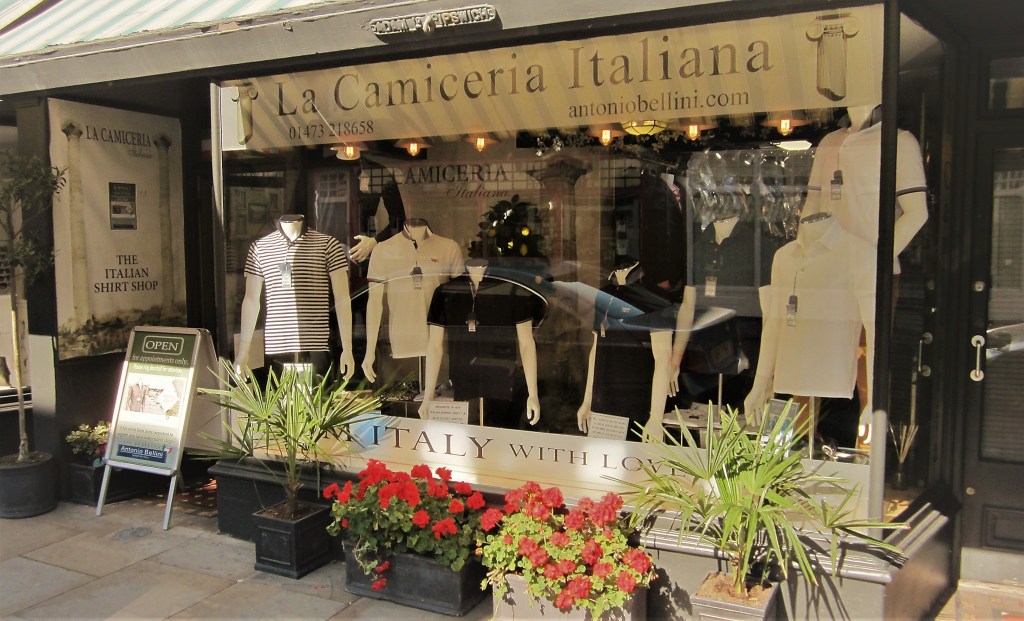
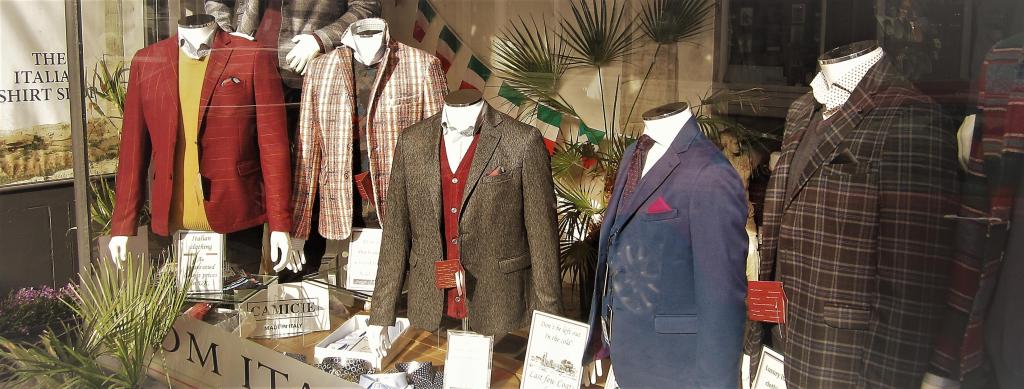
So when my searches landed me again at the virtual door of a relatively local business, I took the opportunity to investigate a small retailer whose website I had discovered at around the time of the first U.K. lockdown and whose shop I have been intending to visit ever since. The Italian Shirt Shop is situated in a rather nice ‘independent’ shopping street not far from the centre of Ipswich. As restrictions have now eased, I recently took the opportunity to make the thirty-mile trip and do some in-person shopping for a change.

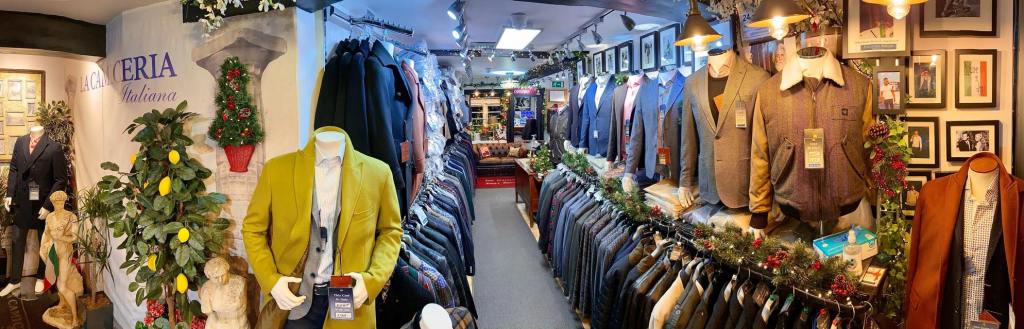
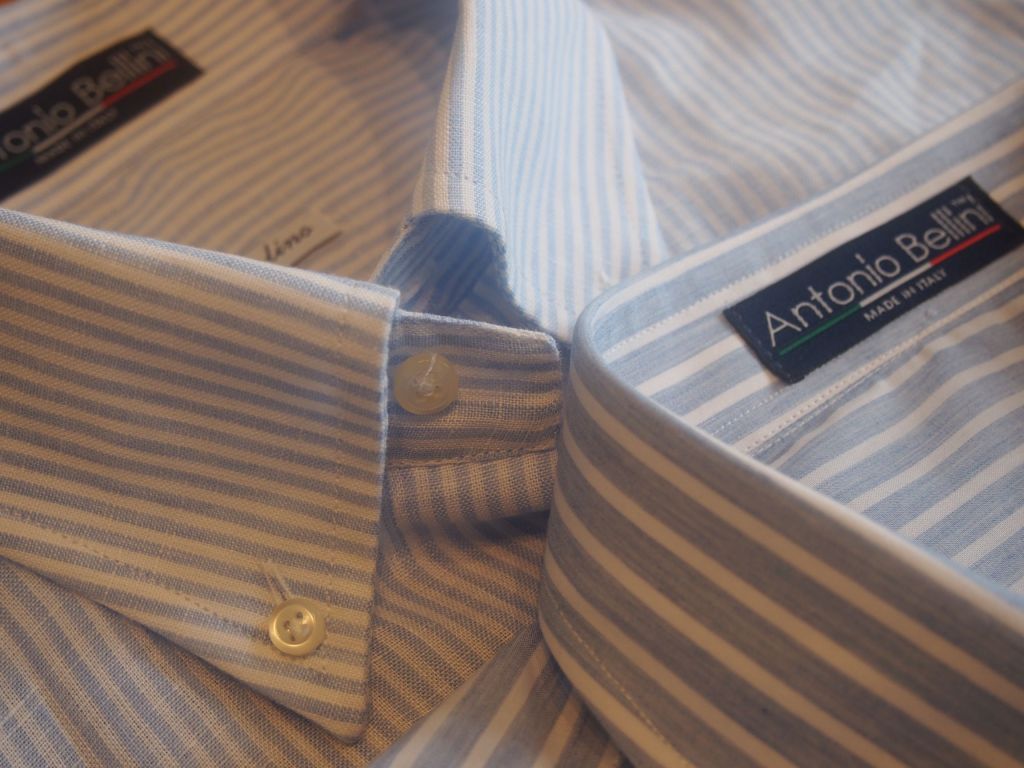
‘Antonio Bellini’ is on a mission to bring Italian style to the British Male – and he appreciates that cost can be an issue. His shop is lovely: a transplanted version of what every small independent Italian menswear shop still is – but without the hefty price tags. Antonio has arrangements with manufacturers in Italy that allows him to retail his own brand at something much more approachable, while still retaining a very pleasing quality. His customer service, too, is exactly what one would hope for from such a shop. He has now diversified beyond shirts – and is certainly a lot more visitable than anything south of the Alps right now.

At present, he only accepts one customer in his shop at a time – which was not a problem on a quiet Thursday morning – and so I had his undivided attention in helping me identify what was admittedly a limited number of items at the more generous end of his size range. This, he says, is a perennial problem with Italian producers, who are widely uninterested in broadening their appeal simply to address the mere inconvenience that customers everywhere are getting larger. He also confirmed that a huge proportion, perhaps 75%, of those vast prices can simply be a premium for having the ‘right’ label. There is much better value to be found elsewhere – including in Ipswich.

I came away with the couple of summer shirts that I had been seeking (and a rather dinky jacket that I hadn’t) – all for a price that would barely cover one shirt from some higher-profile sources. Time will be the ultimate test, of course, but I know a decent fabric when I feel one.

I stand by my comments from the previous post, concerning the opportunities afforded by supporting small businesses online, but I do not think it is incompatible with supporting in person local ones where they do exist. And it is certainly a very much more enjoyable experience to spend time in a real treasure chest like Antonio’s shop, than the virtual equivalent. You can’t stroke all those lovely fabrics online, for a start. Let alone chat with someone who knowledgeably shares your enthusiasm.

My brief splurge is now done – summer shirts and properly weatherproof shoes are once again to hand, their predecessors having been worn to destruction over the past five or ten years. (The shoes might have lasted longer had it been possible to reach a repairer more easily in the past eighteen covid-restricted months…) A couple of items ordered online are yet to arrive – but here’s to one British gent (for despite the name he is British) who has had the nerve to stick his neck out and retail what he loves. Long may he continue to do so – I shall be going back.

Shop photos taken from Antonio’s website with his permission. The views in this post are entirely my own.

Opinion & Thought, Sartoria

Consume – lovingly

Trying to be an ethical and ‘green’ consumer is like walking through a minefield. The complexity of modern production makes it, in many cases, almost impossible to identify the full impact of one’s choices. I’m not sure I trust the labelling to tell the whole story, either; it has just become another aspect of marketing.

I have long pondered the sustainability of Sprezzatura: an unconfessed guilt – or at least doubt – that the principle of discerning consumption could be morally and ecologically acceptable. Choosing superior products as a matter of principle can seem like unreasonable self-indulgence, particularly at a time when the environmental impact of human activity is becoming ever more extreme.

The materials and methods that are sometimes required to produce refined products can involve the disproportionate exploitation of scarce resources, perhaps sourced from obscure places, and manufacturing, to keep costs down, by people paid low wages and living in terrible conditions. Such is the reputation of the sweat shop.

Recent research for a couple of clothing items led me to further suspect that another trend is not helping matters: it seems that the middle-market is being hollowed out. I have trawled quite widely for the items concerned – and my conclusion, not for the first time, is that the choice on offer is increasingly between low-end disposable junk and a high end whose prices are heading for the stratosphere, thus taking better quality goods out of the reach of much of the population.

The most breath-taking example of this was at Brunello Cucinelli – where I happened on a price tag of £1300 for…. a credit card holder. While there are no doubt people out there who will pay this without batting an eyelid, it surely represents the ultimate divorce of any proportion whatsoever between utility and price.

This is only the extreme, however. I can accept that I may simply be failing to keep up with the impact of inflation; as a state employee, my income was always fixed, beyond my direct influence, and relatively modest. It has no doubt been eroded by the pubic sector pay-freeze of the past ten years – and certainly by the change in my own personal circumstances. But even allowing for all that, my impression is that prices at the better end are soaring away from me. A couple of decades ago, we were able – occasionally – to pay out on expensive items, such as one of Bang & Olufsen’s more modest sound systems – and even the occasional small purchase from favourite labels such as Armani. Today, it’s an impossibility. No doubt the premium that such brands have increasingly found they can command is part of it, as is the willingness of the economic elite to pay whatever it takes to preserve their exclusivity.

This might sound like the first-world problems of a self-indulgent whiner, but there is rather more to it than that; Quite apart from my innocent appreciation of good quality, cheap products so often represent a false economy – at least as much so as slavish adherence to outrageously over-priced ‘labels’. So I was pleased to find that my recent reading of JB MacKinnon’s The Day the World Stops Shopping provided sensible support for my views.

From the ethical standpoint, the key point is this: buying good quality (whether sporting a desirable label or not) is often less harmful than the mass-production throw-away alternative. Our B&O system is still doing good service twenty years later, as is our rather-more-expensive-than-IKEA Italian kitchen, most of our other furnishings and indeed quite a number of those clothes. Being well-made, they aren’t unduly showing their age – and we still love them. For what it’s worth, we apply the same purchasing principle to what we eat, though the price point is obviously rather different, and the goods don’t last as long…

As MacKinnon points out, it’s about a mindset. Much of the really harmful consumption is done by those who purchase almost as a reflex; who use items only a few times, if at all, before junking them in favour of newer ones. The alternative (which with satisfaction I noted we have always done) it to know your own deeper needs and preferences. It is about consuming mindfully, no matter what the item concerned. I suppose another word for this is discernment. This means that you will probably set a much higher bar for purchases made, will think hard about the choices and sources, be more prepared to hunt them down, and identify things that you will still like perhaps a decade later (and hence have no need to throw away). As a result you will make fewer but better purchases; in the long run, it need not be more expensive – and it’s as much about minimising waste.

Pleasingly, I think this is entirely in the spirit of Sprezzatura. It means being in charge of one’s own consumption decisions, doing the necessary work to fulfil one’s needs and desires – and having the discipline of mind to live with one’s decisions. As MacKinnon points out, well-made, pleasing items are ones that often age gracefully, and to which one can develop an attachment that will not fade after a few weeks. This is certainly the case with the items I mentioned earlier. And crucially, it results in the lowering of one’s consumption. Apparently, the typical U.K. consumer buys at least several tens of items of clothing per year, and many are only worn once or twice. I buy perhaps two or three items a year – and wear them for many to come. In that sense, not only is the increased outlay offset, but we throw much less away.

I am fairly sanguine about the sourcing of such items. Many years ago, I came to the conclusion that regular trails round the local high streets were pointless in terms of finding much I was prepared to part with cash for; particularly when the outlay is relatively great, I want to be absolutely sure that it is 100% what I have in mind, and the high street chains just did not do that. I cannot shed many tears for their passing.

I am much more prepared to shop online if necessary, to fulfil that criterion. Here again, there is a choice: one can patronise the large conglomerates, or one can seek out the smaller producers who in some cases just happen not to be local. Labels may be all very well, but often the ones you’ve never heard of are pretty good – and better value.

The inflated prices are being driven by the large multinationals, and it is not necessarily the case that smaller producers all charge high-end prices, though it is true that craftsmanship and good quality do cost more. It does mean doing the mouse-work to find them, but I would rather support an independent tailor in Bangalore or leatherworker in Florence than a large corporation that just happens to have a local outlet. Transport costs are an issue – but I concluded that since many of the high street goods are coming from the same countries in any case, I might as well cut out the middle-man and select the people I wish to patronise myself.

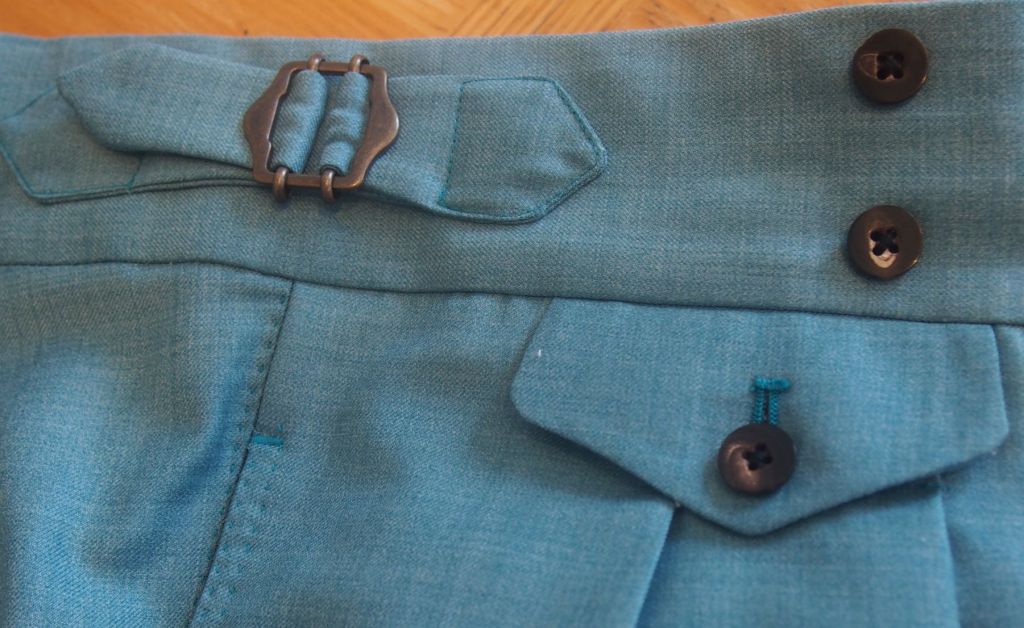
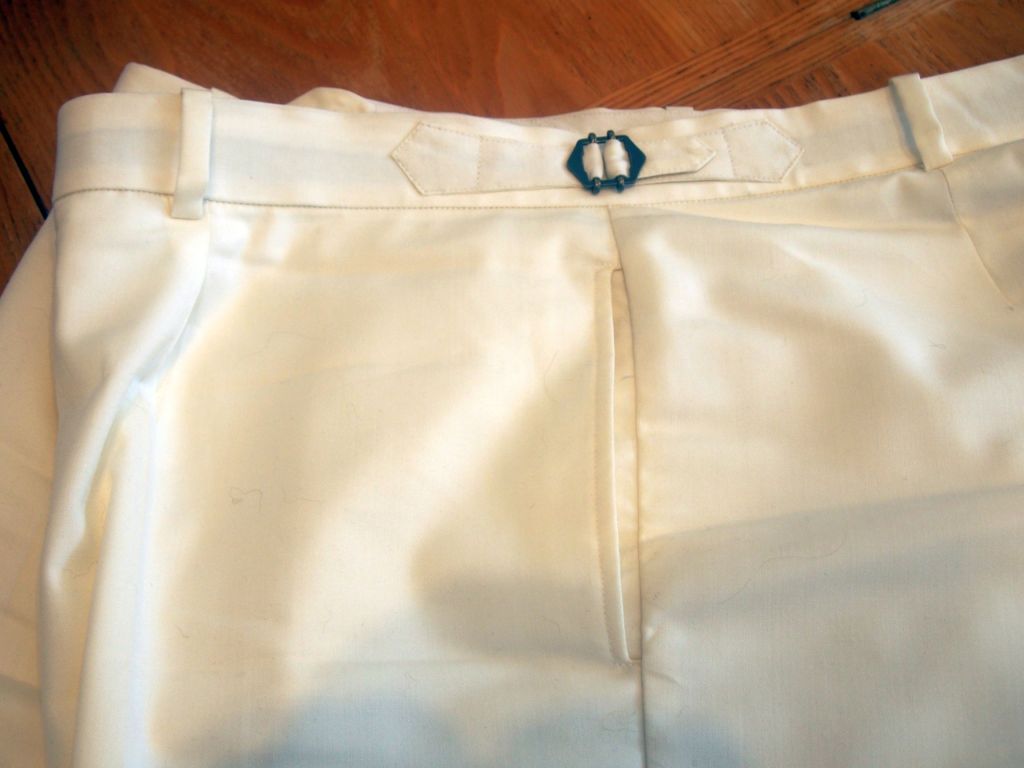
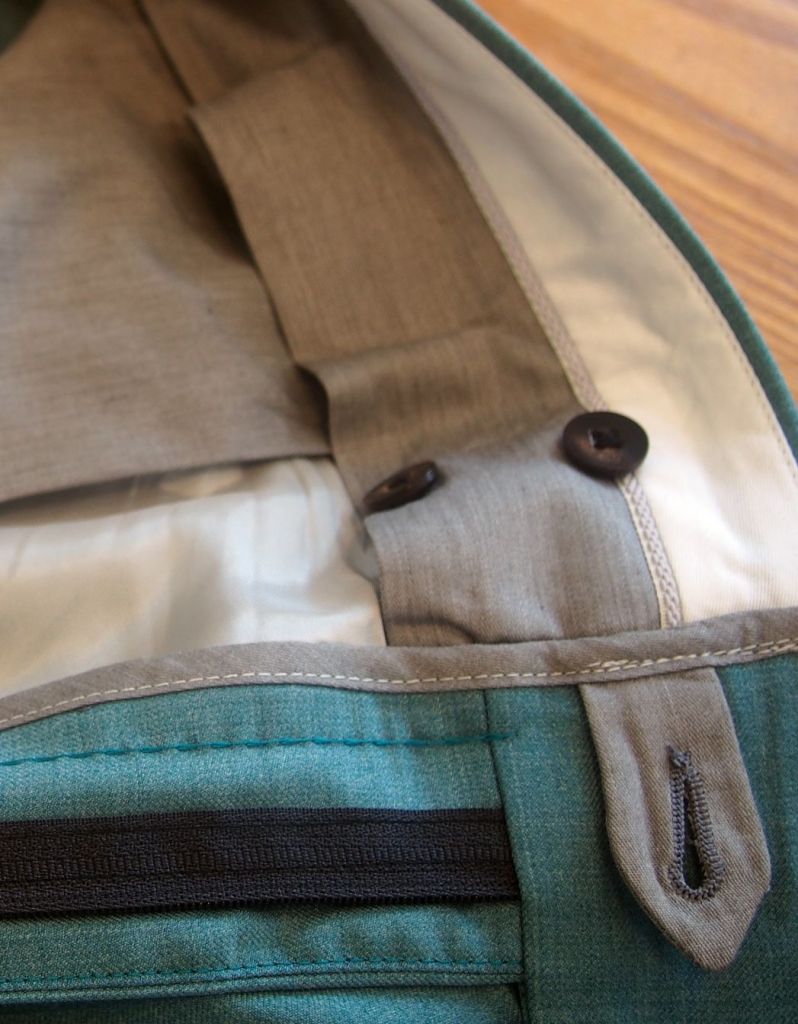
The clothing item in the header picture is one such – a pair of made-to-measure linen trousers that I recently bought from a company in India, which cost little more than a much-inferior pair would on the high street – and which will probably last me for years if previous examples are anything to go by. Such manufacturers are becoming increasingly good at guiding self-measurement and material choices online, and in this case, I took advantage of much-lowered prices, presumably because people are currently wary about buying from India. Apart from an apparent logistics error that sent them from India to the UK via Cincinnati of all places, there would have been little difference in the transport impact – and I have hopefully paid a better wage to those who made them as a result.

There has been much speculation of the impact of the pandemic in moving so much more activity online. I think that will depend not on the mechanics so much as the mindset. If it results in further growth in mindless consumption, as does seem likely, it will undoubtedly be harmful; if on the other hand it makes people think more about what they consume, it need not be.

MacKinnon explained the Japanese word aiyosha – which means “a person who uses a product lovingly”. It is not a rejection of materialism, but about forming a deeper relationship with one’s possessions such that one does not feel the constant need to replace them. That can include accepting that they age – and if they are well-made that need not be a problem. I think this is entirely in keeping with this blog’s philosophy of careful, discerning appreciation of the good things in life.

The appreciation of material quality need not be a source of guilt. The amount of money spent on an item is irrelevant if the intention is only to use it superficially, and ditch it before its time. On the other hand, being aiyosha can be a source of genuine pleasure in our lives. Appreciating quality and individuality are part of that, as is accepting that things will not look new forever. What is more, well-made items are more likely to be repairable, thus extending both their lives and our enjoyment.

I find the search for items that I really like is itself enjoyable, even though it mostly now happens online. It is a world away from the mindless waving of plastic in cloned local “outlets” on a dull Saturday afternoon; the anticipation of delivery is part of the experience, and the revelation of the product when it arrives (usually) a great pleasure. Quite often, small suppliers are still managing to provide a personal touch, such as the hand-written note from a musician in Ireland from whom I recently bought her latest CD, even if it is not quite what one sometimes receives in person in specialist shops.

The real enemy here is mass, planned obsolescence; it is nonetheless what makes the junk economy go round. It also supports millions of jobs world-wide. There undoubtedly rests a huge responsibility on the commercial sector here: if it produces products that are designed to break, while simultaneously pushing the price of higher quality ones beyond the reach of most people, that will make aiyosha, and responsible consumption more difficult – and the result will be ecologically catastrophic. MacKinnon found signs that some companies are re-evaluating their approach, but it is still far from becoming universal.

There is also a responsibility on all of us as consumers: no matter what our price-point, the principle of buying (less frequently) the best we can afford rather than the cheapest we can find still holds. With a shift in our thinking, we can still appreciate good things, while turning it to the benefit of both better-rewarded producers, and the global environment.


Footnote: literally within minutes of posting this article, I was informed by a shirt-supplier in Italy that despatch to the U.K. is suspended because of Brexit. A minefield indeed…

Opinion & Thought, Politics and current affairs

Silver lining?

Five and more years ago, as Brexit and other issues of the post-2008 crash world gathered an alarming pace, I like others found myself wondering, with some fear, what it was all leading to. It was not uncommon for parallels to be drawn with the eras pre-both world wars when things also seemed to be getting out of control. In a sense, we were right – something was coming – though of a nature that few suspected, and it was certainly something that cannot in its primary causes, be called a political crisis. Nonetheless, a crisis it was, and it certainly had a political dimension.

JB MacKinnon’s new book The Day the World Stops Shopping is part of a growing lexicon discussing what will be the shape of the post-pandemic world. He suggests that there have been several times in history where staring into an abyss was necessary to stimulate a ‘correction’ in the direction of humanity’s travel; maybe this is another. In which case, I suggest we have got off lightly – but I still hope he is right.

The Guardian’s architecture critic, Rowan Moore, has also picked up on beneficial changes that may come from the Flight from the Office. Just maybe, some good will come of this ‘new localism’ for our hitherto madly imbalanced and atomised nation. By way of examples, here are some ways in which we, and our small community in East Anglia have been affected.

Five years ago, health considerations forced me to leave full-time employment. Like many, I had commuted out of our town each day, to work thirty miles away. What I never saw until that point was how deserted the place was during weekdays – populated very largely and scantly by the elderly – and young mothers. When I was on holiday, it was by definition the school holidays, which were, themselves untypical of the normal situation.

Particularly when a local convenience store moved to the edge of the town, the centre which a few years previously had always been if not buzzing, then certainly occupied, became practically deserted for hours on end. Since many people started working from home, this has noticeably changed. The regular Thursday market has never been so popular, with several new stalls appearing in recent months.

The photos (top and below – taken on a rather dull day) show two recent developments.

The greengrocer was doing such good business that he has now occupied a vacant shop, renovated it nicely, and now has a seven-day presence in the town: a good, useful local addition that will hopefully endure. The local travel agent also closed during the pandemic, and has not re-opened. In its place, a group of locals has pooled resources and opened a café which also supplies artificial flower arrangements. They opened just before the latest lockdown – but an outside kitchen window – what became known as the Cake Hole (on the left in the picture) – meant that they were able to serve take-away drinks and cakes throughout, while also renovating their inside seating space. They have single-handedly revived the town centre, with outdoor tables and nearby seating pretty much continually occupied during good weather. Passing groups of walkers and cyclists are also making regular pit-stops, and they have further plans for being even more of a community hub. Our town centre once again is an actively ‘inhabited’ place.

Less tangible, but still noticeable, is the sense that somehow the place is less deserted during the week than it used to be. There are more people visibly working at home and popping out into the streets as they need. The whole place feels a little more lived-in, in the way one senses in more clearly vibrant places often not in the U.K.

Changes have also affected us personally. While I now go out to teach again, just twice a week, my wife changed her employment over the winter, becoming a civil servant. Her new employer is in Nottingham, some 130 miles or two and a half hours away. But it has been agreed that she will work permanently from home, with just the occasional trips to H.Q., thus allowing her to accept a position that would previously either been unviable or have meant an unplanned relocation. Others in her team are in Bristol, Newcastle and South Wales, and our home often echoes to a cocktail of (admittedly disembodied) regional accents…

In my own case, most of my non-classroom activity now takes place at home (as it often did, but not any longer during the evenings and weekends…) and I communicate with my students and colleagues remotely. I wonder whether there is a template here that could help to address the risks of burnout in the teaching profession, that ‘got’ me back in 2016.

I wonder how many times this story will be replayed over the coming years, and it may lead for many to improved job opportunities and greater job satisfaction, yet without the need to relocate. It is potentially very good news for all those small places up and down the country, that have been hollowed out in recent years to become dormitory settlements. My wife is now another person present during the day, while the loss of her commute means a combination of more productive time and more to engage in the community where she actually lives. We also (happily!) spend more time together, not least over morning coffee and lunch most days. And we no longer need to get up at ungodly hours.

Despite the social pressure during the last decade or two to claim that one lived for one’s work, it seems that these changes have revealed the truth: far fewer really relished office life or the long commutes that if often required. Maybe this is the opportunity we needed for a real, substantial improvement in the quality of British life.

In many ways, our work-life balance has improved hugely as a result; it is true that not everyone (including teachers) can work permanently from home – but the shift that has occurred has affected enough people that is has still has brought wider benefits, and may yet bring more, if it can become embedded. (It occurred to me some days ago that before the industrial revolution, many people worked at home, so in a sense, this is just a return to a much older way of doing things). We could go a lot further: MacKinnon’s book concerns much wider ecological actions; perhaps this is just the beginning. With any luck, this is the point at which we can start to appreciate the quality of life, rather than just the quantity, as he argues we need to, in order to become properly sustainable.

 Perhaps we have finally learned that life on the hamster wheel is neither very desirable nor beneficial. In which case, the pandemic will be proved to have a real silver lining.

Opinion & Thought, Politics and current affairs, Travel

Will the new “British Railways” be truly Great?

It is hardy news that the British national sense of self has taken a battering in the past half-decade – but in fact, the decline has been going on for far longer than that. It is deeply ironic that the political party that claims to represent most strongly the national sentiment has been most instrumental in demolishing many of the physical expressions of that nationhood, which spoke to people of a coherent sense of community no matter where they happened to live.

A nation exists to a significant extent in the minds of those who experience it; symbolism is important for fostering a sense of common identity and belonging. That in turn is important for creating familiarity with, and loyalty to, a national identity in a way that can embrace the multiple individual identities and ways of life that co-exist in any nation. Done well, they can become a source of shared pride in the institutions that we all use.

I wonder if the politicians who have spent the last four decades fragmenting and privatising most of the key institutions of this country realised what they were dismantling; not only was the disposal of the “family silver” often done at a huge mark-down, but in the process, many of the institutions that embodied the national identity of this country were abolished. We lost a sense of national infrastructure, and a significant part of our sense of cohesion as a result. I am by no means a nationalist by inclination, but that does not prevent me from regretting the way in which this nation’s symbolic institutions have been destroyed in a way that others have not permitted. Having a national “sense of self” need not be incompatible with internationalism, even if some see it otherwise: what I would like to feel about this country is that it can look its peers in the eye as equals, neither better nor worse than they.

This is not about the economic performance of sometimes-inefficient state enterprises, though experience has shown that their private replacements have been only a patchy improvement at best – but the fact that in breaking them up, an important intangible quality of nationhood was also lost. It is perhaps telling that the only one that remains reasonably intact, the NHS, has increasingly become a focus for precisely such national pride.

The infrastructure of a nation needs to stand for more than shallow commercialism; it is a statement of confidence and pride in that nation. It also represents one of the relatively few ways in which citizens can interact directly with the machinery of the State. As such, I have always felt that things like hospitals, schools, post offices and railway stations merited the best ‘identities’ that could be devised: national ikons of sorts.

If that sounds bizarre to British ears, then I can only suggest that we have become so used to seeing such interactions as a simple economic race to the bottom, that we no longer perceive the more symbolic value of belonging that can be a part of them.

Unfortunately, the organs of the British state were run down for years before they were abolished; their supposed inefficiencies were hardly surprising given the low and intermittent nature of their funding. Even in our small town of 5000, the local post office was a civic space; sadly, in its latter years it was neglected to a point of semi-decrepitude, and then replaced by a ‘position’ on the counter of a local convenience store. True to name, its extended hours are indeed convenient – but the loss of civic pride and focus was nonetheless the price we paid. Across the nation, Post Offices have been dumbed down until their civic function was all but unnoticeable.

Another major expression of this idea is the national rail network – but a quarter of a century after it too was privatised, dismantled and fragmented, it seems there is finally hope of a better future. The recent Williams-Shapps report seems to have accepted that fragmentation was a mistake, and that there is a need to re-establish a coherent, national institution.

There has already been plenty of criticism from both left and right; for some, nothing short of full renationalisation will do, while for others, anything that impedes red-blooded commercial competition is anathema. There is plenty of detail to be worked out in the next couple of years, but what matters to me is the fact that we may get a unified national institution back. And that ought to be good for the nation’s sense of self, in the way that Scotrail has become an emblem north of the border.

I’m not hung up on who ultimately runs such institutions and am not unsympathetic to the suggestion that commercial innovation is not something the State does well on its own; maybe there is indeed a place for partnership with the private sector. But I am most definitely unsympathetic to the notion that communal aspects of the State’s identity and purpose should be run solely has hard-driven commercial operations – not least because they have little or no time for the more symbolic values mentioned above. The establishment of a national co-ordinating body (even one with the naff “Great” on the front of the obvious British Railways) is a recognition that railways are inherently an integrated network, whose purpose is more societal than commercial.

If they get the branding and wider planning right, in due course we may end up with a national carrier to be as proud of as the Swiss are of theirs. The signs are again promising: the retention and up-dating of the classic double arrow symbol and the re-adoption of the Rail Alphabet font. Yes, these are seemingly-superficial aspects of a much more profound restructuring – but they can hopefully become the “shop window” for what could become a matter of national pride. I just hope that the final designs are as sleek and forward-looking as the best continental equivalents, and not some horrible, fake-heritage return to the “golden age of the Big Four” pre 1947, or some bombastic confection that majors on in-your-face Union Jacks. There are more subtle ways – but on this, I am less confident…

The key things needed are adequate funding, long-term certainty and operational freedom; if those are delivered, it will indeed be progress in this short-termist nation. The signs are surprisingly good – we now need to see them converted into practice, with simpler ticketing, more coherent timetables and trains designed for quality not capacity-maximisation. Whether the private sector will be sufficiently interested in fixed-profit concessions remains to be seen, though it presently seems they will: after the Covid bail-outs, they are in no position to argue.

Equally, it should be made impossible for them to boost their profits by cost-cutting, which is inevitably reflected in the quality of the service. I am encouraged to see this government (which I mostly despise) accepting that state oversight of state assets is a desirable thing, in the name of public service. I think that is a more major shift in mindset than has yet been realised, and it would be good to see it extended to other sectors. Covid has made clear the necessity of good public infrastructure, and the limits of the commercial sector for providing it. If a sweet spot can be found whereby private-sector skills are harnessed for the public good, in return for a reasonable payment, that is indeed very encouraging, and I think ideologically acceptable.

The key thing is that the public interest (for which read the state) that should be calling the shots, not opportunist private profiteers. That includes valuing the more symbolic aspects of national life that have been ignored for far too long: when I am moving around the country, I want to feel as though I am in the care of the State in which I travel, not just a figure on a private company’s spreadsheet.

Opinion & Thought

Full flow

One of my go-to books during times of difficulty is Flow by Mihaly Csikszentmihalyi, and I’m currently re-reading it. By no means a trite self-help book, it offers inspiring and challenging advice on using one’s life to the full.

The author is a world-renowned psychologist, and yet he seems almost unknown to lay audiences despite his having written several general-readership books, including the one mentioned above. His work has involved collaborations across the globe, into the nature of the most fulfilling experiences that people can experience. I suspect there are many millions more who could benefit from his insight.

The important message  – and my reason for mentioning it here – might be summed up as, “it’s not what you do, but the way that you do it” that makes all the difference to a fulfilled life; something that I think is also encapsulated in the spirit of Sprezzatura. It also seems to come as close as it is possible to, to justifying the claim that there are indeed ‘better’ and ‘worse’ ways of living life. The catch, of course, is that these are not necessarily to be found in the expected places. Above all, trying to conform to external criteria about what life ‘should’ be, is doomed to failure when it comes to personal satisfaction.

Csikszentmihalyi’s research found that the nature of profound human satisfaction does not differ very much across the world, even between extremely different cultures – though the ways in which it is achieved may do. The principal distinction is between things that are done for their intrinsic pleasure, and those that are done with an expectation of external pay-back. Flow and drudgery can be found in the same activity; the distinction comes from the motivation and mindset involved. The book is not excessively judgemental of modern society, but it does lament the extent to which modern life, attitudes and behaviours have been increasingly driven by precisely such external interests – and correlates it with human beings’ failure to grow life-satisfaction by anything like as much as they have their material wealth.

Flow arises when having an ‘optimal experience’, to which Csikszentmihalyi gives the name “autotelic” – in other words, an activity which is its own goal or purpose; a matter, perhaps, of the journey being the destination. In the state of flow, a number of things happen, including total absorption to the extent of losing one’s conscious sense of self, and the loss of a sense of time. Also unimportant is any defined ‘reason’ for doing the activity: it is its own reason.

This is how, over time, people come to have complex experiences – in other words ones where the task is closely-matched to their competence, such that they experience neither the anxiety of inadequacy nor the boredom of under-challenge. Instead, they experience a rewarding sense of personal agency.

Another essential aspect of Flow is that the actions that create it have to be voluntary; if they are externally commanded, this puts us straight back in the realm of activities that are extrinsically defined. However, the strength of this concept is that almost no activity need be excluded; the secret is to define whatever one is doing on one’s own terms. Perhaps the most persuasive aspect of this comes from the way even people held in solitary confinement often redefine their situation in terms of tasks or challenges they set themselves to stop them losing hope or sanity. Even in the most extreme circumstances, the mind has the capacity to take control of its own actions and turn them to benefit.

The conundrum with Flow is that the more competent one becomes, the greater the demands need to be in order to maintain the required level of challenge. While this may seem unrewarding, it is actually the key benefit of the whole concept: in effect it defines the process of human growth. By accepting such challenges, we inevitably become better at things – and by doing so, we refine our understanding and appreciation in a way that moves us from ignoramus, through novice, to expert. But we still need to remember that the only way that works is to do this entirely for our own satisfaction, not for any kudos that it might bring.

And that brings us neatly back to the underpinning idea behind this blog: that almost everything in life is worth doing – but the greatest ‘worth’ comes not from just doing it any old how (as modern society often seems to suggest) but doing it well; from allowing our innate curiosity to guide us towards the niceties of life, where we increasingly refine both our competence and our appreciation of every aspect of life, simply for the self-satisfaction and personal affirmation that it brings. Thus, doing things well – that is with complexity, skill and deep appreciation – is nigh-on objectively better than doing them in a trivial, superficial and extrinsic way. Or than simply never engaging with them in the first place.

Sadly, modern attitudes to discrimination seem to have been misapplied here: those who become connoisseurs in their chosen fields often tend to be lambasted for their perceived elitism, rather than envied for the personal reward that deep appreciation and expertise can bring. Or maybe it is that they are seen and envied for somehow being superhuman, when all they have done is apply a mindset and technique that is actually available to everyone. The error is to judge them according to perceived societal (i.e. extrinsic) values, rather than appreciate that the whole point of deep appreciation and skill is not the acclaim it can bring, but the internal reward of just doing something well. The fact that Flow can be found in almost anything – even something as mundane as doing the housework – comes down to the way one approaches it, rather than the inherent nature of activity itself.

Those who look on, perhaps criticising the perceived, apparent ‘superiority’ of people who make this journey while never bothering to do so themselves, will never begin to understand by just how much they are missing the point. The point of Flow is definitively not to impress; just to lead a satisfying life. Modern life (even in lockdown) can be dull, trivial and pointless – but it doesn’t have to be; all the difference lies in our heads.

Opinion & Thought

Narcissi

In times like these, when we cannot be sure what even the practicalities of life will be like twelve months’ from now, it’s not surprising that there is much debate about what life more generally might be like in future. Writing in the latest edition of Prospect Magazine, the Archbishop of Canterbury calls for a renewed appreciation of the interdependence of people everywhere. More or less what you might expect the nation’s senior cleric to be saying – but Justin Welby is a rather more grounded individual than some of his predecessors, having worked in industry before moving into the Cloth.

It’s perhaps unsurprising, then, that he quotes from a recent book by Mark Carney, the former governor of the Bank of England. Carney mentions an encounter with Pope Francis, who told him, “Your job is to turn the market back into humanity”. Carney develops this theme and discusses how the ‘market economy’ has increasingly become a ‘market society’ in which things essential to a fulfilled life, such as beauty, happiness, joy and relationships have been either marginalised or commodified. For many, life has become the functional exercise in economic rationality that classical economics always pretended it is; anywhere where life is lived solely for its financial efficiency or expediency, this is in effect the case. Anywhere where non-earning life is spent in ‘recreational’ expenditure, the same force has taken hold. Imagination, culture and creativity do not often put food on the table.

I suppose that Sprezzatura blog was started to express my instinctive recoil from this. I have always found that the things that make life worth living, as opposed to tolerating, are far more diverse than those which figure in a purely economic sense. I have always been at a loss to comprehend the many who seem to find agency and self-fulfilment only in employment. Certainly, the wider experience of purposeful work can contribute many things to our lives beyond the simple meeting of economic necessity – but is that all there is to it? Over the years, I have been left with the impression that such people put so much of their time, effort and attention into their work that they inevitably neglect the rest of their lives, the things that might make them “rounded human beings”, equally competent in all aspects of their being. Even their earnings (and what they can be used for) seem of little consequence compared with the act of acquiring them. But what, fundamentally, is the point of living to work?

Bertrand Russell observed that ‘work’ is a construct devised in order to occupy people; there is truth (and probably necessity) in this. He also suggested that its effect has been to quash the necessity of devising more constructive and enjoyable ways of spending our time. He was not precious about this, emphasising the importance of play as well as highbrow activities. He argued that the constructive use of leisure is one of humanity’s last big challenges – but avoiding the issue simply leaves us facing a life of relatively meaningless toil. True, the rewards of work can be wider than this, but for many, the reality is that they spend more of their lives enriching others (not only materially) than they do themselves.

I wonder why this is acceptable. Perhaps the national mindset has something to do with it – and in recent decades, that has indeed placed Work on the high altar of life’s purposes. The expected decrease in workload that was to derive from modern technology has not happened; the work has simply changed in nature. What’s more, cutbacks may have imposed greater loads on those who remain. But I fail to understand those who, it seems, will sacrifice almost any other aspect of their lives for their work.

My mind is still troubled by the notion that so much of that effort has often gone into the furtherance of people other than ourselves, many of whom show no intention of neglecting their own lives, even as they expect that of us. I don’t see it as selfish or narcissistic to assert our own value as human beings, or to ensure that our own lives flourish too: “Attend to your own oxygen mask before helping others with theirs”.

In economic terms, the capital we accrue for others yields far greater returns that the labour that we provide does for us; even in the public sector, executive pay in health and education has pulled away from that of the mainstream workforce, to the extent that I conclude that this is a functional consequence of the quasi-privatisation process. An equitable deal it is not, without our having to give them our souls as well.

All of which led to a certain reaction recently, when it was suggested that the concept of ‘the Good Life’ which Sprezzatura promotes, is self-indulgent; even rather narcissistic.

I’m not quite sure what is so wrong with the idea of a good life. I wonder if the suspicion is a hangover of the Protestant Ethic that still seems to drive our attitude to work – perhaps coupled with the class-memory of a long-hierarchical society: Life is not meant for enjoying; not if you are Us, anyhow.

I would be the first to agree that defining life only in material terms is likely to be unsatisfying and shallow. There has been enough observation of status anxiety to suggest that people who pursue fulfilment via this route rarely find it. Human psychology dictates that material possessions lose their early allure, and the only chance of rediscovering the buzz of ownership comes from buying more, of being perpetually dissatisfied. What’s more, it is all too easy to confuse the motives: where ownership of desirable possessions is perceived as the measure of both personal credibility and social standing, it is all too easy to be swept up into the cycle of mindless, competitive consumption.

I don’t think that scenario really meets the definition of a fulfilled life. But I should add, I don’t think we should feel unduly guilty about material possessions either – provided they are owned knowingly, and for the ‘right’ reasons. While they cannot bring us limitless reward, ownership of genuinely-treasured things can still make an appreciable difference to our lives.

William Morris captured it when he wrote, “Have nothing in your house which you do not know to be useful or believe to be beautiful”. Substitute “house” for “life” and we might have something to guide us here. The important thing is not the status that possessions (whether material or not) may bring, but the joy they can (with limitations) add to our lives, when defined purely by our own criteria. This is not narcissism, but an honest appreciation of that which enhances us.

I lack sympathy equally with those who go out to work in order to stuff their lives with status symbols, those who are too busy working to notice or care what occupies the rest of their lives – and those who deny that any kind of personal comfort or other active choice is anything other than the work of the devil.

It is true, material possessions alone do not do the job. A useful concept here comes from Aristotle:  Eudaimonia, or the concept of flourishing. That word helpfully encapsulates all those things that can lead to human development and growth, including both material enjoyment, but also the non-material values mentioned by Carney. Denying the validity of any of those things only risks diminishing our lives from what they could be in one aspect or another – and for me, Sprezzatura is the vaccine against such risks.

While the word originally refers to an approach to (male) fashion, it has wider implications for the care we devote to our lives, without becoming hidebound by externally-dictated practices. It is also notable that sprezzatura does not define a specific style, so much as the bending of the rules according to unique personal interpretation, in order to please ourselves.

It is true that sprezzatura can become narcissism, as the Peacocks of the Pitti fashion fairs show – but this is because they have lost sight of the spirit of the thing: they are out only to attract attention.

True sprezzatura, I would argue, is better balanced; it is certainly concerned with the effect that one has on the world around us – but its real motive is self-expression. Why else would it have that rebellious streak?

Recent psychological research has suggested that there are in fact two kinds of narcissism: that which really is the expression of people who love themselves just too much – and a (perhaps more common) type, which is in reality the over-compensation of those who suffer from low self-worth. I think this is a critical distinction when it comes to reading and even judging those who appear to suffer from narcissism.

All of which might leave us wondering where a reasonable balance might be found, between self-indulgence and self-denial.

There are, no doubt, as many ideas of what makes a fulfilled life as there are human beings. For all that this blog advances certain preferences, it is not its place to criticise those who have different tastes or ideas. The real problem is not those who have a different idea of fulfilment, so much as those who have none. Lives that appear empty, where external validations such as work are the only reason to live them.

Yet who am I to judge whose they might be, or what they might do about it?

The opposite of Eudaimonia is presumably some kind of emptiness, lassitude or decline: the sort of experience that has seemed common during the Pandemic lockdowns. For all our diversity, homo sapiens seems to have some fairly universal basic needs. Amongst those might be social contact and a sense of purpose, and recent times have widely challenged these things. I would go further and suggest that there is something approaching an objective measure of these things’ impact – namely our state of mental (and to some extent physical) health: more things that seem to have suffered during the past year. I also suggest that those who have a richer internal sense of self may have been better equipped to deal with such challenges. Their ‘purpose’ is their own, ongoing lives in all their facets – and those have never deserted us.

Those fundamental needs represent both a challenge and a threat. The latter because their neglect can lead us down the rabbit-holes of poor wellbeing, and the former because it may well be their constructive, autonomous cultivation that provides the sense of eudaimonia that we need to be fully well.

In simple terms, we have to eat – so we might as well make it something to be actively relished as a joyous part of life: food not just fuel. We need shelter, so we might as well make our homes places where we can feel safe, comfortable and rested. We need to dress, so we might as well do so with imagination and style, that both expresses our personalities and tastes and hopefully brighten the day of those we meet. We need to placate our restless minds – so we might as well make it fulfilling.

And so it goes on. If life is worth living, it is worth living well – both for the moment-by-moment satisfaction of doing things to our satisfaction, and for the personal growth that developing such competence and (self-) knowledge brings. That requires active reflection and discernment – things that take the time that work all too often precludes. We can make of our internal lives as much or as little as we choose, no matter what our outward circumstances. That does include their material dimension – for we cannot attend to those inner needs without attending to their outward expressions.

Neither need we pretend that it is easy; life is never smooth for long. My own recent experience shows that the possession of a ‘good life’ is not always sufficient to prevent difficult times; but I am still absolutely convinced that the same good life is part of the antidote to those difficulties. Without holding on tight to the things in life that I truly value, I would have struggled much more with the challenges of recent months and years; I would have had no Pole Star on which to focus while the currents of poor mental health pushed me hither and thither.

I cannot claim, therefore, that sprezzatura is a failsafe vaccine against adversity; but its apparent absence from people’s lives is, I suggest, indicative of something. The neglect of the basic aspects and needs of one’s life speak of individuals and society that ultimately places a low priority on its own eudaimonia. That they often splurge on meaningless consumerism, externalising their search for happiness in the act of Purchasing, is just the other side of that inner void. That, to me, is akin to having lost any sense of the meaning of life – and poor health can sometimes be the all-too-real confirmation of that. It is easy to make the fundamental mistake of thinking that both eudaimonia and sprezzatura can only have material manifestations, whereas in reality all the non-material aspects of life are at least as important, just not as visible. My understanding of sprezzatura incudes the mind as well as the body, hence many of the topics covered in this blog.

Those who look on with a protestant sense of denial or disapproval are ultimately making their own choices. But it’s worth remembering that perceptions vary around the world: there is no absolute standard for either fulfilment or narcissism. So too does the joy with which different cultures live; I am not only thinking of the original Italian version here (Latin (ex-)Catholicism comes with its own hefty dollops of sorrow) – but it is perhaps about effects which various attitudes can bring to our lives. To what extent are people following different routes really happy? At least in a secular sense, that is the only criterion that matters. I accept that true narcissism is perhaps not really a route to happiness – but I am not sure that the self-denying, empty functionalism of other lives is really any better.

I suspect that inferiority-narcissism is indeed more prevalent than the truly self-aggrandising type. And I don’t think it is harmful. Our eudaimonia might even benefit from rather more of it. The consequence not letting it loose is the prospect of undervaluing our own lives simply because of received or imposed expectations of meaning and appropriateness, and living them less than fully, simply through fear or guilt of having higher expectations of what they might be.

Hopefully, the empty, consumerist rat-race of recent decades has now been shown for what it was: in the end, other things mattered more. That better future cannot only refer to material consumption, and not to work-as-life either. It needs to refer to a more holistic and balanced understanding of what makes a good life, of living every aspect of it to the full. The important thing is that people think for themselves about what that might mean. But unappreciative denial of the good things in life – wherever they come from – is surely not part of it.