 ijstock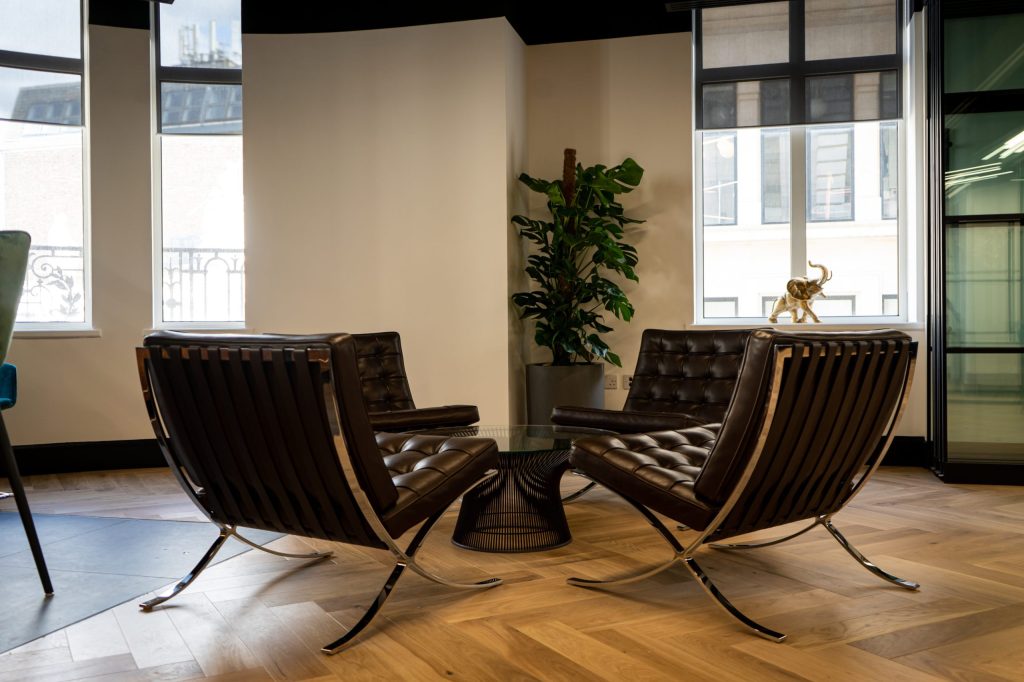
There are some things that are just a step (or two) too far. With a baseline price of over £5000 rising to over £10,000, the Barcelona Chair from Knoll falls firmly in that category. And from first-hand experience, it is not even very comfortable. (The angle formed between the back support and the base of the seat feels too small). A case of form before function? It would not be the first time that architect Mies van der Rohe fell foul of that criticism.
Yet I have always greatly appreciated this particular design, and you only live once… It is indeed an exquisite chair, with the elegant X-form to the legs, and the understated, seemingly-propped leather cushions. On the original, each square of leather was individually sown together, and then the piping was added. The process is almost entirely artisan, which no doubt does contribute to that price tag.
The Barcelona chair was designed in 1929 by Mies for Spanish royal visitors to the German pavilion at the Barcelona exposition of that year, and given recent changes to copyright laws, it will remain a restricted design in some places for some years to come. In theory, therefore cheap reproductions should not exist – especially as the law was tightened up in 2016.
But they do: a quick search online will show that it remains possible to buy reproductions at a fraction of the price of the licensed version, mostly made in China, and of very variable quality. We can be sure, for example, that those cushions will certainly not be made from individual squares of leather (the cheapest may not even be real leather at all…) – and I would not have a lot of faith in the quality of the welding either.
All of this presented me with a dilemma: I have always wanted to own a piece of this design, but shelling out such amounts for something that is not even comfortable was out of the question. So is it reasonable to buy one of the replicas? Not only are there the practical considerations, but also the ethical ones too.
On the one hand, I am not in favour of flouting laws (copyright or otherwise) when they happen not to suit you – but against that, one might also have reservations about the restrictive practices that keep the costs of the original so astronomical. Is there really any justification beyond a closed market for charging such figures for a design item whose designer died in 1969? And yes, I know the same argument might be applied to items like Rolexes and indeed fine art. Can one ever justify a copy?
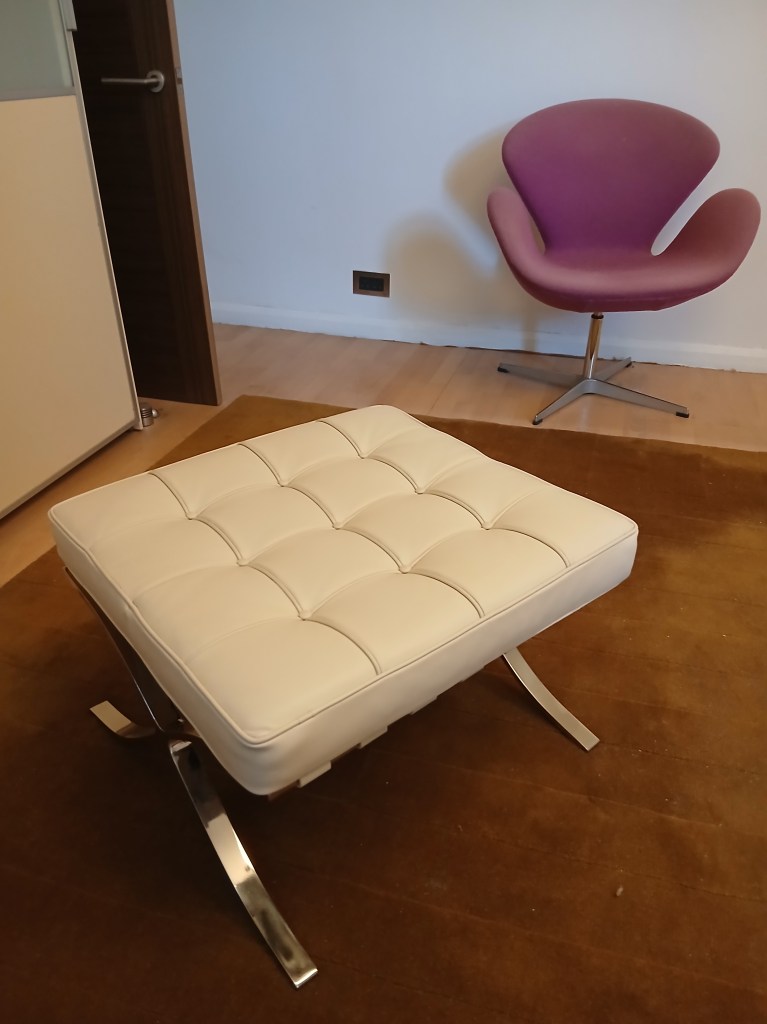
So what to do? The reason it is even possible to manufacture replicas is that they are constructed in places where the original patents have already lapsed, or were never recognised in the first place – and they are normally sold as “in the style of” rather than originals. There seems to be little sign of a crackdown on such practices.
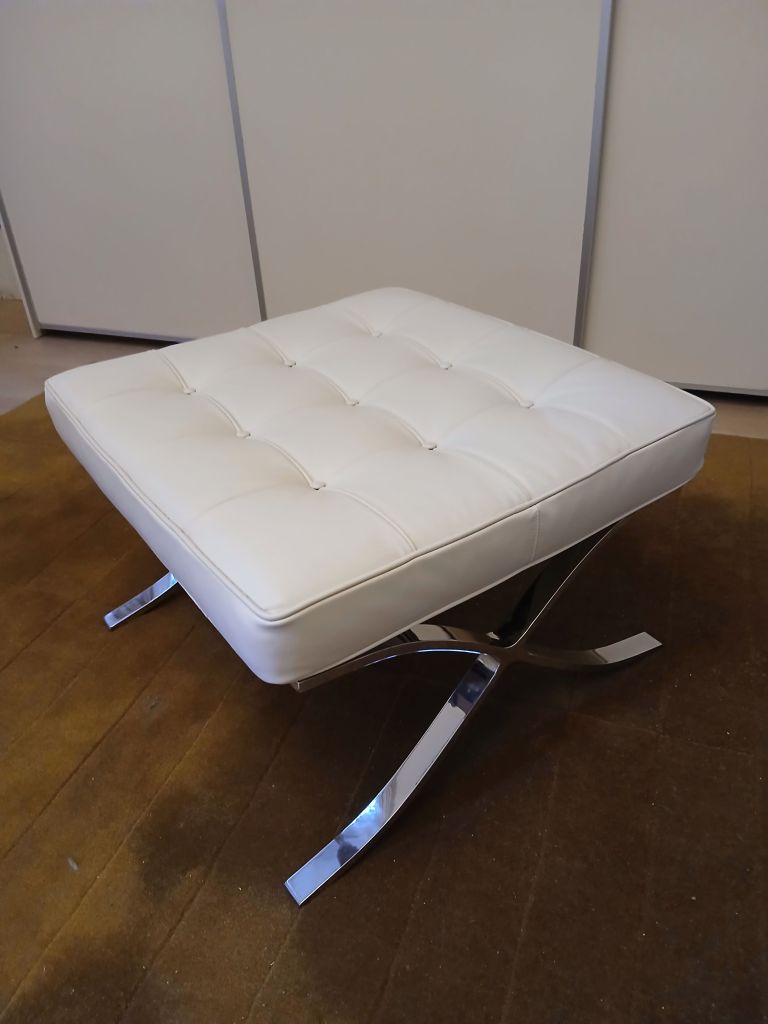
The design issues were solved by deciding to purchase the ottoman stool rather than the chair – the basic design style is the same – but without that awkward back angle. And an exhaustive search of potential suppliers led me to Iconic Interiors, based in Hull and led by Mark Holdsworth, who seems to be a genuine enthusiast for this furniture. He sourced his own version in China, but has taken great care not to compromise on the quality of the materials, the dimensions or anything else. The leather is top-grade aniline, though no doubt the individual squares are not there (if this matters…). The only significant omission is Mies’ signature stamped into the frame as is the case on the Knoll version. His Barcelona ottoman sells for about 20% of the price of the Knoll, which still makes it a more significant outlay than the really cheap copies. In its own right, it is a piece of good-quality furniture that so happens to replicate a classic design.
Mark’s items have been placed next to originals and found to be indistinguishable in quality by experts. And so, from the item that eventually arrived, it seems to be. Time will tell how it lasts, but first impressions are very good indeed.
In fact, this is not the first time we have taken this approach, as we have owned a replica Jacobsen Swan chair for some years now, also made in China, and bought from a now-forgotten company. However, once again, I refused to be seduced by the lowest price, and ended up with an item that seems to be standing the test of time well enough, even if the fabric used is not, I suspect, quite as durable as an original.
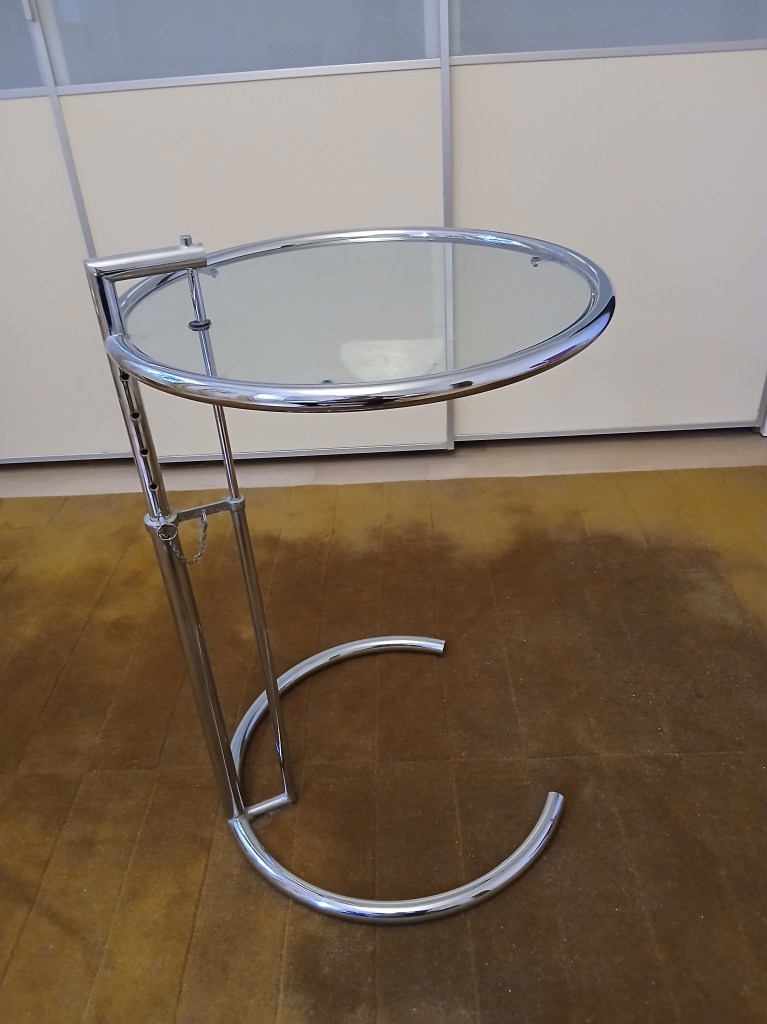
When it comes to “original”, the mark with modern classics of this sort is a piece either made continuously by the company that made the original (it does not have to be old) – or more contentiously, by the company that bought the original licence – as is the case with Knoll and the Barcelona chair. In the same room, we have an original Eileen Grey side table – and it has to be said that no difference in quality is discernible between that item and the two reproductions.
Does it make a difference in one’s mind? Well yes, of course, the knowledge is always there that one owns a replica – but what constitutes ‘original’ and ‘replica’ is complex. Knoll only acquired the license in 1964, and the name “Barcelona” came even later. So Knoll did not manufacture the 1929 originals, so in some sense, their model is no more ‘original’ than any other.
For those of us without infinitely elastic budgets, the choice is between owing a replica or nothing at all. When it comes to fine art, not everyone can own an original Picasso – but that has not stopped countless prints being sold, entirely acceptably, to those who appreciate such things; nobody objects on licensing grounds, to different orchestras performing the works of the great composers. I don’t really see why furniture should be so different. In that light, I don’t regret the choices we made here; the key has been to remain as faithful to the originals as possible and not dilute the designs for the sake of cheapness.
They still add a great deal to the rooms where they stand. Democratic Design says amen to that.
 SPREZZATURA