Opinion & Thought, Travel

Travel confuses the mind.

panettone

Musings of a cultural magpie, part 2.

They say that travel broadens the mind. Sometimes, I think it just confuses it.
Over the years, I have been a house-guest of perhaps half a dozen French people, sometimes for a week or more at a stretch. I have visited the homes of a good many others, not to mention some of their schools and workplaces – and have hosted a similar number in return.

Hardly a representative sample of a populous nation, of course, but perhaps rather more than average for a Brit. It’s hardly surprising that those people were all quite different in both personalities and life-styles, just as individuals are anywhere – and yet my dominant memory of them, collectively, is their overwhelming Frenchness.

I had similar experiences in Germany, with the added complication of being nowhere near as competent a German-speaker as a French. Luckily, my hosts all spoke good English, and the same is true of Switzerland, where I have the most enduring friendships. Once the language issue is minimised, you can progress.

I recall the timidity with which I first made such connections, something that has fortunately lessened over the years. While this was doubtlessly partly a matter of personality, I suspect that neither is it an unusual experience. Anxieties perhaps hinge most obviously on language and food, tinged with a less-focused fear of making an unintended faux-pas. At a deeper level again, I was aware of a self-imposed sense of being an “ambassador” for my country. It ought to be possible for people just to be people, no matter where they come from!

But for all that the British may carry the extra baggage of their self-perceived ‘apartness’, I doubt that such anxieties are a one-way affair; indeed the comments and behaviours of those who have stayed with me suggested as much. To some extent, it is a simple matter of unfamiliarity.

What this perhaps betrays is the fact that national identities still matter; that despite several decades of intensifying integration between the nations of Europe, we have yet to cast off those national characters and become some kind of bland, homogenous Euro-citizen, the kind of thing of Eurosceptics’ worst nightmares.

I think the cultural dissonance that we experience on such occasions is entirely natural, and nothing to be ashamed of, even if it makes sense to try to overcome it. In fact, it is just as possible to experience similar feelings in an unfamiliar part of one’s own country, or with people whom one does not know well. All the nationality issue does is raise pre-existing stakes somewhat. Yet despite that, when travelling around one’s own country one is not, I think, struck firstly by its homogeneity. From the ‘inside’, such things are taken for granted, one notices subtle differences more quickly – and it takes something exceptionally symbolic to prompt the “so English” response. I’m pretty sure that the same phenomenon applies elsewhere: we just take our own cultures for granted.

Yet our tendency to “other” people is more difficult to overcome than we like to think. There is evidence to suggest that it is a natural survival instinct, and such things are not easily over-ridden: it takes a great deal of work to remove all illiberal thoughts. Even though I am entirely comfortable in the countries that I mentioned earlier, and despite the fact that I know some places and people in those countries better than plenty in my own, it can still be difficult to get beyond that first-level sense of ‘otherness’, even when it is a wholly positive experience.

I still tend to think of Swiss friends, French friends, German friends – not just friends; I expect it is reciprocal. In recent years, I have made progress in this respect. Some of my Swiss friends, in particular, are now so familiar that the nationality issue has (almost) disappeared, and I just think of them as discrete individuals like any other – until they say or do something that re-emphasises their otherness… Can it ever disappear completely?

But it has taken a lot of years and shared experience to get to that point. With people I know less well, it is less easy to do; again, I suggest this is quite normal, and not only an international problem. (I sometimes wonder what lies behind the public bonhomie of EU leaders’ meetings: do they really share so much that the national differences are secondary?)

The same is true of places: those that I return to year in year out have eventually become just places (almost) like any other where I spend part of my life. When we are in Basel, it is almost impossible not to flit between three countries just in order to function. Our friends live within about ten minutes’ drive of both France and Germany; their son went to school in ‘another’ country; they own a second home in Germany – about a hour’s drive away. Eventually, you start forgetting which country you are in – certainly between Germany and Switzerland; France is a little more ‘different’ – and that difference therefore perhaps intrudes more. (I wonder, though if that is true for the Swiss and Germans too: I don’t think I would ever mistake Scotland or Ireland for England, for all that we share so much…)

I suppose it would be possible to criticise all of the forgoing quite heavily. It could be a purely personal difficulty, that many people don’t experience at all. But I somehow doubt it: my feelings are born from many years of deliberately confronting the issue. I remember just how (needlessly) intimidating my early trips to other countries were – and I can see the journey I have travelled. Much evidence suggests that the bulk of the British population, at least, is still in the starting blocks. I don’t think an annual foreign holiday comes anywhere near adequately addressing it: you have to access local people and places for a start – and you have to keep going back.

I suppose that it could even be seen as a form of racism: the confession of a limited mind that can’t escape its own constraints. Perhaps – but it is not for the want of trying. It is born of decades of experience – and I suspect that anyone who claims it isn’t remotely that difficult really hasn’t thought about it very deeply. The more I understand these issues, the more complex and intractable they can seem…

Where does this leave us in terms of our own national identity? I ended part one by saying that I don’t like much of what I see of my own nation’s modern identity. I find little there that I wish to “own” – which is why I have gone looking elsewhere for something that is meaningful to me.

Yet I suspect that we can’t ever fully escape the culture into which we were born. Emigrating to another country might be a valiant attempt – but the extent to which one can ever really become someone else is doubtful. Despite citizenship tests, taking another nationality is fundamentally a legal and financial matter; I doubt if that act alone ever really changes one’s mindset very much. I suspect that people who live abroad are ultimately destined to be perpetual outsiders, perhaps eventually in their native lands too. They risk becoming – dare I say – “citizens of nowhere”. Perhaps that is why many are so sensitive about the label ‘ex-pat’?

So, much as I love my perceptions of certain other countries, I remain highly suspicious that they are anything more than romantic stereotypes, born of one’s inescapable tendency to generalise. Neither am I convinced that fleeing a country in which I feel almost as much a foreigner as anywhere else, would actually solve anything. The daily routines might change; familiarity would definitely increase – but would that experience destroy precisely what I appreciate about those places as an outsider? Would greater familiarity just breed contempt of what I previously admired?

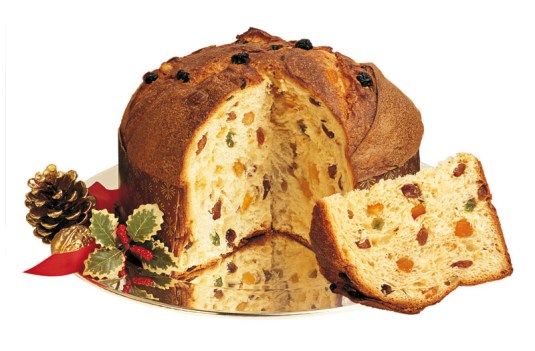
There is, however, no law that says one should only be influenced by one’s birth-nation, no matter how nationalists might want it that way. People have been inspired by what they encountered abroad for centuries: it was the whole raison d’être of the Grand Tour. Somewhere along the way, we can cross a rubicon from infatuation to genuine adoption. Part of that no doubt involves getting past infatuation and moving onto marriage. By doing that we both remove “foreignness” and simultaneously make ourselves a little more cosmopolitan. Now that panettone, for example, is eaten throughout Europe, is it now less Italian – or are those doing the eating a little more Italian? (And what happens when we Brits do what we always do and adulterate it, or turn it into bread-and-butter pudding?)

I think one thing is certain: this is neither a quick nor easy process: extending one’s cultural horizons beyond one’s national ones can set up all sorts of conflicts. Maybe this is, too, what the much-derided “Little Englanders” are afraid of. Perhaps it is all the worse because of the relative weakness of their home culture?

Facing it can be a challenging proposition – but especially so for those who rarely venture (in their heads, if not their bodies) beyond their own little island.

(Final part to follow)

Opinion & Thought

The wood and the trees of an English Christmas.

cog19

Taking a crisp Christmas evening turn around the small, ancient town where we live, my thoughts returned to something I had read a few days before. Quite a few of the houses were in darkness, but in others, still-open curtains allowed glimpses into timber-framed rooms where formal tables were set, or the remnants of the Christmas lunch lingered. Children lounged on sofas, engrossed with digital devices, while candles flickered in inglenook fireplaces, occasional hints of adult laughter somewhere out of sight. If anywhere, then surely this is where the heart of the nation is to be found, and on this of all nights, in this most turbulent of years? Was this much-needed evidence of a nation at ease with itself?

I’ve never paid very much attention to the repeated suggestions from a number of commentators that there is a crisis of English identity. Not because I necessarily disagree with the premise, but because (despite my roots) English identity simply didn’t interest me very much. I’m not sure what it is, for a start. For all that one gets a certain impression in a small, relatively affluent town in the liminal lands where the Home Counties merge into East Anglia, I was all too aware that it is hardly universal.

At the precise same moment as I was walking, there were rather different scenes being enacted within a matter of tens, or at most a few hundred miles, all of which exert their own claim to the national identity. The mean and glossy streets of the capital are a mere 45 miles away – where both international oligarchs and destitute homeless continue their proximate but parallel lives. I was aware, too, of places I know in the midlands and north, that still feel dour and abandoned decades after the last heavy industry closed. I know of the bed-sit land of faded seaside resorts, the remaining fishers and farmers scraping a living from the northern hills and harbours, and I know about the drug and knife-crime – and the bland, cloned suburbs – of the big towns and cities where nine in ten Britons now live. I wondered what significance a “national identity” could possibly have.

What’s more, I’ve long set my sights further afield: I know communities in Germany, Switzerland, Italy and more, which somehow always seem more appealing, more characterful, more vibrant, and more cared-for. I’ve been to autumnal and Christmas festivities in countries where such things seem to have an intensity, warmth and authenticity that make English efforts look watery and half-hearted. These images, too, are particularly potent in December, not least because their traditions have gradually infiltrated ours, to the point that it isn’t clear any more what ‘English’ actually is.

It’s been a long-term process of course. Much of the English Christmas is a Victorian confection, with a hefty chunk of German import, courtesy of Victoria’s husband. More recently, we’ve added German Christmas markets and stollen, Italian panettone, and Scandinavian hygge. Ironic, really, when you know that much of the community has just voted to cut itself off from Europeanism. And there has, of course, been a hefty and brash dose of Americanism, too.

The thing about Christmas, of course, is tradition: precisely that to which one might turn in search of a nation’s true identity. But once again, I am faced with not knowing what to make of it. A few weeks ago, my town also had a “traditional” Christmas market of its own, an enjoyable community event that happens every year – but dominated by loud pop music and flashing lights. On Christmas Eve, we had carols around the town tree; a good few hundred turned up, but few seemed willing or able to sing very well, and most seemed more interested in the arrival of Santa Claus to the strains of Wizzard’s I Wish it could Be Christmas Every Day. Well, I suppose it has become a tradition of a sort – but it is, for my money, hardly the stuff of national identity, at least not one I would want to identify with.

It is telling that there have been several complaints this year, that the relatively recent import that are Christmas markets is rapidly being turned into just another fest of cheap commercial tat at odds with the experience abroad. That is certainly my experience: every second-rate garden centre now has a few sad kiosks that it brands “Christmas Market” on huge plastic banners along the adjacent trunk roads. Somewhere, something – quite a lot in fact – is being lost. Not only can we not maintain our own genuine traditions, but it seems that we can only debase the imported ones too.

I find it all genuinely saddening. It’s not that I’m humbug. I love the festive season: it is the one time of the year when tradition almost gets the better of my modernist tastes – but it also seems to me to be the time when our lack of authentic English culture – and its replacement with a cheap plastic version that comes pre-assembled and microwave-ready, is at its most blatant and repulsive.

Yet the article cast a rather different light on this. It struck home where others have not, because it argued that Englishness is in crisis precisely because it has, for too many for too long, been defined by the absence of something. To feel English is to feel the loss of something that other cultures still seem to have. To be English is to be not-Scottish, -Irish or -Welsh: to be part of the majority-hordes of these islands for whom an authentic identity is not allowed. For many, it seems it is also be emphatically not-European.

It has only been amplified by the resurgence of Scottish, Irish and Welsh identities with the United Kingdom, and it is indeed very easy to feel that England is missing out on something. This was something I could identify with: in most of my experiences of my supposedly own culture I repeatedly get an uneasy sense that it is fake, or at best contrived. It is perhaps why my own need for identity has sent me looking elsewhere. For all that the English think they are a tradition-loving nation par excellence, the supposed tradition with which they seem to identify is a plastic confection of commercialism, sentimentality and low-brow popular entertainment. In fact, when presented with the earthiness of real, ancient English pagan-derived tradition, most recoil in horror.

The “traditional” English Christmas seems to me to be a sickly confection of middlebrow convention lashed together roughly between the years of 1850 and 1950, whose main purpose is to boost commerce. And like everything in this country, it is heavily class-based. The ideal Christmas descends from notions of quasi-Victorian middle-classness – and for those who can’t muster the considerable means now needed to do that properly, there is a synthetic, plastic version on offer, which was until some years ago characterised by Noel Edmonds’ facile jollity and loud pullovers on the BBC.

What perhaps hit home hardest about the article was its suggestion that those, like me, whose Europeanism has been such an important part of our lives – soon to be torn away – are in fact simply experiencing a different manifestation of the same difficulty.

In identifying closely with other countries and their cultures, we are, it suggested seeking a surrogate for our own lack of identity. It is a suggestion that resonated strongly. Why is it that we admire the Christmas traditions of Germany, Italy, Scandinavia – and yet somehow little of our own makes much of an impact? Why is it that we seek the cuisines, lifestyles, durables, furnishing and fashions of elsewhere? Why is it that English offerings seem pale and insubstantial by comparison? Even within the British context, I find much more to attract me in the Scottish and Irish identities, an experience compounded by an inexplicable fascination I have had with the landscapes, places and traditional music of those cultures since childhood. Could it be that even as a child I somehow latched onto places that could provide something that was missing from my bland English non-identity?

The more one thinks about the issue of identity, the more perplexing it becomes – not least because I have a large suspicion that it is like looking for trees and barely seeing even a wood: when one is ‘inside’ a culture, it is simply not visible. The icons, habits and thoughts that comprise it are simply the stuff of everyday life, so familiar that they seem devoid of the distinctiveness that one perceives when looking in on someone else’s culture from the outside.

In a way, that is rather sad: it means that the only cultures we can ever truly appreciate are ones that are not our own. I must say, though, that other cultures I have experienced seem fully aware of their own cultural selves, and revel in them to a degree that the English would probably find embarrassing. In another, it might offer reassurance that English culture is not as non-existent as it might seem. Perhaps we are simply looking too hard for something that is, by definition, too innate to see. Those digital devices, plastic decorations, fake traditions, loud music and louder pullovers are English culture. The trouble is, I just don’t like it.

(to be continued)

Arts, Architecture & Design, Opinion & Thought

Tech made sexy…

20191221_135911

A regular reader – it seems there are such creatures lurking out there – observed that there hasn’t been much “living well” (as in the strap-line), here for a while. (“Too much heavy politics”…)

I pointed out that living life well is not always the same as “the good life”. Epicureans don’t have a monopoly: it is possible to be a Sceptic, or even a Stoic and still “live life well”. All depends on your expectations…

In recent times, the situation in my home country has been such that trying to live well has indeed involved a significant degree of political and cultural soul-searching. But that’s all part of it: I’m not convinced that living in cossetted but mindless luxury really is “living well” in any case. Trying to face life’s tribulations in a reflective, intelligent manner is surely part of it too.

Even though my interpretation of sprezzatura goes well beyond the original, I would argue that beneath the apparently effortless elegance of a certain way in which some Italian men dress lies rather more thought and even soul-searching, not to mention a willingness to subvert the norms, than is at first apparent. In other words, it means being original and authentic, taking the best of convention, but to bending it to your own authentic self. All I’m doing is taking that idea beyond clothing…

But it’s true, we shouldn’t neglect the more material aspects of life. Mens sana in corpore sano and all that.

Which is all a rather long preamble to a deliberately trivial post.

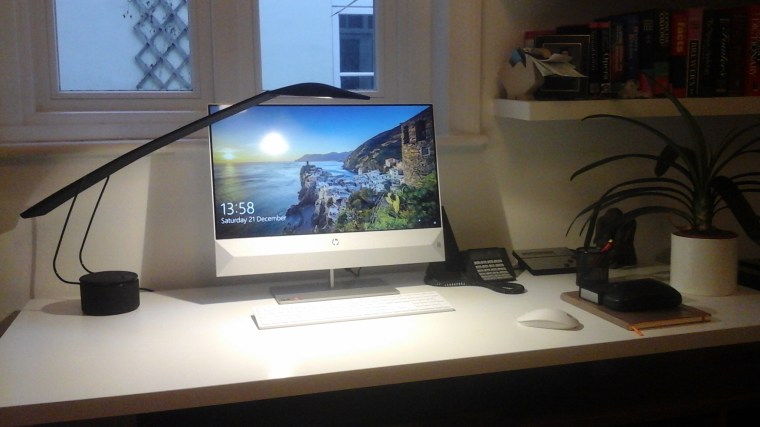
Microsoft is ceasing security support for Windows 7 in January next year; despite several attempts, my old machine resolutely refused to install the free upgrades to Windows 10 that were offered earlier this year – and so the only alternative gradually narrowed down to the purchase of a new machine. Despite some concerns over the sustainability of such a move purely on software grounds, this has now been done. I need a desktop computer because I undertake quite a lot of design work for my published articles and personal interests, which is much less easily done on a portable device. But I don’t see why even a relatively functional activity like using a computer shouldn’t make its own contribution to a generally well-lived life.

The purchase prompted a major re-organisation and repaint of the multipurpose room where I do my work. Computer design has advanced in huge steps in recent years, no doubt driven by Apple, but now extending to more affordable machines like the excellent all-in-one HP model just purchased.

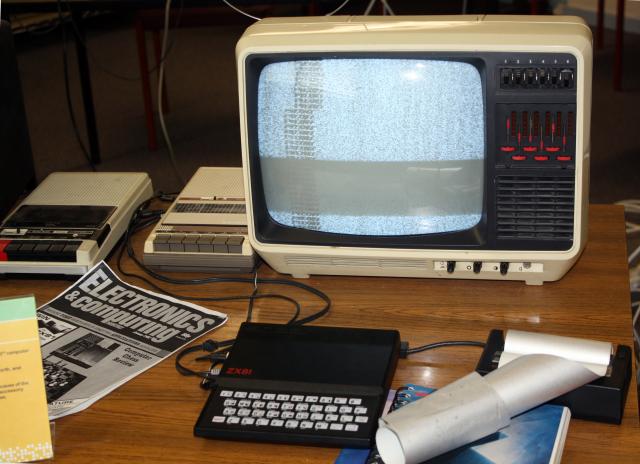
I first used computers in the early 1980’s, and even then, I thought that the techie guys had missed a trick when it came to wrapping their amazing goodies in something better than a boring black box. Here’s a reminder of the way we were:

img_0744_mid

Forty years on, and they finally seem to have realised that for many people, awesome microprocessors aren’t enough…

There’s no doubt that writing in a light, bright environment on an aesthetically pleasing device is materially a vastly better experience, particularly in these short, dark, dog-days of the year. It  has more than repaid the effort (and expenditure) required. Sometimes, progress is real.

Opinion & Thought, Politics and current affairs

Ditch the Dogma?

I have never belonged to a political party. Well, almost never. I joined the Labour Party for a short while, with the explicit intention of electing Jeremy Corbyn. I believed – and still do – that his policies were what the country needs at present. (It was the only time in my life where my vote has had any meaningful effect. Afterwards, my membership lapsed, as I felt the job was done, and the Party should not be further influenced by arrivistes).

For what it’s worth, I still think that move was successful. For all Corbyn’s subsequent disappointments, he has succeeded in shifting the national agenda to the Left. He put properly social-democratic policies back into the public arena. That may be his legacy.

But after the initial shock of last week’s election result, I have a problem. I have inadvertently found myself not disagreeing with a few of the things Boris Johnson has now said. I am entirely aware of the great likelihood that much of it is hot air, perhaps even intentionally so. I am not about to start trusting the man one iota. But more than that, as I said above, I am not and never will be, dogmatically partisan.

My political decisions derive purely from aligning my wishes and beliefs for my country with a party that says it will deliver them. It has never been a perfect fit; that’s life. Normally I have been best accommodated by the left-of-centre parties. But if another part of the political spectrum starts making noises that I agree with, why should I dismiss them purely on tribal grounds? Not doing so is surely the mark of a modern, independent-minded voter, and of politics working properly. A bigger failure was the tradition of voting tribally, according to generations of family loyalty, with one party sanctified and the others condemned purely as a matter of ritual.

In the last days, Johnson has reportedly said:

  • The Conservative Party needs to change for good. Err, yes.
  • The government’s newly-elected northern MPs need to “deliver” for their constituencies. Err, yes.
  • That those northern votes are probably only loaned to the Conservatives. Err, yes.
  • That he has “got the message” on the NHS and will enshrine higher spending in Law. Err, yes.
  • That he will invest in rail transport and other infrastructure. Err, yes.
  • That we need to come together as a nation. Err, yes.
  • That we will shake up the Civil Service. Err, yes – with reservations over how and why.

It’s hardly a full manifesto-worth of agreement, and once again, I concede that what he says and what he does may well be very different things – but he would hardly be the first politician for whom that was true. Yet if what I perceive as the ‘right’ decisions are made for the country, does it really matter very much who makes them? Isn’t that the whole point of representational politics?

I have read much about the poor state of British government. There are plenty of authoritative, independent writers such as Anthony King who advocated a major overhaul of the Civil Service years ago. Its upper echelons have possibly been a major obstacle to change in Britain for too long. There was a reason so many politicians loved Sir Humphrey Appleby: they recognised the accuracy of the character. For all that Appleby has a point (below) surely the prospect of dismantling such pillars of the establishment ought to appeal to the Left?

There are clearly big risks – not that the nation now has much choice but run with them. Regrettably, matters such as electoral reform are probably once again out of the question for the time being: Johnson hardly has the incentive to look at it.

And then there is the matter of Brexit. On this, I am resolutely and implacably opposed to Johnson’s past direction of travel. It is a defining matter;  even alone it ensures that I will never actually vote Conservative.

But that does not imply there is nothing to be done. It pays to listen to your opponents. The much-despised Dominic Cummings is no fool, and he may have a point when he claims that the Remain movement inadvertently hardened the likely outcome by making compromise more difficult. Johnson is now largely free of the need to pander to Nigel Farage and his own hard-liners too, if he so chooses. There is some evidence to suggest that he is not a hard Brexiter by instinct. As a teacher, I know there are times when you have to put your foot down, to over-state your case.

There have been a few other noises from Conservative MPs about recognising the depth of feeling of pro-Europeans. That itself is progress. Sometimes, in order to achieve (some of) your objectives, it is also necessary to give some ground in order to allow your opponent to come towards a mid-point. So there is perhaps still a slim chance that Brexit will be soft, which while still objectionable, is less so than the other type. 

An underlying tenet of the Remain campaign is presumably that it values European ways of doing things. When it comes to politics, the ‘European Way’ involves talking to your opponents, trying to find consensus and compromise, metaphorically holding your nose – and working with them where possible. That approach was also defended by the Left over Corbyn’s contact with various rebel groups.

By contrast, the stubborn tribalism seen in the Brexit conflict – which involved a bunker mentality on both sides – did nothing more than perpetuate the traditionally confrontational nature of British politics. It is all too evident where that has now led. For all that pro-Europeans portray themselves as compassionate, reasonable people, there has been a lot of talk that does not really fit that description, even if it didn’t quite plumb the depths of the Brexiters. No matter how much they feel they were forced into this, the ‘big’ thing to do now is to play a part in the reconciliation process. It will not be easy – but that is the European approach. The Far Right, in particular thrives on uncompromising attitudes from others; this somehow needs to be defused rather than stoked.

There is a need to start looking for places, no matter how slim, where agreement can be found. Perhaps the starting point is the relative consensus about the fundamental problems facing this country, irrespective of their attributed causes.

Pro-Europeans do not need to set aside their views; indeed they need to argue for them all the more strongly in future. Part of the European movement’s failure has been the absence of challenge to forty years of misinformation; that needs to change. But there is now a need to engage with the opposition in the hope that at least a tolerable compromise can be reached. Has Johnson just hinted at willingness?

There is a strong possibility that I am being too optimistic, born from nothing more than temporary relief at the removal of uncertainty. Fundamental beliefs need to be protected. Extreme caution will be very necessary. But I think we should not be too hasty to condemn developments that have not yet happened, which may be born more of fear and disillusionment than clear thinking – and we should also be ready to endorse positive actions if and when they do occur – even if they are a compromise on our ideal situation – and even – perhaps especially? – when they come from our opponents.

In this, I think the EU itself has been a model institution: willing beyond the call of duty to engage with a withdrawing UK despite its regret at the situation, standing firm on its own fundamental position – and seeking a workable compromise.

That is the modern European way.

Opinion & Thought, Politics and current affairs

If you want to understand the UK election result, look at Ireland, not the continent.

Back in 2015, at the end of a more innocent age, Tim Marshall wrote a book called Prisoners of Geography. In it, he argued that the principal governing force behind human activity is not, as we choose to think, free will – but the geographical configuration of the planet on which we live.

Geopolitics is not a widely-discussed subject – at least not explicitly so, though according to Marshall, much of what happens in the world is underpinned by it. This is no less true of the 2019 British General Election result, which saw a right-wing nationalist party returned with an increased majority – and the issue that underlay it: Brexit.

Pro-European Britons, particularly on the Left, may be reeling under what they see as the denial of the self-evident truth of the modern world, namely the U.K.’s future as a social-democratic member of the E.U. It was very attractive to a certain sort of well-travelled, often-educated Briton for whom the EU had increasingly felt like home – me included.

But our dream of the place we earnestly believe that Britain needs to be is, and always has been, compromised by those pesky geopolitics. The 2019 election has just shown this once again: our worldview is simply not persuasive enough to carry a decisively large percentage of the wider British public with it. The tough fact is, the U.K. is marginal to the European land mass, and it has always had split loyalties as a result; EU membership was simply not important enough to many enough for the issue to carry the election. And that’s without considering Britain’s history, which has left it with a deluded sense of its own importance. For centuries, British policy was to divide the continent in order to prevent an anti-British alliance (which itself may have been more neurosis than real threat – but it worked). What has really changed? But maritime nations are no longer strategically pivotal; instead, they have become marginal. The British seem not to have noticed.

The Interrail generation has always ‘read’ the U.K. from its proximity to the continent. We travelled widely; we formed international friendships; we eagerly grasped every shred of evidence that the U.K. was gradually becoming more like the rest of the Europe that we saw and admired. It was not a delusion: particularly in the last twenty years, since the internet turbocharged communications, there has indeed been convergence, some visible, some less so. Eurosceptics glued to their TVs during the Champions’ League know not what they do. Eurostar altered perceptions too – albeit mostly for those living in the South East. The fact that the British economy shed its post-war difficulties was probably also due to integration with a larger entity – that effect has repeatedly been observed elsewhere. In pure trading terms, the ‘economies of scale’ count. But we ignored the fact that they don’t work socially, culturally – and perhaps geopolitically. In reality, Britons as a whole are little more ‘Europeanised’ than they ever were.

If you want to understand Britain in those terms, don’t look at the continent; look at Ireland. For in doing so, we hold a more realistic mirror to our own place vis-à-vis the rest of Europe, and perhaps gain a better understanding of the true nature of our own country. Simply put, continentals perceive the U.K. in something like the way the British perceive Ireland.

I can’t claim to know Ireland intimately, though I have travelled over much of its southern half – and through my love of its music, I have repeatedly rubbed up against its people, both music-friends who live there, and Irish friends in the U.K. Playing ‘their’ music may have provided something of a cultural pass-partout that other Brits have not had. For my purposes here, I will also plead guilty to doubtful wisdom of blurring the political and geographical uses of the term ‘Ireland’, because we are really talking about a combination of the two.

To an even greater extent than the U.K., Ireland is not a modern European country. True, if you drive around the Dublin ring-road, you will see light industrial estates similar to those on the outskirts of Rouen or Ghent. True, if you take the empty new toll motorways to the west, you could easily believe that you were on a western-French autoroute on which they have been conspicuously modelled. True, in central Dublin, you can use the tram as you can in Strasbourg or Basel. But it doesn’t take long to realise that these things are symbols of desire, a statement of what the modern Ireland wants to be, not what it yet wholly is; that is still visible down the side-streets. Outside these bubbles, much of Ireland still struggles with its location on the periphery of Europe, where the land is often poor, and where the population, while youthful and rising, is low enough to make wider development problematic. You can see it in the difficulty that the Irish have had with developing their infrastructure: the place simply isn’t big or populated enough to compete successfully with a whole continent, now that continents matter more than seaways. Without the EU funds, it might not have happened at all.

You can also find it in the mindset. I don’t for a moment wish to indulge in typical English condescension towards a country whose culture is, in many ways stronger and more productive than my own – but it still has a largely nostalgic, provincial mentality. The modernity that I described strikes me as a somewhat contrived denial of a historico-geo-political reality that is still uncomfortably close to the surface. This is an island where religion has only quite recently lost a significant grip – and allowed the ‘permissiveness’ of modern internationalism seen in otherwise-universal matters such as abortion and same-sex partnerships – and where it is still seen as novel – even if proudly so – for the Premier to be non-white and gay.

It is a nation that still venerates its past – as seen in the enduring presence of traditional music – even though its actual practice is a minority interest in a nation that is prouder of having produced the likes of U2. But Irish exports still overwhelmingly play on traditional images of Ireland. It still takes little for bitter-sweet nostalgia for the island’s troubled past to come pouring out. While the small towns with their multitude of independent businesses may look picturesque, they are still demographically and economically precarious – often dated, and hardly an expression of modern Europe. They are resolutely inward-looking: while Irish hospitality is everything it is reputed to be, the communities feel introspective; the warm welcome is that extended to strangers, not the familiarity of fellow-locals.

Even the shiny buildings in Dublin’s docklands have been built using cash that had be attracted by an aggressive policy of ultra-low corporation tax, which is a distinctly un-European approach. When we first visited around fifteen years ago, much of the South resolutely failed the Cappucino Test: our tongue-in-cheek measure of how cosmopolitan a place actually is. On more than one occasion, the advertised cappuccino turned out to be filter-coffee topped with aerosol cream… and while things have definitely improved since, in our experience, it is still not certain that a decent vegetarian meal will always be available.

But above all, Ireland is a long way from the continent. Not necessarily in terms of kilometres – but because those kilometres are mostly water, in people’s minds they expand ad infinitum. You can only get in and out by ship or aircraft, as used to be the case in the UK too. The sheer practical fact of Ireland’s physical isolation alone is sufficient to explain most of the above – and indeed the admirable determination of the Irish that it will be otherwise. But you only have to arrive via the docks at Dublin or Waterford to be reminded that pretty much every expression of modern, cosmopolitan Ireland has to be imported.

While the practical, economic benefits for Ireland of belonging to a much larger economic unit are most visible, I can also sympathise entirely with Ireland’s Europeanism  on another level: as a peripheral lump of rock on the edge of both a large continent and a larger ocean, it actually has more to prove – including to itself – than those countries closer to the core of Europe, where it happens much more easily and naturally. It is not alone; it is a known cultural phenomenon that peripheral areas identify more strongly with their cultural cores than those cores do with themselves. (We see the same with the Ulster Unionists vis à vis the UK). In the case of Eire, there is also a strong imperative to define the modern nation in opposition to its historic master (on which it is nonetheless heavily reliant) – namely the UK.

At the same time, it is these peripheral areas that experience conflicted identities. The characteristics I have described above are not unique to Ireland; many outlying parts of Europe, from Scandinavia to Southern Italy, have difficulty in identifying unreservedly with the core European identity. In fact, we should not claim that Europe is only about that core identity: it is a dispersed and disparate place – but for all that, there clearly is a core, built around France, Germany and Benelux. While it has not been an entirely smooth journey, at least the Irish have had the sense to understand that their best future lies in a partnership with that core, in a way that many British still refuse to do – and they are getting on with it.

I do hope that Irish readers understand this is not criticism of their country. The key point is this: the British have historically tended to look down on the Irish as provincial, disorganised and poor. They have seen Ireland as a country riven by backward-looking sectarian tribalism and hamstrung by poor geography. Those geographical realities have indeed done more to shape the Irish state – and still do – than the modern Irish might be comfortable admitting.

But as I said at the outset, we British can learn a lot from Ireland. Our problem with the EU is that in relation to the continent, we are just the same. Jean-Claude Juncker quipped that “everyone understands English – but no one understands England”. It is truer than he realises – in much the same way as the English don’t really understand the Irish. They are islanders, they are ‘other’; their different geopolitics gives them a fundamentally different mindset as a result. Continentals – being continental – tend to underestimate it. Equally, no post-joining attempt was made at European state-building in the UK, because it was never understood to be important.

Like the Irish, we British are still essentially islanders, also more primitive, more tribal and more inward-looking than we care to admit, no matter what the aspirations of a minority. Insular cultures tend to be conservative, and they are habitually suspicious of ‘foreign’ influences. In some ways, our closer proximity to the continent only exacerbates the problem, amplifying the inequalities between the South East and the rest and making the identity-dilemma all the sharper. What’s more, while the Irish share with many continental countries, relative youth as a nation – and traumatic events in their recent past that has forced them to think hard and positively about the kind of nation they want to be – the UK was able to wallow in post-War triumphalism and ignore such issues – until now, when hard choices belatedly need to be made.

The recent election has simply showed this all over again: when the chips were down, the British voted for More of The Same. Very little has really changed. The prospect of a European future was sloughed off in favour of the usual insular, inward-looking delusion of purely national greatness that always prevails. Sadly for we pro-Europeans, this is the true nature of the British people. De Gaulle spotted it when he vetoed the UK applications to join in the 1960s. Little has really changed – because the fundamental geography that gives rise it never does. Such delusions can only come from un-connected living on an island, permanently decoupled from the greater tides of humanity that have shaped modern continental co-operation. Until the next ice age, when sea level falls and the land-bridge returns, it will be ever thus.

Most of us as quite literally too far away to see what we are missing.

Opinion & Thought, Politics and current affairs

Maintaining the momentum

One of the few beneficial effects of the Brexit experience has been the long-overdue social debate that it has sparked. People now seem willing to engage in meaningful discussion about the nature and state of this country, where previously there seemed to be relatively little interest. It has also been one of the more positive impacts of social media that such debate is now possible. In the past couple of years, I have had numerous productive discussions about the current position in the U.K. and what arguably needs to change within it. Resources have been shared, thinking has moved on.

In particular, people seem to have woken up to the fact the Britain is not some kind of nirvana, that “everywhere else is worse”, as was implicit in the everyday British mindset for so long. There is real discussion going on about other societal models, and how some other countries manage to find success in fields where this country repeatedly and persistently fails. There is at last some recognition of the insular smugness of that traditional British worldview, which has blinded so many for so long – and even an emergent acceptance that in our conservatism, we have turned into a rather unimaginative stodgy nation, afraid of change, who are very often being run rings around by the flair of more creative, innovative places and peoples elsewhere.

I think, though, that the British have yet to achieve a more objective understanding of their country’s natural and geographical situation that would allow them to address some of its enduring structural and attitudinal problems.

And too many still seem to think that higher standards “can’t be done here”. In a way, the  absence of ambition which that betrays is the single greatest indictment of the place we have now reached. 

But tomorrow, it looks as though the large part of the population that remains dead to such debate will vote to allow the old Establishment to put the cork back in the bottle, to ignore the debate, to re-assert the old ways, the old privileges, all the things that have caused the problem in the first place – perhaps for another generation. For too many, the old habits and mindset are so established, so innate, that their only reaction to challenge is to turn their back on it, and cling to what they know: a dull delusion of “Britishness”.

Quite how one can cut through to the fearful, the small-minded, the inward-looking, who it seems can only imagine the future as more of the same flawed past – while simultaneously showing a respect for their right to differ that they don’t often show in return – I really don’t know. As I said in my last post, real cultural change is extremely hard to bring about, and if they won’t engage in constructive debate, I am not sure how we can even begin.

Part of the problem is that they don’t want to: conservatism is by definition about continuity – about resisting change – and tends to be the preserve of those who feel they have little need to shape a different, more positive future – or little power to do so. In some countries, it defends a system that tends to work; in the case of the U.K. there is a stack of global comparators that suggest the opposite.

The resultant neglect is shocking; the stresses of Brexit have laid bare the extent to which the Establishment is prepared to neglect the nation that is notionally in its charge, in order to preserve its own primacy in the pecking-order. All it has really learned in a century is the need to make a few more quasi-democratic noises to keep the masses quiet. In reality, it still feels it can ignore a petition with over six million signatures, and even the constitutional conventions that it largely evolved, when it so chooses. Meanwhile, many of the rest continue to labour under a set of social assumptions and values with the same provenance, which are more widely seen as inappropriate for modern societies, but which are so embedded here as to be almost unconscious. Britain’s enduring preoccupation with status and social class, for example, only really shows how little progress there has been in removing its influence.

In reality, British conservatism seems to mean allowing only those changes that benefit existing privilege, thus perpetuating the problems which have led the country to its present moment of reckoning. The entire message is about a return to the past. Too often, even necessary change (not least the embracing of a more realistic view of Britain’s place in the world) has been rejected because it threatened the status quo. This, I suspect, is the real reason underlying conservatives’ antipathy for the EU: in its ideals at least, it is just too egalitarian  and future-orientated for them.

This country is paying the price for its complacency: a complacency started – and encouraged – by those historic elites, but in which the wider population is now complicit. We took too much on trust. We believed the assurances that everything was already for the best. We tolerated the neglect of necessary change in our national processes; in some cases we even voted to endorse it. We claimed powerlessness when things deteriorated.

If those of the conservative establishment were the sincere democrats and believers in “freedom” that they claim, they would long ago have enacted change. They could have started with the electoral system. They could have willingly examined alternative models and venues for our political institutions. They could have tackled private education and other wealth-perpetuated privilege. They could have devolved power to the regions. They would not have dragged their heels on environmental legislation to the point that the EU had to prosecute. And they could have accepted that their neo-liberal economic experiment has not worked for most of the population. Instead, they often enhanced it. So long as the system worked for them, they just didn’t care about the wider failings – and they still don’t. “Compassionate conservatism” has been revealed for the contradiction and lie that it is.

If the powers of conservatism are allowed to reassert themselves, this is precisely how they will carry on. None of the essential changes will happen. I’m not sure how it can be stopped; traditionally, it seems to take a revolution to topple embedded elites – but I think we need to be very careful what we wish for in that respect: such things rarely run according to plan. And I suppose that democracy needs to include the right of turkeys to vote for Christmas, though it should surely accommodate the rights of others not to be dragged down against their will, too.

There must be another way to ensure that the productive debate of the last three years does not just wither.