Opinion & Thought

Had

I wish I did not keep getting a vague feeling of being had: of being short-changed by life in present-day Britain: of occasions where reasonable expectations are rarely met. While one might have to cut some slack for the longer-term effects of the pandemic, and social changes such as the shift of almost everything online, too often it feels as though the concept of fair value has disappeared.

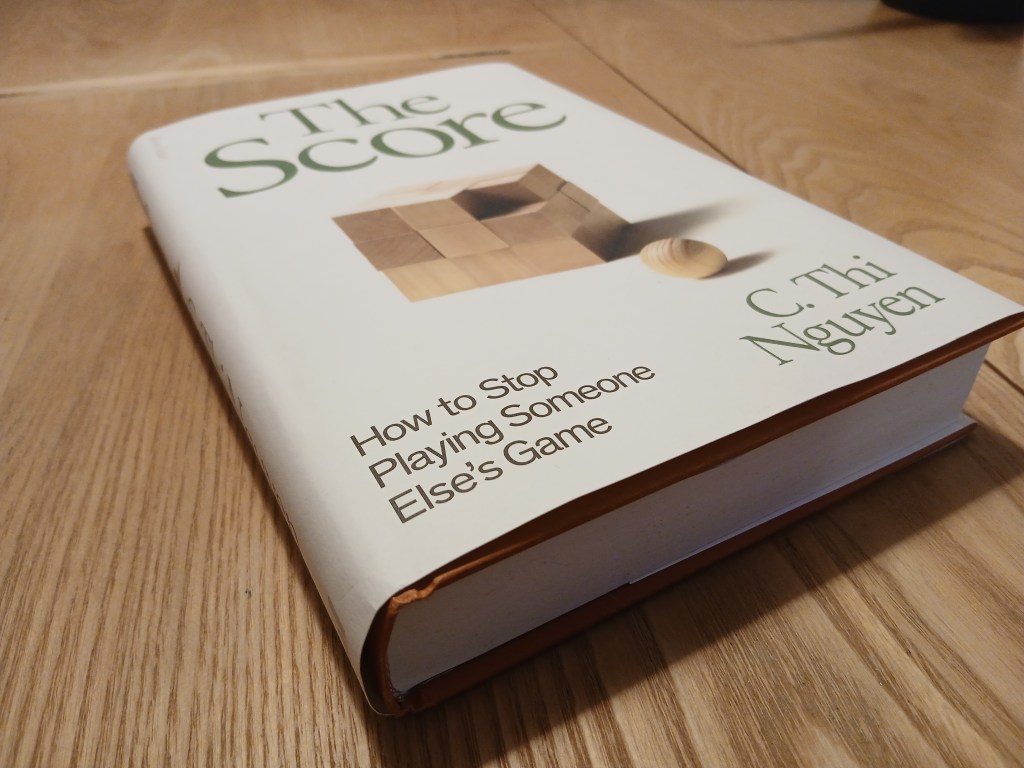
I’ve just finished reading C. Thi Nguyen’s book The Score, which surely is a candidate for the geek-book of the year, but it nonetheless shines strong light on some relevant concepts. First amongst these is something I have long been preoccupied with, namely the way in which explicit targets corrupt genuine value. Nearly fifty years ago, the incoming Thatcher government would have had us believe that target-driven privatisation was going to provide wider choice and lower costs; half a century on, it is apparent that state monopolies have simply been replaced by even more powerful and insidious private ones, which now have virtually total control over the way markets, even countries, function.

Nguyen calls targets Metrics, by which he means the ways in which modern society has come to benchmark almost everything. He argues that the benefit of this comes from fungibility – in other words, the ability to quantify standards and procedures irrespective of which interchangeable human-being happens to be on shift today. And so, we get standardised products no matter who is frying the burgers. But he also argues that the downside of metrics is that they all-too-easily become targets in their own right, often behaving in perverse ways.

One of his most arresting examples is certain (presumably American) Law Schools, whose success metric bizarrely included the number of applications rejected – presumably in the interests of remaining exclusive. The outcome was an increase in offers made to patently unsuitable candidates, purely so that they could be rejected and the metric met.

I felt a surge of recognition at this story, as my own experience of the British education system over several decades was similar: since emphasis was placed on league tables and exam results, almost the entire education system has shifted from teaching subject matter for its own sake to teaching students explicitly how to pass exams (gaming the system might be a better description). Exams whose results are invalidated by the fact that they are all too often not supported by genuine student insight. From this emerges a mindset that cannot accept justified failure on the part of some as the price for genuine success by others – and along the way, both groups of students are sold short. Few teachers dare to swim against this tide; I was one of them, and I paid a heavy price for doing so.

But to return to my initial sense of being short-changed…

Metrics have the additional effect of measuring the measurable, rather than the valuable. And so the emphasis shifts away from what is truly of value towards that which can be measured. Everything is effectively dumbed down because simplistic things are most easily measured – for example, the amount of money a sales assistant took in their shift – but not the quality of service they provided, or the satisfaction the customer did or did not experience. And that’s where the feeling of having been had comes from.

I think this mindset has now infected almost every aspect of life in the U.K.  Somewhere in my residual awareness is a sense of a fair transaction; I accept that one cannot have something for nothing and I expect to pay a fair price for things I buy. In some cases, I am prepared to spend quite a lot, but I expect good quality of service and product in return.  Would that the other parties in such transactions still seemed to think the same thing. But fair service seems to have gone by the board; what matters to most commercial organisations is solely the metric that delivers the largest annual profit. From this perspective, the sole reason for the troublesome existence of The Customer is to feed the corporate bottom line. Whether they get good value for money – or even a fit-for-purpose product – is simply not an issue.

There is an aggregate effect here too: there seem to be two models for company profit: one sells disposable junk at a bargain basement price, while the other sells premium products to the vanishingly small percentage of the market for whom being fleeced is not a concern. And in some cases, the only difference seems to be the price of the twt….

 In between the two, those who are willing or able to pay moderate amounts for decent quality have been squeezed. The situation seems to have become more extreme as the income of the wealthy few has soared, and with it the prices of products that want to preserve their “exclusivity”, while I guess, if you are prepared to settle for cheap junk, you don’t care less in the first place. This is another manifestation of inequality, and it shows even in my local town. Home to around 200,000 people and relatively affluent, it is not a backwater – and yet its retail offering has been hollowed out so that it really only serves these two markets. Choice is an illusion, though to be honest, I doubt this is an issue that probably concerns the vast majority, for whom cheapness seems to be the only criterion in town.

It has been made worse by the widespread disappearance of local businesses, ones for whom good customer service and value were essential aspects of what they provided. A particular hurt has been the disappearance of the last specialist menswear shop in my town, which served me for thirty years with intermittent purchases of good quality clothing. I can hardly begrudge Duncan his retirement, but it has left a hole. There is now nowhere locally where I can buy any clothes that I am prepared to part with cash for.

In the search today for a new summer suit, I have instead been investigating one of the longer-lasting (now only) high street brands, which at least still seems to offer a reasonable selection. They even offer some suits made from good-quality Italian fabrics. On my first enquiry, we ascertained, however, that the cutting and stitching was nonetheless done in China to a British template, albeit apparently at a factory that did seem to know what it was doing. So not really an Italian suit at all. I went back for a second look today, and a different assistant assured me that beyond doubt the suits were manufactured in Italy. I did not push for a second look at the label: the “Made in Italy” label is not applied to anything lightly, and I knew it would not be there.

The question is, why would I spend money at a shop where either a) the company does not care about dissembling on the provenance of its clothes (the “Italian fabric” was writ large, while “made in China” was quite the opposite) and b) where the staff is either unknowledgeable or dishonest enough to tell a straight lie even to a customer who was proposing to spend a not inconsiderable sum?

A similar thing can be seen with food outlets; in theory, the increase in such places on the high street ought to be a cause for celebration – and we are still some way from the density of cafes and restaurants found in many continental places. But it is not – because they deal almost exclusively with food treated in the same way as junk clothes: a huge, spurious choice of various incarnations of mass-produced chain-food pap, and virtually nothing for those who want choose a different deal, who would – yes- be prepared to pay (an amount) more for something of genuine quality. That still tends to be the difference between British towns and their continental counterparts.

The answer, of course, is that 99% of the time, they get away with it. People who know or care about these things are so few and far between that we make next to no dent in the companies’ income whether we decide to buy or not. In the UK in particular, the mass market buys almost entirely on price, while what matters to those on the selling side is simply whatever ruse they can deploy to maximise their revenue; all else is irrelevant. Even, it seems to the point of not caring about those sectors of the market who want something else. It is a matter of put up or shut up. To avoid repetition, I will skip details of several other recent experiences; suffice it to say the above were not unique events.

There is, of course, an aggregate impact of all this: I am a strong proponent of local shopping. Town and city centres are essential parts of their communities and I would be very happy to purchase as much as possible in such places. And you can’t feel fabrics or taste food online. But what am I to do if my needs are increasingly ignored? If I am not able to spend my money on things I genuinely want, then I cannot – or will not – patronise such shops. I am not prepared to feel that I have been had. We are left with places that largely purvey junk – while those with the means and (maybe) the taste patronise somewhere else entirely.

I am then left with no alternative but to do the legwork virtually – and shop online, where at least I know that the sales assistant (me) will give the customer (also me) the care that his purchase deserves.

Arts, Architecture & Design, Opinion & Thought

Faking it.

There are some things that are just a step (or two) too far. With a baseline price of over £5000 rising to over £10,000, the Barcelona Chair from Knoll falls firmly in that category. And from first-hand experience, it is not even very comfortable. (The angle formed between the back support and the base of the seat feels too small). A case of form before function? It would not be the first time that architect Mies van der Rohe fell foul of that criticism.

Yet I have always greatly appreciated this particular design, and you only live once… It is indeed an exquisite chair, with the elegant X-form to the legs, and the understated, seemingly-propped leather cushions. On the original, each square of leather was individually sown together, and then the piping was added. The process is almost entirely artisan, which no doubt does contribute to that price tag.

The Barcelona chair was designed in 1929 by Mies for Spanish royal visitors to the German pavilion at the Barcelona exposition of that year, and given recent changes to copyright laws, it will remain a restricted design in some places for some years to come. In theory, therefore cheap reproductions should not exist – especially as the law was tightened up in 2016.

But they do: a quick search online will show that it remains possible to buy reproductions at a fraction of the price of the licensed version, mostly made in China, and of very variable quality. We can be sure, for example, that those cushions will certainly not be made from individual squares of leather (the cheapest may not even be real leather at all…) – and I would not have a lot of faith in the quality of the welding either.

All of this presented me with a dilemma: I have always wanted to own a piece of this design, but shelling out such amounts for something that is not even comfortable was out of the question. So is it reasonable to buy one of the replicas? Not only are there the practical considerations, but also the ethical ones too.

On the one hand, I am not in favour of flouting laws (copyright or otherwise) when they happen not to suit you – but against that, one might also have reservations about the restrictive practices that keep the costs of the original so astronomical. Is there really any justification beyond a closed market for charging such figures for a design item whose designer died in 1969? And yes, I know the same argument might be applied to items like Rolexes and indeed fine art. Can one ever justify a copy?

So what to do? The reason it is even possible to manufacture replicas is that they are constructed in places where the original patents have already lapsed, or were never recognised in the first place – and they are normally sold as “in the style of” rather than originals. There seems to be little sign of a crackdown on such practices.

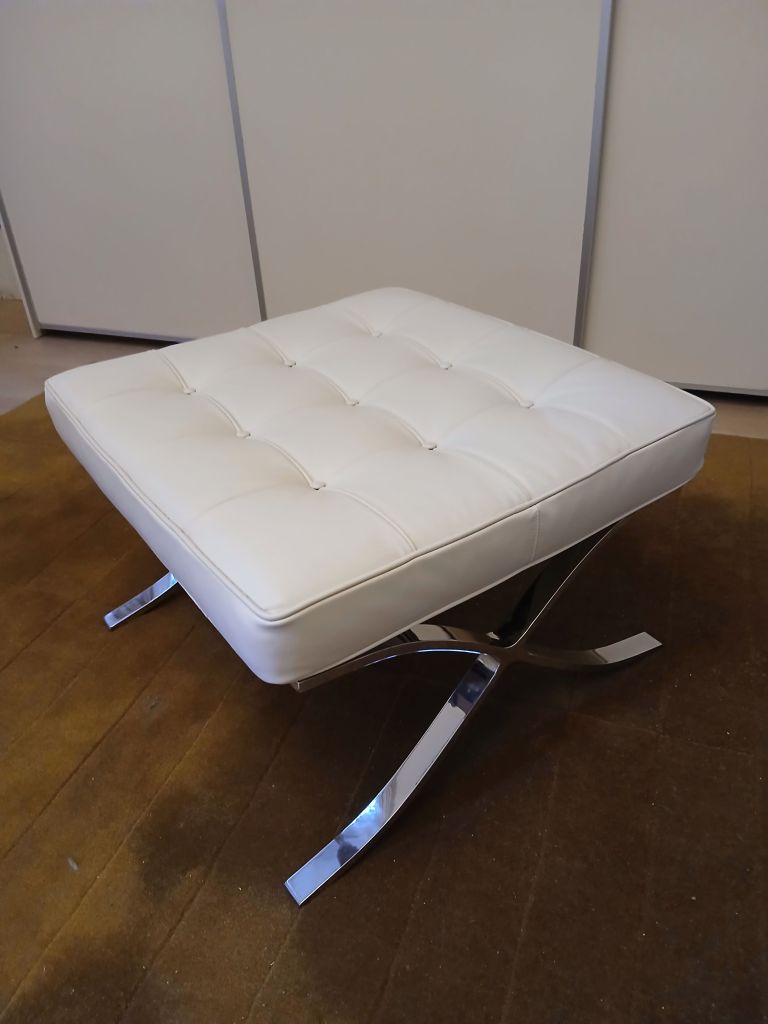
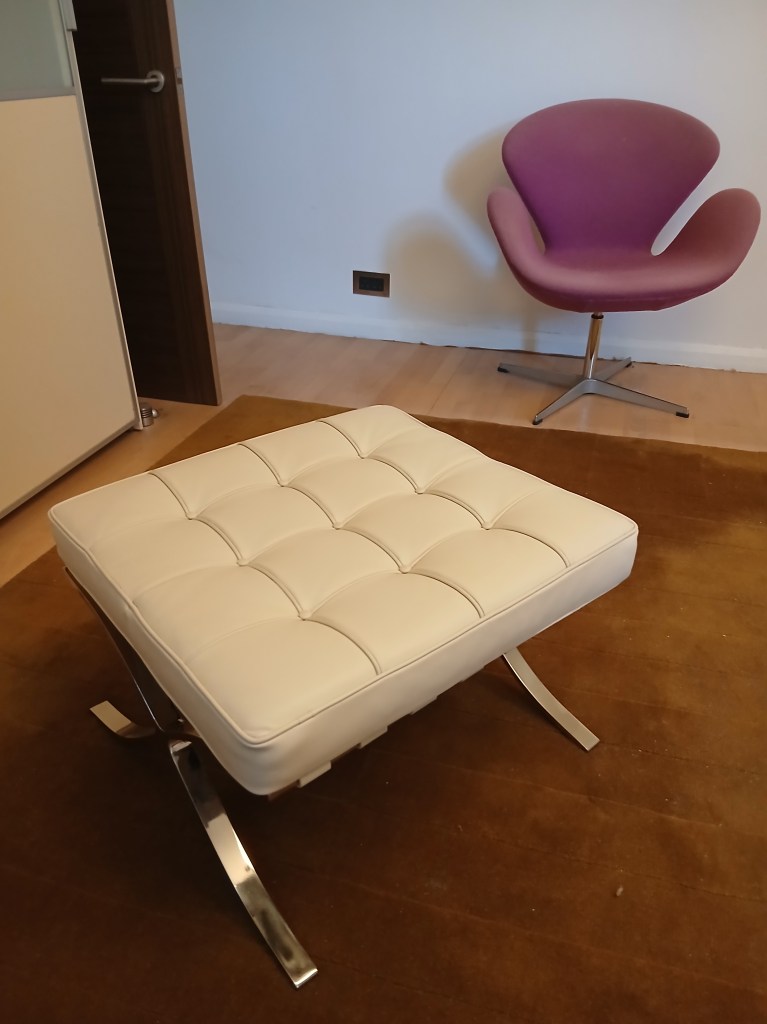
The design issues were solved by deciding to purchase the ottoman stool rather than the chair – the basic design style is the same – but without that awkward back angle. And an exhaustive search of potential suppliers led me to Iconic Interiors, based in Hull and led by Mark Holdsworth, who seems to be a genuine enthusiast for this furniture. He sourced his own version in China, but has taken great care not to compromise on the quality of the materials, the dimensions or anything else. The leather is top-grade aniline, though no doubt the individual squares are not there (if this matters…). The only significant omission is Mies’ signature stamped into the frame as is the case on the Knoll version. His Barcelona ottoman sells for about 20% of the price of the Knoll, which still makes it a more significant outlay than the really cheap copies. In its own right, it is a piece of good-quality furniture that so happens to replicate a classic design.

Mark’s items have been placed next to originals and found to be indistinguishable in quality by experts. And so, from the item that eventually arrived, it seems to be. Time will tell how it lasts, but first impressions are very good indeed.

In fact, this is not the first time we have taken this approach, as we have owned a replica Jacobsen Swan chair for some years now, also made in China, and bought from a now-forgotten company. However, once again, I refused to be seduced by the lowest price, and ended up with an item that seems to be standing the test of time well enough, even if the fabric used is not, I suspect, quite as durable as an original.

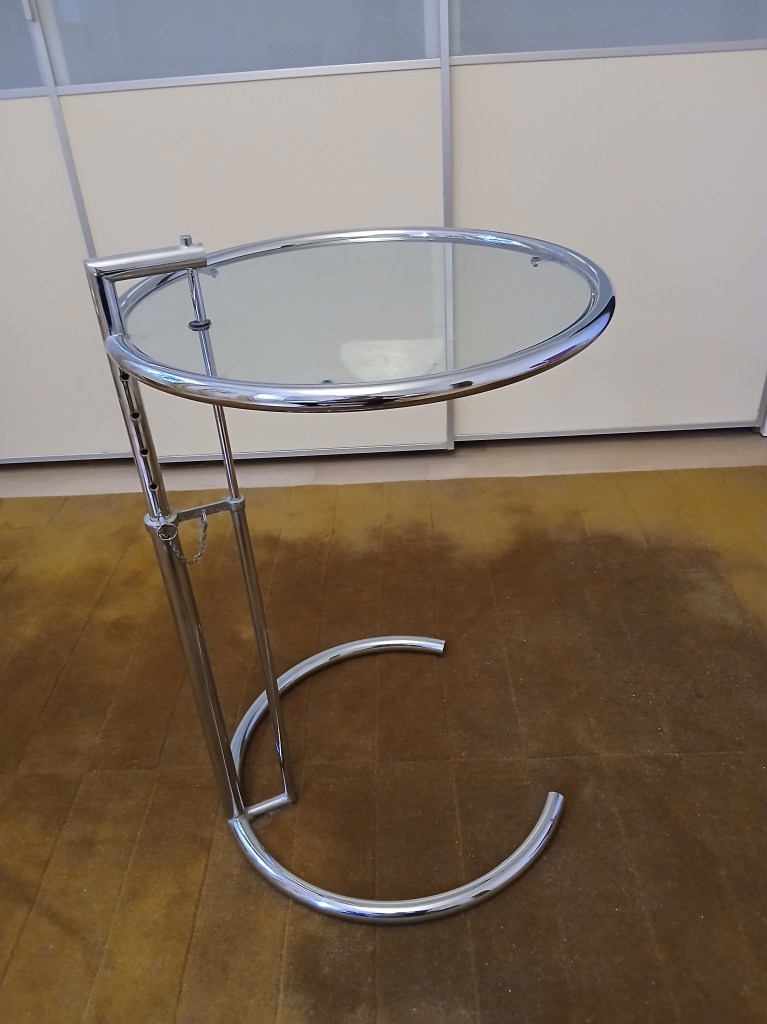
When it comes to “original”, the mark with modern classics of this sort is a piece either made continuously by the company that made the original (it does not have to be old) – or more contentiously, by the company that bought the original licence – as is the case with Knoll and the Barcelona chair. In the same room, we have an original Eileen Grey side table – and it has to be said that no difference in quality is discernible between that item and the two reproductions.

Does it make a difference in one’s mind? Well yes, of course, the knowledge is always there that one owns a replica – but what constitutes ‘original’ and ‘replica’ is complex. Knoll only acquired the license in 1964, and the name “Barcelona” came even later. So Knoll did not manufacture the 1929 originals, so in some sense, their model is no more ‘original’ than any other.

For those of us without infinitely elastic budgets, the choice is between owing a replica or nothing at all. When it comes to fine art, not everyone can own an original Picasso – but that has not stopped countless prints being sold, entirely acceptably, to those who appreciate such things; nobody objects on licensing grounds, to different orchestras performing the works of the great composers. I don’t really see why furniture should be so different. In that light, I don’t regret the choices we made here; the key has been to remain as faithful to the originals as possible and not dilute the designs for the sake of cheapness.

They still add a great deal to the rooms where they stand. Democratic Design says amen to that.

Food, Opinion & Thought

Vanilla

It’s the hot chocolate that gives it away. A week or two ago, we were in a fairly average café in our local town, and I ordered one. It arrived promptly enough but turned out to be – as expected – the usual disappointing fare of over-sweet Cadbury’s powder, though in this case worsened by the fact that it was over-dilute and tasted mostly of water.

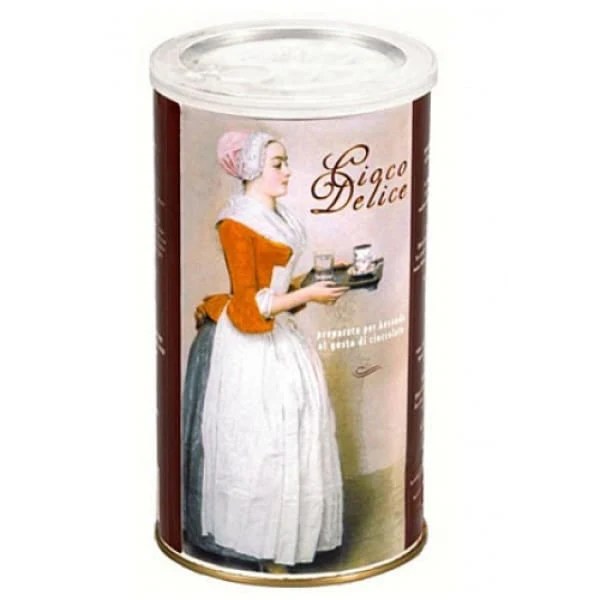
A few hot chocolates previously, I was in Lille, where chocolat chaud arrived as melted chocolate and a jug of hot milk. The same is normally the case in Italy, where hot chocolate has the consistency of double cream and almost needs to be spooned.  Inspired by this, at home we have taken to using Molinari which is at least available online in the U.K.

The trouble is, one’s palate adjusts to the flavours one consumes, which makes the insipid British offerings all the worse for us… We have the same experience with coffee; at home, we habitually drink Illy Italian coffee and make it with a Gaggia espresso machine, which delivers something like Italian strength – which is now our natural point of reference. What we mostly find in the coffee shops on British streets, despite their proliferation, is brown bathwater. Despite the coffee shop hype, and multiple gimmicky flavourings,  the baseline product repeatedly disappoints.

A couple of decades ago, I welcomed the spread of coffee shops across the U.K. It seemed like a major step forward for civilisation. In particular, I recall an early branch of Costa at Liverpool Street station, when it was still independently owned, and still felt like a proper Italian coffee bar, complete with polished granite counter, chromed high stools, proper pastries, and baristas who knew what they were doing.

Sadly, in recent years, I’ve all but given up on getting a good coffee in the U.K., at least outside a specialist restaurant. Coffee shops have become just another retail outlet clone for big business. Both Costa and Pret a Manger (hitherto my fall-backs for a half-decent cup) seem to have travelled the dumbed-down route. In lieu of decent drinks, both now offer the same buckets of dilute brown precipitate as Starbucks, to be sucked through the plastic lid of a cardboard takeaway cup. As with most things in Britain, we are only ever given a diluted version of what happens elsewhere.

My guess is that the loss of distinctiveness of such brands is not unconnected to the fact that both were bought out by large conglomerates, which broadened the reach but, in the process, completely destroyed the product. My second guess is that this trend is another import from the U.S.A, whose coffee, if the average Americano is anything to go by, is even more anaemic than ours. Once again, quantity over quality. It seems that the mass-business model is not to offer anything that might offend anyone by being too tasty. But in the process, they only end up giving even greater offence to those of us who prefer something more distinctive.

Apparently, the growth in the café sector in the U.K. at present is with independents. We do have some locally – but sadly they mostly seem to have used the chains as their template, both in terms of ambience and product.  https://www.lovetoast.co.uk/toastwitham   They talk the talk about loving coffee – but my experiences of drinking there revealed the same over dilute buckets as everywhere else.

From hot drinks to life in general.

What concerns me here, is why the British public puts up with this treatment. Which comes first: the companies diluting standards, and with it, expectations – or a public whose taste is so vanilla in the first place, that the companies know they won’t sell anything more distinctive?

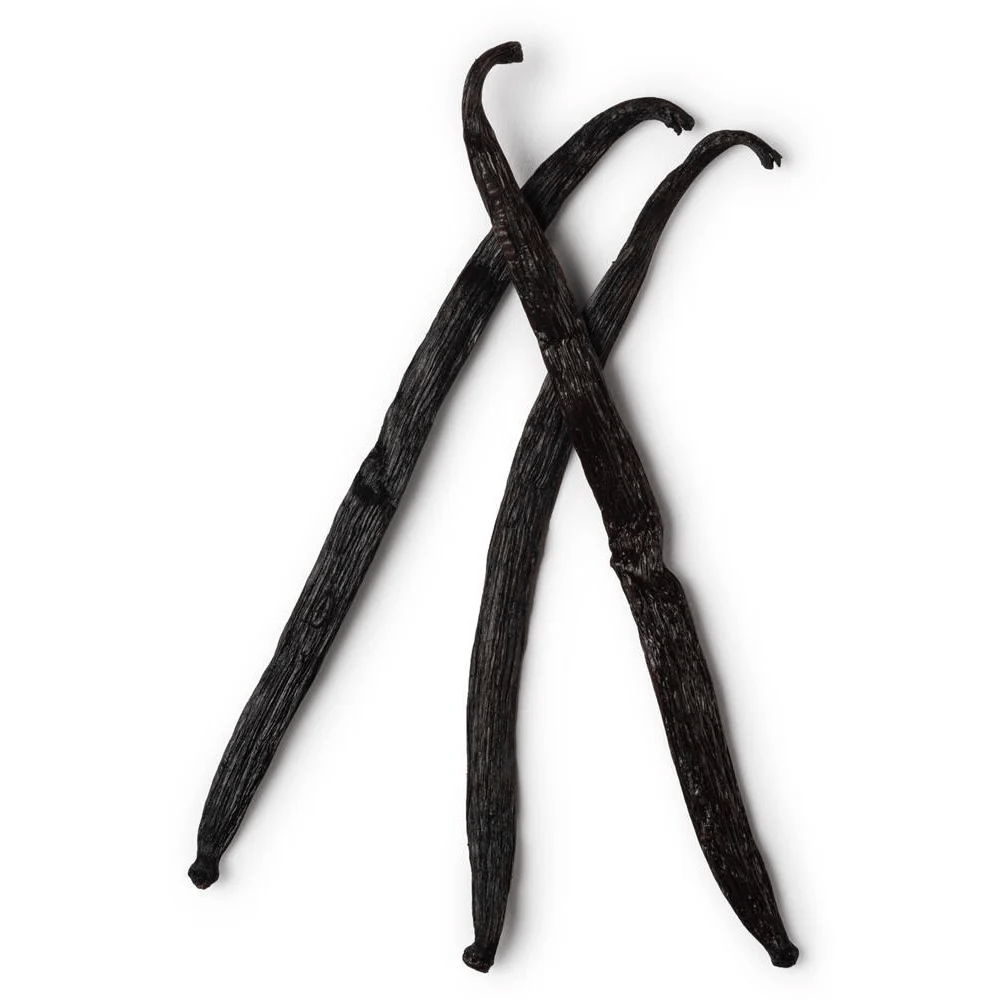
I don’t have anything against genuine vanilla either – it is a very pleasant flavour used properly (which is not in gimmicky flavoured coffees…) But there’s a reason the word has also come to mean bland – and in that respect, it seems to describe British taste perfectly. In fact, those flavoured coffees tell a tale of their own: of a market that values gimmicks over good basic quality. Novelty to distract from the inferior quality of the basic offering.

One might have hoped that by now the much-vaunted British food and drink revolution of the Nineties and Noughties would have embedded itself in the national psyche of successive generations, but in actual fact, Vanilla seems to be getting worse. The end-product of that ‘revolution’ with regard to food seems to have been the gourmet burger – which ultimately is still just a burger –  and an increased range of pseudo-ethnic outlets which, from what I can see, just offer various incarnations of fast food. Packaging it as ‘street food’ doesn’t deny what it ultimately is: processed junk.

One might also have thought that increased health awareness would have had an impact, but my close professional contact with the current generation of teens suggests they eat more junk than ever before, and a lot of them don’t touch anything that isn’t Coke or ‘flavoured’ water when it comes to drinks.

One of the repeated experiences I have across the Channel is places where one’s senses are fed rather than ignored. I can’t help it: it just happens. Time and time again. As I wrote a short while ago, the experiences of different countries do strongly suggest that tastes and expectations are not the same everywhere. One can debate whether the products on offer reflect the market or dictate it – but either way, I am still bemused why British tastes are just so, well – vanilla. Anaemic. Or as one writer put it, Taste Free.

It is not only hot drinks: as I’ve bemoaned before, the same goes for standards in everything: the overriding principle is Bland. I’ve learned never to trust the reviews on Trustpilot – most people seem to have completely different benchmarks). Everything seems to need to be diluted, its teeth and claws removed, before it is acceptable to the anodyne ‘Great’ British public. Or are many other people also sitting there in their local Costa secretly disappointed at the offering? And if so, then Why?

Despite much mulling of this over the years, I still am not much closer to an answer. When presented with such an opinion, many people become indignant, as though national pride could and should not be affronted in this way. But if they are part of the problem, they are scarcely going to understand it. For them, Italian coffee will just seem unbearably strong. Maybe the climate has something to do with it, or maybe it’s what a historic Protestant ethic of self-denial does to our feelings about sensory indulgence? But then, other northern European countries, just as cold and just as Protestant, don’t seem to have the same difficulties producing decent Kaffe und Kuchen and indeed good quality other things too…

I suspect that knowing your own preference is part of it, something else where, in the taste stakes, it seems that  many Britons are still in the starting blocks. It is certainly the case that stronger tastes become – ahem! – more Marmite – you either like them or you don’t.  If you do not know your own preferences, you cannot be discerning. You will meekly, passionlessly, accept what you are given, in a way I suspect the French consumer, for example, rarely does should it be substandard. Until people boycott places that offer inferior products, those places will carry on getting away with it.

A recent YouTube watch, mulling the British mindset seemed to major on “easy going” as a British characteristic. Perhaps: so easy going as never to stand up for decent standards when they are needed.

It doesn’t give me satisfaction to have these experiences. It is a great disappointment that life on this side of the Channel sometimes seems to be lived in diffident shades of grey compared with what happens elsewhere. I can’t see any other real reason why it should be so – except that the culture itself is now so diluted that people never want to do the work to appreciate anything more distinctive. So used have they perhaps become to the bland offerings of big commerce. In other words, it is as it is simply because the majority of people are themselves now so vanilla that they are content to let everything else be, as well.

Arts, Architecture & Design, Food, Opinion & Thought

Props

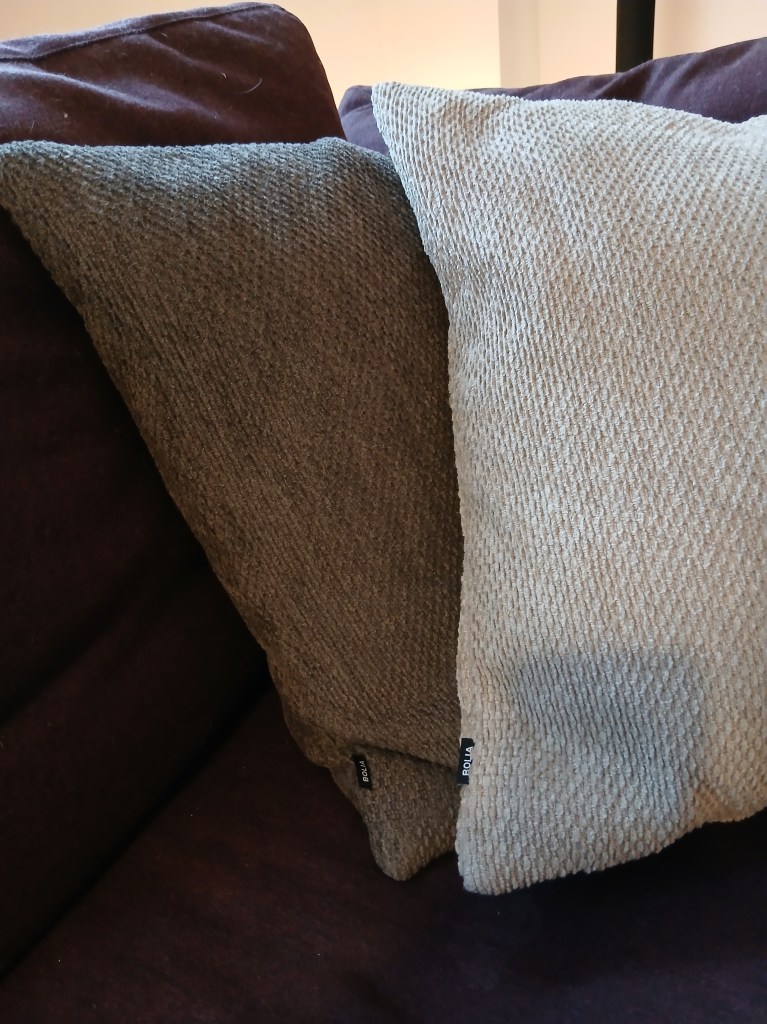
On our dusk walk back to the station during our visit to Lille, our eye was caught by a brightly-lit interiors shop. As with so many shops on the continent, it was the enticing window display that did it. Before we knew, we were inside. We had gone to Lille minus hand luggage, which is just as well, since we exited sporting two very large bags containing four nicely textural wool cushions for our sofas. It was also just as well that we had restrained our other purchases that day to a box of pâtes de fruits from Méert, since we had quite a job getting through Eurostar check-in and onto the train.

So once again, we returned from France with enticing stuff, an eventuality much more likely from there than here. And it started my mind rolling on why stuff is important; after all, I spend a lot of time on this blog talking about it…

In my head, I can hear a riposte to my frequent laments about poor quality in the U.K.: people who are secure in their identities and lives do not need emotional props to make their lives worthwhile. Maybe that is why the U.K. plays everything down: its citizens are already wholly secure in themselves….

If only the evidence supported it. Quite apart from the mental health crisis, it is not that the British eschew stuff: consumer culture has never been more dominant in the nation’s life, and shopping is apparently still a national recreation, even if now done online rather than on the high street. We have so much stuff that apparently self-storage facilities are a growth sector… But when we have so much, how can we possibly appreciate it all? 

I’m not going to decry stuff as a modern sin; people have coveted attractive objects since early human times. What has perhaps changed is the balance between quality and quantity: we are now so used to it, that stuff is as cheap psychologically as it can be monetarily.

So I am not going to apologise for, in effect, arguing for more veneration of stuff. Quite apart from purely practical necessity, personal possessions may well be props for our fragile egos, as they have been since early times. The secret lies in the appreciation: choosing more carefully in the first place, and then actively appreciating what we are lucky enough to have, rather than taking it for granted, throwing it away – and buying more. People have long had possessions – but the important bit is the treasuring – rather than taking for granted. If wool cushions can genuinely add a small amount of pleasure to one’s life, then why not? But choose carefully and don’t throw away and replace after a short period!

While writing this, my attention turned to the contents of our chocolate basket, sitting on the post-lunch table.  Even there, the issue was clear: Exhibit A (below) shows the contrast in how chocolate is presented in the U.K. and Switzerland. This is not contrived: the bar of Cadbury was given to me at Christmas by a student; the Lindt was our regular fare bought from a local supermarket, and is reasonably representative of how chocolate is packaged in Switzerland. And yet it is Cadbury’s that is the most popular chocolate in the U.K.: cheap – and almost taste-free. Once again, dumbed down ‘product’ triumphs over something altogether more rewarding.

I tried a square of the Cadbury but could eat no more. The packaging said it all: 20% cocoa solids and “contains vegetable fats other than cocoa solid”. Enough to have hitherto made the EU exclude the British product from being described as chocolate in continental markets. It tasted of nothing but sugar. The dumbed-down packaging says all one needs to know about the mindset of how such products are marketed in the U.K.: a childish candy, rather than the more complex, adult offering of the Swiss. To be fair, Hotel Chocolat and others are slowly educating the British public about the possibilities – but there is a long, long way to go….

While I’m generally a fan of mindfulness, I found the concept of appreciation journalling a bit over the top  – until it occurred to me that in part, this blog does exactly that: it makes the case for choosing and owning of stuff as something less trivial: a matter of active celebration rather than mere mindless routine. One might still have the guilt-trip about needless consumption, but one solution is to turn ‘mindless’ into ‘mindful’. Material possessions can bring real pleasure to our lives – if chosen carefully and appreciated to the full. And in terms of ‘total consumption’, I suggest that choosing better is more likely to decrease our overall consumption, since it reduces levels of boredom and the need for the constant replacement of what we own.

Purchasing may be fun, but the defining part of the process should not be that moment, so much as the ongoing process of appreciative ownership. Indeed, purchasing is more pleasurable when one has the anticipation of a meaningful relationship with what one is buying. I suspect the Saturday afternoon arms-full leisure-shoppers don’t get this: our culture shops on quantity over quality every time. Mainstream retailers probably prefer it this way – but if one does decide to patronise a more discerning supplier, one finds a rather different attitude, where fewer-but-better still makes sense…

The French, Italians and others seem to know this better. My impression is that they are not as indiscriminate in what they buy as many British. Food is a perfect example: the veneration takes on almost cult-like status with renowned foodstuffs, and the knowledgeable selection of ‘good stuff’ is the informed customer’s part in this ritual. It’s a courtesy to the producer to have a deep appreciation for, and discrimination of, what one is buying. It can apply to other things too: it’s notable that many of the world’s great brands come from these countries. But I am not suggesting that brands are essential; while they acquire their reputations for a reason, there are plenty of good products out there from unknown suppliers. It’s the quality, not the label that is important.

The word ‘prop’ has another meaning: as in the ‘properties’ that actors and artists use to express their lives and work, to make that work more intense and more effective. Every day is part of the drama of one’s own life; the careful use of props to amplify and express our experiences, even to affirm our identities, is not a crime, but an integral part of the human experience – at least if done in the spirit of genuine appreciation.  

But as with chocolate, in that respect not all stuff is equal.

Opinion & Thought, Travel

Li(tt)lle differences

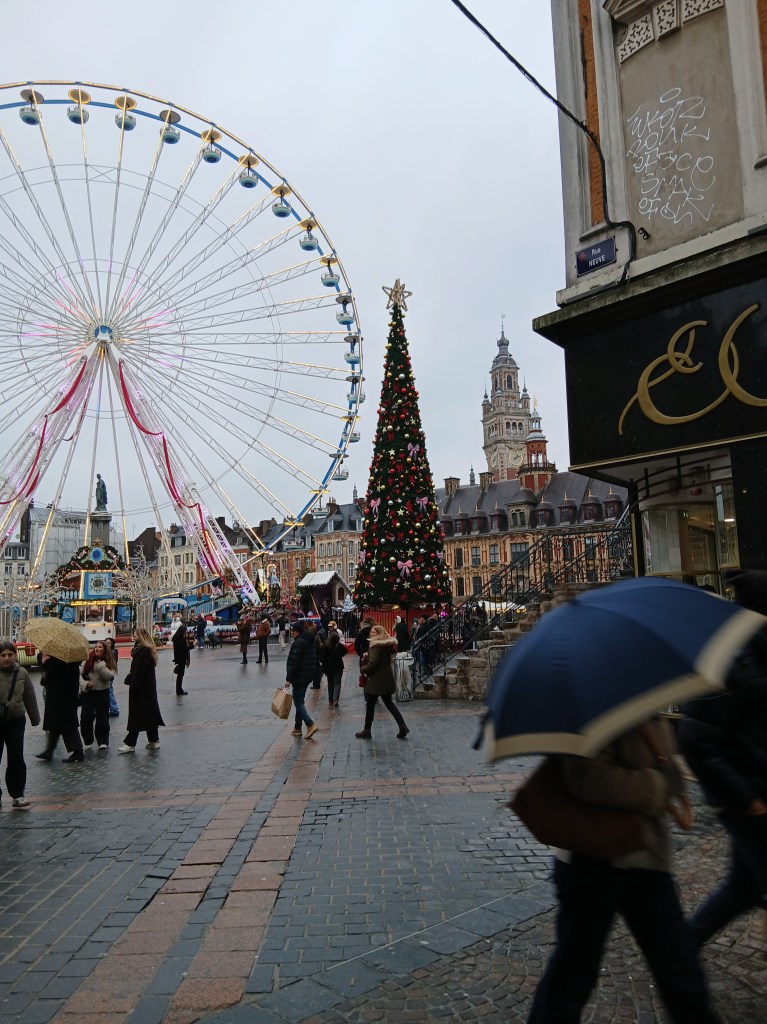
The transition from southern England to northern France on Eurostar is rapid, no more than 25 minutes or so. We took a daytrip to Lille a few weeks ago, our first since 2020, which was unknowingly made in the last weeks before lockdowns began.

Unlike trips made to the continent when I was younger, the brief suspension of daylight while passing under the sea is insufficient to make it feel as though you have come a long way; while the open spaces of France contrast markedly with the smaller landscapes of Kent, in many ways, the experience is one of continuity. We adjust pretty immediately.

And yet, unnoticed, many things do change, notably, the culture – a phenomenon that has always both fascinated and frustrated me. The crow-flies distance from our home to Lille is a mere 130 miles, but despite the short journey, culturally, it feels like much more. I’m not only talking about the language, though it is always a joy to be able to give my French a work-out, but Lille (unsurprisingly) is utterly French and thus worth getting up at an ungodly hour on a January weekend morning for a spot of flânerie, lunching and shopping.

I get withdrawal symptoms if I can’t do this from time to time. For me, continental city life – or at least the imagining of it – comes as close to lived perfection as I can envisage. And to be frank, there is almost nowhere in the UK that gets near that combination of architecture and cultural sophistication that is available even just 80 minutes from St Pancras.

Lille is much more manageable than Paris for a day trip. I know the city well, having visited many times over the years and have something approaching a routine for such visits – there are several streets and buildings that must form part of the base-touching. We have added to this over the years by, for example, heading to the Rue de Gand for lunch – a street a little outside the centre, which has a reliable choice of estaminets and crêperies, one of which we patronised this time for one of the best galettes I have eaten perhaps ever.

Despite the internationalisation of retail, Lille also retains many independent shops, and even the chains don’t seem as aggressively, homogeneously bland as they do in the U.K. I think the French consumer expects more, so even those shops have to try harder. Here we come to one of those marked differences: just why is it that so many independent shops survive in France, despite the fact that it too has a large out-of-town sector? And those shops seem very well frequented. They offer a far wider range of esoteric goods than one might see in the average British town or city.

I suspect it may concern approaches to things like city planning and business rates – things that have crushed many independent businesses in the U.K.  But I think it may also be a matter of attitude: those independent shops and restaurants can only survive because they are patronised – and I can see enough to note that it is not all tourist trade. Not on a cold Saturday in January. And even approaches to planning and tax rates are underpinned by a set of values.

The same thing might be said about the patrons. Unlike in the U.K., the majority of the populace of Lille still seems to think it worth dressing reasonably well for an afternoon in town. This is not to say that everyone is dressed to the nines – but there is little of the general scruffiness that one sees in the streets of towns on this side of the Channel. People make more effort.

Sitting in various restaurants and cafes, we noted groups of young people sheltering from the cold over hot chocolates – but the tarty clothes, fake tans and multiple piercings of much British youth were little in evidence. French kids somehow seem more wholesome; OK, I know that can’t possibly be the whole truth, but it is the impression. And while we’re on the subject of hot chocolate, that arrived as melted real chocolate in a glass cup, with a jug of hot milk – not the over-sweet Cadbury’s powder that is standard fare in the U.K.

 I know that it is too easy to see such things in a biased light, but this is nonetheless an impression that repeats on each visit; at what point does it cease being rose-tinted bias and just become the truth? And Lille is hardly an entirely prosperous city, so it cannot all be the product of economic privilege. For all that this may be subjective, it seems to me that France simply has a more sophisticated culture than the U.K. It simply does not tolerate the degree of dumbing down, dilution or outright bastardisation that is commonplace in the U.K. And I’m hardly the first to point this out. People at large in the UK are simply not brought up to expect good things, let alone with concepts such as “good judgement” that might allow them to discriminate more effectively.

One notes the difference, too, in small things such as the attractiveness of shop window displays. I have written about this before, but each return visit only confirms the impression. I can only conclude that that is a response to a culture that has different aesthetic expectations. This year, we added to our reference points with a gallery from where we are in the process of buying a painting that would be considered impossibly avant-garde for anywhere in this country – perhaps outside certain chichi parts of London.

Underlying my fascination with such contrasts is the question of why they arise; after all, these are communities that live a matter of only tens of miles apart, less than the distance between different parts of either country.

The easy answer would be “The Sea” – and it is surely indisputable that the English Channel is responsible for quite a lot of the contrasts between Britain and the continent. Over centuries, different traditions arose on either side of the divide, at times when crossing it was nowhere as easy as it is now.

But even this answer is not a full explanation. It does not explain why it is the British side that so often debases everything it touches or otherwise reserves it only for the elites with the finest breeding or the deepest pockets. Culture is about more than distance. And even the ease of international travel seems to be doing little to erode the differences between England and France. If anything, they seem to be getting wider, as this country plunges further into its Brexit-induced decline.

What really makes the difference is what happens in people’s minds. This is a topic I will return to, but it increasingly seems to me that the key to sustaining a cultural identity is what is sown in people’s minds. In the case of the U.K., the population under 50 years of age has never known a country not thrown open to the bleak functionality of the neo-liberal free market, with its chill commercialisation of almost every aspect of life; the replacement of cultural capital with the bland efficiency of big business, enterprises that have no interest in the warmth of the cultural fabric, but which exist solely to hoover up the maximum amount of consumers’ cash as efficiently and soullessly as possible. And most people now accept and collude with that. Maybe they don’t even know that different is possible.

The French, by comparison, seem to retain a much wider understanding of the meaning of the quality of life; they still understand that the intangibles are important – as experienced in the food and aesthetics witnessed on one random day in January 2026. Things that are not some elite luxury but are just the general daily fabric of a good quality of life. It is no accident that that country is known for these values; what perplexes me more, in this age of high-speed transport and international mobility, is why such values still seem to fail to make the journey a mere 130 miles to the adjacent country, where in some ways, life is as demoralisingly different as it could possibly be.

Opinion & Thought

Catharsis.

I was told that blogs were dead and buried. Yesterday’s news. No one reads them any more. Yet over a thirty-month content drought, I have kept Sprezzatura alive, and much to my surprise, there has continued to be a reasonable level of traffic.

As any long-time readers will know, this blog was indeed intended to be catharsis – for my own mind during a difficult period of my life, and hopefully by extension, others in need of some soothing of their own. At least one item ended up in print, in a magazine-feature on mental health. It’s about things that can make our lives both materially and mentally better; things that are often perceived as rarefied, but which I believe we exclude to our detriment; things whose relevance for their own lives, people often seem to dismiss – but about which I utter a defiant “I do!”

I think catharsis is still most definitely required; life is no less perplexing than it was when I started writing back in 2017. I still think that over-indulgence doesn’t help, but neither does denial; that trying to find that sweet-spot between cloying self-centredness and hair-shirt abstemiousness, of treating oneself legitimately well is a valid and necessary quest.

A criticism might be that this blog is about expensive things – but it mostly isn’t. True, many good things come with a cost attached – but it’s about being and doing as well as having; in general, it’s about the act of appreciation. When it comes to spending, I have often found that it is not the amount that matters, so much as how it is deployed – what tolerance one does or doesn’t have for inferior things, and how much work one is willing to put into finding something better – where cost can be substituted with effort. It’s also about accepting that, as Terence Conran advocated, simplicity can often be better than bling. Coming back to the original Italian meaning of the word, sprezzatura is not really about living life expensively, but imaginatively. But on occasions, I can’t deny that it helps to believe that one really is “worth it”.

The lack of recent posts is not down to a sudden loss of faith, so much as the fact my own life resumed something of its prior pace, and to be honest, I felt that I had rather exhausted my message at the time. However, more of life’s ups and downs, and the chance of a series of conversations over the last year have made me think that it is time to say and share more.

I’ve once again had to fall back on my resilience, as there having been some challenging times over the past couple of years. Even as I thought I was perhaps past that bad period, more of life’s sadnesses arose, not least the loss of a good friend over two years to cancer, and some less serious but still worrying health concerns of my own. At such times, it is all the more important to try to keep one’s spirits up – and I have become increasingly aware of the power of ‘grounding’ – trying to anchor oneself in the present, to appreciate the good things that we experience and not to get unduly strung up about what might happen next.

This positive thinking is something that we can actively cultivate, and I have come to suspect that doing so has a practical impact on both our state of mind and our wider quality of life, as lived day-to-day.

So I think the time may now be ripe to reprise this blog, if perhaps not as intensively as before; as I move towards retirement, there are certainly many projects and events that are worthy of coverage, and if the reading of my esoteric and eclectic search for a ‘well-lived life’ provides catharsis to others as well, then all to the good.

Opinion & Thought, Politics and current affairs

Free?

The recent decision by the EU to require a single type of electronic device charger from 2024 is a great example of the kind of thinking that is too rarely evident in the U.K. Predictably, the U.K. will not be following suit – it is precisely the kind of thing that the likes of Johnson will seize as evidence of the “freedoms” created by Brexit.

The usual rhetoric about big government and personal freedoms accompanied that announcement, together with the vacuous “it will restrict innovation” – as though the future of the world hinges on how we plug our devices in. It might be more convincing if the U.K. had any kind of track record on innovation in such fields…

So it seems that we are to remain free to live with confusing tangles of multiple cables, none of which will fit more than one brand of device – and free to keep the frustration of never having the right one available just when we most need it. We will remain free to need to need new cables and chargers each time we buy a new device rather than re-using the existing ones. We will remain free to be exploited by manufacturers who perpetuate these things on purpose.

But we will not be free to reduce the number of irritating wires and chargers, to experience the simplicity of use of a universal system, nor will we be free to reduce the amount of electrical waste that we create as a result. We will not be free to refuse unneeded equipment and the additional cost that must come with it.

The thing is, freedom is not always an absolute: freedom from one thing comes at the expense of constraint elsewhere. In the U.K. and the U.S., Freedom is often invoked as the right of individuals to do as they please. But it comes at the expense of having the freedom to make poor choices – and to suffer the impositions of those who have more power to exert their own freedoms than we do ours. As a result, we live in countries which lack adequate co-ordination and which suffer the inefficiencies that come about from the freedom to create multiple, conflicting and wasteful systems.

‘Big Government’ is almost seen as original sin in these places – something that inevitably reduces individual freedoms. But big(ger) government, done effectively and with enlightenment, can increase freedom by reducing conflicts such as the one described above. It is the job of government to co-ordinate responses to the needs of millions of people, so that they may be effectively and universally delivered. As with any other mechanism, the failure to maintain it properly tends to lead to breakdown – as we are finding in many aspects of national life at present.

Ironically, true freedom may require a degree of conformity from those involved – but there are many times where such small sacrifices result in better organisation, higher standards, and liberation from those who use such hot air to keep us in chains.

Opinion & Thought

Sophistry and the planting of seeds

After over five years of waiting, I’ve finally had a reasoned, informed discussion with a Brexiter. The specifics aren’t important, but it was perhaps significant that the individual (who is not known to me personally) also has a background in education and the exchange did take place on social media. The former provided a little shared ground – but as the discussion developed, it quickly became apparent just how limiting the practicalities of conducting complex debate by such means actually are.

This coincided neatly with both my finishing Tim Harford’s book How to Make the World Add Up and the final proof reading of my own book on Critical Thinking (now begins the hard search for a publisher…)

After several other recent encounters where my attempts to reason carefully with Brexiters ended in yet more mockery and abuse, my concern about the balkanisation of public opinion had not exactly subsided. Whatever our views, it really is not healthy if all we can do is close our ears and call each other nasty names in lieu of searching for an accommodating way forward.

The Sophists were thinkers and orators of ancient Greece. Over time, rhetoric and winning an argument came to dominate reaching the truth (I will leave aside here the deep difficulties within that word…). Sophistry is alive and well in modern society. It seems that our formal politics depend on it – especially in the system we have in the U.K. where the “winner takes all” – and achieving that winning position in both a general election and more widely seems more important than wise (let alone conciliatory) government itself. It hardly sets a good example to society at large… (With this tail well and truly wagging the dog, much of what passes for governance in this country is now, it seems to me, little more than collateral effects of the supremacy battle within the Westminster Bubble).

Social media also seem to thrive on sophistry, if only because they tap into a fundamental human competitiveness and boost it by removing the usual social conventions that might make one keep at least one ‘glove’ on when debating face to face. So often it seems that the real purpose of interaction is to win the argument, rather than find factual accuracy – let alone approach consensus or deeper understanding of another point of view. Maybe I am being hopelessly idealistic here, but it is still a great pity, since more mature use of social media has, I believe, huge potential to boost proper civic debate.

Both Harford’s book and the art of critical thinking in general can perhaps inform the way forward, and even guide our personal conduct and strategy.

It is all too easy to get sucked into sophistry oneself, when operating in a sphere that encourages it. Regularly reminding oneself that ‘winning’ the argument is neither likely nor necessary can help. The chances of fundamentally quashing another view to the point of abandonment are tiny, as is easily appreciated if one reflects on the difficulty one might encounter oneself in conceding the same. People rarely make fundamental changes to their positions except through profound personal experiences – and the chances of a discussion on social media being one are about nil. A little respect simply accepts that one’s opponent will be in the same position, and it is all the more unlikely if those positions really are the product of genuine thought and experience, rather than dogma.

In which case, shifting the objective towards a genuine exploration of the issues and contrasting perspectives is much more likely to be productive. How to do that? My own approach is hopefully to model good practice, for example by:

  • never using ad hominems;
  • always being prepared to look for compromise;
  • trying to find commonality and consensus where it does exist, even outside the debate itself;
  • understanding the difference between fact and interpretation or opinion;
  • trying to address opposing points rather than ignoring or rubbishing them;
  • conceding when one does not have a good answer;
  • maintaining politeness and good humour;
  • firmly asserting one’s credentials without bragging or demeaning the other person;
  • most importantly, explicitly (and if necessary, repeatedly) stating one’s aims and code for the discussion.

I won’t pretend that I always achieve all of this, particularly under fire but it is still, I think, a good aspiration. Sadly, sheer experience suggests that many people are so preconditioned that they can’t respond in kind – but that too does not diminish the aspiration. Retaining the moral high ground is probably still good advice.

In the recent experience, my interlocutor sadly began by dismissing my points and claiming (without any basis) that I had no experience in the subject matter and did not know what I was talking about. Privately, I knew this was ridiculous – but how to prove otherwise without appearing condescending? However, just for once, continued engagement did shift the argument onto more constructive ground and we proceeded to have detailed and lengthy interactions over several days, before agreeing to close it simply due to the practical constraints. It finished courteously.

What did it achieve? Tim Harford points out the importance of curiosity: curious people are more likely to engage with alternative views because their own are subject to modification, whereas the incurious will simply close their ears and blast away. Such flexibility at least makes it more possible to respect and respond to another position even if one does not agree with or adopt it. It also makes a shifting of positions towards greater tolerance or consensus just a little more likely. A recent feature in The Guardian, which has put opponents face to face over a meal has found something similar: given the right conditions, balkanised positions can be eroded and consensus or at least mutual respect found.

Harford suggests that when it comes to real sticking points, it can be better to ask people progressively to elaborate their understanding of their own position, rather than attempting to contradict them. If they cannot, then this self-realisation is more effective than anything one can say oneself. It does not necessarily mean that they will concede openly, of course. In other words, the key to a successful debate is to pay attention not to your own views, but to those of the other, no matter how much you disagree with them.

In the recent discussion, it became clear that the other person was (unsurprisingly) no more likely to shift wholesale to my point of view than I was to hers. I felt there were omissions and contradictions in her stance – ironic given her claim to authority, and precisely a criticism she levelled at mine. I did my best to respond accordingly, though I felt that fewer of my own points were directly addressed in return. When presented with a challenge, it can feel easier to shift the argument that address it – but it is a weaker and less persuasive response. I drew my own conclusions – privately.

It seemed as though we were seeing the world in through parallel lenses: broadly the same information interpreted in diametrically opposite ways, nothing profound enough to alter that fact.

Nonetheless, the discussion was civil; over time we found there were areas of agreement, and at the same time, I suspect some points were raised by either side that the other had not previously considered. If our interaction has any longer lasting effect, I suspect it will be incremental – and this is perhaps why we need to see such events as the ‘sowing of seeds’ that may just germinate given time and modify someone’s long term view. It works both ways, of course – and perhaps that is the final benefit: it is better to talk properly to our opponents than abuse them, give a little, learn a little and then part, disagreeing if necessary – but perhaps slightly the wiser.

Opinion & Thought

Presents of mind

“C’est pour offrir?”

“Oui. S’il vous plaît”

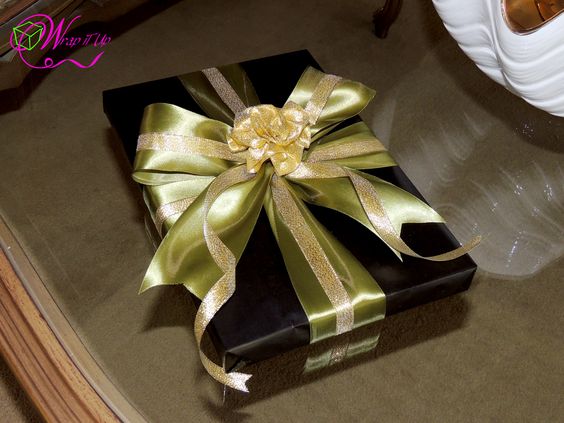
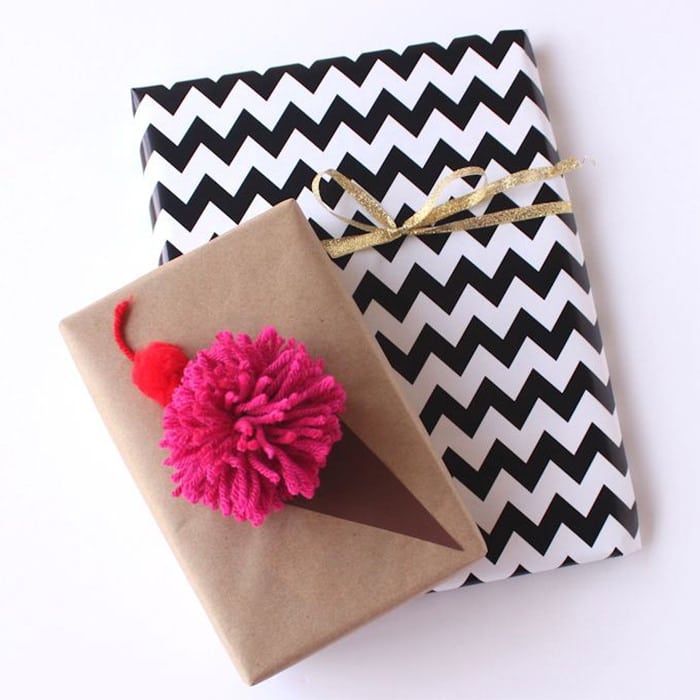
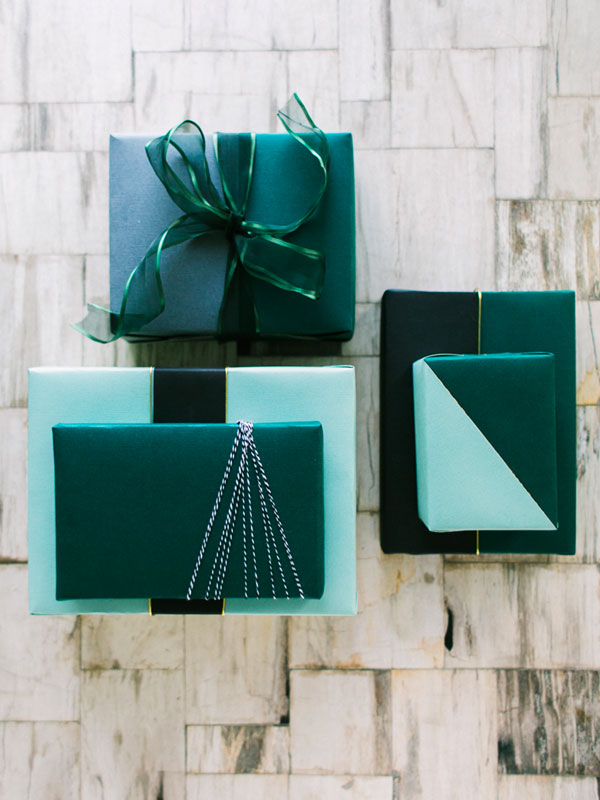
I watched, enchanted, as the assistant deftly turned a small white card box into a minor artwork. But I also learned: how the paper needs to be only a little larger than the surface area of the contents; how thicker, better quality paper folds and cuts more cleanly than cheap stuff; how one should fold it in as closely into the corners as possible; how the end flaps should never stray onto the main surfaces, how to wrap tricky objects by starting from the largest surface, and how to use a minimal amount of tape so as not to mar the effect.

The package was expertly quartered with ribbon, the loose ends made into a bow and drawn across the back of the scissors blade to curl them, a decorative sprig attached. The Swiss are masters at such small acts of hospitality. My hosts were delighted; I went home and practised.

The giving and receiving of presents is a significant gesture and worthy of care: an expression of appreciation and understanding from one human being to another. Choosing something to give, gratuitously to delight another involves effort and insight; it means assuming proxy powers to enhance another’s life.  Dig deeper and you find yourself confronting profound questions about whether humans are fundamentally competitive or collaborative creatures: the act of voluntarily giving something away could even be counter-evolutionary, which may be why the sense of beneficence it generates can be so pleasurable for the giver too…

But while the giving and receiving of presents can be a delightful thing, offering moments of innocent joy, it is also a minefield of potential misjudgement and faux-pas; in this apparently simple act, there are so many judgements to be made – which may be why it is so often played down, made more pragmatic than symbolic, just another tick on the to-do list.

Perhaps the French phrase gives an inkling of this: something to be offered. Not insisted upon, nor taken for granted; perhaps something artfully chosen and presented, highly personal – tentatively, humbly proffered for acceptance. Therein lie imponderable questions about whom the present is really for, and what its purpose is:  the stage is set for a delicate pas-de-deux between giver and recipient. But while the obvious answer might be the latter, there is more to it than that.

 One can begin by wondering whether it is the act or the artefact that is more important; “It’s the thought that counts” might give us an answer – but which thought? Whose? Not all presents are chosen or given wholly willingly. And what if it’s wide of the mark?

An artfully-given present demands empathy from the giver towards the recipient, in order to know what will both delight and be of use. As important is the implied care that was taken in the choosing; to that extent, a present says much about the giver too, and this therefore allows him or her some sovereignty over the act. Thus it also requires receptivity, good grace and a willingness to be delighted on the part of the recipient.

So presents may be as much about giving as receiving; while I appreciated that as little as a child as anyone else, over time I have come to enjoy the act of seeking out suitable gifts that I hope will delight their intended recipients – but which also say a little about me and our relationship in the process. For there are, after all, two people involved in this act.

Literally and figuratively wrapped up in all this is the nature of the gift itself: should it be useful, or simply beautiful? Whom should it most delight – the giver or the receiver? Is the purpose to say, “Here is something I hope you will like” or “Here is something that I like, that I hope you will too”? In an ideal world, they will overlap of course – but let’s not get too ambitious… People nowadays tend to have very specific wishes, but there may be times when something more generic but genuinely charming comes closer to hitting the spot – as we tend to do with people we know less well.

If it’s really the thought that counts, then the nature of the present itself perhaps matters less, so long as it is not actually rejected. Most people are realistic and tactful enough to understand the occasional failures, though it is still an opportunity lost and a disappointment gained, for what is a present if not genuinely loved…? What is perhaps more difficult is misjudgements that persist year after year, with neither side apparently learning very much. A kind of entrenched resignation sets in at yet another tea towel from….. A seriously mis-received present can cause embarrassment and cause nearly as much offence as does a good one pleasure; see www.dauphin/henryV/tennisballs.…..

And so we very often play safe. We fall easily into judging a present by its content rather than its symbolism; I am as guilty as the next, though I am still as delighted by something genuinely unexpected, provided it genuinely pleases me – but that is the difficult bit, for that involves knowing me more than a little…and I’m not keen on the subterfuge required to cover up the less successful ones.

If specialness is the main criterion, a present doesn’t need to be large or expensive; I would rather receive something nice to eat or drink (nicely wrapped of course) than an ugly but ludicrously expensive watch, a bubble-packed green plastic smoke-emitting toy dragon with illuminating LED eyes, a baggy orange acrylic pullover that I really will never bring myself to wear even once, or even a pair of Beolab-28 speakers, which Bang & Olufsen’s website is (without apparent irony) offering in its ‘gift suggestions’, for a mere £10,750. A badly misjudged present suggests that the person giving it either does not understand, or does not care – or both; it wasn’t a present, just an obligation. Repetition only makes it worse…

Sadly, I think a lot of the charm has already been lost. I blame the usual suspects, namely commerce and the media, who shamelessly devalue everything they touch so long as it boosts the bottom line. Modern retail couldn’t care less about the niceties, so long as we all part with shedloads of cash in the process; it benefits from turning present-giving from a symbolic act into a utilitarian and expensive one. Many have been conned, seeming to believe that the important criteria are the size, number and cost of the presents, rather than how well-considered or genuinely delightful they are. Why does anyone need to give the same person multiple presents? Do two presents delight twice as much as one? If nothing else, the Law of Diminishing Returns says not…

With the loss of ‘well-given’ has also gone ‘well-received’: particularly now that we often know what the wrapping (if present) will contain, much of the delight is lost before we have even started, replaced by inevitability, no matter how nice the item. Once the present is opened, it is put aside on the pile with all the others, possibly (if it is lucky) to be revisited another day. Just another act of material acquisition.

Yet despite the foregoing, I admit I have become a complete Present Pragmatist. I think it was the realisation that this is indeed a two-way process that did it – and it seems I am, once again, in a very small minority. I’m not sure where else the best resolution can lie between two people who for whatever reason (perhaps great distance?) only have a rudimentary appreciation of each other, for whom presents may be bought more because of the relationship involved than a deep desire to delight that individual. I would rather receive no present at all than an inappropriate one, just because someone did not think hard enough about the pas-de-deux. That may sound ungracious, and appear to contradict my earlier point about the respective prerogatives of the giver and receiver – but the solution surely lies in the level of understanding necessary between those people in the first place. If the price of resolving that issue is to do my own legwork, then so be it.

It is not a matter of having expensive tastes. I would rather receive something small but well-chosen – or else add my own contribution, to make affordable something that otherwise might not have been – than be given something useless to me just because it was cheap, of an “appropriate” size/value, or because it briefly amused to the person who bought it. Not that this has proved much defence against “I changed my mind and bought you this instead…” – leaving me to pick up the entire bill for what we had previously been agreed would be shared….

All manner of complexities can simply be sidestepped by either specifying very closely what one would like (sending a hyperlink is almost fool-proof), allowing only a very small number of people to do one’s shopping – or even mutually buying one’s own, and settling up later. This seems to avoid most of the tide of polyester pyjamas, sugary snacks and joke socks (that play Jingle Bells) that might otherwise arrive. It even avoids some (but not all) of the gaudy, sticky-tape-plastered (and definitely not recyclable) wrapping paper that seems to be that national norm when it comes to ‘presentation’, Swiss standards being rare here. And given that much of the symbolism is already gone by that point, I am also mercenary in my use of online shopping to minimise the tedious logistics.

I hasten to say that I do apply the same logic the other way round: people should have what they tell me they want, no matter what I think. I learned years ago that there is no point going to great lengths to acquire something special for someone, only for it to be utterly lost on them. Nor to wrap things especially nicely if they are routinely shredded without a glance. My belief that nice things always cut through was shown to be hopelessly naïve.

So, I largely save my efforts for those who do understand, and accept that I will be buying a fair number of the watering cans, car tyre pumps, underwear and novelty nick-nacks that some people would just buy for themselves rather than requesting as presents. That is, I suppose, another form of good grace – the acceptance that one should completely suspend one’s own input when giving, and just do what was asked. I suppose it means that I accept (reluctantly) that my idea of Giving is not the only valid one. Except that inwardly, I don’t; too much of the essence has been lost.

There are, however, certain lines I will not cross: I always buy the best present I can afford rather than the cheapest (or first) I can find, I do not dilute my budget by adding needless extras – and I still wrap tightly and with minimal tape.

I don’t intend this post to be taken too seriously, but neither is its message unimportant. It may speak of ships passing in the night, of people who, for whatever reason do not really understand or value or think hard enough about each other, even when they may supposedly be close. Present-giving easily becomes tokenism, ritual, routine, rather than a genuine expression of delight, appreciation and respect – not of the thing itself, but of one person in another.

Happy Christmas.

Opinion & Thought

Not just for Christmas…

As another year eases down with scarcely a bump onto the runway leading to Christmas, even this occasional curmudgeon must admit that he likes this time of year. Indeed, it is probably the single most Sprezzatura event in the calendar – the time when even those who progress through life heads down, pedalling furiously are supposed to let up and acknowledge that life can be good. Indeed, even should be good. That we can spend a little time just being mellow, and appreciating and sharing our comforts.

I tend to feel, though, that rather too much hinges on one day; particularly if the religious side of Christmas is of no concern, then quite why the rituals of one particular day are put on such a pedestal is rather mystifying. I suppose the whole thing needs a focus in order to be what it is – but it is also worth remembering that 25th December is not pivotal everywhere; for some, Christmas Eve is of more importance. And that’s without the flip side of the coin, of course, namely that rituals can easily become a rods of unwelcome familial ‘duty’ for the back, even without added complications such as for those who must work on 25th.

I have always preferred the growing anticipation of Advent to The Day itself, not least because there is longer to savour it. It is not as though there is a scarcity of short, dark days in need of uplifting…

I think one of the great things about the online world is the way in which one gains a far greater sense of things happening elsewhere, than was the case in the bad old days when most of us were much more locked into our respective narrow national conversations. It is great that I can watch a webcam from Spitsbergen or Namibia as I have been doing in recent days. And I can see how many of my favourite places are preparing.

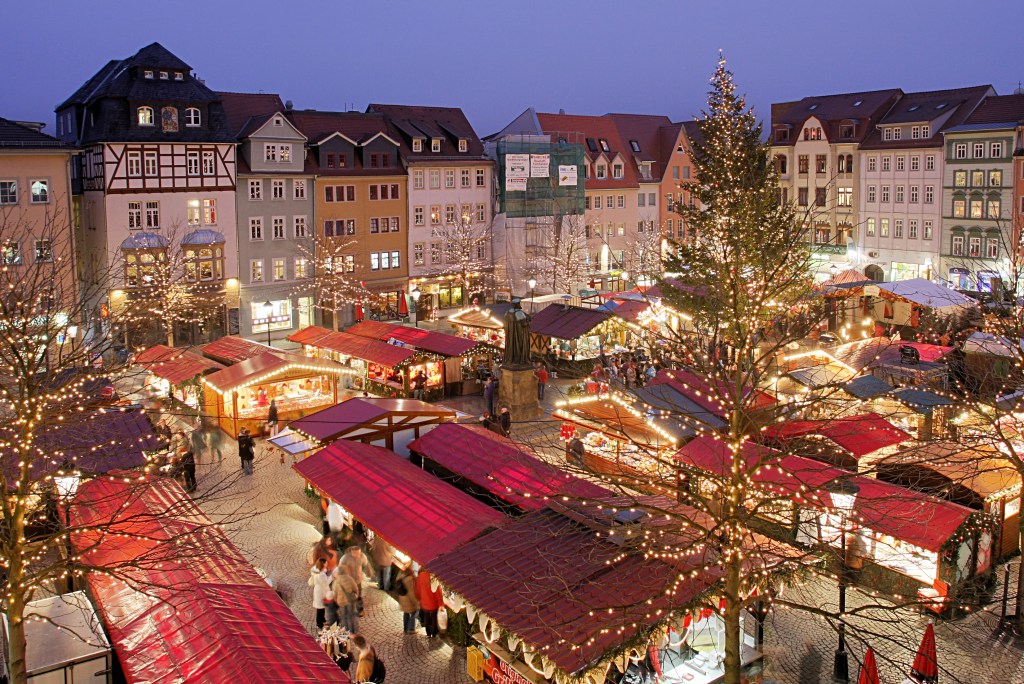
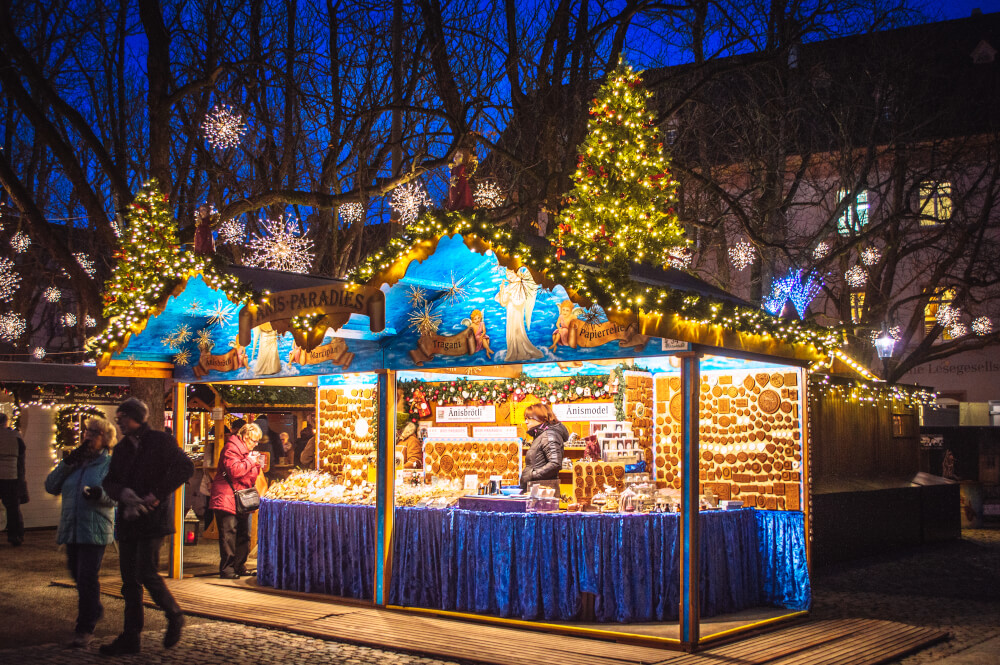
Especially in the past two years, I have appreciated the opportunity, courtesy of YouTube, to take walks through cities, rides on trains, and view domestic interiors and routines across the world, that has done a little to make up for the total absence of physical travel. In recent weeks, I have visited the decorated streets of a dozen countries, and strolled virtually through the Christmas markets of some of my favourite continental cities.

I will leave the real Bah-Humbug to the Christmas Nationalist (my description) who seemed incapable of letting even the season of goodwill interrupt his steady stream of Brexit tosh, to the irritation of quite a few. It was not I who pointed out that nearly every ‘British’ Christmas tradition is actually a continental import. Speculation followed about just what was the original, insular British Christmas; it’s almost impossible to say, of course, given the amount of cultural to-and-fro that has always existed between these islands and the rest of the world, and the near-continent in particular.

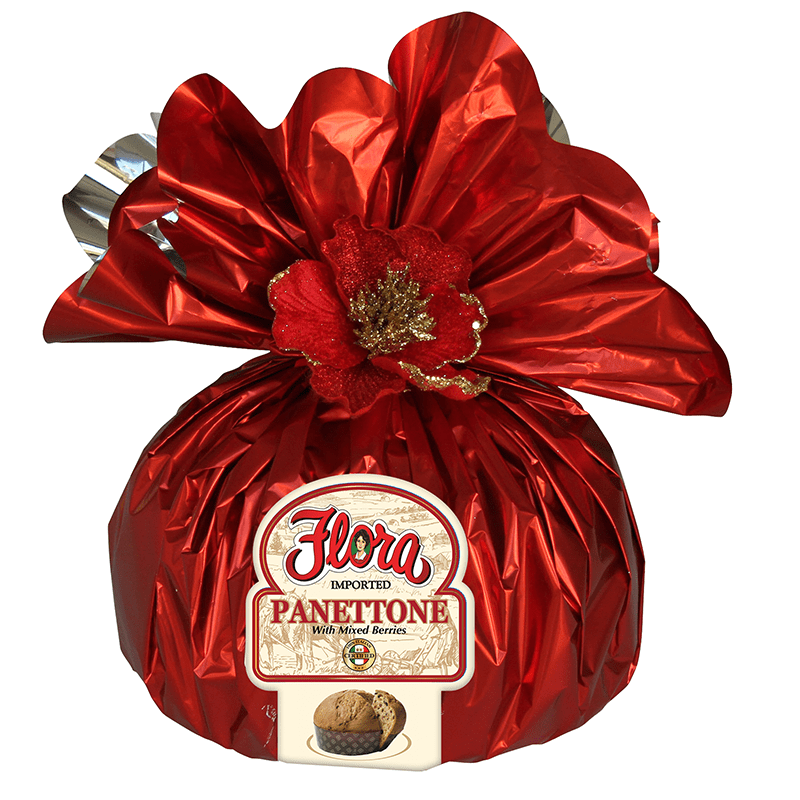
In true Brexit style, the CN seemed not to be listening, however, as his various totems were overturned. What is apparently important is that we have OUR OWN British Christmas now! Forget all those lousy foreign imports such as panettone, lebkuchen, stollen, Christmas markets, turkeys, port, and Christmas trees for heavens’ sake. It felt as though The Queen at 3pm was all there was left. And that I can well do without…

Christmas is the time of year when our supposedly shared values and culture are most on display – be that through the general belief in “peace and goodwill”, the way in which a formerly Christian festival is now the closest thing we have to a secular, global one, and (sadly) the extent to which we have let it become an orgy of commercialised material consumption.

Culture in this sense is not the stuff of museums; it is simply what all people everywhere value and do in their lives; at this time of year, that is more on show that usual.

Yet there is a tension here: at a time of supposed togetherness, individual self-determination has never been stronger; while Christmas as an international (retail?) phenomenon still seems to be growing, I suspect there is more divergence than ever in what individual people actually do. And so, we arrive at a cultural pick-and-mix, where we are all left to compile our own particular versions of Christmas, as with everything else. They may not always mesh well; CN and I found ourselves on resolutely opposing sides. The defender of British libertarianism in effect demanded that we should all now follow the same narrow, laid-down (imagined?) British-only version of Christmas Freedom – whereas I, a little to my surprise, ended up advocating the kind of cultural magpie-ism that might also be the source of some of my worst Christmas nightmares.

It can turn into a very personal minefield (I feel a post on the art and politics of present giving coming on…). Personally, I am very happy that my festive season is now a little internationalised in a way it wasn’t as a child: there are Italian and German goodies in the cupboard alongside the Christmas Cake; there are Scandi-styled decorations on the tree rather than tinsel; I enjoyed my virtual walks through the Christmas markets, and I take my present-giving lead from what I have seen elsewhere. The images in my mind are, if anything, more of Christmas in Milan, Berne, Strasbourg or Lille than closer to home. Except, to varying degrees, that is my cultural home – it has all melded into a comfortable, pleasurable whole that reflects my sense that home is no longer constrained by a narrow stretch of water. We are all parts of the same thing, which is in a sense, surely part of the message of Christmas.

But there is also the risk of disappointment; as the options have multiplied, we cannot assume that even those nearest to us share the same tastes and values. Despite my best efforts, I struggle to appreciate many aspects of the home-grown effort. It’s not just the scam “Winter Wonderland” mudbaths; the homegrown ‘Christmas Markets’ we have visited have always been disappointing jamborees of junk food and tack – pale imitations of the continental versions; why do we always have to adulterate and dumb down? I don’t understand, either, those who want flashing plastic widget-fixers for presents; a present, even a small one, should be something special. I don’t understand the need to get paralytic or to make the outside of my home look like Piccadilly Circus. That said, I have yet to find anywhere in the U.K. whose municipal lights come even close to the spectacular displays found on the continent. Many here are sad, embarrassing and/or garish.

I still don’t understand where the instinct for Christmas to be a time of either Bah-Humbug or inane bad taste came from (whether tacky pullovers, weak T.V. or daft behaviour). My best guess is the only other nation that seems to do Christmas as badly as the U.K. – that found on the other side of the Atlantic, whose “Holiday Season” seems even more toothless than ours. But then, they have Thanksgiving too… Noel Edmonds may have a fair bit to answer for, too. I suppose the answer is that we are discussing a nation that largely doesn’t know how to enjoy itself gracefully in normal times, so there is no reason why Christmas should be any different. It either ends up hidebound, forced, daft or paralytic, while those who beg to differ are (mercifully) left to their own devices, but tacitly agreed to be party-poopers.

But we’re back where we started: Christmas is about Sprezzatura to all wo/men – and as in the rest of the year, the British are not collectively very good at it.

I’m not a real curmudgeon: I enjoy Advent and Christmas – because all it really does is amplify my normal approach:

 A (good) Life is for Life, not just for Christmas.