 ijstock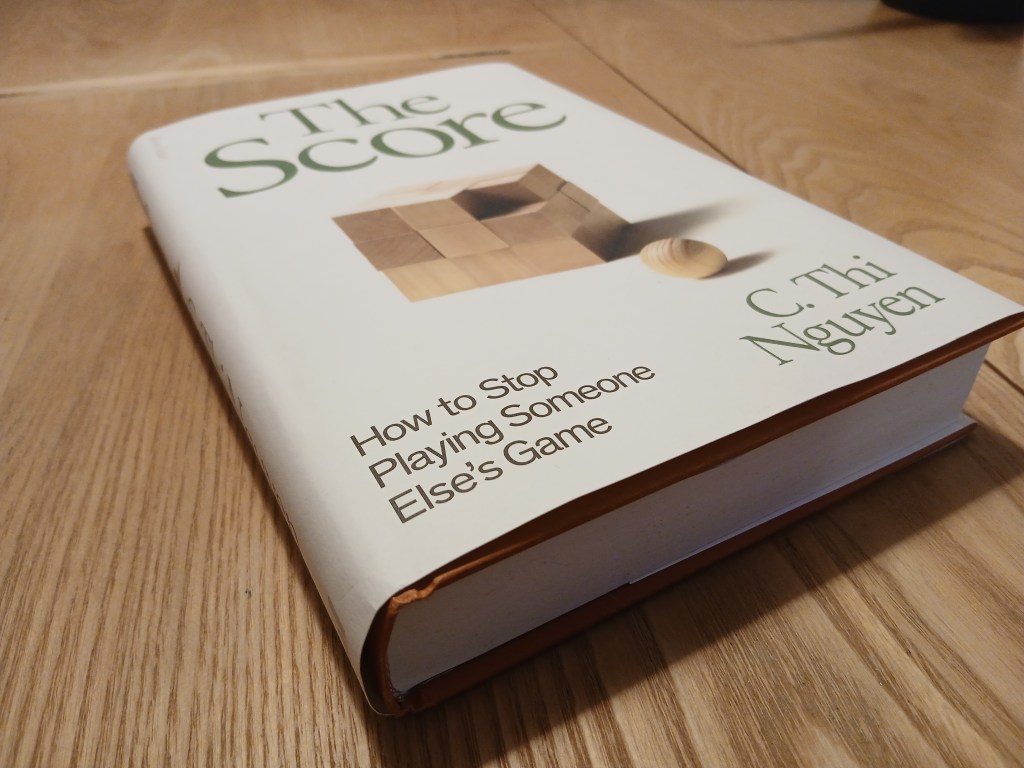
I wish I did not keep getting a vague feeling of being had: of being short-changed by life in present-day Britain: of occasions where reasonable expectations are rarely met. While one might have to cut some slack for the longer-term effects of the pandemic, and social changes such as the shift of almost everything online, too often it feels as though the concept of fair value has disappeared.
I’ve just finished reading C. Thi Nguyen’s book The Score, which surely is a candidate for the geek-book of the year, but it nonetheless shines strong light on some relevant concepts. First amongst these is something I have long been preoccupied with, namely the way in which explicit targets corrupt genuine value. Nearly fifty years ago, the incoming Thatcher government would have had us believe that target-driven privatisation was going to provide wider choice and lower costs; half a century on, it is apparent that state monopolies have simply been replaced by even more powerful and insidious private ones, which now have virtually total control over the way markets, even countries, function.
Nguyen calls targets Metrics, by which he means the ways in which modern society has come to benchmark almost everything. He argues that the benefit of this comes from fungibility – in other words, the ability to quantify standards and procedures irrespective of which interchangeable human-being happens to be on shift today. And so, we get standardised products no matter who is frying the burgers. But he also argues that the downside of metrics is that they all-too-easily become targets in their own right, often behaving in perverse ways.
One of his most arresting examples is certain (presumably American) Law Schools, whose success metric bizarrely included the number of applications rejected – presumably in the interests of remaining exclusive. The outcome was an increase in offers made to patently unsuitable candidates, purely so that they could be rejected and the metric met.
I felt a surge of recognition at this story, as my own experience of the British education system over several decades was similar: since emphasis was placed on league tables and exam results, almost the entire education system has shifted from teaching subject matter for its own sake to teaching students explicitly how to pass exams (gaming the system might be a better description). Exams whose results are invalidated by the fact that they are all too often not supported by genuine student insight. From this emerges a mindset that cannot accept justified failure on the part of some as the price for genuine success by others – and along the way, both groups of students are sold short. Few teachers dare to swim against this tide; I was one of them, and I paid a heavy price for doing so.
But to return to my initial sense of being short-changed…
Metrics have the additional effect of measuring the measurable, rather than the valuable. And so the emphasis shifts away from what is truly of value towards that which can be measured. Everything is effectively dumbed down because simplistic things are most easily measured – for example, the amount of money a sales assistant took in their shift – but not the quality of service they provided, or the satisfaction the customer did or did not experience. And that’s where the feeling of having been had comes from.
I think this mindset has now infected almost every aspect of life in the U.K. Somewhere in my residual awareness is a sense of a fair transaction; I accept that one cannot have something for nothing and I expect to pay a fair price for things I buy. In some cases, I am prepared to spend quite a lot, but I expect good quality of service and product in return. Would that the other parties in such transactions still seemed to think the same thing. But fair service seems to have gone by the board; what matters to most commercial organisations is solely the metric that delivers the largest annual profit. From this perspective, the sole reason for the troublesome existence of The Customer is to feed the corporate bottom line. Whether they get good value for money – or even a fit-for-purpose product – is simply not an issue.
There is an aggregate effect here too: there seem to be two models for company profit: one sells disposable junk at a bargain basement price, while the other sells premium products to the vanishingly small percentage of the market for whom being fleeced is not a concern. And in some cases, the only difference seems to be the price of the twt….
In between the two, those who are willing or able to pay moderate amounts for decent quality have been squeezed. The situation seems to have become more extreme as the income of the wealthy few has soared, and with it the prices of products that want to preserve their “exclusivity”, while I guess, if you are prepared to settle for cheap junk, you don’t care less in the first place. This is another manifestation of inequality, and it shows even in my local town. Home to around 200,000 people and relatively affluent, it is not a backwater – and yet its retail offering has been hollowed out so that it really only serves these two markets. Choice is an illusion, though to be honest, I doubt this is an issue that probably concerns the vast majority, for whom cheapness seems to be the only criterion in town.
It has been made worse by the widespread disappearance of local businesses, ones for whom good customer service and value were essential aspects of what they provided. A particular hurt has been the disappearance of the last specialist menswear shop in my town, which served me for thirty years with intermittent purchases of good quality clothing. I can hardly begrudge Duncan his retirement, but it has left a hole. There is now nowhere locally where I can buy any clothes that I am prepared to part with cash for.
In the search today for a new summer suit, I have instead been investigating one of the longer-lasting (now only) high street brands, which at least still seems to offer a reasonable selection. They even offer some suits made from good-quality Italian fabrics. On my first enquiry, we ascertained, however, that the cutting and stitching was nonetheless done in China to a British template, albeit apparently at a factory that did seem to know what it was doing. So not really an Italian suit at all. I went back for a second look today, and a different assistant assured me that beyond doubt the suits were manufactured in Italy. I did not push for a second look at the label: the “Made in Italy” label is not applied to anything lightly, and I knew it would not be there.
The question is, why would I spend money at a shop where either a) the company does not care about dissembling on the provenance of its clothes (the “Italian fabric” was writ large, while “made in China” was quite the opposite) and b) where the staff is either unknowledgeable or dishonest enough to tell a straight lie even to a customer who was proposing to spend a not inconsiderable sum?
A similar thing can be seen with food outlets; in theory, the increase in such places on the high street ought to be a cause for celebration – and we are still some way from the density of cafes and restaurants found in many continental places. But it is not – because they deal almost exclusively with food treated in the same way as junk clothes: a huge, spurious choice of various incarnations of mass-produced chain-food pap, and virtually nothing for those who want choose a different deal, who would – yes- be prepared to pay (an amount) more for something of genuine quality. That still tends to be the difference between British towns and their continental counterparts.
The answer, of course, is that 99% of the time, they get away with it. People who know or care about these things are so few and far between that we make next to no dent in the companies’ income whether we decide to buy or not. In the UK in particular, the mass market buys almost entirely on price, while what matters to those on the selling side is simply whatever ruse they can deploy to maximise their revenue; all else is irrelevant. Even, it seems to the point of not caring about those sectors of the market who want something else. It is a matter of put up or shut up. To avoid repetition, I will skip details of several other recent experiences; suffice it to say the above were not unique events.
There is, of course, an aggregate impact of all this: I am a strong proponent of local shopping. Town and city centres are essential parts of their communities and I would be very happy to purchase as much as possible in such places. And you can’t feel fabrics or taste food online. But what am I to do if my needs are increasingly ignored? If I am not able to spend my money on things I genuinely want, then I cannot – or will not – patronise such shops. I am not prepared to feel that I have been had. We are left with places that largely purvey junk – while those with the means and (maybe) the taste patronise somewhere else entirely.
I am then left with no alternative but to do the legwork virtually – and shop online, where at least I know that the sales assistant (me) will give the customer (also me) the care that his purchase deserves.


 SPREZZATURA