Arts, Architecture & Design, Travel

Modernism on a marshy coast

bh04

Having been born a westerner, to me the coast always meant towering cliffs and rocky outcrops with crashing waves or at least a decent swell. By contrast, the eastern coast of England is deeply uneventful, as the land (sometimes literally) slips apologetically into the sea. On this side of the country, you have to go to Yorkshire before anything more dramatic happens. I recall looking at maps of the country as a child, and thinking that the bit of the coastline north of London looked particularly untidy, before it sorts itself out north of Ipswich into the distinctive bulge of East Anglia.

The sea (well, the nearest salty inlet) is a mere ten miles from my home, and yet much of Essex feels distinctly un-coastal. By a strange fluke of geography, the country actually wraps itself around its coast, so that you can travel a good forty road miles, approach the coast and find yourself looking across at a place not very far from where you started. But if you add up the total length of the salt marshes, inlets and creeks, it adds up to the longest (salt-water) coastline of any county in England.

It’s a chaotic landscape of salt marsh, mud flat and low-lying islands, some of which can be reached by causeways at low tide. It’s also one that human activity has done its very best to mess up further, with a legacy of jerry-building extending from some of the earlier fishermen’s sheds by way of oil refineries to acres of sprawling mobile home camps clamped desperately around little apologies for beaches, which for most of the time lead you not so much to water as vast expanses of mud. The recent addition of off-shore wind-farms tames the scene further, though I must admit an admiration for those graceful and slightly surreal structures, which I think are at least an improvement on Shell Haven refinery. I suppose if you grew up in Tower Hamlets, it’s a welcome release. Yet, over the years I have come to appreciate that it does have a rather melancholy atmosphere of its own.

bw01
The Blackwater estuary at low tide


And it does yield bounty, even if one might have reservations about the water-quality of the North Sea. Mersea Island near Colchester has been the source of oysters since Roman times, while further south, Maldon’s marshes are home to a particularly fine sea salt. The area is internationally recognised as a sea-bird sanctuary, and I have seen seals just off the beach at Walton on the Naze.

I do wish, however that more had been done to prevent the particularly sad kind of sprawl that I mentioned earlier: it takes a lot to see even a little of the picturesque in the rows of caravans, and blingy housing estates. So it was pleasing yesterday to walk out past Maldon to the beginnings of open coastline on the way to Goldhanger. A cold wind was blowing in off the sea (special delivery from Norway) so it was wrap-up-warm weather. We (two former colleagues and I) headed for what passes as a headland where a set of rather unusual-looking structures could be seen, and not far from where we knew there was one of the excellent Tiptree Tea Shops. These have spread in recent years to become a much-appreciated highlight of the more visit-able places in this ambivalent county. They are the creation of another eminent local concern, Wilkin Jams of Tiptree (by Royal Appointment), and they serve excellent lunches, cakes and cream teas.

The structures, built by Osea Leisure Park, turned out to be a modern take on traditional Indian Ocean beach hut no less, a line of ten in contrasting pastels, perched on stilts and just 20cm above the water at high tide. They were designed to have minimal impact on the protected beach beneath. It’s pleasing to see some genuinely innovative, high quality architecture being put into such a place – even if the cost of purchasing one, around £25,000, means it’s hardly a democratic gesture…

OLYMPUS DIGITAL CAMERA

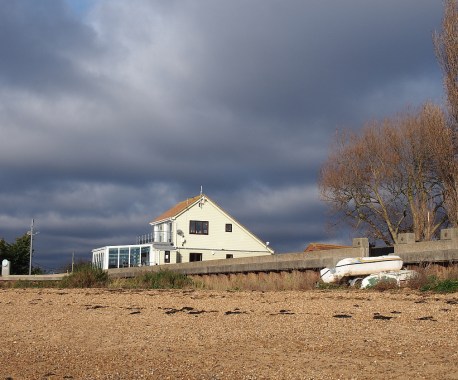
The nearby tea room offered a refuge from the wind, and served up warm drinks and cakes before our return to the cars at Heybridge Basin. Looked at from the right angle, it could almost have been somewhere much more romantic, even a little Arthur Ransome. Just shows what a little imagination can do to the way humans intervene in even relatively mundane places.
ts01
The Osea View tea room

https://www.tiptree.com/index.php/tiptree-tea-rooms/locations.html
Food

Multum in Parva*

OLYMPUS DIGITAL CAMERA

I quite like the idea of having lifetime quests. They needn’t be anything terribly grand (though they can be – opera-singing, anyone?) but it’s just the notion of going on a gradual, unhurried journey to try to find a particular holy grail that is important to you. Two of my particular ones relate to food, and as I said, neither is particularly important of itself – and yet there is much potential within for the discovery and perfecting of some small point of order. The first, which I will relate here by means of sticking my neck out rather in this little photo essay, is the quest to make a perfect ragù alla Bolognese, and the second is to come as close as I can given certain constraints to making the perfect pizza.

I regret to say that it seems to be a particular trait of the British to adulterate – nay  bastardise – cultures from other places. Copying is something all cultures do – but we seem to have a particular gift for ruining perfectly good dishes by not being bothered to do make them properly. So here is my own personal assault against the travesty that is the typical British spag bol. I have eaten the proper thing many times in Bologna, so consider myself reasonably qualified to judge it a success, and give myself, after about a quarter of a century of trying, about 9/10. It is still not quite the perfect Bolognese flavour, but it ain’t bad…

The key to this is slow cooking – while preparing this article, I set the pot simmering at around 1pm and kept a weather-eye on it during the afternoon. By 7.45 it was ready…

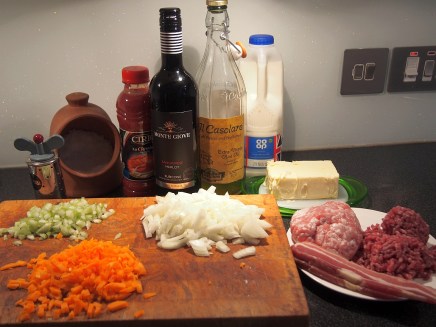
Ingredients:

  • One onion, one carrot, one stick of celery – all very finely chopped to make the traditional ‘base’ for the sauce.
  • 250-300 g passata (Cirio recommended) Note: no tinned tomatoes…
  • 150g minced beef
  • 150g minced pork
  • One or two strips of pancetta to about 40g, finely diced
  • Salt and pepper
  • Milk (yes – milk!) as required, perhaps 200ml
  • Around 200-250 ml red wine.
  • Olive oil and/or butter for sweating the vegetables
  • And that is all.
  • Makes six portions, and is worth freezing.

OLYMPUS DIGITAL CAMERA

Method:

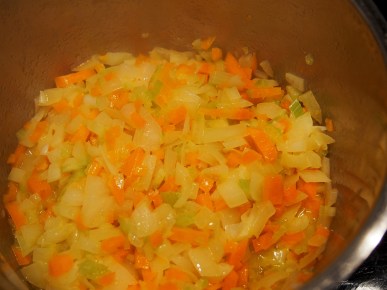
Melt the oil and/or butter in a medium sauce pan and sweat the vegetables until they are well softened and reduced.

OLYMPUS DIGITAL CAMERA

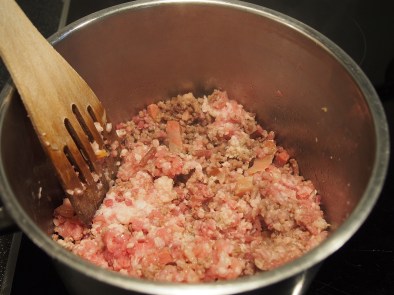
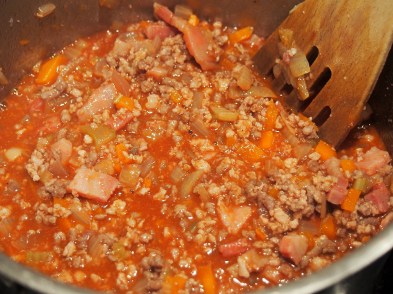
In a second, larger pan, heat more oil and/or butter and brown the various meats, starting with the pancetta, and then adding each at a time. Allow to colour thoroughly, but do not burn.

OLYMPUS DIGITAL CAMERA

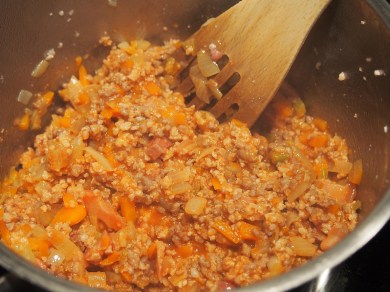
Add the vegetables to the meat and combine thoroughly.

Add a small amount of passata until the mixture is moist but not flooded – the tomatoes should not dominate the appearance or taste of the dish.

OLYMPUS DIGITAL CAMERA

Add the red wine and bring to a slow simmer. Again, do not flood the mix.

OLYMPUS DIGITAL CAMERA

Season with salt and pepper.

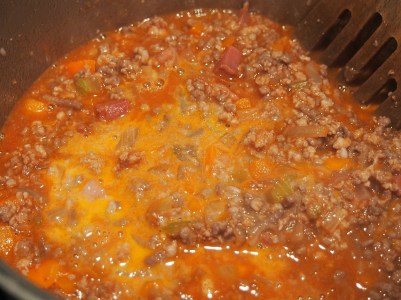
Allow to simmer until the ingredients start to mix fully, and then add around 50ml of milk and mix in. This is the secret of a traditional ragu, which gives it a particular colour and flavour.

OLYMPUS DIGITAL CAMERA

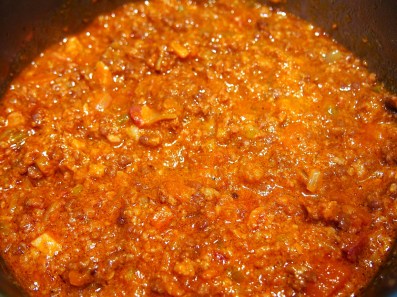
Leave the mixture to simmer on a very low heat for an absolute minimum of two hours, ideally several times that. When it becomes a little dry, add a small amount more milk.

The final consistency should be moist but not runny; serve.

OLYMPUS DIGITAL CAMERA

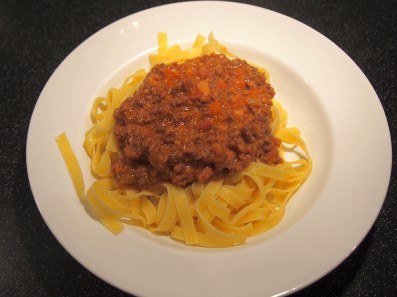
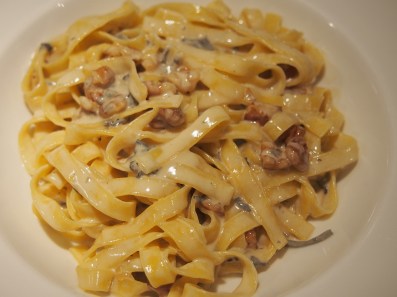
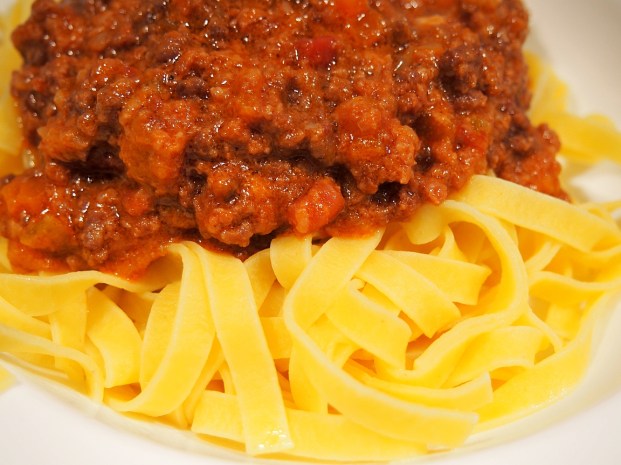
Ragu is never eaten with spaghetti in Bologna, tagliatelle being much superior for coating with the sauce. Why not splash out on some quality to go with your efforts?

OLYMPUS DIGITAL CAMERA

I normally mix the sauce into the pasta, but left it separate for the photo, so that the consistency is visible. Italians also add far less sauce than the typical Briton – there should be a coating, not a flood – and they also tend to let their food cool a little before eating, so as to release the flavours.

OLYMPUS DIGITAL CAMERA

My wife, being vegetarian, does not appreciate this at all. The benefit of this dish is that it needs to be made in bulk, but is one of the few things I think freezes without too much harm. While this is cooking away, I normally prepare for her a simple sauce of cream, blue cheese and walnuts – which takes all of four minutes…

OLYMPUS DIGITAL CAMERA

*Much in a Little (the motto of England’s smallest county, Rutland)

Arts, Architecture & Design, Opinion & Thought

Well rounded people

bench

Autumn term 1975. Monday morning started with double woodwork – and for me the slightly strange experience of learning in my father’s department. Although it’s perhaps a pity it didn’t come mid-way through the week, I always looked forward to the lesson (which was not taught by my Pa…). Given the academic routine of the grammar school, I found great pleasure of making dovetail joints or turning bowls on the lathe for a change. Unlike certain of my father’s colleagues, I never saw practical lessons as inferior, and I think it is where my now much-valued aesthetic appreciation and streak of perfectionism came from. I well remember my father’s fury when, one day he was summoned to the Headmaster’s office (where he was still seen as the chippie) and instructed to repair fifty wooden exam desks. He replied that he was not the odd-jobs man. Indeed, he was and is a highly-skilled cabinet-maker.

It was also interesting how some of the best in the class during those lessons were not the academic stars (though there was crossover); I think it was good that this gave those with different talents a chance to shine – and the academic ones a taste of what it was like to struggle a bit.

This recollection is particularly in my mind at the moment as my father, now 83, (and still making violins for a hobby) is currently collaborating with a young friend and me to construct a facsimile of a mid-century Scandinavian piece of furniture  by Kai Kristiansen in American black walnut (shown in rosewood above). It is a wood he has never worked before and he is quite excited by the prospect; it is proving to be a most enjoyable experience, which has ranged from researching the original, to analysing the construction, adapting it for the workshop and personal taste, to sourcing suitable timber. A specification and price has been agreed, and construction will start shortly.

Practical skills have been repeatedly looked down on by educators in this country; it is though they are somehow insufficiently worthy, given their apparent lack of intellectual rigour. My former teacher Peter Whitton knew this was not true, for despite being a Classicist, he was never happier than in his woodwork shop, where he too turned out fine pieces.

At present, I am starting to look at what I do next; the medication is gone, and I can feel my mental strength returning little by little. Amongst a number of ‘irons in the fire’ I am tempted to branch part-time into interior design, a field I have followed for many years. I defy anyone to claim that the processes involved are intellectually weak; indeed, I know of few so demanding exercises as solving difficult design dilemmas. And then there is the fact that one (hopefully) has a beautiful end product, which can be admired by those with the aesthetic sensitivity to do so. It is very tempting to sign up for that diploma.

Last Friday, we went to the opening night of Grayson Perry’s exhibition The Life of Julie Cope at FirstSite in Colchester; I am also currently reading his book The Descent of Man, and despite Perry’s lurid persona and less than rigorous academic background, let no one claim that this is not both a skilled and highly erudite man.

At the other end of the spectrum, I know of individuals educated to the highest academic levels, who are not able to perform the simplest practical tasks for themselves, and who seemingly lack any ability really to see (in the deep sense) beauty in their surroundings. They may have trained minds (and I’m all for that) but they seem impoverished in other ways. Is this the cost of the strong emphasis on academia? The ultimate sadness for my father came some years ago when the Craft & Design department he had founded and developed over forty years was closed to make way for a computer suite. No more opportunity for today’s sixth formers to do something practical as part of their week’s programme.

This is short-sighted: many highly-educated people do also appreciate the arts and practical crafts; they provide a complete diversion into another rich aspect of life which I for one would never be without. Peter also knew this, as did the many clearly-thoughtful people at the Perry exhibition.

Only target-chasing educational managers seem snooty enough to disparage the breadth that comes from the empowerment to produce and appreciate tangible works. Our neighbouring nations such as Germany have never disparaged practical skills either – and a comparison of the two nations’ economies tells all that need to be said about that.

Bring back double woodwork on Monday mornings – especially in the most academic schools. Breadth, depth and richness in education is important.

Sartoria

Chester British?

CB01

Manchester, “summer” 2014. Urgent need dictated the purchase of a new pair of trousers, and House of Fraser was near our hotel. I don’t like jeans (all denim and rivets), and I don’t really like chinos (too much crinkly double stitching on the seams and often so rigid that you look like you’re wearing lengths of drainpipe), and on the British High Street that doesn’t leave a gent much choice. After what was looking like another fruitless trawl round the menswear department, an assistant hared off upstairs to bring down some trousers he knew were languishing up there (“that might fit sir rather better”). He came back with a pair of rather nice flannels (this was a Manchester summer after all) which did indeed fit, and as two-year old remnants were offered at a not-to-refuse price. Thus happened my first encounter with Chester Barrie.

Very satisfactory they proved to be, so I was delighted some months later, to notice that an outlet shop was opening in a shopping ‘village’ just a few miles from my home, of which more later.

Chester Barrie is a long-established tailor whose flagship store opened on Savile Row in 1937. Simon Ackerman, its owner, had had experience of American gents’ tailoring, and sought to create an early global brand. Sir Winston Churchill, Cary Grant and Frank Sinatra were customers.

The brand has a complicated corporate history similar to many others, but the important thing here is its emergence in recent years as a strong exponent of modern British tailoring. While Sprezzatura loves all things Italian, it is still something of a sadness that the home industry doesn’t offer more to please my eye. For me, traditional British tailoring is just too formal, stiff and class-redolent. It may work if you are a member of a city law firm or bank, but I have no wish to wear the badges of those particular cliques, with all the chauvinistic clubbiness that it too easily implies.

What’s more, the clash of multiple primaries, loud patterns, checks, stripes and pastels that one often sees at the ‘country’ end of the look too, to me suggests nothing more than a blatant disregard for the simple rules of aesthetics – or else incipient blindness. There is something in that guidance about never wearing more than two colours at once, and matching the belt and shoes. Perhaps it doesn’t matter when you’re shooting grouse.

So Chester Barrie is a very welcome presence on the market, and I think can give the Italians a good run for their money, in both the styling and the presentation of their collections. The clothes are sharp, modern and yet clearly British. That said, they make an Anglo-Italian blend a distinct possibility, and this is especially useful in the trouser department where Italian imports may look great but clearly aren’t cut with northern European body shapes in mind.

CB02

The fabrics in use are of superb quality (often, I note, Italian in origin) and the manufacturing equally good (also done in Italy on their premium line) – which strikes me as a little ironic for a Savile Row company, but I’m not complaining. I don’t intend to review specific items here, but recommend a click to the website for a more comprehensive view.

And those outlets: they are important. This is certainly not cheap clothing, the prices in a regular outlet easily rivalling those of Milan and Rome – but a little research will reveal that House of Fraser regularly offers a limited range of C.B. clothing with some good mark-downs. The C.B. website offers its own seasonal sales too – and the three outlets in Braintree, York and Gloucester offer good service and some items at prices so reduced as to make the High Street chains seriously blush. Well worth the cost of a tank of petrol to make a visit to one of them, if needs be.

It is good, at long last, to see a British clothier grasping the market for modern, forward-looking clothing with a Brexit-defying edge, and not letting go.

http://www.chesterbarrie.co.uk/

https://www.chesterbarrie.co.uk/store-locator


Opinion & Thought, Politics and current affairs

Why I am not wearing a poppy this year.

It’s a great pity when life is so full of avaricious commercial operators shouting at the public, that even those who do inalienable good, such as charities, feel the need to copy them. I do sympathise – how else are they to be heard? But in fact, I think that is a misconception: most of the public is entirely capable of distinguishing between the two and acting accordingly. I rather suspect that the problem comes from the executives of charities, who more and more closely resemble the CEO’s of big business, maybe on  occasions are even one and the same, and self-promotion is the one strategy they know. After all, they probably have targets to meet.

So I was somewhat displeased to receive a good month or more ago, in the mail (which will have cost) a wooden cross (which will have cost) with a poppy attached, some rather over-assertive promotional material and a donation form. This commemoration is for good reason focussed on 11th November, and does not need to start in early October just to steal a march on the competition.

My other reasons are regrettably more political: the lesser is the memory that for years, my former employer required me to wear a poppy (at my own expense)  ‘to set a good example to the pupils’. I felt it did the opposite, by turning a voluntary gesture of patriotic remembrance into an act of corporate policy. And it certainly removed from those who might have wanted it, the opportunity to set an example of a different kind.

And more seriously still, in the past twelve months, I have seen too many social media pictures of French war cemeteries deployed in the service of the Brexit movement. If the two are to become conflated, I will never wear a poppy again: this Remembrance should remain essentially apolitical, and if those whom I consider to have committed the most atrocious act of national vandalism are going to claim, even incidentally, the poppy as a symbol of their so-called patriotism, then I can no longer comply.

Inasmuch as any of those largely conscripted dead really held the lofty ideals we often attribute to them, I suspect they too would be appalled at the wanton damage by some in this country to the internationalism that was founded to stop more having to follow them. Furthermore, the misappropriation of symbolism by overt nationalist movements has far too many uncomfortable historic precedents for me to be comfortable with it.

I may be taking this too seriously, but I think not: these are serious matters. I hope someone from the Haig Fund, which I have supported for many decades is reading this, and reflecting on the implications of other people following suit. It is a long-standing national institution that does not need to stoop to base commercialism; charitable giving is a principled, voluntary activity, and the hard-sell only serves severely to undermine that ethic.

And in the current political climate, the Haig Fund (as it was) perhaps also needs to look hard at who is, by accident or design claiming its totem, and for what purposes.

Opinion & Thought

Discriminating? Discerning? Definitely!

wine

I can’t remember where the phrase comes from – perhaps an episode of Yes Minister, or maybe The Good Life – but it goes, somewhat pleadingly, “…but we are discerning people…!”

The implication is that there is a group within society whose views in matters of taste and judgement are superior to the rest. It is something that has intrigued me for a long time, simply because of the very complex questions it raises about matters of aesthetic merit, quite apart from the less appealing but still interesting overtones of social snobbery and elitism.

Even the words are difficult: while we might accept that discrimination may be a good thing when it comes to a choice of wine, it most certainly would not be were the issue the politics of race, gender, age, disability or intelligence –  and quite rightly so. Discernment is perhaps discrimination’s gentler cousin – but it still implies the ability (and entitlement?) to make the ‘right’ judgements about things.

I suppose the deep assumption behind this blog is that discernment – discrimination even – is at least part of the secret to a satisfying life. Some people might see even that claim as rather totalitarian – but I really don’t see the point in allowing all sorts of indiscriminate twt into one’s life, whether that be in one’s personal mores, the way one treats others, the general ‘standards’ one aims at, or the material or intellectual things with which one surrounds oneself. And I don’t think that hair-shirt wearing simply because others may be unwilling or unable to follow suit is really the best way to tackle that particular problem. Otherwise, life simply becomes a race to the bottom.

We don’t have very consistent standards about this though: many would probably accept that some people have better judgement than others when it comes to a matter like wine, antiques or art, less so when discussing food, perhaps and very few might accept the same when considering music or fashion. Why this should be so is difficult to fathom; perhaps it relates to the perceived ability or entitlement of individuals to access those fields and make meaningful decision about them.

But there still remains the difficulty that verdicts about good/bad and right/wrong can ultimately be nothing more than the product of subjective consensus between individuals – and then we get into the whole social minefield of which groups (should?) have the authority to decide what, for example is ‘good’ art. Very often, the whole matter is inextricably tied up with matters of social class and power, with Establishment values both holding sway, and also being used as a kind of passport to entry of that particular clique.

Yet history shows that quite often the Establishment gets it wrong: given that ‘genius’ often correlates with individuals who disrupt established norms, the wrong-footing of the cultural elites is a regular feature of art history. Bizet, Modigliani and Miles Davis are just three examples of people who were initially rejected, only to be hailed for their genius at a later stage. So even now, can we really be objective that Picasso was a great artist whereas a graffiti-hoodlum is not? What about Banksy? Or the political murals of Northern Ireland and elsewhere?

So social acceptability is actually a very unreliable measure of quality, for all there are plenty of vested interests that might want us to believe otherwise.

Are wines that sell for hundreds of pounds a bottle really worth so much more than the average supermarket offering? I suspect many people would say not; the usual argument seems to be that if you like it, that’s all that matters. And yet, on the one occasion in my life when I tasted a truly distinguished wine, a Château D’Yquem, I was forced to concede that the experience was unlike any other wine I had ever drunk. The fact that it is only periodically produced, using techniques of the most extreme care and – yes – discrimination regarding what is acceptable, produced an incomparable result.

So perhaps it comes down to matters of aestheticism: the surprise about that d’Yquem was the fact that I could still taste it a good ten minutes later, so intense was it, even a slightly unnerving experience if you are not expecting it. And from that, where are we to go with all those other fields where discernment appears to play a part? What about music? Food? Fashion?

Having listened to almost no music whatsoever during my illness of the last year (when you’re not in the mood, it’s just annoying noise) my first resort has been classical music; after that long silence, it is all the more clear to me at least, that the intricacy of that music, the purity of the sound, and perhaps above all its ability to capture mood and emotion really does transcend all other types. And yet, even that is not going to convince many!

But as I have listened more, I have also rediscovered the lighter but still very subtle nuances in the various traditional musics that I enjoy, particularly the Irish and Scottish traditions. They too are capable of being very moving indeed, but they are also perhaps one of the less socially-acceptable forms of music according to conventional tastes.

As my sense of enjoyment has returned, food has started again being something more than mere fuel, and the pleasure of properly made pizza, pasta and other simple dishes is back. But note, my use of ‘properly made’: I still have preferences that I consider to be superior to the alternatives – for there is a huge difference between an wood-baked artisan pizza and the average chain restaurant offering, and having eaten both, no one will persuade me otherwise!

In the final reckoning I think it has to come down to how receptive one is to aesthetic experiences. It is also a very complex matter: knowledge of the ‘authenticity’ of that wood-oven pizza is most definitely part of the package – but why should the cognitive aspects of the experience be disregarded? Likewise, some music simply has more innate sonic qualities than other – but the ability to know that depends not on the music but on the receptiveness of the listener. It does not mean, incidentally, that other forms of ‘aesthetically lesser’ music do not have their place: they simply have different purposes – but it may be pushing it to claim that all forms of music are aesthetically equal.

When it comes to clothing, for me there are certain fixed qualities, such as tactility , colour and texture of the material, the fit (whether it flatters or not), and the standard of the craftsmanship. Nothing especially to do with a particular ‘fashion’ though most certainly the cultural connotations that clothes can carry can influence the emotional experience one has of them.

Some things are as close to ‘definitely better’ as it is possible to be: I think that natural fibres are superior to synthetic ones for very deep, primitive sensual reasons, nothing to do with conscious preferences. In the same way, I suspect that acoustic music tends to chime more deeply with the human psyche than the inevitable distortions of amplified sound – which more often than not then tries to compensate by use of excessive volume. Not at all the same thing.

What I do not accept is that some sectors of society should – or do – have a monopoly on ‘good taste’. This seems to afflict some nations more than others: the consensus about what makes a ‘good’ espresso or croissant are pretty-much universal in the cultures concerned, the ‘rules’ surrounding them are there for widely accepted practical reasons and cross social boundaries.

While high demand does tend to inflate prices, the ability to buy is not in itself a measure of aesthetic value. I do not like the way in which the Establishment often considers it has cornered the market in good taste and priced it accordingly – but equally I am not keen on the kind of inverse-snobbery of those who will do anything just to prove the opposite.

Discernment in aesthetic matters has the potential to enrich the lives of any and every one: ‘judgement’ is a skill that can be learned through experience; it does not have to carry a huge price tag, just the willingness to look, feel, reflect and compare. But I equally do not accept (or even entirely understand) the opposite viewpoint that discernment should be reviled for its supposedly-elitist overtones: even at the most basic sensory level, not everything is equal in this world.


Sartoria

Lussoti – Anglo-Italian style on a good footing…

Luss01
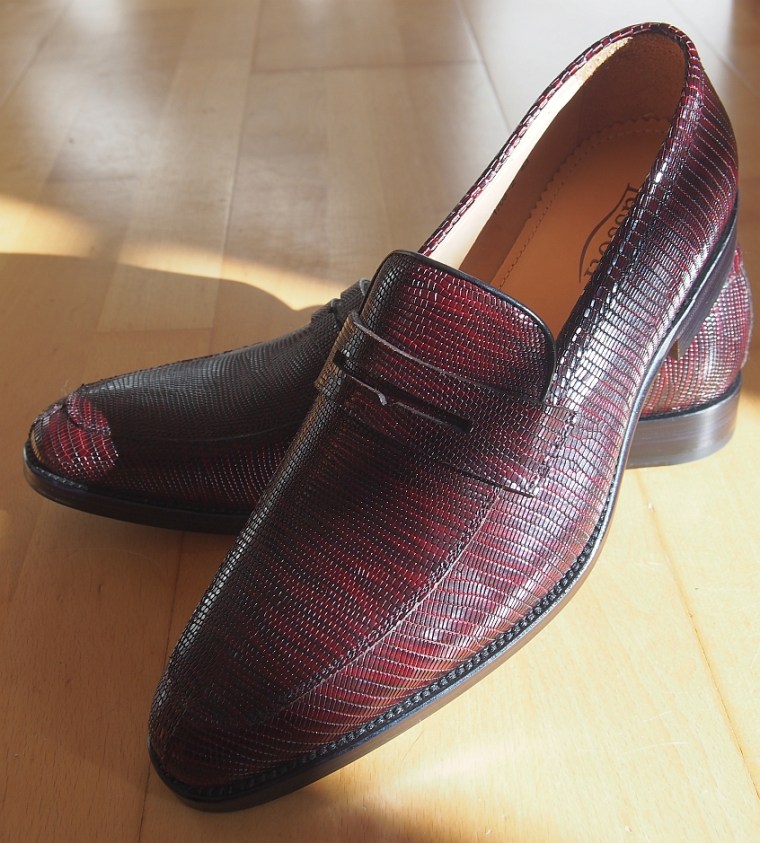
Giovanni penny loafer

For some time I have been bemoaning the fact that much British men’s footwear, as well as being deadly dull, was not even well-made any more. Having run out of patience with offerings that lasted barely a season, and given the local famine of inspiration, I got myself up to the West End to see what might be had. I tracked down one of the few self-owned Loake outlets and my jaw hit the deck: £800 for a pair of ordinary-looking black brogues… Well, I suppose I should have expected that from the Burlington Arcade – but when even Russell & Bromley who, while a quality shoe-maker are hardly top of the tree, charge in excess of £200 for a similar pair, I began to realise that it was probably my frame of reference that was out of date…

What’s a man of average means to do? The kind of money I was used to spending on shoes was all too evidently a false economy. Luckily, the dear old internet came to the rescue once again, and doing the virtual rounds of Tuscany, I found several makers who would dispatch to the U.K. – but again, Italian shoes don’t come cheap…

Enter two companies who can provide something of an answer: Scarosso, who are a small German-Italian outfit, and the newcomer Lussoti, who are based not in Chiantishire so much as Chesterfield. Lussoti Shoes may have a convincing Italian ring to the name, but there’s more to it than meets the eye.

The company is the project of Luke Twigg and Garry Marshall, who were equally fed up with the lack of good quality, reasonably-priced men’s shoes on the market. Having met little success in sourcing shoes from other makers, they set up their own brand, largely designed in-house, but manufactured using the top-notch  labour and materials of and in Tuscany.

The result? A small selection of hand-made shoes which display a distinct Italian styling but with prices which, while not exactly cheap, at least make the occasional acquisition a distinct possibility. By keeping out the middle-men, cost-savings can be passed on to the customer, and result in a collection the majority of which comes in at between £100 and £250. I have by now re-educated myself such that this is an acceptable price to pay for a product that will hopefully last and last – and after all one does not need new shoes every day…

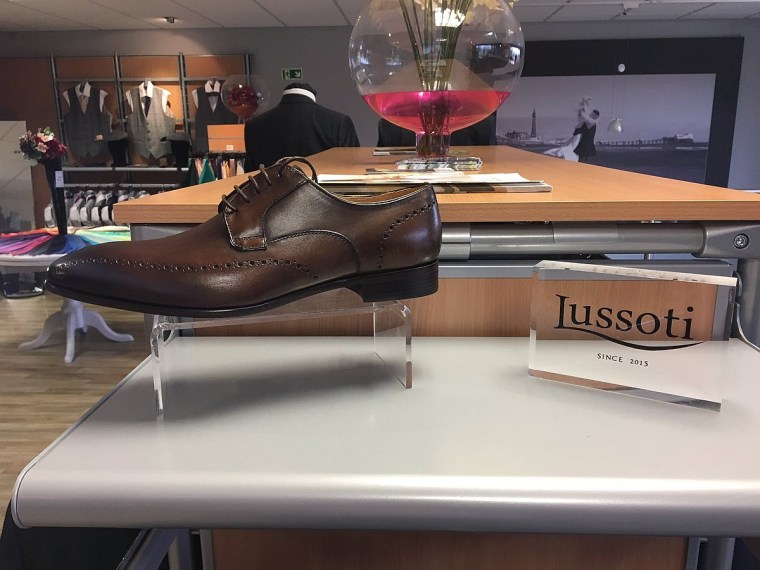
What makes a significant difference, too, is the quality of the product. Not only are these designs that are quirky and sharp enough to be different without marking oneself out on the mean streets of Chesterfield or Colchester as a full-on Mafioso, but the material quality and craftsmanship really stands out. From the sturdy slip-type box, to the dust bags and complimentary shoe horn, this is a very good all-round retail experience for the price. The two pairs that I now own are light but sturdy, and were almost like wearing slippers from the word go. None (yet) of the six months of agony needed to wear in a pair of Loakes. I like fairly pointed shoes, which are more interesting than blunt-nosed British types. These are just right, with ample toe-room, which is not always the case.

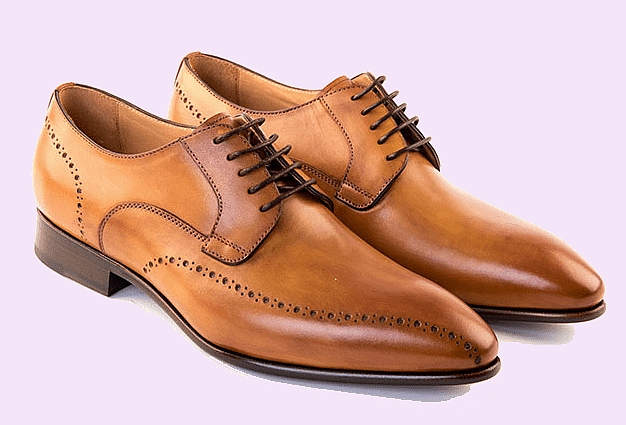
The Nero derbies are extremely supple and while I don’t really like brogues, I find the hand-stamped, oblique reference to those over-elaborate items vaguely amusing. I ordered a pair/size combination that was out of stock, Luke scoured his retailers until he secured a pair for me in just a couple of days.

Luss02
Nero derbies

The more recently-arrived Giovanni embossed burgundy penny loafers are also delightful, though needing slightly more walking in. For someone who dislikes ‘boring black’ shoes, these are a good, slightly subversive alternative with grey or black suit or trousers.

As I mentioned in the previous post, I am intrigued to see a number of pan-national companies like this arising as a means of reconciling demand for distinctive products with the places that can supply them. Although the company has only been established since 2015 their shoes are already being retailed in selected shops across the U.K. and at one place in the U.S.A.

Full marks to these gents for the initiative and I just hope that the madness of Brexit does not do too much harm to business models like this.

https://lussoti.com/

The views are solely my own, though the review was written with the co-operation of Lussoti Shoes. The appalling puns are entirely my own work; well, it was one of those afternoons…

Opinion & Thought, Politics and current affairs, Sartoria

Suits E.U., sir!

I can hardly be the only British gent who is regularly bombarded by advertising from Jermyn Street shirt manufacturer Charles Tyrwhitt. I wrote to them several years ago pointing out that while I approved of their democratising marketing strategy, I would be more happy to buy their clothes if their tailoring and design was not all so old-school British. I pointed out that traditional British menswear is often starchy-formal and has associations of occupation and social stereotype that I don’t feel happy with – and that’s without the age profile that it still implied.

I received one of their habitually jolly letters in reply, explaining that this was what the British market still wanted. Well, some years on, I note a distinct modernisation of Tyrwhitt’s catalogue, with sharper styles and fabrics sourced from amongst others, good Italian mills. I also noticed recently, the first appearance of a non-white model in the catalogue: well done – but about time too! I’m certainly not claiming any influence over the decision, but I think it has made Tyrwhitt a more appealing clothier, and has hopefully broadened their market as a result.

While there’s no question over the quality of traditional British men’s tailoring, my reservations still hold, and this is why I tend to prefer French and Italian style – it is slightly sharper while also less formal, more open to interpretation and relatively devoid of the overtones of social class.

So I’ve been delighted to discover more recently, a number of British companies that are challenging the conservative norm by offering British clothing – designed for British body shapes – while looking to the continent for some of their design inspiration. I will be reviewing items by a number of these companies in forthcoming posts.

In the meantime, I must admit I rather worry about the effect of Brexit on this welcome development. Here we have companies doing their design work in one country, sourcing their materials and doing their manufacturing in others, and retailing from others again. A number of them seem to be relatively small start-ups, and one might almost suggest that there is the making of a pan-European industry here, which provides for a range of clients by taking the requisite elements from the different traditions. And that’s without the large number of European companies now selling internationally. If it leads to an improvement in the general sartorial standards of the male British population, that will be a welcome bonus, too.

I will mention the names of Chester Barrie clothing, Lussoti Shoes, Scarosso Shoes and of course Charles Tyrwhitt as some that seem to be taking this route (there are others) – and end by saying that I hope they have plans for dealing with Brexit, because it would be a great shame if their interesting business models and the stylish, well made products they are making, were destroyed as a result of this madness.


Food

Zen and the art of pastry-making

patisserie

Pâtisserie production is a notoriously fiddly process. The fineness of the pastries, choux, custards and glazes all takes time and there are few short-cuts that aren’t immediately obvious as such. There has been quite a debate in the press in recent weeks about the virtues or otherwise of various mass-produced croissants, perhaps prompted by news that the old techniques are in decline in France too, no doubt provoked by a shortage of butter.

My last encounter with a full-on traditional croissant was in a rather ‘proper’ cafe in Lyon, the summer before last – and suffice it to say that it was a world away from the things one is routinely forced to accept in the U.K.

I know that croissants are not fully-considered patisserie, but the principles are the same – and I was suddenly taken by the urge some weeks ago to revisit some of the recipes I used perhaps twenty-five years ago, after my first proper encounters with the real thing in France.

I find it actually rather pleasant to spend the afternoon doing some non-essential cooking. And with my other interests including distinctly-obsessive attention to detail, the intricacies are even rather welcome. I will admit, too, that some of the intimidation that proper cooks feel for patisserie had simply, out of ignorance passed me by. My wife, who has never before known me do such things was, I think, rather impressed when she arrived home to find I had made a very satisfactory pâté brisée; I simply didn’t know it was meant to be difficult…

OLYMPUS DIGITAL CAMERA

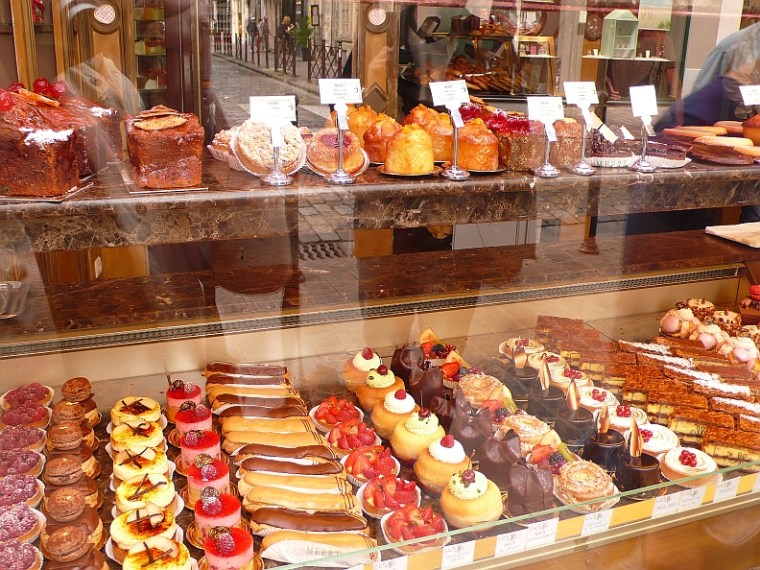
I think the other thing I like about patisserie is that it is meant to be spectacular and it appeals to the closet exhibitionist in me. Quite often it’s easier to do than it might appear, once you know the secrets. Think about the effect seen in a shop window in the 16th – Patisserie Valerie is a worthy contribution in this country – but it has a good way to go yet…

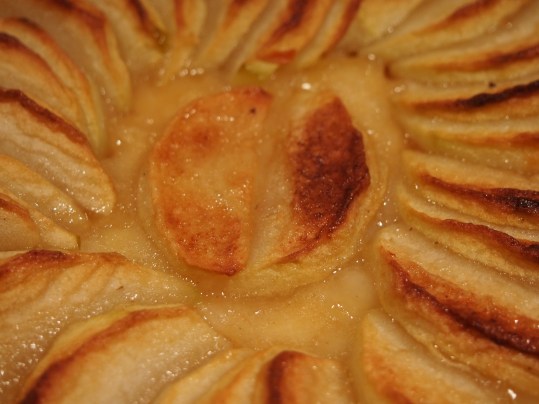
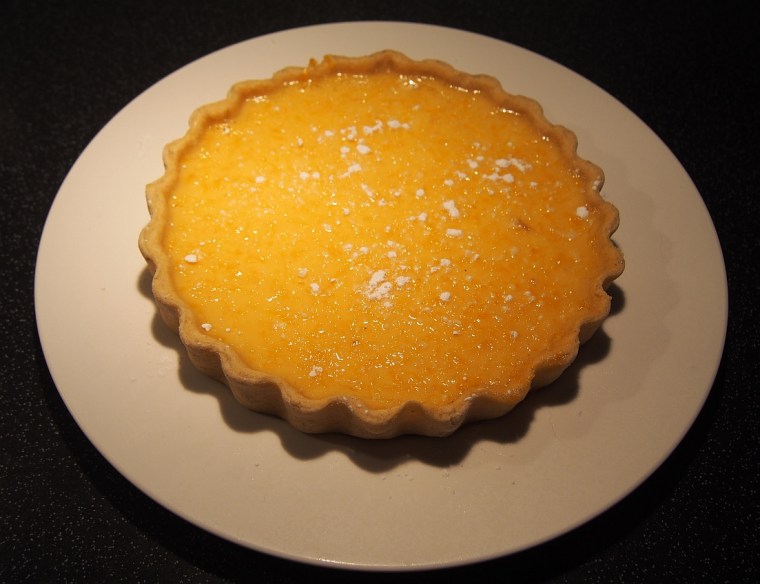
Anyway, I offer by means of evidence of my endeavours one old and one new (at least to me): the tarte aux pommes is one I resurrected from my earlier efforts, while the tarte aux citrons is the result of a request – no directive – from my wife having eaten two of the apple ones. Next on the list may indeed be home-made croissants, which I did make a couple of times many years ago with reasonable success, or perhaps chocolate éclairs – but I am also tempted by an opera cake, which is just that bit more jewellery-like flamboyant again. There’s a bit of brushing-up on technique and presentation required yet; I will report back on progress in due course.

And the secret for all those of my countrymen visibly shrinking from the thought of voluntarily spending time in the kitchen: it’s not work when you don’t have to do it.

TaC