Opinion & Thought, Travel

An M25 for high speed trains?

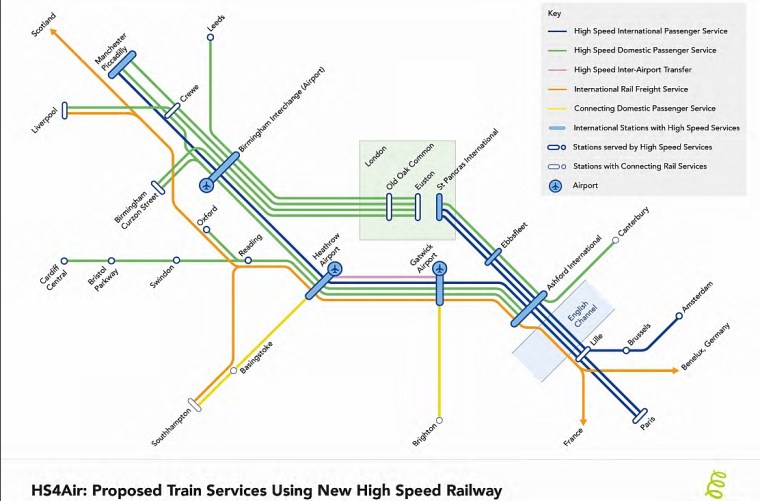
HS4a schematic

Our last two trips on the continent were both by train. The first was to Lyon, the second to Basel via Strasbourg. In the past it has always been necessary to change trains in Paris, and using the RER (fast metro) with luggage was never the easiest of experiences. However, recent high-speed openings have changed the landscape. The trip to Lyon involved a twenty-minute wait at Lille Europe, which is just one hour from where we parked our car at Ebbsfleet, just off the M25. At Lille, we switched to a TGV duplex (double deck) which was heading for Marseille. The trip from Lille to Lyon was three hours, making a car-to-hotel time of a little under six hours, not very much longer than the time by air with all its attendant mucking around. The second trip was very similar, with a change in Lille onto a Strasbourg train again around about a three-hour direct time. Back in 2006, the last time I travelled to Strasbourg by train, it was four hours just from Paris.

What has made this possible is the completion of further high-speed rail in France, most particularly the extension east to Strasbourg. It seems to have prompted SNCF to re-cast its connections in Lille so that they are now useable by British travellers. The key section of track was built some time ago, which is the Paris by-pass, which means that trains can travel direct between provincial centres using this by-pass line as a hub-and-spoke network.

In my opinion, London desperately needs something similar. With the construction of High Speed 2 to Birmingham getting tentatively underway, the time to think about this is now. The original intention was to link the new line to the Channel Tunnel line under London, but this was abandoned due to the cost. Those making the decisions seemed incapable of conceiving that people from north of London might ever want to travel anywhere beyond our capital. As a result, people seeking a connection will need to make their way along the Euston Road and check in all over again at St. Pancras, which one estimate suggests could add two hours to the journey time from, for example Birmingham to Paris, thus rendering it utterly and hopelessly uncompetitive with air. One might have hoped that the extra millions spent to facilitate better connections with the entire north of Britain might have been worth it – but it seems not. Such is Whitehall bunker thinking.

At last, however, it seems as though there is a little creative thinking going on about the nation’s transport needs. It’s a pity it is coming from a private sector company rather than a forward-thinking State, but anything is better than nothing, and the company concerned is highly credible in the engineering and transport sector. A proposal has been tabled for a connecting line from HS1 to HS2 called HS4air. The name makes more sense when one remembers that HS3 is the putative trans-Pennine route and the new proposal will also link Heathrow and Gatwick with a high speed (fifteen-minute) shuttle, thus allowing them effectively to operate as one airport.

The line would re-use the longest straight on the existing railway in Britain, from Ashford to near Gatwick, whence it would tunnel under the airport and the North Downs before paralleling the M25 to Heathrow and HS2. It would cost about £10bn for the 140km line.

HS4air map

Personally, I had always envisaged a London by-pass paralleling the M25 north of London where it could link to the other main radial main lines, but in many ways this new proposal make better sense, and it would offer many parts of the provincial U.K. vastly improved access not only to the airports but potentially the continent too. We might even end up with something that looked like an emergent network.

This is the kind of thinking that has long been present on the continent – hence the possibility to those trips that I described above. Unfortunately, it is much rarer to see this kind of vision in the U.K. and it deserves to be taken seriously. It would be good to see some serious efforts being put into improving the options for those who live beyond London – but given that approval will presumably lie with Westminster, I’m not going to hold my breath.

Arts, Architecture & Design, Opinion & Thought, Politics and current affairs

Authenticity and the modern Brit.

Bb01

I know: a post about Brexit and a Scottish folk band is going to have most clicking straight on past – but that is my point: hear me out!

There is much in modern life not to like; that ultimately seems to be what the Brexit vote was about. I am not however going to enter the fray here as to whether it is right or not – but it is unarguable that it has provoked a national debate in this country the like of which I have never seen. After several decades of somnolence, the conspiracy of ‘events’ has finally woken the British up to what their nation(s) have become – and plenty (on both sides of the debate) don’t much like it.

I would argue, however, that the reasons for this have little to do with our membership of the European Union, so much as the free reign that the forces of globalised capitalism have been given in this country – see the previous post. It is that which has really generated the crisis of identity currently being experienced in Britain. We have willingly been fed a diet of mass-produced, commercialised everything, whose main purpose is to hoover up as much of the nation’s disposable income as possible, as efficiently as possible. That means products that are cheap to produce and so bland that they will offend no one. As a result, they also come completely devoid of any cultural references that might make them distinctive – and this is no less so with the music industry as any other.

So it saddens me that for all the bashing many have been giving our country, perhaps justifiably, there are plenty of things of which we can still be proud – but which are regularly overlooked or ignored by the national mainstream. The fact that we have a vibrant folk and roots music scene is one – our musicians are in demand around the world within their own relatively small pool. Breabach, the subject of this piece are off to Australia next month, and regularly play across North America and continental Europe, where people seem to appreciate our native music if anything more than many British do. Possibly the strongest elements of a varied tradition are found in Scotland and Ireland – but while the Union endures, I am going to claim part of them for myself. In particular, the Scottish music scene has benefitted from the cultural confidence that devolution has brought, and a generation of young musicians has grown up shamelessly bringing new takes to something anciently British.

Breabach may well look like a traditional pipe-and-fiddle band – but that is not the half of it. Their music is almost entirely original, for all that they introduce traditional motifs and instrumentation. They are superb musicians, as tight as anything you would expect to find from people with a far higher profile. You won’t find much more than a hint of strict traditional music here – much of it ranges from a ‘wall of sound’ associated with much more contemporary genres, to lengthy pieces that verge on the symphonic on occasions. They are unafraid of sophisticated, syncopated rhythms, in amongst which they weave elements of Gaelic song and traditional tunes as well as many of their own compositions. There is even step-dance, used on an amplified ‘floor’ in part for its percussive quality.

They played to an appreciative full house and standing ovation in The King’s Place in London on Thursday, the first of a few warm-up gigs for the slack period between the Celtic Connections festival in Glasgow and their Australian tour. There is little affectation and few huge egos about these people: for a first encore, they went completely unplugged on a Gaelic song – and in the interval and after the concert, they were out front-of-house in good folk style, chatting with their audience and selling the inevitable CDs themselves.

The Scottish scene is but one part of a lively music genre that is affirmative and authentic. It exists not in a few large stadia for the financial gain of large international promoters, but in small venues the length and breadth of the nation, where it is a real and distinctive part of community and national identity. Breabach, however, show that it can also put its best clothes on and become something of much more contemporary relevance – a mark of a newly-emboldened national consciousness – in a way that is entirely of the present, even as it pays its due respects to the long and ancient history of these isles. Those in search of genuine Britain for a dose of national pride could do a lot worse than listen in.

http://breabach.com/

Sceptics also see also: https://tommygirard.wordpress.com/2012/02/14/breabach-the-desperate-battle-of-the-birds/

Bb02


Opinion & Thought

Isn’t capitalism fun!

Essex town.jpg

‘Lovely’ is probably not a word that goes with ‘Essex’ in many British people’s minds. And yet the county does have its unspoiled parts, even if they take some hunting out. I am fortunate enough to live in one – a small medieval town surrounded by largely open countryside. But in the next ten years, much will go under the bulldozer, as we are currently facing several large schemes for mass housing development, to say nothing of a waste incinerator up-wind of the town, and a major new road scheme… Such is the consequence of living in what, we are told, is the most rapidly–growing area of Britain. And nothing – but nothing – must come in the way of economic ‘progress’. To object is just to be a NIMBY.

A recent article in The Guardian had the temerity to question the popular ‘wisdom’ that there is a housing shortage in Britain; the problem, it said is more the degree of speculation that goes on in the housing market pushing prices out of people’s reach. A neighbour added that the ease of access to credit was adding to the problem, as people see houses as investments rather than residences. Recently I noticed the sale of some apartments in a neighbouring village specified as for sale “to investors only”.

https://www.theguardian.com/commentisfree/2018/jan/27/building-homes-britain-housing-crisis

It is becoming clear that far from bringing the virtues of quality and freedom of choice, this country’s economic model is socially an utter disaster. As I mentioned in the previous post, it is not difficult to come to the conclusion that business activity here is completely out of control. It seems that the only values that count for anything are monetary ones – and that anything at all is worth sacrificing for a quick buck. Well, I suppose that is the natural instinct: it is what companies do. But we have also had decades where successive governments have failed to do what governments are for – and that is regulate such activity in order to retain a reasonably equitable balance for all.

Instead, they have allowed the psychology of the market to flood into every nook and cranny of national life: if it doesn’t make money, it is not worth doing. That is also the message, this week, of the government minister who called for any degree-level subject that does not have immediate economic benefit to lose its financial support.

At this stage in Britain’s story, I fail to see how anyone cannot notice that such narrow, economised thinking is cutting deep into the nation’s fabric. Hospitals can no longer treat people because their funds need to be funnelled into paying back private contractors; schools are making staff redundant rather than cut the increasingly large salaries of the academy chain heads. (The one who did that to me was well into six-figure salary level himself – and I don’t think cutting that was on his money-saving agenda: the loss of my livelihood (and mental health) was just collateral damage in the preserving of his – that’s how this system works).

And we are seeing yet further tracts of our relatively scare land mass torn up and turned into mass housing of the most banal and over-priced sort – at the same time as the executives of the companies doing it reap multi-million pound bonuses. What’s more, they show utter disregard for the social and environmental consequences of their activities: most of the new developments round here will be utterly dependent on car use – and will be completely devoid of any social infrastructure. Those things just eat into profit margins.

It is not good for democracy either: the erosion of public space by private owners continues apace – and we are finding that even when the planning process (itself not above question) rejects an application, it is only a matter of months before it is resubmitted and the fight to object begins all over again. There is only so much that local residents can do in their spare time: it is not an equal fight.

What we have here is a system that will stop at nothing in the chase for profits. One wonders where it will end: is it realistic to imagine the big construction companies one day winding themselves down on the grounds that they have built all the houses that will be needed? They need to build to justify themselves – and of their own volition, while there is money to be made, they will never stop. But in that sense they are only typical of a system that has got its priorities utterly wrong.

The monotone from the politicians continues: this country needs to be more competitive, needs more business acumen, and more entrepreneurs. It is true, any country needs a productive economy – but at any price? And yet, far from enhancing lives further such people are now the prime movers in destroying much of what makes life liveable for many; the only lives that really improve are their own. The story of my own area is only that which is happening the length and breadth of the nation; being in the South-East it may be rather more pressurised – but that is all.

As one local observed recently during a discussion on these things, “Isn’t capitalism fun?” We are getting to the point where it is no longer the preserve of the loony extremes to believe that a complete re-think is rapidly becoming necessary.

Opinion & Thought, Politics and current affairs

The cultural cost of Carillion

Carillion
source: Carillion plc website


(…and others like them).

As a child of the Sixties and Seventies, I have never shared the view that public utilities are a bad thing. I remember visiting the local SWEB electricity board showroom when we needed to buy new appliances, or to pay a bill (those were the days…) – and to a lesser extent, there was a consciousness that the basics of life were provided for all by a caring, social State. Even the much-maligned British Rail was somehow a benign entity, cash-starved and declining though it was. SWEB too may have been a bit dowdy, but even to a six year old, it somehow exuded a benevolence that a private company never can.

I was in my twenties when most of the privatisations took place. Even then, I had my doubts: why should the civic assets of our nation be placed in the hands of a few, for their private profit? Macmillan’s observation about selling the family silver was correct. And how can a private company, with shareholders to keep happy and a profit to make, deliver basic needs more cheaply and more equitably than the State?

We now know the answer: it can’t. Deregulated markets have come to mean one thing only: an opportunity for a small group of greedy individuals to enrich themselves at everybody else’s expense. It is no coincidence that the wealth of the richest has hit the stratosphere during this period. Deregulation primarily gave carte blanche to those people to devise ever more devious ways of meeting short-term shareholder expectations – thereby releasing huge rewards for themselves. And we won’t even begin on corporate tax avoidance.

A lot of this has happened below the radar: who knew, for instance, that almost all of the water utility companies are now de-listed and owned by private equity funds and the like? No opportunities there for the small investor. Then we have the executives of Persimmon reaping huge bonuses on the back of state-subsidised housing construction – and Carillion’s bosses brazenly altering rules to ensure their bonuses could not be clawed back even in the event of company failure. How much more evidence is needed? And yet there are those in government who still hesitate “to interfere in the affairs of the business sector”… The fact is, the private sector exists, as it always did, to make a profit for the few, not serve the many. It will not do anything that compromises its short-term profitability – and it will do anything that enhances it – immoral or illegal included – if it thinks it can get away with it. The myth of the customer being king has been revealed for the sham it always was, and the only surprise (to me at least) is that so many knowledgeable people apparently believed it would be otherwise.

For four decades, Britons have been fed the ‘wisdom’ that the private sector is more dynamic and more efficient than the state. A whole string of failures is now showing this not to be true, and as Polly Toynbee suggested in The Guardian recently, Britain is now lumbered with a toxic brand of unaccountable, amoral capitalism that will probably take more decades to rectify – or preferably dismantle. Public-private profit may be one thing, but working against the public interest is another. My impression is that things have not gone as far on the continent; few countries followed Britain down the wholesale-privatisation route – and it is now evident how wise that was.

Yet there are two elements of this disaster that are not receiving much coverage.

Firstly, many of the rogue individuals who are responsible for this wholesale malpractice are the products of one toxic generation, whose genesis dates back to a certain Prime Minister whose policies encouraged them: the almost-forgotten Yuppies of the Eighties and Nineties, the Nick Leesom clones who never got caught – but who still made their fortunes gaming the post- Big Bang deregulated City. They nearly ruined the system then; in the meantime they have gone on to become the captains of industry and are still lining their pockets – only from positions of much greater power and influence. The sooner they are brought to book, the better.

The second is the cultural change that has accompanied privatisation. I sense that the commercialised private sector extends much further into people’s lives – and the wider cultural institutions of this country – than has been permitted elsewhere. As a non-TV viewer, it is most evident to me on the few occasions I do see broadcast media – the level of commercial intrusion that people seem to tolerate shocks me. It seems there is no aspect of British life that the private sector has not been able to turn into an opportunity to make a quick buck. The homogenising effect on the population has, I believe been huge: people’s lives have increasingly become mere conveyor belts of pre-packaged, standardised offerings, from the homes they live in to the clothes they wear, from the holidays they take to the food they eat, to the music they hear – everything revolves around that which it is profitable for commerce to purvey. There is a huge difference between a citizen and a consumer; in Britain, we only have the latter.

It can be argued that people have choice – but I think the wider corporate case masks the truth here: it is the M&S white-knickers argument again. People will buy what they are given if it’s all there is, and the hassle of trying to go against the flow is too much for most. Most companies attempt to homogenise their markets around mass-producible products. And they are becoming ever more sophisticated – and ever more disingenuous – in persuading people that that is what they really wanted all along. Orwell’s Big Brother has turned out to be a private corporation.

It has gone too far when nearly all elements of our culture are now determined by their profit margins. There is, in my view, no case whatsoever for running schools and hospitals as even quasi-commercial operations. Quite apart from the inefficiencies that are the same as elsewhere, management has been diverted from providing basic services into meeting contractual targets; interpersonal relations on which such organisations run have been severely damaged by the target-chasing that results. It is also fundamentally morally wrong for profit to be made from basic needs, let alone misfortune. It amounts to the monopoly of the helpless.
Cornerstones of our culture, such as the intellectual independence of our universities are being subordinated to their need to run as increasingly rapacious businesses; this cannot be right. Unrestrained business appeals most basely to people’s greed; in that sense it is also responsible for high levels of debt, the psychological damage of over-consumption and the environmental disaster that services it.

I would also include wider cultural matters in this: is there really a need for art galleries, museums and even charities to be made to operate as profit centres? Why should welfare targets be determined by how much money they save, rather than disburse? Their benefit is of an entirely different nature, and in difficult times most of all, it should not be denied those who cannot make them pay. Contractual constraints and that same profit motive have made it impossible for ordinary people to do the obvious things in situations where the personal touch ‘going beyond the necessary’ makes all the difference.

Forty years on, it is inescapable that the promised Eden of high-quality, privately provided services for all has proved to be an illusion. It was always going to, not least because in the eyes of profit-seekers, the most vulnerable either merit only the most pared-back of loss-leader provision – or they simply don’t even exist. One might even consider it only marginally more ethical for the private sector to offer every last luxury to the wealthy – and then fleece them utterly for it. This country is now run as a private racket for the benefit of a small number of greedy, amoral people – and they need to be stopped.

I have great doubts that any politician will have the courage to tackle this; even Corbyn will probably find tackling the vested interests a lot more difficult than he expects, assuming he ever wins power to begin with. And even if we start making amends now, the cultural damage will take decades and generations to put right. It is one thing to have a market economy – but we now have a market society. It was never much of a ‘partnership’ to begin with – more of a mugging.

Opinion & Thought, Politics and current affairs

Choice architecture

salt flat

I disapprove of what you say, but I will defend to the death your right to say it,’  Anon

Isaac Asimov wrote a 1957 short story called The Last Trump. Come the Last Judgement, the dead rise as expected, and the topography of the earth disappears, leaving just a featureless plain. People no longer die – but they no longer grow or develop either. Those finding themselves there gradually realise that they are not in Heaven but the other place… Hell is utter, unremitting blandness.

I’ve written before about the judgements people make in their lives; maybe it’s professional instinct, but I remain fascinated (and sometimes horrified) by why people decide as they do. I am interested in what Nobel Prize-winner Richard Thaler describes as ‘choice architecture’ – or the way in which the decisions people make are framed, either by themselves or others.

I get the impression that being wrapped up in their own little worlds, many people don’t look particularly closely at their fellow humans; or maybe they do, and are just concealing their dislike at what they see. On the contrary, being nosy, I can’t help looking hard: at what people are putting on the supermarket conveyor belt, at what they are choosing to wear, where they choose to go, how they choose to spend their time. Maybe I attribute too much to small actions, and I do respect people’s right to do as they see fit – but that also applies to my ‘right’ to draw conclusions as well. Like Thaler’s, my interest is nothing more than a benign concern for the health of our society and democracy, and in some ways the little things speak volumes.

We could head here in the direction of Brexit, about what seems to be so fundamentally different in the world-views of Remainers and Leavers – we both inhabit the same planet, and yet from some of the conversations I have actively sought out this year for ‘research’ purposes, one can be left with the impression that the two groups inhabit parallel but mutually exclusive universes.

I have encountered something of the same at the local scale: having become involved in moves to support the small, historic town where I live, I have tried to advocate a forward-looking stance for maintaining its future viability. While there were some voices of support, I have encountered what I suppose is ‘typical small-town conservatism’: people do not want anything to change, or to be different from an imagined past – even when it is cogently argued that the ‘continuity’ they support is in historic terms an illusion. It is no good arguing that past eras were bold in their time; neither does it wash to argue that a lot of supposed historicism is actually fake: medieval UPVC doubled-glazed leaded lights, anyone?

As I said at the start, one must respect people’s democratic right to hold their views: but whether that implies that all views are of equal validity is another matter, particularly when some can be shown to be inconsistent or based on factual inaccuracies. It makes for fraught communal decision-making, particularly when some of the most vocal reactionaries are advocating precisely the approaches that are causing the problems in the first place. It’s like defending people’s right to eat as much junk food as they choose, knowing that the cost will eventually fall on the taxpayer.

In my opinion, the worst thing is unthinking conformity: the people whose supermarket shopping consists of exactly the same manufactured ready-meals as everyone else. Christmas Cake? Buy it in a box. Mince pies? Ditto. I think one can reach tentative conclusions about the world-views of people who do this, especially when one remembers the many benefits of making (or learning to make?) one’s own. Need new clothes? Head for the department store to buy the habitual uniform of leisure-wear. I think it does say something that so many people pay so little attention to their appearance. Need a holiday? Just pick up the nearest bucket-shop resort package. And so it goes on, the majority just following the herd, without, I suspect giving any thought whatsoever to their democratic right to stand out from the crowd. I worry that the main cause is the normalising effects of mass-media and rampant commercialism, stopping people from using their own critical faculties. I suspect, too, that some of this is a malaise brought on by the dominance of work: until I stopped working, I had simply not realised how many things I had been blocking or shelving simply on account of the head-space dominance of my working life. Is this good for us?

It is no more righteous to be a habitual rebel than a habitual conformist: it’s not the stance so much as the authenticity of the decision that matters. I suppose one could argue that majority views are simply arrived at because they are ‘right’ – but how so, when they demonstrably lead to harm? And not only of the visible kind, for I suspect there is a mental price, too, for the fear of standing out from the crowd. The predictability of the behaviour worries me too: as The Independent used to claim “Great Minds don’t think Alike”.

Back in my historic small town, I proposed we should construct a modernist centrepiece, a new community building that would be a confident statement of the town’s future. I found some buildings that in my mind’s eye would look stunning; a lot of people reacted as though I had suggested they should spit-roast their grandmothers. What is fascinating here is not the actual opinion so much as the deep differences in the mechanisms that result in them: why do some people react with revulsion to precisely the things I find inspirational, and vice versa? My best-fit answer so far is that it is not a matter of considered judgement so much as a fear of standing out, or of the unknown; some people are less afraid of their own minds than others.

A rather unkind word that I encountered for the first time this year is ‘sheeple’. Unfortunately, it does increasingly seem to sum up a large part of the population’s view of its own power of agency. It wouldn’t perhaps matter so much if it didn’t have the potential to lead us into deep difficulties – as all those who believed the lies peddled by the key Brexiters have shown. Whether Brexit or the health effects of junk food, it just shows that the majority is not always right.

Unthinking conformity can only lead to a featureless societal plain that is indeed some form of hell.


Arts, Architecture & Design, Opinion & Thought, Travel

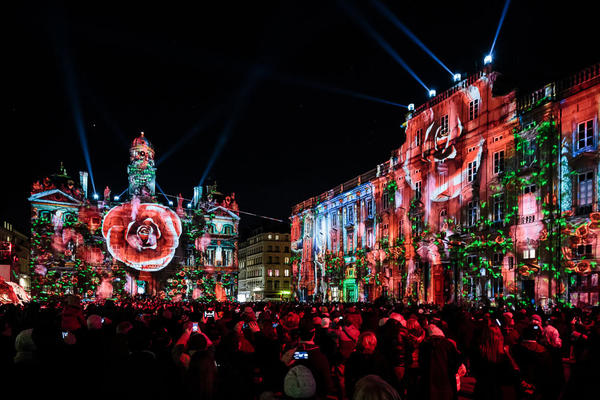
Seeing the urban light

Fete-des-Lumieres-Place-des-Terreaux-Lyon

Fête des Lumières Lyon 2017

One of the things I admire about continental European countries is the way they ‘inhabit’ their towns and cities. While we in Britain have made great strides with revitalising our main urban areas in recent years, I always feel that the continentals, and in particular the French and Italians have a superior sense of urbanism. And it often extends to the smaller towns in a way that it often doesn’t in the U.K., where many of their equivalents feel half-hearted, if not hollowed-out.

Continental towns are not simply machines for shopping; they do not seem to have suffered from the corporate erosion of public space as has been highlighted here recently: for better or worse, squares and streets belong to all the people, and are not the sanitised pathways between shops that one sees here, with any ‘undesirable’ elements rapidly being moved on by private security guards. Consequently they seem to me to have a more authentic life to them, not that that is to diminish the hardship felt by the homeless, for example.

Another aspect of this is the number and scale of the festivals that take place; again Britain is catching up – we seem to have caught the habit of Christmas markets recently – but somehow we still don’t quite have the ‘conviction’ that comes from such festivities being long-established. Perhaps it will come with time.

I have always enjoyed the genuine communality of such festivals, amongst them the Herbstmesse and Fassnacht in Basel, and the Christmas market and Fête des Géants in Lille.

One on my bucket list is the Fête des Lumières in Lyon, which is has been happening this week. I like Lyon a lot: for a large city, it is remarkably civilised, and has a cosmopolitanism and sophistication that its British equivalents have yet to learn. The FdL is one of the most spectactular festivals I know, its technical accomplishment and, it has to be said expense, something that is beyond the ambitions of most cash-strapped British local Councils. That said, I think a large amount of it has to come down to vision, and it probably helps that the French have a great sense for graphic art, and they originated the ‘son et lumière’ spectacles of which this is probably the greatest. Every time watch, I am amazed at the creativity and technical accuracy of these artists of light. Enjoy the clips from this year’s festival.


Arts, Architecture & Design, Opinion & Thought

Well rounded people

bench

Autumn term 1975. Monday morning started with double woodwork – and for me the slightly strange experience of learning in my father’s department. Although it’s perhaps a pity it didn’t come mid-way through the week, I always looked forward to the lesson (which was not taught by my Pa…). Given the academic routine of the grammar school, I found great pleasure of making dovetail joints or turning bowls on the lathe for a change. Unlike certain of my father’s colleagues, I never saw practical lessons as inferior, and I think it is where my now much-valued aesthetic appreciation and streak of perfectionism came from. I well remember my father’s fury when, one day he was summoned to the Headmaster’s office (where he was still seen as the chippie) and instructed to repair fifty wooden exam desks. He replied that he was not the odd-jobs man. Indeed, he was and is a highly-skilled cabinet-maker.

It was also interesting how some of the best in the class during those lessons were not the academic stars (though there was crossover); I think it was good that this gave those with different talents a chance to shine – and the academic ones a taste of what it was like to struggle a bit.

This recollection is particularly in my mind at the moment as my father, now 83, (and still making violins for a hobby) is currently collaborating with a young friend and me to construct a facsimile of a mid-century Scandinavian piece of furniture  by Kai Kristiansen in American black walnut (shown in rosewood above). It is a wood he has never worked before and he is quite excited by the prospect; it is proving to be a most enjoyable experience, which has ranged from researching the original, to analysing the construction, adapting it for the workshop and personal taste, to sourcing suitable timber. A specification and price has been agreed, and construction will start shortly.

Practical skills have been repeatedly looked down on by educators in this country; it is though they are somehow insufficiently worthy, given their apparent lack of intellectual rigour. My former teacher Peter Whitton knew this was not true, for despite being a Classicist, he was never happier than in his woodwork shop, where he too turned out fine pieces.

At present, I am starting to look at what I do next; the medication is gone, and I can feel my mental strength returning little by little. Amongst a number of ‘irons in the fire’ I am tempted to branch part-time into interior design, a field I have followed for many years. I defy anyone to claim that the processes involved are intellectually weak; indeed, I know of few so demanding exercises as solving difficult design dilemmas. And then there is the fact that one (hopefully) has a beautiful end product, which can be admired by those with the aesthetic sensitivity to do so. It is very tempting to sign up for that diploma.

Last Friday, we went to the opening night of Grayson Perry’s exhibition The Life of Julie Cope at FirstSite in Colchester; I am also currently reading his book The Descent of Man, and despite Perry’s lurid persona and less than rigorous academic background, let no one claim that this is not both a skilled and highly erudite man.

At the other end of the spectrum, I know of individuals educated to the highest academic levels, who are not able to perform the simplest practical tasks for themselves, and who seemingly lack any ability really to see (in the deep sense) beauty in their surroundings. They may have trained minds (and I’m all for that) but they seem impoverished in other ways. Is this the cost of the strong emphasis on academia? The ultimate sadness for my father came some years ago when the Craft & Design department he had founded and developed over forty years was closed to make way for a computer suite. No more opportunity for today’s sixth formers to do something practical as part of their week’s programme.

This is short-sighted: many highly-educated people do also appreciate the arts and practical crafts; they provide a complete diversion into another rich aspect of life which I for one would never be without. Peter also knew this, as did the many clearly-thoughtful people at the Perry exhibition.

Only target-chasing educational managers seem snooty enough to disparage the breadth that comes from the empowerment to produce and appreciate tangible works. Our neighbouring nations such as Germany have never disparaged practical skills either – and a comparison of the two nations’ economies tells all that need to be said about that.

Bring back double woodwork on Monday mornings – especially in the most academic schools. Breadth, depth and richness in education is important.

Opinion & Thought, Politics and current affairs

Why I am not wearing a poppy this year.

It’s a great pity when life is so full of avaricious commercial operators shouting at the public, that even those who do inalienable good, such as charities, feel the need to copy them. I do sympathise – how else are they to be heard? But in fact, I think that is a misconception: most of the public is entirely capable of distinguishing between the two and acting accordingly. I rather suspect that the problem comes from the executives of charities, who more and more closely resemble the CEO’s of big business, maybe on  occasions are even one and the same, and self-promotion is the one strategy they know. After all, they probably have targets to meet.

So I was somewhat displeased to receive a good month or more ago, in the mail (which will have cost) a wooden cross (which will have cost) with a poppy attached, some rather over-assertive promotional material and a donation form. This commemoration is for good reason focussed on 11th November, and does not need to start in early October just to steal a march on the competition.

My other reasons are regrettably more political: the lesser is the memory that for years, my former employer required me to wear a poppy (at my own expense)  ‘to set a good example to the pupils’. I felt it did the opposite, by turning a voluntary gesture of patriotic remembrance into an act of corporate policy. And it certainly removed from those who might have wanted it, the opportunity to set an example of a different kind.

And more seriously still, in the past twelve months, I have seen too many social media pictures of French war cemeteries deployed in the service of the Brexit movement. If the two are to become conflated, I will never wear a poppy again: this Remembrance should remain essentially apolitical, and if those whom I consider to have committed the most atrocious act of national vandalism are going to claim, even incidentally, the poppy as a symbol of their so-called patriotism, then I can no longer comply.

Inasmuch as any of those largely conscripted dead really held the lofty ideals we often attribute to them, I suspect they too would be appalled at the wanton damage by some in this country to the internationalism that was founded to stop more having to follow them. Furthermore, the misappropriation of symbolism by overt nationalist movements has far too many uncomfortable historic precedents for me to be comfortable with it.

I may be taking this too seriously, but I think not: these are serious matters. I hope someone from the Haig Fund, which I have supported for many decades is reading this, and reflecting on the implications of other people following suit. It is a long-standing national institution that does not need to stoop to base commercialism; charitable giving is a principled, voluntary activity, and the hard-sell only serves severely to undermine that ethic.

And in the current political climate, the Haig Fund (as it was) perhaps also needs to look hard at who is, by accident or design claiming its totem, and for what purposes.

Opinion & Thought

Discriminating? Discerning? Definitely!

wine

I can’t remember where the phrase comes from – perhaps an episode of Yes Minister, or maybe The Good Life – but it goes, somewhat pleadingly, “…but we are discerning people…!”

The implication is that there is a group within society whose views in matters of taste and judgement are superior to the rest. It is something that has intrigued me for a long time, simply because of the very complex questions it raises about matters of aesthetic merit, quite apart from the less appealing but still interesting overtones of social snobbery and elitism.

Even the words are difficult: while we might accept that discrimination may be a good thing when it comes to a choice of wine, it most certainly would not be were the issue the politics of race, gender, age, disability or intelligence –  and quite rightly so. Discernment is perhaps discrimination’s gentler cousin – but it still implies the ability (and entitlement?) to make the ‘right’ judgements about things.

I suppose the deep assumption behind this blog is that discernment – discrimination even – is at least part of the secret to a satisfying life. Some people might see even that claim as rather totalitarian – but I really don’t see the point in allowing all sorts of indiscriminate twt into one’s life, whether that be in one’s personal mores, the way one treats others, the general ‘standards’ one aims at, or the material or intellectual things with which one surrounds oneself. And I don’t think that hair-shirt wearing simply because others may be unwilling or unable to follow suit is really the best way to tackle that particular problem. Otherwise, life simply becomes a race to the bottom.

We don’t have very consistent standards about this though: many would probably accept that some people have better judgement than others when it comes to a matter like wine, antiques or art, less so when discussing food, perhaps and very few might accept the same when considering music or fashion. Why this should be so is difficult to fathom; perhaps it relates to the perceived ability or entitlement of individuals to access those fields and make meaningful decision about them.

But there still remains the difficulty that verdicts about good/bad and right/wrong can ultimately be nothing more than the product of subjective consensus between individuals – and then we get into the whole social minefield of which groups (should?) have the authority to decide what, for example is ‘good’ art. Very often, the whole matter is inextricably tied up with matters of social class and power, with Establishment values both holding sway, and also being used as a kind of passport to entry of that particular clique.

Yet history shows that quite often the Establishment gets it wrong: given that ‘genius’ often correlates with individuals who disrupt established norms, the wrong-footing of the cultural elites is a regular feature of art history. Bizet, Modigliani and Miles Davis are just three examples of people who were initially rejected, only to be hailed for their genius at a later stage. So even now, can we really be objective that Picasso was a great artist whereas a graffiti-hoodlum is not? What about Banksy? Or the political murals of Northern Ireland and elsewhere?

So social acceptability is actually a very unreliable measure of quality, for all there are plenty of vested interests that might want us to believe otherwise.

Are wines that sell for hundreds of pounds a bottle really worth so much more than the average supermarket offering? I suspect many people would say not; the usual argument seems to be that if you like it, that’s all that matters. And yet, on the one occasion in my life when I tasted a truly distinguished wine, a Château D’Yquem, I was forced to concede that the experience was unlike any other wine I had ever drunk. The fact that it is only periodically produced, using techniques of the most extreme care and – yes – discrimination regarding what is acceptable, produced an incomparable result.

So perhaps it comes down to matters of aestheticism: the surprise about that d’Yquem was the fact that I could still taste it a good ten minutes later, so intense was it, even a slightly unnerving experience if you are not expecting it. And from that, where are we to go with all those other fields where discernment appears to play a part? What about music? Food? Fashion?

Having listened to almost no music whatsoever during my illness of the last year (when you’re not in the mood, it’s just annoying noise) my first resort has been classical music; after that long silence, it is all the more clear to me at least, that the intricacy of that music, the purity of the sound, and perhaps above all its ability to capture mood and emotion really does transcend all other types. And yet, even that is not going to convince many!

But as I have listened more, I have also rediscovered the lighter but still very subtle nuances in the various traditional musics that I enjoy, particularly the Irish and Scottish traditions. They too are capable of being very moving indeed, but they are also perhaps one of the less socially-acceptable forms of music according to conventional tastes.

As my sense of enjoyment has returned, food has started again being something more than mere fuel, and the pleasure of properly made pizza, pasta and other simple dishes is back. But note, my use of ‘properly made’: I still have preferences that I consider to be superior to the alternatives – for there is a huge difference between an wood-baked artisan pizza and the average chain restaurant offering, and having eaten both, no one will persuade me otherwise!

In the final reckoning I think it has to come down to how receptive one is to aesthetic experiences. It is also a very complex matter: knowledge of the ‘authenticity’ of that wood-oven pizza is most definitely part of the package – but why should the cognitive aspects of the experience be disregarded? Likewise, some music simply has more innate sonic qualities than other – but the ability to know that depends not on the music but on the receptiveness of the listener. It does not mean, incidentally, that other forms of ‘aesthetically lesser’ music do not have their place: they simply have different purposes – but it may be pushing it to claim that all forms of music are aesthetically equal.

When it comes to clothing, for me there are certain fixed qualities, such as tactility , colour and texture of the material, the fit (whether it flatters or not), and the standard of the craftsmanship. Nothing especially to do with a particular ‘fashion’ though most certainly the cultural connotations that clothes can carry can influence the emotional experience one has of them.

Some things are as close to ‘definitely better’ as it is possible to be: I think that natural fibres are superior to synthetic ones for very deep, primitive sensual reasons, nothing to do with conscious preferences. In the same way, I suspect that acoustic music tends to chime more deeply with the human psyche than the inevitable distortions of amplified sound – which more often than not then tries to compensate by use of excessive volume. Not at all the same thing.

What I do not accept is that some sectors of society should – or do – have a monopoly on ‘good taste’. This seems to afflict some nations more than others: the consensus about what makes a ‘good’ espresso or croissant are pretty-much universal in the cultures concerned, the ‘rules’ surrounding them are there for widely accepted practical reasons and cross social boundaries.

While high demand does tend to inflate prices, the ability to buy is not in itself a measure of aesthetic value. I do not like the way in which the Establishment often considers it has cornered the market in good taste and priced it accordingly – but equally I am not keen on the kind of inverse-snobbery of those who will do anything just to prove the opposite.

Discernment in aesthetic matters has the potential to enrich the lives of any and every one: ‘judgement’ is a skill that can be learned through experience; it does not have to carry a huge price tag, just the willingness to look, feel, reflect and compare. But I equally do not accept (or even entirely understand) the opposite viewpoint that discernment should be reviled for its supposedly-elitist overtones: even at the most basic sensory level, not everything is equal in this world.


Opinion & Thought, Politics and current affairs, Sartoria

Suits E.U., sir!

I can hardly be the only British gent who is regularly bombarded by advertising from Jermyn Street shirt manufacturer Charles Tyrwhitt. I wrote to them several years ago pointing out that while I approved of their democratising marketing strategy, I would be more happy to buy their clothes if their tailoring and design was not all so old-school British. I pointed out that traditional British menswear is often starchy-formal and has associations of occupation and social stereotype that I don’t feel happy with – and that’s without the age profile that it still implied.

I received one of their habitually jolly letters in reply, explaining that this was what the British market still wanted. Well, some years on, I note a distinct modernisation of Tyrwhitt’s catalogue, with sharper styles and fabrics sourced from amongst others, good Italian mills. I also noticed recently, the first appearance of a non-white model in the catalogue: well done – but about time too! I’m certainly not claiming any influence over the decision, but I think it has made Tyrwhitt a more appealing clothier, and has hopefully broadened their market as a result.

While there’s no question over the quality of traditional British men’s tailoring, my reservations still hold, and this is why I tend to prefer French and Italian style – it is slightly sharper while also less formal, more open to interpretation and relatively devoid of the overtones of social class.

So I’ve been delighted to discover more recently, a number of British companies that are challenging the conservative norm by offering British clothing – designed for British body shapes – while looking to the continent for some of their design inspiration. I will be reviewing items by a number of these companies in forthcoming posts.

In the meantime, I must admit I rather worry about the effect of Brexit on this welcome development. Here we have companies doing their design work in one country, sourcing their materials and doing their manufacturing in others, and retailing from others again. A number of them seem to be relatively small start-ups, and one might almost suggest that there is the making of a pan-European industry here, which provides for a range of clients by taking the requisite elements from the different traditions. And that’s without the large number of European companies now selling internationally. If it leads to an improvement in the general sartorial standards of the male British population, that will be a welcome bonus, too.

I will mention the names of Chester Barrie clothing, Lussoti Shoes, Scarosso Shoes and of course Charles Tyrwhitt as some that seem to be taking this route (there are others) – and end by saying that I hope they have plans for dealing with Brexit, because it would be a great shame if their interesting business models and the stylish, well made products they are making, were destroyed as a result of this madness.