Opinion & Thought

Discriminating? Discerning? Definitely!

wine

I can’t remember where the phrase comes from – perhaps an episode of Yes Minister, or maybe The Good Life – but it goes, somewhat pleadingly, “…but we are discerning people…!”

The implication is that there is a group within society whose views in matters of taste and judgement are superior to the rest. It is something that has intrigued me for a long time, simply because of the very complex questions it raises about matters of aesthetic merit, quite apart from the less appealing but still interesting overtones of social snobbery and elitism.

Even the words are difficult: while we might accept that discrimination may be a good thing when it comes to a choice of wine, it most certainly would not be were the issue the politics of race, gender, age, disability or intelligence –  and quite rightly so. Discernment is perhaps discrimination’s gentler cousin – but it still implies the ability (and entitlement?) to make the ‘right’ judgements about things.

I suppose the deep assumption behind this blog is that discernment – discrimination even – is at least part of the secret to a satisfying life. Some people might see even that claim as rather totalitarian – but I really don’t see the point in allowing all sorts of indiscriminate twt into one’s life, whether that be in one’s personal mores, the way one treats others, the general ‘standards’ one aims at, or the material or intellectual things with which one surrounds oneself. And I don’t think that hair-shirt wearing simply because others may be unwilling or unable to follow suit is really the best way to tackle that particular problem. Otherwise, life simply becomes a race to the bottom.

We don’t have very consistent standards about this though: many would probably accept that some people have better judgement than others when it comes to a matter like wine, antiques or art, less so when discussing food, perhaps and very few might accept the same when considering music or fashion. Why this should be so is difficult to fathom; perhaps it relates to the perceived ability or entitlement of individuals to access those fields and make meaningful decision about them.

But there still remains the difficulty that verdicts about good/bad and right/wrong can ultimately be nothing more than the product of subjective consensus between individuals – and then we get into the whole social minefield of which groups (should?) have the authority to decide what, for example is ‘good’ art. Very often, the whole matter is inextricably tied up with matters of social class and power, with Establishment values both holding sway, and also being used as a kind of passport to entry of that particular clique.

Yet history shows that quite often the Establishment gets it wrong: given that ‘genius’ often correlates with individuals who disrupt established norms, the wrong-footing of the cultural elites is a regular feature of art history. Bizet, Modigliani and Miles Davis are just three examples of people who were initially rejected, only to be hailed for their genius at a later stage. So even now, can we really be objective that Picasso was a great artist whereas a graffiti-hoodlum is not? What about Banksy? Or the political murals of Northern Ireland and elsewhere?

So social acceptability is actually a very unreliable measure of quality, for all there are plenty of vested interests that might want us to believe otherwise.

Are wines that sell for hundreds of pounds a bottle really worth so much more than the average supermarket offering? I suspect many people would say not; the usual argument seems to be that if you like it, that’s all that matters. And yet, on the one occasion in my life when I tasted a truly distinguished wine, a Château D’Yquem, I was forced to concede that the experience was unlike any other wine I had ever drunk. The fact that it is only periodically produced, using techniques of the most extreme care and – yes – discrimination regarding what is acceptable, produced an incomparable result.

So perhaps it comes down to matters of aestheticism: the surprise about that d’Yquem was the fact that I could still taste it a good ten minutes later, so intense was it, even a slightly unnerving experience if you are not expecting it. And from that, where are we to go with all those other fields where discernment appears to play a part? What about music? Food? Fashion?

Having listened to almost no music whatsoever during my illness of the last year (when you’re not in the mood, it’s just annoying noise) my first resort has been classical music; after that long silence, it is all the more clear to me at least, that the intricacy of that music, the purity of the sound, and perhaps above all its ability to capture mood and emotion really does transcend all other types. And yet, even that is not going to convince many!

But as I have listened more, I have also rediscovered the lighter but still very subtle nuances in the various traditional musics that I enjoy, particularly the Irish and Scottish traditions. They too are capable of being very moving indeed, but they are also perhaps one of the less socially-acceptable forms of music according to conventional tastes.

As my sense of enjoyment has returned, food has started again being something more than mere fuel, and the pleasure of properly made pizza, pasta and other simple dishes is back. But note, my use of ‘properly made’: I still have preferences that I consider to be superior to the alternatives – for there is a huge difference between an wood-baked artisan pizza and the average chain restaurant offering, and having eaten both, no one will persuade me otherwise!

In the final reckoning I think it has to come down to how receptive one is to aesthetic experiences. It is also a very complex matter: knowledge of the ‘authenticity’ of that wood-oven pizza is most definitely part of the package – but why should the cognitive aspects of the experience be disregarded? Likewise, some music simply has more innate sonic qualities than other – but the ability to know that depends not on the music but on the receptiveness of the listener. It does not mean, incidentally, that other forms of ‘aesthetically lesser’ music do not have their place: they simply have different purposes – but it may be pushing it to claim that all forms of music are aesthetically equal.

When it comes to clothing, for me there are certain fixed qualities, such as tactility , colour and texture of the material, the fit (whether it flatters or not), and the standard of the craftsmanship. Nothing especially to do with a particular ‘fashion’ though most certainly the cultural connotations that clothes can carry can influence the emotional experience one has of them.

Some things are as close to ‘definitely better’ as it is possible to be: I think that natural fibres are superior to synthetic ones for very deep, primitive sensual reasons, nothing to do with conscious preferences. In the same way, I suspect that acoustic music tends to chime more deeply with the human psyche than the inevitable distortions of amplified sound – which more often than not then tries to compensate by use of excessive volume. Not at all the same thing.

What I do not accept is that some sectors of society should – or do – have a monopoly on ‘good taste’. This seems to afflict some nations more than others: the consensus about what makes a ‘good’ espresso or croissant are pretty-much universal in the cultures concerned, the ‘rules’ surrounding them are there for widely accepted practical reasons and cross social boundaries.

While high demand does tend to inflate prices, the ability to buy is not in itself a measure of aesthetic value. I do not like the way in which the Establishment often considers it has cornered the market in good taste and priced it accordingly – but equally I am not keen on the kind of inverse-snobbery of those who will do anything just to prove the opposite.

Discernment in aesthetic matters has the potential to enrich the lives of any and every one: ‘judgement’ is a skill that can be learned through experience; it does not have to carry a huge price tag, just the willingness to look, feel, reflect and compare. But I equally do not accept (or even entirely understand) the opposite viewpoint that discernment should be reviled for its supposedly-elitist overtones: even at the most basic sensory level, not everything is equal in this world.


Opinion & Thought, Politics and current affairs, Sartoria

Suits E.U., sir!

I can hardly be the only British gent who is regularly bombarded by advertising from Jermyn Street shirt manufacturer Charles Tyrwhitt. I wrote to them several years ago pointing out that while I approved of their democratising marketing strategy, I would be more happy to buy their clothes if their tailoring and design was not all so old-school British. I pointed out that traditional British menswear is often starchy-formal and has associations of occupation and social stereotype that I don’t feel happy with – and that’s without the age profile that it still implied.

I received one of their habitually jolly letters in reply, explaining that this was what the British market still wanted. Well, some years on, I note a distinct modernisation of Tyrwhitt’s catalogue, with sharper styles and fabrics sourced from amongst others, good Italian mills. I also noticed recently, the first appearance of a non-white model in the catalogue: well done – but about time too! I’m certainly not claiming any influence over the decision, but I think it has made Tyrwhitt a more appealing clothier, and has hopefully broadened their market as a result.

While there’s no question over the quality of traditional British men’s tailoring, my reservations still hold, and this is why I tend to prefer French and Italian style – it is slightly sharper while also less formal, more open to interpretation and relatively devoid of the overtones of social class.

So I’ve been delighted to discover more recently, a number of British companies that are challenging the conservative norm by offering British clothing – designed for British body shapes – while looking to the continent for some of their design inspiration. I will be reviewing items by a number of these companies in forthcoming posts.

In the meantime, I must admit I rather worry about the effect of Brexit on this welcome development. Here we have companies doing their design work in one country, sourcing their materials and doing their manufacturing in others, and retailing from others again. A number of them seem to be relatively small start-ups, and one might almost suggest that there is the making of a pan-European industry here, which provides for a range of clients by taking the requisite elements from the different traditions. And that’s without the large number of European companies now selling internationally. If it leads to an improvement in the general sartorial standards of the male British population, that will be a welcome bonus, too.

I will mention the names of Chester Barrie clothing, Lussoti Shoes, Scarosso Shoes and of course Charles Tyrwhitt as some that seem to be taking this route (there are others) – and end by saying that I hope they have plans for dealing with Brexit, because it would be a great shame if their interesting business models and the stylish, well made products they are making, were destroyed as a result of this madness.


Opinion & Thought, Politics and current affairs

Getting on with the in-laws

Pont d'Europe
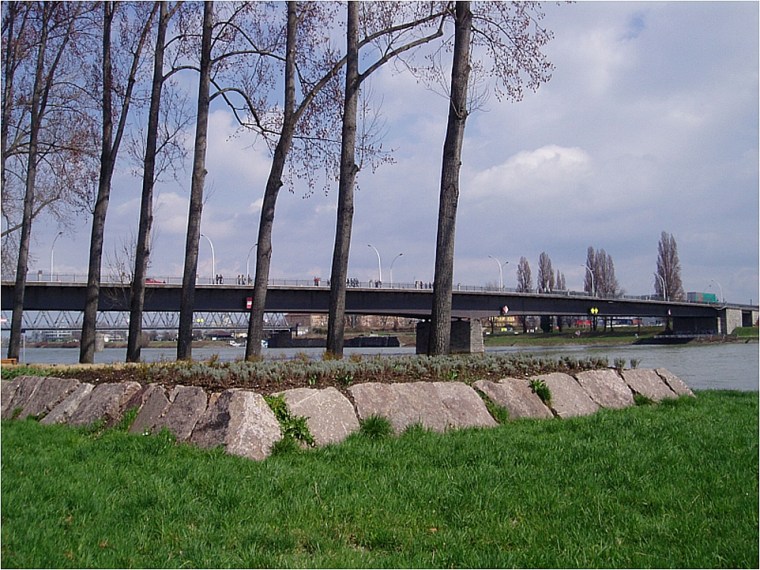
Pont de l’Europe, Strasbourg. France on this side, Germany on t’other.


The marriage vows of the Christian church revolve around the notion of lifetime commitment. If there is a lack of commitment, or a failure to take those vows seriously, the chances of the marriage lasting are immediately weakened . So it has been with Britain and the rest of the E.U.

A few brave souls have recently been suggesting that there should be more rather than less European engagement in Britain, and it is perhaps instructive to consider what might have happened had British domestic power decided to encourage the nation fully to engage with the E.U.

I wonder how many people know that the southern counties of England and the northern regions of France technically constitute Trans-Manche Euro-Region. It is part of a policy called Interreg dating from the 1990s to foster cross-border co-operation in all parts of Europe.

Here is how the Daily Mail reported it in 2006:

New map of Britain that makes Kent part of France…and it’s a German idea

For centuries the people of Kent have called their county the Garden of England. So they might find it quite a surprise that – according to the European Union at least – they are actually part of France.

Along with next-door Sussex, Kent has been rolled in with the Calais area on a map drawn up for Brussels.

The Tories accused the EU of plotting to undermine nation states and even “wipe Britain off the map”.

Never failing to use the E.U. to make domestic capital, Eric Pickles claimed:

“Under the Labour Government, Britain has already been subdivided into regions as part of John Prescott’s empire building.

“I fear Eurocrats could literally wipe Britain off the map and hardworking families and pensioners should be concerned that Europe wants the authority to build a database of their homes – this threatens to lead to an EU-wide property tax.

The Daily Telegraph reported the same development thus:

New EU map makes Kent part of same ‘nation’ as France

They have tried to redraw the map of Europe before. Now a German-led “conspiracy of cartographers” stands accused of trying to use a new European Union directive to give Brussels the power to change national boundaries.

Under the changes, those living in Kent and East Sussex would find themselves not inhabitants of Britain, but the TransManche region, where their fellow citizens would not be their English-speaking neighbours but the French-speaking population of northern France.

North of the TransManche would be the North Sea region, taking in all of eastern England and vast areas of Scandinavia, Germany and the Low Countries.

Western Britain and Ireland would become the Atlantic region, a huge zone that also takes in parts of France, Spain and Portugal.

Perhaps most bizarre would be the Northern Periphery region, lumping together the population of north-west Scotland with their very distant cousins in Norway, Sweden, Finland, Greenland and Iceland.

The barely-disguised xenophobia made no attempt at balance, barely even at accuracy, beyond a footnote to the effect that the Euro-regions were largely intended to co-ordinate economic, environmental and transport planning, and that they were chaired by local authorities. There was no attempt whatsoever to consider why such co-operation might have been beneficial.

No matter that plenty of people in northern Scotland do not consider Scandinavians to be ‘very distant’ cousins, or that there is already a healthy cultural exchange going on between the ‘Celtic fringe’ nations of Europe.

The implications of such reporting for British perceptions of Europe hardly needs further explaining.

Our failure in Europe became a self-fulfilling prophesy. Had we joined Schengen and the Euro and –yes – shared the associated risk, the practical impact would have been significant. For example, the planned trains from the British regions to the continent would have remained viable because domestic passengers could have filled empty seats (as happens every day on the continent), rather than their being neurotically ‘sealed’ on departure. Without the deterrent of airline-style check-in at the Tunnel, it would become as easy to commute from say Ashford to Lille as it is across any continental border. The Channel would have become no greater barrier than the Alps. Had we joined the Euro, there would not even be the inconvenience of differing currencies.

I have a friend who lives in Basel; every day, his son used to travel to school in Germany and thought very little of it. Every day, thousands of people travel from Belgium into the Greater Lille area, from Kehl in Germany into Strasbourg, and from France into Basel and Geneva to work or shop. It is a non-event. But we British have never been allowed to find out what benefits this could bring. Our political classes have utterly failed to see that the world has moved on. Their every action still reeks of a colonial mindset where Britain’s supposed ‘sovereignty’ needs to be defended against hostile outsiders, no matter what cost to the nation. They cannot get their heads around the fact that Britain is now – and should be – just one amongst the many partner-nations in Europe. They never even got round to removing European Affairs from the Foreign Office. Which says it all.

In fact, the real issue here is the refusal of the British Establishment to relinquish power even when it is clearly in the nation’s interest. We see the same thing evident in their reluctance to move power down the scale to the regions as well. It is all about keeping maximum power in Whitehall.

I believe we would be in a very different place now, had British opinion-formers decided to commit to the European marriage rather than remaining the frigid, stand-offish partner who only ever wanted to remain single anyway.

It is true that as an island nation, we Brits probably had more work to do to get used to our new marriage: visiting the in-laws is rather more involved than walking across a bridge. But had those in government taken a different line, by now we would be seeing the benefits of a seamless relationship with our partners.

Instead of declining post-Tunnel, the channel ports might have connected and thrived – and the shameless Brexit-disdain that the residents of Dover have shown for their opposite numbers in Calais might never have happened.

Opinion & Thought, Sartoria

The God of Small Things

bresciani

It may seem rather pathetic that an established teacher, with many years’ experience and a professional blog to his name should be reduced to blogging about…. socks. But in the year since I stopped working, certain things have come into sharper perspective. Even though I worked hard to prevent it, I hadn’t realised the extent to which a regular sixty-hour week comes to dominate your life. Even while not at work, or travelling the thirty miles to and from school, much time was spent chewing over professional matters. Pretty much everything else was shoe-horned in around the edges, at least mentally, even when I was supposedly doing other things. It did me no good.

So it is remarkably pleasurable to be able to get up in the morning and have the time actually consider what clothes I want to wear, rather than just flinging on the usual work-compliant suit and tie. I have always enjoyed men’s style, and even tried to carry this through to the rough-and-tumble of the school environment. I felt it was part of setting a good example, and maintaining high personal standards.

But now I can appreciate such niceties for their own sake, along with the pleasures of fresh morning coffee or an autumn walk. For reasons unknown to me at the time, during my period of convalescence I had the urge to renew my wardrobe, and again I have had time to choose carefully. It was remarkably cathartic.

Bresciani socks are about as good as they get, being made from top-quality materials by a skilled manufacturer in Italy. There are few outlets that retail them in the U.K., but a good choice can be had from meschausettesrouges.com in Paris. Twenty pounds for a pair of socks may seem outrageous, but as with many beautiful things, it is only when you receive them that one can appreciate the craftsmanship, the excellent fit, and the superb materials. So the price perhaps becomes a small one to pay for a small taste of excellence, and the fact that the article itself is so mundane somehow adds to the pleasure.

It’s easy to sneer at such apparent vanity, but it occurred to me that there is a deeper and more significant point here. The key to appreciating fine things is a willingness to see rather than just look, to sense and savour the material qualities of the world around us rather than taking them for granted. To stop what one is doing and just appreciate our sensory surroundings is akin to the ‘living in the moment’ that Mindfulness promotes as an antidote to mental angst. It is a tendency that can be developed with practice. I think it works – it is not shamelessly materialistic to appreciate the sensory qualities of material things – and all it takes is the time and restraint to stop and do so. In fact, the appreciation of what one has, rather than envy at what one does not, is the antithesis of the status anxiety that afflicts so many lives.

But that, I fear, is the one thing hassled modern lives deprive us of: the time to stand and stare (or feel). I suspect it is also what we hurried north-Europeans yearn for in our envious perceptions of the South – the time for the leisurely savouring of life’s pleasures, in a way our cold-climate Protestant-ethic culture does not really encourage. And the more you do it, the more one learns to value superior quality, not in the envious sense, but simply for the extra pleasure it brings. I suspect that is the secret of southern European brio, and it is a cultural meme that we would do well to learn.

Much of modern life seems to me to thrive on dissatisfaction and anxiety; instead of devoting time to fire-fighting on mental health matters, maybe it would be better to dedicate good time to the appreciation of the small pleasures in life that might make emergency action less necessary.

Like an innocent appreciation of the simple, tactile pleasures of a small piece of beautiful fabric.

https://www.meschaussettesrouges.com/en/  (usual disclaimer)


Arts, Architecture & Design, Opinion & Thought

What’s the use of design porn?


john-pawson-ramy-gill-w-tel-aviv-jaffa-hotel-and-residences-israel-designboom-04
John Pawson apartment, Tel Aviv

If you have ever looked at a piece of ‘design’ that has just blown you away – then you will know about Design Porn. For all the vestigial Puritan in us might niggle that the material world is immaterial, things do have the ability to affect us, sometimes deeply.  In fact, the media are now so skilled at exploiting this that almost anything can be presented as deeply desirable: objective clear.

But you might also have noticed, if you look at published interiors of this type, that they rarely if ever feature human beings. The minimal modern interior is at its best when there are no human forms to sully the perfection. Even in the odd instance where a body does appear, it is usually a fey someone dressed all in black or white and reduced to an impressionistic blur. I wonder if anyone really lives like that.

It’s not difficult to become cynical about this: the images presented are not so much habitable interiors as pure art, the interior as sculpture, the whole purpose of which is the perfect image, not a place in which to live.

It’s also worth remembering that most interior photo-shoots are arranged by architects and designers and take place before the space concerned has been occupied. It is therefore free of the detritus of everyday life, and indeed the scuffs and marks that its simply being inhabited will bring.

OLYMPUS DIGITAL CAMERA

Does this mean that it is all an illusion? Or perhaps even a delusion? I don’t think so. I find images of design perfection uplifting – because they can be, so long as you accept them for what they are: inspiration, glimpses of a life you might conceivably lead, if only the messiness of real life didn’t get in the way. It does no harm to dream. And as Elisabetta Risatto, owner of the blog Italian Bark[i] says, most people she encounters as a designer have not the first clue what they really like. Visualisations of perfection can help, as long as they don’t intimidate.

OLYMPUS DIGITAL CAMERA

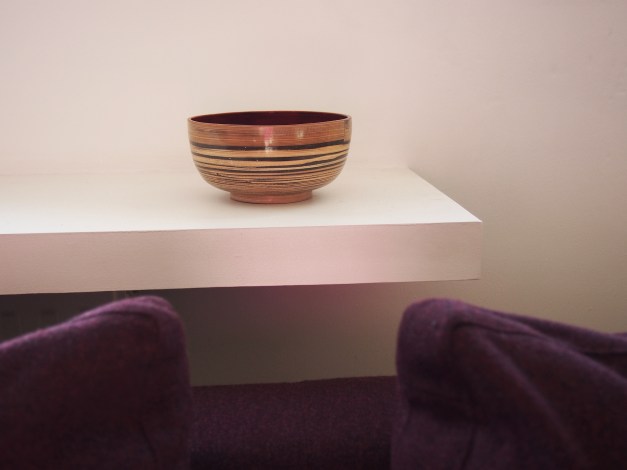
Modernism was not conceived for a billionaire’s luxury show-piece; its origins lie in the Bauhaus and mid-century Scandinavian belief in functional, democratic design for all. Eero Saarinen designed sanatoria in the modernist style fully believing in the health benefits of clean, pared back, wholesome living in this case for ill people. The Bauhaus also revolved around a democratic mass-production ethic so it’s ironic that many of the best modernist pieces have become so sought-after that they have been priced out of the reach of most ordinary mortals. There are plenty of sources of more affordable items in the same mould; the bamboo bowl above, for example cost just a few pounds. And maybe the odd signature-piece is worth the lifetime-investment.

Our own home is inspired by the minimalist wonders one sees in the press and online; I say ‘inspired’ because I don’t have the means to acquire the super-models that are frequently featured – and we do live in it full-time. I sometimes wonder what those trophy homes look like once they are occupied by people who presumably can’t help but be as imperfectly human as the rest of us, whatever the size of their bank-balance; what kind of lives do the owners of those places lead? Or maybe the point is, they are never occupied, being merely investment items of those who have far more money than sense – again rather against the spirit of the original modernism.

OLYMPUS DIGITAL CAMERA

We have tried to make our modest space beautiful in our own eyes, and it is uplifting just to be in, on a sunny early-autumn morning like today’s. Except for the header, the pictures accompanying this piece were taken there, and you have my promise that other than a little lighting-balancing, no tricks have been played with them. I think we have proved, at least to our own satisfaction that minimal-ish modernism is a liveable, practicable style. Visitors to our home often tell us that they like it, but could somehow “never do that” themselves. But we do well enough for our own satisfaction, and come close enough to the ideal that our home is mostly a calm, relaxing and aesthetically-rich place to be. I will also add that our budget, while not tiny, is certainly not that of a trophy-home owner. That doesn’t matter: what is more important is not just to look but to see the aesthetic potential that is all around you. Pictures of perfection can help that process.

This style also has the practical benefit of being easy to clean. If only we could teach the cat to be tidy…

[i]  https://www.italianbark.com

Opinion & Thought, Politics and current affairs

Notes from beyond 4: Are we all together in this?

ijstock's avatarteaching personally

If Gaby Hinsliff is to be believed, it seems as I’m not so much on the scrap-heap as in the vanguard of a revolution against the long-hours culture. If she’s right, people are tiring of the amount of time they are being required to give to their employers. Of course, there’s more to it than that, particularly in a vocation like teaching – but it is possible that a combination of stagnant wages, the country’s ever-growing wealth disparity and the sense that those in charge really don’t care very much really is causing the blinkers to fall.

In my case, I put my all into my career for thirty years, to an extent to which that was so is really only apparent now I have stopped. It is what we were told we should do – by people whom, it turns out were offering illusory rewards, and who were interested…

View original post 824 more words

Opinion & Thought, Politics and current affairs

A very British revolution.

EU-UK-flag
Image: wintonsworld.com

Britain is one of the very few European countries that have not experienced a revolution or other significant national trauma in the recent past – by which I mean the past couple of centuries. France, Spain, Russia and more have all come to a point where the old regime was sufficiently unpopular to endure; radical action was the way forward. Of those who did not experience this, the majority were forced into a fundamental rethink of their raisons d’être by virtue of World War Two. Only in Britain, despite the difficult conditions, was continuity the theme.

Further back in time there was the English Revolution of the second half of the 17th Century – but it was such an uncertain affair that historians cannot even agree on which event is best labelled as such. While it did bring an end to absolute monarchy, the fact that the Restoration took place shortly afterwards might cause one to doubt whether it really constituted a significant new start.

In the meantime, British national identity has come to be defined by two surprisingly short interludes, the first deriving from its economic prowess between around 1850 and the early Twentieth Century, and then the country’s military-political role in the Second World War, neither of which were as unequivocal or unilateral as the national story would have us believe, and certainly neither embedded in popular democracy.  Combined with its insular outlook, it has arguably given this country a self-perception based on past glories which has seen no need to adapt to the immense changes in the world in the meantime.

Events like the Suez Crisis in 1956 perhaps dented the nation’s sense of pre-eminence – but did not destroy it. Deindustrialisation in the 1970s caused the last vestiges of economic dominance to fall away, and is perhaps the source of the country’s schizophrenic superiority-inferiority complex that we see today.

But adapt it could not. As U.S. Secretary of State Dean Acheson said in 1971, “Britain lost an empire and has not yet found a role”. It is still true today – but as it became increasingly impossible to ignore this fact the country simply retreated further and further into the nostalgia that is the root cause of the Brexit decision. Despite having the outward appearance of a modern democracy, this country is still largely run by a small elite, in some cases the descendants of the aristocracy, but supplemented with those who have gained power through money. The old social calendar is still there, albeit largely unseen, for those with the money and connections to access it. Even being charitable, they can have little sense what life is now like for the ordinary people of the country.

The European Union represents a huge threat to these people’s hegemony – for a start it emanates from countries that have known real trauma in a way the British have not – and who have had to rethink their societies from the ground up. Post-war idealism set in place in many of those countries institutions that while by no means perfect, are based on a fundamental assumption of Equality. The E.U. is the greatest expression of that; anyone studying its workings or watching it at first hand (as I have) can be left in no doubt about that, even if the reality is not above criticism.

Such ideas threaten (or are perceived to threaten) the old order that still holds the reins of power in Britain. Principles such as Proportional Representation and consensual politics in general threaten the long-standing hegemony of the British Right, and are therefore to be panned. The E.U. was resisted at every turn when it tried to speak directly to the British People, and its implementation of policy that was not directly beneficial to the British Establishment was rejected or diluted in the form of opt-outs.

It would not be accurate, I suspect, to suggest that everything the British did to resist the E.U. was done for nefarious reasons; some of it is probably the entirely genuine response of an established patriarchy to perceived threats to its existence. But the British Establishment has a view of the world that has changed even less than that of the rest of the nation; it simply cannot get its head round the fact that Britain is no longer the pole around which the world revolves, and it simply does not ‘get’ the fact that the E.U., for all its imperfections, is a body intended to benefit ordinary peoples.

Widely- benign legislation such as workers’ rights, an insistence on democratic institutions in its member-states, and environmental and consumer protection have traditionally been far stronger than the British domestic equivalent. Likewise regional aid, which has to date done far more for Britain’s deprived further regions that Westminster ever has.  Unlike the militaristic British it’s role in the wider world has been conciliatory (though admittedly not always effective). But they threaten the established order; why else would this country ‘need’ so many opt-outs from legislation that for the most part suits 27 similar nations well enough?  Just what is so special about this country – except the privilege retained by and for those who run it?

Recent events, of which Brexit is merely the peak – have finally pushed British delusion to the point that it can no longer be ignored. The failure of neo-liberal economic policies to distribute wealth to more than a small minority, while simultaneously eroding both social infrastructure and welfare support for the rest, the failure to restrain the vested interests that now hamstring this country, and scandals such as M.P.’s expenses have finally shown the British that their domestic system is no less rotten than some of those to which they considered themselves superior by birthright.

But the hegemony of the British establishment is as strong as it is concealed. A sense of powerlessness and apathy exists amongst the ordinary people of this country; it is the inheritance of a nation whose ordinary citizens are in fact not citizens at all, but subjects of the monarch – a monarch in whose name many national institutions still technically operate, and who on theory can still have the last word on the laws of the land. Cow-towing to authority (and raging about it privately later) is the national instinct.

Despite the fine words, there is a tacit but distinct lack of the determination to build and defend a just society such as I have seen in those countries that have known still (just) within living memory what it is to lose it. Most people just shrug; I won’t decry the unwillingness to take the barricades – I don’t know if I would have the courage either.

Such is the ‘respectable’ plausibility of the Establishment that they have succeeded in deflecting the anger of many, towards the E.U. itself. Those people are gullible enough to believe the age-old platitudes about British greatness, dished out by those who have most interest in perpetuating the national myth. I fear that even many who march in favour of the E.U. don’t really know much about it – it’s just where they go on holiday. Where were they over the past decades when those of us who advocated pro-Europeanism met universal indifference – that is when we weren’t being shouted down?

But at least we are beginning to see the real state of things. The rottenness of the British political system is now in plain view – from a Prime Minister who claims to execute the will of the people while wantonly ignoring the wishes of at least half of them (that is not how true democracies work) – to the brazen use of public money to cling to office when the normal route fails.  And now a blatant power-grab as laws are repatriated. People are decrying the loss of democracy – but didn’t they notice, we never really had it? A patriarchal, elective dictatorship (hidden behind that veneer of upper class respectability) was the perceptive phrase.

One of the weaknesses of European Integration is the fact that it still relies on stereotypes between neighbours who are still getting to know one another; the British have hidden behind that veneer of decency that our diplomats exude, concealing the rot going on behind it; the continentals were taken in. Now, their delusions have been well and truly shattered; we no longer have any more credibility than those nations on whom we traditionally look down. It is clear to all from the table-thumping that the British political class – let alone the rest – just don’t ‘get’ the fact that running a continent has to be built on negotiation, consensus and the sharing of risk; why would they? They don’t even run their own country that way.

I don’t expect to see blood on the streets if Britain any time soon – and I won’t suggest that that is a bad thing. But what else is it going to take before the order changes in this country? I suspect that many Britons still don’t realise how potentially serious this schism is – after all, national disasters only happen overseas.

My hope is that the continuing impossibility of the task ahead will eventually turn floating public opinion. Much national credibility will have been lost, and the damage to the social fabric of the country will take a generation to heal. But if that can happen, then we may look back on this period as the time when Britain did finally find a new role for itself. Maybe this trauma is precisely what is needed – a form of velvet revolution – for ordinary Britons finally to notice and understand the importance of the project that has been developing on their doorsteps – and choose to take an active role in it after all.

Opinion & Thought

Perfect?

rug

Have nothing in your house that you do not know to be useful, or believe to be beautiful.

William Morris

Matters of opinion are difficult; what can feel like a self-evident truth to one person is nothing more than unsupportable bias to another, and none more so in matters of culture and taste. It doesn’t matter: in one sense we are all alone in this world. No one but us can experience what we experience and so insofar as that is true, it doesn’t unduly matter whether others agree. This blog takes as its premise the belief that an innocent appreciation of the qualities and details of things and experiences can enrich our daily lives, a form of creative mindfulness, the opposite of taking life for granted.

But that in itself is nothing more than an opinion, albeit one borne out by repeated personal experience, not only mine. Day-to-day life would suggest, however, that it is a minority view with anything that makes life instant, easy and undemanding generally commanding far more popularity (and profit). You can live life deeply, or in the shallows; if we accept for a moment the possibility that you get out of life what you put into it, then that raises quite fundamental questions about the world-views and the value attached to life by many of our fellow humans. Too busy to see the wood for the trees?

The psychologist Mihaly Csikszentmihalyi researched this issue in depth, through tens of thousands of individual studies across cultural boundaries. He found that people reported their greatest life-satisfaction when having to strive, but not so much that they failed. The complete absorption that people experience under those conditions, he named Flow. I am greatly persuaded by this concept: my secular view is that in the (probable) absence of an afterlife, the best thing we can do with our time is to live to the full and help others to do the same. That is entirely independent of any personal preferences that are implied: the only arbiter need be oneself.

This might sound like the ultimate self-indulgence, but it is not necessarily so: I don’t mean just being hedonistic. True, one can become grossly narcissistic in one’s indulgence, but equally one can simply enjoy for what it is, an uncomplicated appreciation of the more pleasurable aspects of life. Even where status and perceived luxury muddy the waters, this can still cut through. The supposedly finer things can be consumed for the status they are perceived to confer (label on the outside) – but they can equally be appreciated simply for what they are (label on the inside).

Oliver James and others have reported higher life-satisfaction amongst those of the world’s (economically) poorest people who (provided they did not lack the basics) were able to meet their expectations and enjoy simple pleasures, than amongst the ultra-rich whose motive was often competitive ostentation. Things that are done for show or to impress are far less likely to achieve Flow than things done for their intrinsic personal reward, even when the results superficially look the same. There is a lesson for us all in there.

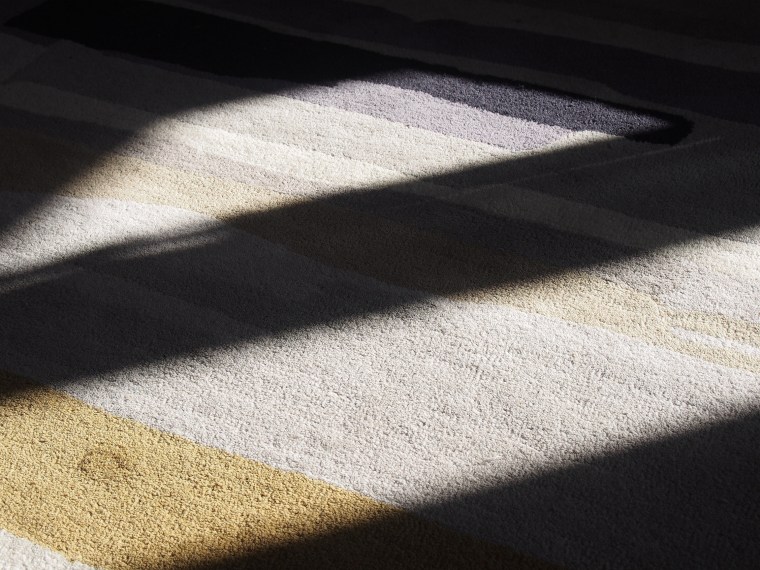
Satisfaction is not only found from big achievements; the appreciation of the niceties of anything can contribute at least as much to the sense of a life well lived: even learning to appreciate the quality of sunlight falling on woollen rug or wooden floor. The concept of mastery is very important to one’s sense of self-efficacy and fulfilment, but it is more about one’s powers of observation as the size of one’s wallet. That is why the notion of sprezzatura is attractive: understood non-judgmentally it implies a refined knowledge of a subject in a way that glories in the detail, without taking itself too seriously. I would also argue that those who revel in the fulfilment of the Mind but neglect their physical worlds miss out on as much as those who do the opposite.

But aiming at perfection brings a problem, and I don’t mean the likelihood that it is unachievable: kept in proportion, precisely therein lies the challenge. More problematic is defining it in the first place. I’m not sure what society at large makes of the matter; common wisdom seems to have decided that it is better to lower your expectations and not to aim at the seemingly-unattainable (except with your credit card), but that very word can only be defined by having tried and failed. I think the secret lies in accepting that one will never entirely succeed before one starts, but still being prepared to value what one can achieve for itself.

Perfection implies the acceptance of a gold-standard, and gold appears to be out of fashion. Fusion food, for instance, relies on blending – some might say bastardising – traditional recipes. One may read this as the worst thing to do if one is aiming for perfection; another may argue that it is the way new forms of perfection are created. The same can be applied to pretty much any creative endeavour, at any level of competence. Who is right?

Personally, I take a gentle pleasure from attempting to appreciate the niceties; a fortunate side-effect of my new, non-employed status is the time to do this, and I am happily making up for lost time. Sometimes that means mastering established forms, though I am not so conservative as to reject everything new. But if there is no accepted standard, there is no way of even attempting to agree on how good something really is, new or old alike.

Many of the benchmarks of perfection are arguably little more than the preferences of those who claimed to know enough to lay down the law. Or is there more to it than that? The only way to know something to try it.

There is pleasure in learning to appreciate the finer points of things – most things – even accepting that judgements are, ultimately, arbitrary. This is why some people embark on personal quests to ‘perfect’ their musical, sporting, linguistic or practical abilities. Part of that is learning the time-honoured practices that have been found to contribute to excellent results; arbitrary perhaps, but validated by longevity and consensus. Even if one then chooses to break the rules, one really needs to know what they were to begin with, otherwise one is simply left with ignorance.

Even when one falls short it permits an appreciation of the expertise of others, that one simply cannot attain if one has never bothered to try.

Floor

Arts, Architecture & Design, Opinion & Thought

The White-Knicker argument


Meet ‘The Trafalgar’ and ‘The Mayfair’. Together with their nostalgically-named counterparts they make up an arcadian-sounding housing development on the outskirts of a large town in eastern England. They are not cheap: even a two-bedroom semi in the Trafalgar costs in excess of ¼ million pounds. And for that money, you get a master bedroom a mere three metres square or so.

Stanway

The picture above was taken this morning of the development under construction. This unmitigated monstrosity is currently being thrown up at a rate of knots – and my reaction to seeing it made me want to do something similar. What was admittedly fairly indifferent open land until a few months ago is rapidly being buried under bricks and asphalt, presumably to stay that way for a century or two – that is assuming these meretricious little hovels last that long. And it’s not only a few houses: in total there are, I should think, several square kilometres of the stuff. The mediocrity is only matched by the romanticised hyperbole with which the development is being promoted. I would suggest this verges on misrepresentation.

I know people need somewhere to live (but would you really trust the building industry to tell you how many new houses are needed?) and I know that not everyone can afford something glamorous – but this is a disgrace. Mass housing is not easy to get right, on account of its sheer volume – but is this really the best we can do?

The white-knicker argument was supposedly used by Marks & Spencer to justify only selling white underwear – because that was all their customers ever bought… The fact that people buy these things is not the reflection of positive choice that the developers would have us believe – while this is all that is provided in people’s price ranges. The U.K. has a record of building shoddy, architecturally catastrophic mass housing, but there have been enough instances of poor construction and soulless non-communities being created that you would have hoped we would have learned by now.

Wellbeing comes in many forms, but the homes we live in have to rate as one of the most significant. Actions speak louder than words, and it is not stretching the point too far to read some very antisocial attitudes into the people who allow these things to be built – namely the opinion that any old rubbish is good enough for ‘ordinary people’.

What is more, having been staggered recently at the complexity of the British planning process, and the near-paralysis it can induce, the fact that these slums of the future are still being built suggests that it is not fit for purpose. When the debates only centre on quantities and locations and virtually neglect the essential qualities that make or break new houses, what on earth is it actually achieving? The answer seems to be the utter bastardisation of this country’s natural environments and architectural heritage.

I have acquaintances ‘inside’ the planning process who overflow with stories of the abuses perpetrated by developers, from the ‘accidental’ destruction of protected trees to the social amenities that were somehow overlooked. Yet they rarely seem to be prosecuted for their failures. Then there is the widespread failure to develop infrastructure to accompany the developments; before I stopped work, my journey was becoming increasingly delayed as more and more housing developments were constructed alongside the main road, clearly on the assumption that the commuter traffic would pour out onto it every morning. Yet nothing was done to upgrade the road; while the developers are no doubt sunning themselves in their Spanish haciendas, the rest of us pay the daily price for their corner-cutting.

There have been numerous reports in the press recently about the shoddy quality of mass-produced homes – hardly surprising when one notes the unseemly haste with which they are constructed –  whereas Grand Designs’ Kevin McCloud, who is now venturing into mass home-building of a more enlightened sort, reports overwhelming demand for his products.

HAB
HAB plans for Bristol


Much better developments are being built – but they are still in the minority.

CBM
Carrowbreck Meadow, a Passivhaus development near Norwich


It is not as though people do not want better than these Disney-esque, quasi-nostalgic theme-parks to live in. It has to be admitted, though, that the British pre-occupation with ‘heritage’ (seemingly even of the fake sort) probably prevents some more innovative, contemporary solutions from getting off the ground.

It makes me extremely angry that it is still apparently acceptable to fob off much of our populace with such shoddy living spaces; experience suggests that it is not the case everywhere in Europe.

Unfortunately, the bottom line of the construction companies is still the dominant factor in determining the environments in which millions of British people live.

Food, Opinion & Thought, Sartoria

The not-so-bare necessities

I have been looking at some architectural impressions of various new developments. I always find architects’ sketches an attractive source of optimism, a promise of a better future. But notice how the human representations within are always stylishly dressed: people who, one could imagine working in glamorous creative industries or finance.

When these creations get built, many do bear passing resemblance to the designers’ dreams of a corporate Utopia – but those who populate them most definitely don’t look the same. I’ve recently spent time in a few such places: the enormous development that is the Stratford Olympic site for one. For all the lustrous finishes of the Westfield Shopping Centre, for all the stylish shops that occupy it, the majority of the clientele actually sports jeans and T-shirts or branded leesure-wear; stylish they aren’t. Truly well-dressed people are few and far between: one wonders who actually buys the clothes on show in the windows – maybe it’s just foreign tourists? Snobbery might resort to the fact that this is East London – but the same was pretty much true of the Grand Arcade in Cambridge, Chapelfield in Norwich, the Highcross Centre in Leicester, central Manchester and Birmingham, not to mention the glamorous alien that has landed in distinctly humdrum Chelmsford – Bond Street.

Truly stylish people have become almost an extinct species in Britain. It’s not as though we don’t have a time-honoured reputation for sartorial quality – even the Italians have a soft spot for traditional British style, menswear in particular. But who wears it any more, except possibly City bankers and Sloanes in Kensington? And even there, I suspect standards are slipping – the workplace is the last bastion of formal dress in Britain, but  that too is going increasingly casual.

Having done a little delving, there seem to be two issues that might be to blame: long working hours and a Protestant Anglo-American history.

Having recently suspended my own full-time employment, I can well appreciate the effect that it can have on one’s mind; when the attention is fully on the career, there is little mental space or energy left for the other aspects of life, let alone something so supposedly trivial as dressing artfully. And that’s where the second element kicks in: for all our supposed modernity, there remains a stubborn distrust of ‘show’ in British culture. A puritanical understatement is preferred, whether people are aware of it or not. I was inclined to blame America, the source of so many cultural evils, but there actually seems to be more interest with dressing well in the States than there is in Britain, if a quick web-trawl is anything to go by.

In fact, perhaps the mistrust is less spiritual and more societal: traditional British style still has strong associations with Class. People who choose to dress smartly are ‘probably’ either Hooray Henries, Toffs or other upper-class twits, and it isn’t cool to be identified as one of them. Much better to affect the inverted snobbery of wearing extortionately-priced sportswear and bling that make you look as though you’ve come straight from The Bronx.

Or maybe it isn’t even that: I suspect the majority of modern Britain either simply never thinks about how it looks, or doesn’t care, to the point of neglect. A concern for such issues only shows how shallow you are anyway, doesn’t it?

Well, I beg to disagree. True, taking care of one’s self may be unimportant when compared to huge global issues, but if every life is precious, then why waste it through neglect? Effort expended on small niceties adds colour and artistry to everyday life; it has a cumulative effect on the quality of that life and is a sign of self-respect.  I challenge anyone not to feel better if they eat well, live in cared-for surroundings, and take care of their personal standards in general. Conversely, what does it say not to care about these things? That life is trivial, unimportant, not worth taking care with? It may be that your priorities in life lie elsewhere – but somehow I suspect that they actually just took their leave some time ago. I think it was the designer Tom Ford who said that dressing well is a courtesy to others; if he is right, then it cannot say much about one’s care for other people either, to deprive them of that small pleasure.

What is true of clothes is also true of food, standards of speech and conversation and all other aspects of social intercourse. Collectively, these things create a context and tone for social interaction. In Britain, we supposedly had a food revolution. It’s true, the quality on offer has vastly improved, but eating well is still for the special occasion rather than the quotidien, and I suspect that most foodie books and programmes are consumed vicariously. When one listens to what people actually say about their lives, casual junk and supposed convenience seem to reign supreme.

It takes courage to maintain personal standards when everyone around you is dropping theirs, but I suspect there is a sneaking respect for people who do. In the small town where I live, there is one gent, probably in his early seventies, who regularly steps out in tweeds, plus-fours, waistcoats and a natty line in caps. He is clearly untroubled by the fact that he stands out.

But, in a very positive sense, everyone knows who he is.