If Gaby Hinsliff is to be believed, it seems as I’m not so much on the scrap-heap as in the vanguard of a revolution against the long-hours culture. If she’s right, people are tiring of the amount of time they are being required to give to their employers. Of course, there’s more to it than that, particularly in a vocation like teaching – but it is possible that a combination of stagnant wages, the country’s ever-growing wealth disparity and the sense that those in charge really don’t care very much really is causing the blinkers to fall.
In my case, I put my all into my career for thirty years, to an extent to which that was so is really only apparent now I have stopped. It is what we were told we should do – by people whom, it turns out were offering illusory rewards, and who were interested…
Britain is one of the very few European countries that have not experienced a revolution or other significant national trauma in the recent past – by which I mean the past couple of centuries. France, Spain, Russia and more have all come to a point where the old regime was sufficiently unpopular to endure; radical action was the way forward. Of those who did not experience this, the majority were forced into a fundamental rethink of their raisons d’être by virtue of World War Two. Only in Britain, despite the difficult conditions, was continuity the theme.
Further back in time there was the English Revolution of the second half of the 17th Century – but it was such an uncertain affair that historians cannot even agree on which event is best labelled as such. While it did bring an end to absolute monarchy, the fact that the Restoration took place shortly afterwards might cause one to doubt whether it really constituted a significant new start.
In the meantime, British national identity has come to be defined by two surprisingly short interludes, the first deriving from its economic prowess between around 1850 and the early Twentieth Century, and then the country’s military-political role in the Second World War, neither of which were as unequivocal or unilateral as the national story would have us believe, and certainly neither embedded in popular democracy. Combined with its insular outlook, it has arguably given this country a self-perception based on past glories which has seen no need to adapt to the immense changes in the world in the meantime.
Events like the Suez Crisis in 1956 perhaps dented the nation’s sense of pre-eminence – but did not destroy it. Deindustrialisation in the 1970s caused the last vestiges of economic dominance to fall away, and is perhaps the source of the country’s schizophrenic superiority-inferiority complex that we see today.
But adapt it could not. As U.S. Secretary of State Dean Acheson said in 1971, “Britain lost an empire and has not yet found a role”. It is still true today – but as it became increasingly impossible to ignore this fact the country simply retreated further and further into the nostalgia that is the root cause of the Brexit decision. Despite having the outward appearance of a modern democracy, this country is still largely run by a small elite, in some cases the descendants of the aristocracy, but supplemented with those who have gained power through money. The old social calendar is still there, albeit largely unseen, for those with the money and connections to access it. Even being charitable, they can have little sense what life is now like for the ordinary people of the country.
The European Union represents a huge threat to these people’s hegemony – for a start it emanates from countries that have known real trauma in a way the British have not – and who have had to rethink their societies from the ground up. Post-war idealism set in place in many of those countries institutions that while by no means perfect, are based on a fundamental assumption of Equality. The E.U. is the greatest expression of that; anyone studying its workings or watching it at first hand (as I have) can be left in no doubt about that, even if the reality is not above criticism.
Such ideas threaten (or are perceived to threaten) the old order that still holds the reins of power in Britain. Principles such as Proportional Representation and consensual politics in general threaten the long-standing hegemony of the British Right, and are therefore to be panned. The E.U. was resisted at every turn when it tried to speak directly to the British People, and its implementation of policy that was not directly beneficial to the British Establishment was rejected or diluted in the form of opt-outs.
It would not be accurate, I suspect, to suggest that everything the British did to resist the E.U. was done for nefarious reasons; some of it is probably the entirely genuine response of an established patriarchy to perceived threats to its existence. But the British Establishment has a view of the world that has changed even less than that of the rest of the nation; it simply cannot get its head round the fact that Britain is no longer the pole around which the world revolves, and it simply does not ‘get’ the fact that the E.U., for all its imperfections, is a body intended to benefit ordinary peoples.
Widely- benign legislation such as workers’ rights, an insistence on democratic institutions in its member-states, and environmental and consumer protection have traditionally been far stronger than the British domestic equivalent. Likewise regional aid, which has to date done far more for Britain’s deprived further regions that Westminster ever has. Unlike the militaristic British it’s role in the wider world has been conciliatory (though admittedly not always effective). But they threaten the established order; why else would this country ‘need’ so many opt-outs from legislation that for the most part suits 27 similar nations well enough? Just what is so special about this country – except the privilege retained by and for those who run it?
Recent events, of which Brexit is merely the peak – have finally pushed British delusion to the point that it can no longer be ignored. The failure of neo-liberal economic policies to distribute wealth to more than a small minority, while simultaneously eroding both social infrastructure and welfare support for the rest, the failure to restrain the vested interests that now hamstring this country, and scandals such as M.P.’s expenses have finally shown the British that their domestic system is no less rotten than some of those to which they considered themselves superior by birthright.
But the hegemony of the British establishment is as strong as it is concealed. A sense of powerlessness and apathy exists amongst the ordinary people of this country; it is the inheritance of a nation whose ordinary citizens are in fact not citizens at all, but subjects of the monarch – a monarch in whose name many national institutions still technically operate, and who on theory can still have the last word on the laws of the land. Cow-towing to authority (and raging about it privately later) is the national instinct.
Despite the fine words, there is a tacit but distinct lack of the determination to build and defend a just society such as I have seen in those countries that have known still (just) within living memory what it is to lose it. Most people just shrug; I won’t decry the unwillingness to take the barricades – I don’t know if I would have the courage either.
Such is the ‘respectable’ plausibility of the Establishment that they have succeeded in deflecting the anger of many, towards the E.U. itself. Those people are gullible enough to believe the age-old platitudes about British greatness, dished out by those who have most interest in perpetuating the national myth. I fear that even many who march in favour of the E.U. don’t really know much about it – it’s just where they go on holiday. Where were they over the past decades when those of us who advocated pro-Europeanism met universal indifference – that is when we weren’t being shouted down?
But at least we are beginning to see the real state of things. The rottenness of the British political system is now in plain view – from a Prime Minister who claims to execute the will of the people while wantonly ignoring the wishes of at least half of them (that is not how true democracies work) – to the brazen use of public money to cling to office when the normal route fails. And now a blatant power-grab as laws are repatriated. People are decrying the loss of democracy – but didn’t they notice, we never really had it? A patriarchal, elective dictatorship (hidden behind that veneer of upper class respectability) was the perceptive phrase.
One of the weaknesses of European Integration is the fact that it still relies on stereotypes between neighbours who are still getting to know one another; the British have hidden behind that veneer of decency that our diplomats exude, concealing the rot going on behind it; the continentals were taken in. Now, their delusions have been well and truly shattered; we no longer have any more credibility than those nations on whom we traditionally look down. It is clear to all from the table-thumping that the British political class – let alone the rest – just don’t ‘get’ the fact that running a continent has to be built on negotiation, consensus and the sharing of risk; why would they? They don’t even run their own country that way.
I don’t expect to see blood on the streets if Britain any time soon – and I won’t suggest that that is a bad thing. But what else is it going to take before the order changes in this country? I suspect that many Britons still don’t realise how potentially serious this schism is – after all, national disasters only happen overseas.
My hope is that the continuing impossibility of the task ahead will eventually turn floating public opinion. Much national credibility will have been lost, and the damage to the social fabric of the country will take a generation to heal. But if that can happen, then we may look back on this period as the time when Britain did finally find a new role for itself. Maybe this trauma is precisely what is needed – a form of velvet revolution – for ordinary Britons finally to notice and understand the importance of the project that has been developing on their doorsteps – and choose to take an active role in it after all.
Have nothing in your house that you do not know to be useful, or believe to be beautiful.
William Morris
Matters of opinion are difficult; what can feel like a self-evident truth to one person is nothing more than unsupportable bias to another, and none more so in matters of culture and taste. It doesn’t matter: in one sense we are all alone in this world. No one but us can experience what we experience and so insofar as that is true, it doesn’t unduly matter whether others agree. This blog takes as its premise the belief that an innocent appreciation of the qualities and details of things and experiences can enrich our daily lives, a form of creative mindfulness, the opposite of taking life for granted.
But that in itself is nothing more than an opinion, albeit one borne out by repeated personal experience, not only mine. Day-to-day life would suggest, however, that it is a minority view with anything that makes life instant, easy and undemanding generally commanding far more popularity (and profit). You can live life deeply, or in the shallows; if we accept for a moment the possibility that you get out of life what you put into it, then that raises quite fundamental questions about the world-views and the value attached to life by many of our fellow humans. Too busy to see the wood for the trees?
The psychologist Mihaly Csikszentmihalyi researched this issue in depth, through tens of thousands of individual studies across cultural boundaries. He found that people reported their greatest life-satisfaction when having to strive, but not so much that they failed. The complete absorption that people experience under those conditions, he named Flow. I am greatly persuaded by this concept: my secular view is that in the (probable) absence of an afterlife, the best thing we can do with our time is to live to the full and help others to do the same. That is entirely independent of any personal preferences that are implied: the only arbiter need be oneself.
This might sound like the ultimate self-indulgence, but it is not necessarily so: I don’t mean just being hedonistic. True, one can become grossly narcissistic in one’s indulgence, but equally one can simply enjoy for what it is, an uncomplicated appreciation of the more pleasurable aspects of life. Even where status and perceived luxury muddy the waters, this can still cut through. The supposedly finer things can be consumed for the status they are perceived to confer (label on the outside) – but they can equally be appreciated simply for what they are (label on the inside).
Oliver James and others have reported higher life-satisfaction amongst those of the world’s (economically) poorest people who (provided they did not lack the basics) were able to meet their expectations and enjoy simple pleasures, than amongst the ultra-rich whose motive was often competitive ostentation. Things that are done for show or to impress are far less likely to achieve Flow than things done for their intrinsic personal reward, even when the results superficially look the same. There is a lesson for us all in there.
Satisfaction is not only found from big achievements; the appreciation of the niceties of anything can contribute at least as much to the sense of a life well lived: even learning to appreciate the quality of sunlight falling on woollen rug or wooden floor. The concept of mastery is very important to one’s sense of self-efficacy and fulfilment, but it is more about one’s powers of observation as the size of one’s wallet. That is why the notion of sprezzatura is attractive: understood non-judgmentally it implies a refined knowledge of a subject in a way that glories in the detail, without taking itself too seriously. I would also argue that those who revel in the fulfilment of the Mind but neglect their physical worlds miss out on as much as those who do the opposite.
But aiming at perfection brings a problem, and I don’t mean the likelihood that it is unachievable: kept in proportion, precisely therein lies the challenge. More problematic is defining it in the first place. I’m not sure what society at large makes of the matter; common wisdom seems to have decided that it is better to lower your expectations and not to aim at the seemingly-unattainable (except with your credit card), but that very word can only be defined by having tried and failed. I think the secret lies in accepting that one will never entirely succeed before one starts, but still being prepared to value what one can achieve for itself.
Perfection implies the acceptance of a gold-standard, and gold appears to be out of fashion. Fusion food, for instance, relies on blending – some might say bastardising – traditional recipes. One may read this as the worst thing to do if one is aiming for perfection; another may argue that it is the way new forms of perfection are created. The same can be applied to pretty much any creative endeavour, at any level of competence. Who is right?
Personally, I take a gentle pleasure from attempting to appreciate the niceties; a fortunate side-effect of my new, non-employed status is the time to do this, and I am happily making up for lost time. Sometimes that means mastering established forms, though I am not so conservative as to reject everything new. But if there is no accepted standard, there is no way of even attempting to agree on how good something really is, new or old alike.
Many of the benchmarks of perfection are arguably little more than the preferences of those who claimed to know enough to lay down the law. Or is there more to it than that? The only way to know something to try it.
There is pleasure in learning to appreciate the finer points of things – most things – even accepting that judgements are, ultimately, arbitrary. This is why some people embark on personal quests to ‘perfect’ their musical, sporting, linguistic or practical abilities. Part of that is learning the time-honoured practices that have been found to contribute to excellent results; arbitrary perhaps, but validated by longevity and consensus. Even if one then chooses to break the rules, one really needs to know what they were to begin with, otherwise one is simply left with ignorance.
Even when one falls short it permits an appreciation of the expertise of others, that one simply cannot attain if one has never bothered to try.
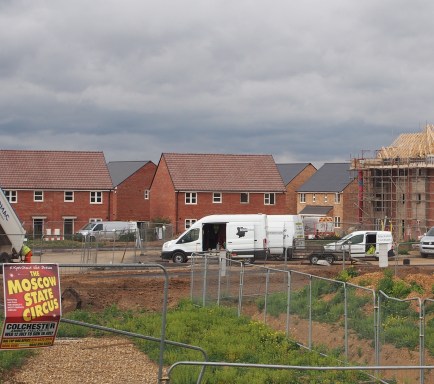
Meet ‘The Trafalgar’ and ‘The Mayfair’. Together with their nostalgically-named counterparts they make up an arcadian-sounding housing development on the outskirts of a large town in eastern England. They are not cheap: even a two-bedroom semi in the Trafalgar costs in excess of ¼ million pounds. And for that money, you get a master bedroom a mere three metres square or so.
The picture above was taken this morning of the development under construction. This unmitigated monstrosity is currently being thrown up at a rate of knots – and my reaction to seeing it made me want to do something similar. What was admittedly fairly indifferent open land until a few months ago is rapidly being buried under bricks and asphalt, presumably to stay that way for a century or two – that is assuming these meretricious little hovels last that long. And it’s not only a few houses: in total there are, I should think, several square kilometres of the stuff. The mediocrity is only matched by the romanticised hyperbole with which the development is being promoted. I would suggest this verges on misrepresentation.
I know people need somewhere to live (but would you really trust the building industry to tell you how many new houses are needed?) and I know that not everyone can afford something glamorous – but this is a disgrace. Mass housing is not easy to get right, on account of its sheer volume – but is this really the best we can do?
The white-knicker argument was supposedly used by Marks & Spencer to justify only selling white underwear – because that was all their customers ever bought… The fact that people buy these things is not the reflection of positive choice that the developers would have us believe – while this is all that is provided in people’s price ranges. The U.K. has a record of building shoddy, architecturally catastrophic mass housing, but there have been enough instances of poor construction and soulless non-communities being created that you would have hoped we would have learned by now.
Wellbeing comes in many forms, but the homes we live in have to rate as one of the most significant. Actions speak louder than words, and it is not stretching the point too far to read some very antisocial attitudes into the people who allow these things to be built – namely the opinion that any old rubbish is good enough for ‘ordinary people’.
What is more, having been staggered recently at the complexity of the British planning process, and the near-paralysis it can induce, the fact that these slums of the future are still being built suggests that it is not fit for purpose. When the debates only centre on quantities and locations and virtually neglect the essential qualities that make or break new houses, what on earth is it actually achieving? The answer seems to be the utter bastardisation of this country’s natural environments and architectural heritage.
I have acquaintances ‘inside’ the planning process who overflow with stories of the abuses perpetrated by developers, from the ‘accidental’ destruction of protected trees to the social amenities that were somehow overlooked. Yet they rarely seem to be prosecuted for their failures. Then there is the widespread failure to develop infrastructure to accompany the developments; before I stopped work, my journey was becoming increasingly delayed as more and more housing developments were constructed alongside the main road, clearly on the assumption that the commuter traffic would pour out onto it every morning. Yet nothing was done to upgrade the road; while the developers are no doubt sunning themselves in their Spanish haciendas, the rest of us pay the daily price for their corner-cutting.
There have been numerous reports in the press recently about the shoddy quality of mass-produced homes – hardly surprising when one notes the unseemly haste with which they are constructed – whereas Grand Designs’ Kevin McCloud, who is now venturing into mass home-building of a more enlightened sort, reports overwhelming demand for his products.
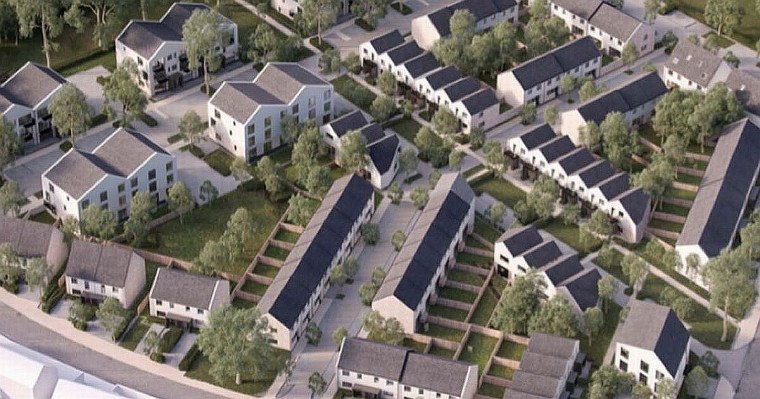
HAB plans for Bristol
Much better developments are being built – but they are still in the minority.
Carrowbreck Meadow, a Passivhaus development near Norwich
It is not as though people do not want better than these Disney-esque, quasi-nostalgic theme-parks to live in. It has to be admitted, though, that the British pre-occupation with ‘heritage’ (seemingly even of the fake sort) probably prevents some more innovative, contemporary solutions from getting off the ground.
It makes me extremely angry that it is still apparently acceptable to fob off much of our populace with such shoddy living spaces; experience suggests that it is not the case everywhere in Europe.
Unfortunately, the bottom line of the construction companies is still the dominant factor in determining the environments in which millions of British people live.
I have been looking at some architectural impressions of various new developments. I always find architects’ sketches an attractive source of optimism, a promise of a better future. But notice how the human representations within are always stylishly dressed: people who, one could imagine working in glamorous creative industries or finance.
When these creations get built, many do bear passing resemblance to the designers’ dreams of a corporate Utopia – but those who populate them most definitely don’t look the same. I’ve recently spent time in a few such places: the enormous development that is the Stratford Olympic site for one. For all the lustrous finishes of the Westfield Shopping Centre, for all the stylish shops that occupy it, the majority of the clientele actually sports jeans and T-shirts or branded leesure-wear; stylish they aren’t. Truly well-dressed people are few and far between: one wonders who actually buys the clothes on show in the windows – maybe it’s just foreign tourists? Snobbery might resort to the fact that this is East London – but the same was pretty much true of the Grand Arcade in Cambridge, Chapelfield in Norwich, the Highcross Centre in Leicester, central Manchester and Birmingham, not to mention the glamorous alien that has landed in distinctly humdrum Chelmsford – Bond Street.
Truly stylish people have become almost an extinct species in Britain. It’s not as though we don’t have a time-honoured reputation for sartorial quality – even the Italians have a soft spot for traditional British style, menswear in particular. But who wears it any more, except possibly City bankers and Sloanes in Kensington? And even there, I suspect standards are slipping – the workplace is the last bastion of formal dress in Britain, but that too is going increasingly casual.
Having done a little delving, there seem to be two issues that might be to blame: long working hours and a Protestant Anglo-American history.
Having recently suspended my own full-time employment, I can well appreciate the effect that it can have on one’s mind; when the attention is fully on the career, there is little mental space or energy left for the other aspects of life, let alone something so supposedly trivial as dressing artfully. And that’s where the second element kicks in: for all our supposed modernity, there remains a stubborn distrust of ‘show’ in British culture. A puritanical understatement is preferred, whether people are aware of it or not. I was inclined to blame America, the source of so many cultural evils, but there actually seems to be more interest with dressing well in the States than there is in Britain, if a quick web-trawl is anything to go by.
In fact, perhaps the mistrust is less spiritual and more societal: traditional British style still has strong associations with Class. People who choose to dress smartly are ‘probably’ either Hooray Henries, Toffs or other upper-class twits, and it isn’t cool to be identified as one of them. Much better to affect the inverted snobbery of wearing extortionately-priced sportswear and bling that make you look as though you’ve come straight from The Bronx.
Or maybe it isn’t even that: I suspect the majority of modern Britain either simply never thinks about how it looks, or doesn’t care, to the point of neglect. A concern for such issues only shows how shallow you are anyway, doesn’t it?
Well, I beg to disagree. True, taking care of one’s self may be unimportant when compared to huge global issues, but if every life is precious, then why waste it through neglect? Effort expended on small niceties adds colour and artistry to everyday life; it has a cumulative effect on the quality of that life and is a sign of self-respect. I challenge anyone not to feel better if they eat well, live in cared-for surroundings, and take care of their personal standards in general. Conversely, what does it say not to care about these things? That life is trivial, unimportant, not worth taking care with? It may be that your priorities in life lie elsewhere – but somehow I suspect that they actually just took their leave some time ago. I think it was the designer Tom Ford who said that dressing well is a courtesy to others; if he is right, then it cannot say much about one’s care for other people either, to deprive them of that small pleasure.
What is true of clothes is also true of food, standards of speech and conversation and all other aspects of social intercourse. Collectively, these things create a context and tone for social interaction. In Britain, we supposedly had a food revolution. It’s true, the quality on offer has vastly improved, but eating well is still for the special occasion rather than the quotidien, and I suspect that most foodie books and programmes are consumed vicariously. When one listens to what people actually say about their lives, casual junk and supposed convenience seem to reign supreme.
It takes courage to maintain personal standards when everyone around you is dropping theirs, but I suspect there is a sneaking respect for people who do. In the small town where I live, there is one gent, probably in his early seventies, who regularly steps out in tweeds, plus-fours, waistcoats and a natty line in caps. He is clearly untroubled by the fact that he stands out.
But, in a very positive sense, everyone knows who he is.
When living within striking-distance of London was still more novelty than nuisance, I used to travel into the city frequently. A favourite pause came to be the Costa Coffee bar at Liverpool Street Station. It was tucked away almost under the stairs by the entrance to the underground station. It was only small, with a glass frontage and polished granite counter piled high with all sorts of Italian goodies. Mostly, one perched on stools at a high counter in the window; as a place to pause for an espresso, it was just like a snippet of Italy dropped into the station.
Fast-forward three decades, and Costa is of course massive. It was bought from the original Italian family by Whitbread and rolled out ad nauseam across the country. To be fair, the coffee is still pretty good, but the décor was rapidly watered down into something more anodyne and cheaper to mass-produce. What we gained in ubiquity, we lost in style. The food is acceptable, but has again become less distinctive rather international-bland; various types of themed drink that have never been anywhere near Italy have been introduced. It’s pretty much a standard chain now.
Last Saturday, we travelled to Stratford to meet family who were visiting the World Athletics Championships. Hunting around a packed Westfield Centre, we couldn’t find anywhere to eat that didn’t have an hour’s queue. After running out of ideas, I eventually spotted a cafe that also had the word pasticceria over the door. Hmm: I guess not many chains – or their punters – know what one of those is. Maybe this is worth checking out – and thus we landed in Caffé Concerto.
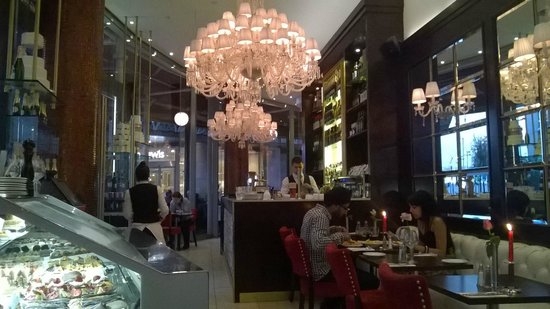
For a new building, the fitters have done a very passable job of conjuring up a dark-wood and marble Torinese-style interior. The materials seem to be real, and the place felt right. Many of the touches that one would see in Italy, but the average theme restaurant would ignore or filter out, were there. It was no surprise that there had been at least some Italian input into the place; the Maître d’ was clearly Italian, even if most of the other (properly-attired) staff were Easterners. They appeared to have had proper training – or at least they were working somewhere where their likely exposure to proper ‘waitering’ from back home could be applied. All very impressive; and what’s more, despite the queues, there was no hustling people to move on quickly.
As for the food: my expectations always fall when one is given a laminated menu – although to be fair this happens very often on the continent too, these days. The fare was a slightly strange mix of English and Italian, with some notable omissions – no pizzas, and no pannacotta on the desert list. But there was an excellent choice of risotto and pasta dishes, much for veggies, and some correct-looking meat and fish. And one or two give-aways that these people know what they are doing, such as Bellini on the cocktail list.
Sure enough, when the food arrived, it was excellent and clearly prepared by someone who knew what they were doing. I opted somewhat hesitantly for a spaghetti carbonara – risky when unknown, as it can be turned into a solid lump of pasta and congealed cream all too easily. But this was light and in moderate portion, with decent pieces of what looked like hand-cut pancetta giving an excellent smoky-salty hit. My wife’s aubergine rigatone siciliana was equally excellent.
I pined due to the lack of pannacotta on the desert menu, as this is always an acid test of an Italian eatery – but a piece of tiramisu gateau was a reasonable substitute, even if it lacked totally in liqueur content. The follow-up espresso was of a good size, though somewhere up Mont Blanc in terms of strength, not quite fully Italian and missing the accompanying glass of water. But these are minor niggles in what was otherwise a surprisingly good experience. What pleased me too, was the fact that the place felt right.
It was only when I got home that I discovered that Concerto is a chain – at least within the bounds of London, there being about a dozen more dotted around the capital – plus one in Birmingham. But I think it shows that control has been retained by people who know what they are doing, by which I mean serving up a good Italian experience rather than making money for some anonymous venture capital company. My other favourite, Carluccio’s is just about managing the same trick, even though Antonio relinquished day-to-day control some time ago. That said, a look at the website shows the full corporate infrastructure behind the thing. Perhaps it shows that chains do not have to be dumbed down and characterless.
So on the one hand, it would be nice to see Caffé Concerto spreading to places that did not involve hauling into the capital, but on the other, what risk that it would do a Costa, be bought out by big business and turned into a shadow of its former self, whence everyone except the investors lose out? Quite a dilemma.
When your professional life takes as its raw material human beings themselves, it is difficult not to become curious about what makes them tick: why some people take one course while others take a different one, why some people respond well to a particular stimulus while others do the opposite. Then there is the whole issue of what constitutes ‘success’ in life – something the education world is almost obsessed with.
I don’t intend to delve into nature versus nurture here, but the choices individuals make do seem to be governed in part by the prevalent cultures within which they live. When I ran a partnership with a school in Switzerland, the differences were pronounced: before pairing students up, I used to ask for a written self-portrait from each participant. Year upon year, it was remarkable how the Swiss came back with long lists of favourite authors, musical instruments played, sports and hobbies pursued, languages spoken and more – while many of my own British students struggled to write much at all, even when prompted. Shopping and ‘socialising’ were the main two; there were exceptions on both sides, of course – but the pattern was too marked over too many years to be mere chance.
Long acquaintance with both countries does suggest that this reflects a wider pattern: it’s hard to substantiate such things, but my lasting impression is that the Swiss lead active lives, wherein they themselves are the main instigator of their chosen path, whereas the typical Briton is more passive and herd-like, perhaps feeling less able to assert their own direction and individuality, and more content for (and dependent on) third parties to provide the stuff of life.
The reasons for this are too complex to explore in depth here, but I suspect that they go well beyond the respective wealth (and therefore means) of the countries concerned; perhaps British passivity is rooted in history, in a strongly hierarchical society where people knew their often-suppressed place, and have never really shaken it off. The Swiss, by contrast, have a strongly egalitarian streak, and despite the immense wealth of some people in that country, it rarely seems to express itself in the kind of (anti)social snobberies that are rife in Britain.
This concerns me especially at the moment, given the current flux in relations between Britain and the continent. My own hopes of European union were always primarily cultural – but it seems that, as a nation, we really haven’t learned very much from our close relations with our neighbours – and now it appears we are about to pull up the drawbridge again.
What has always inspired me most about the continent might be summed up in its relative resistance to the ultra-liberalism of the Anglo-Saxon economic model, where just about everything in life is becomes a commercial opportunity to be exploited – and much thereby loses its authenticity. Ironically, this comes out strongly in the respective ways of life: unlike the British, there does not seem to be the same chasing of material status Switzerland, though that is absolutely not to suggest they don’t appreciate substance; things are appreciated for their quality and style, not their trendiness, branding or opportunity to flash ostentatious wealth. People seem to be less taken in by commercial manipulation, in the way one sees plenty of people in the U.K. spending their cash on armfuls of ephemeral trendiness irrespective of the fact that the quality may be poor.
It seems to me that in their rush to prove (mostly to themselves) that they are not the poor relations, many Britons fail to appreciate the things – material and otherwise – that really add up to a good life. I will develop this idea in another post in due course – but as a culture we often scoff at the things that really can improve one’s quality of life while expending huge effort on doomed attempts to be cool or trendy. The main reason is this: we don’t seem to realise that a well-lived life comes from self-respect and self-knowledge, not from the contents of your shopping bags.
In 2012, the government announced the largest investment in railway electrification since the 1970s. Lines to Bristol and South Wales, Sheffield and the East Midlands, and across the Pennines between Manchester and Leeds, and from Southampton to the Midlands were all due to be wired. We were told that it would bring journey savings, efficiency gains, environmental gains, removal of freight from the roads, and more – all of which in technical terms is true.
Last week, the same party scrapped most of the schemes due to cost over-runs on the one that has actually got underway between London and Bristol. We are now told we don’t need electric trains and the ‘visual intrusion’ they bring. They can’t both be right.
Why does this county so often fail in matters of national investment? By comparison, virtually all of the French, German and Italian main line networks have been electric for decades – and in Switzerland the coverage is 100% – even down to rural branch lines. Then there is the money that has already been wasted raising bridges and tunnels for wires that will not now appear, and designs for trains whose performance will be compromised from the start by the need to carry round heavy diesel engines.
What the government never admits is that the problem here is of its own making: by privatising the railways, a great deal of technical expertise has been lost: private franchise holders are not interested in this kind of long-term investment, and much of the skill-base that was present under British Rail was simply pensioned off. Replacement expertise can be, and has been bought in – at a cost. The new infrastructure was developed in Switzerland – but as with all private ventures, the costs of the profit motive, delay compensation and legal complexity ratchet up overall costs and have resulted in a huge cost-overrun on the Great Western scheme even before it is finished.
The other unspoken matter, I suspect, is the imminent loss of EU moneys that would have funded some of the work under the Trans-European Network programme and for instance, the follow-on electrification of suburban lines in the Welsh Valleys, which will presumably not now happen either. In the past few years, schemes in this country have been funded to the tune of €43 million by the E.U. Also note that it is the provinces that are going to lose out yet again – I wonder whether the same decision would have been taken for London’s network. The graph below shows per capita investment by English region in public transport in 2016. It makes salutary viewing in that respect.
A fast, modern and efficient rail network is an essential piece of infrastructure for any nation, but yet again our masters have failed to grasp the opportunity to make a radical step forward – a valuable scheme torpedoed by short-term political expediency. Once more, this country is failing to deliver something than many of our neighbours have had for decades, and which will be all the more necessary to allow the British economy to compete when or if Brexit occurs. The contrast is notable between the fanfare with which the programme was launched and the way it was unceremoniously buried on the last day before the parliamentary recess: standard procedure for failed policies. Yet again, our sclerotic, indecisive political system will have wasted money planning but then failing to deliver what a few years it told us we urgently needed.
I wonder how History will judge this period in the story of the British nation(s). Living through it, the predominant impression is of directionless chaos, with all the usual certainties about the State we live in suspended, not least that unspoken national belief that disasters happen elsewhere.
Having encountered grass-roots continentals on an annual basis for the last couple of decades, it has only reinforced my view that by comparison there are some very ugly, uncivilised characters in Britain. We’re not the only ones of course: there is a segment of German society which is pretty brutal too, and no doubt most countries have their equivalent – otherwise we would not have seen the rise in far-Right support that we have. How do you respond to such threats?
When Theresa May became Prime Minister, I suspect like many, was prepared to give her space, if only because the alternatives were worse. Despite her secretive and authoritarian instincts, she is no fool, and at least projected the right image. It doesn’t need me to describe what has happened since.
But I wonder whether History may still judge her more kindly than we currently suspect. When I was teaching, I sometimes used a form of reverse psychology with difficult pupils. If one creates what is admittedly an illusion between the consequences of two courses of action, it is possible to deflect people from self-destruction without a loss of face. It uses a classic cognitive flaw where people fall for a false dichotomy.
I find it hard to understand May’s trajectory on Brexit without recourse to one of two explanations: either she was a closet Brexiteer all along, and she simply kept her powder dry during the referendum campaign – which is disingenuous enough that if true, she deserves to lose her position on the strength of it alone; or she is playing the same cognitive flaw with the nation. Realising the democratic impasse created by the referendum result, could she be giving the nation a taste of the consequences that it will face if hard Brexit goes ahead, in the hope that enough people will recoil before it actually comes to pass, that a rethink becomes possible? Why else would she still be playing hard-ball? It is like my teacher-strategy of outlining consequences to a difficult pupil and then asking, “Do you REALLY want to go down that path? Are you SURE?”
Meanwhile, prominent characters on the EU side seem to be doing as much as they can to leave the door open for Britain. Their motives may be less than pure, of course – but my admittedly-biased impression is that they are showing a concern for the people of this country that many do not show for themselves, and nor indeed do their national leaders. Will they yet save us from ourselves?
The current debate in Britain is not just the one that should have happened before the Referendum, but the one that should have been happening for the last forty years. But maybe at last, the British are starting to realise what the European project is really about.
Events in the interim have clearly not gone to plan for May – but there are some signs that public opinion is indeed beginning to shift about what outcome it prefers. Maybe the brinksmanship is starting to have an impact. There’s a long way to go, and I offer this theory without much confidence that it holds water.
But if it turns out to be correct, May could still go down in history as one of our most courageous Prime Ministers after all.
I’ve been dabbling on the fringes of local democracy. The small town where I live is noted for its outstanding heritage and excellent quality of life, but like many such places, it presently faces multiple challenges from various forms of development that are closing in. In the case of housing, the big builders frequently target such places because homes sell quickly there for a premium. But in the process, they very often ruin what was attractive in the first place.
Neighbourhood plans were a political initiative to give at least a semblance of local self-determination – it depends on how cynical you want to be. But my impression is that these activities are suffering from the same malaise that seems to afflict all of modern life – over-management.
I will hasten to say that I am sure those heading in this direction mean only well; it is just that for many people, professional life has become about little more than endless committee meetings and they can see nothing beyond this approach. It seems that nothing in modern organisations can move without a pile of policy objectives, dozens of meetings and tome of paperwork.
There are some people who glory in all of this – and I have met my fair share of professional committee-sitters in my time. The Healthy Schools Initiative was one; I spent a fair amount of time in meetings with people who seemed far more concerned with ticking boxes, writing policies and acquiring accreditation logos than actually effecting real change. And for all that the logos were indeed acquired, very little of real use actually changed. Certainly nothing that justified all the expensive professional hours spent in those meetings.
If local democracy is to mean anything, be it in schools or entire communities, it is surely about giving people the ability to make a real impact on the places where they live and work. That should not require dozens of sub-committees and expensive consultants and analysts. And when I put some practical ideas forward, it seemed as though, being ‘projects’ – as opposed to policies – they have to go in the box marked ‘aspirational’, for attention only at some ill-defined moment in the far future.
The cynic in me says that death-by-management is a product of a society that struggles to create enough ‘real’ jobs for its people. Equally, I know that communal activities do need to be co-ordinated, money accounted for, and democracy observed. But on that last point, the triumph of the professional committee-member is not democratic, for it excludes a whole tranche of people who do not operate in that way. Furthermore, such hidebound procedure strangles the ability of the doers to operate in their own, possibly rather esoteric ways; bureaucracy and committee-work are not known for their creativity and imagination, and history is littered with influential people who revolutionised their fields precisely by not following the rules laid down by their dullard masters.
Over-management kills stone dead the ability of such people actually to bring about real, on-the-ground improvements.
 ijstock








 SPREZZATURA