 ijstock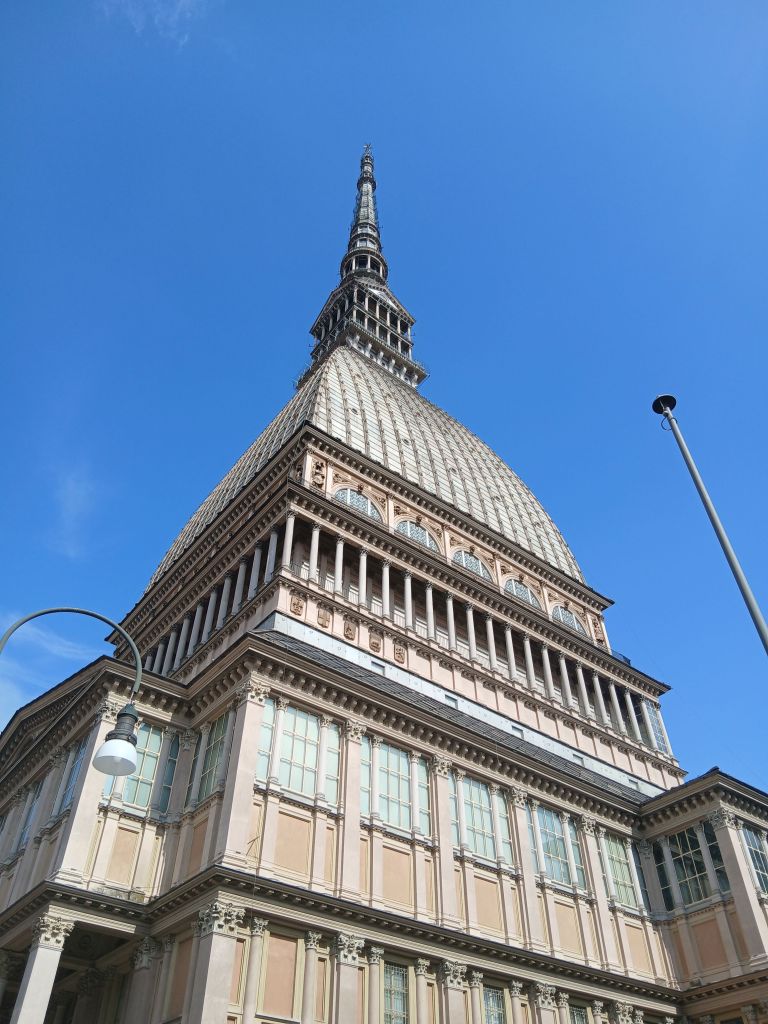
It had been becoming obvious for some time that a dose of Italia was needed, our last visit having been to Bologna, too long ago in 2018. It was tempting to return to a city we like a lot, but in the end, we decided to tread new streets.
Liking to pose pointless philosophical questions to myself, I pondered what is the ‘right’ way to approach a city like Turin. The fourth largest in Italy unsurprisingly has huge numbers of galleries and museums, but I’m afraid that isn’t really why we go. Had the opera season been underway, we might have indulged – but it wasn’t. And as a geographer, I am much more interested in the lived culture and character of the present-day city than paying homage to the dusty stuff in the museums.
In many ways we use ‘Italy’ as a template for our own lives – for approaches to food, clothing, home furnishings – and (when possible) la dolce vita in general. Indeed, for this blog too. But of course, this is all a conceit, even if a harmless (and hopefully even healthy) one, more about our perception of a country than the current state of the real place. Hence the need for a reality-check from time to time.
Thus, we stayed in a self-catering apartment in the centre, albeit furnished in our preferred modern minimalist style rather than anything more traditional. Much of our visit was spent in flânerie, during which we covered most of the central area, enough to gain a sense of the atmosphere of the place, sitting in the bars and cafes (once we had found them), watching the locals. And in this, some of our preconceptions were shaken. Sadly(?) Italy seems to be following the rest of the wealthy world down the same mass-produced anywheresville of high commerce and prepackaged – well – everything.
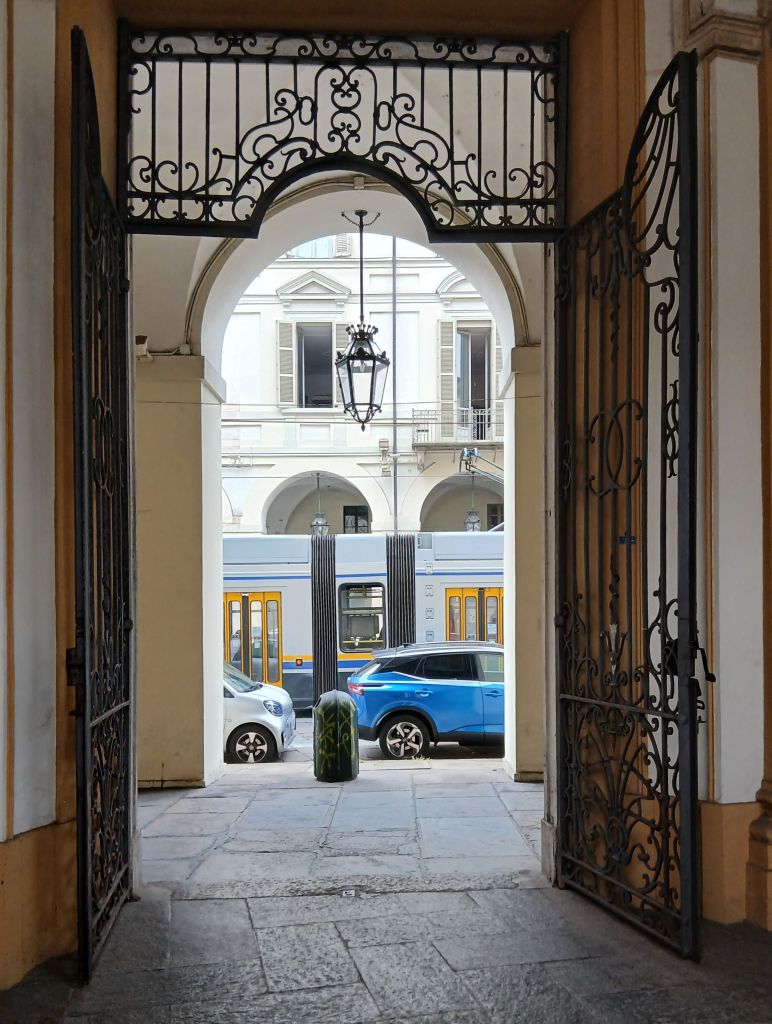
That’s not to say there is nothing worth seeing; far from it. The architecture is grand, the piazzas expansive. The Mole Antonelliana (top) is just ugly. The French and Savoy influences are clearly there, so there is perhaps less of the sheer exuberance of much of the rest of Italy. That we had expected; the globalisation less so.
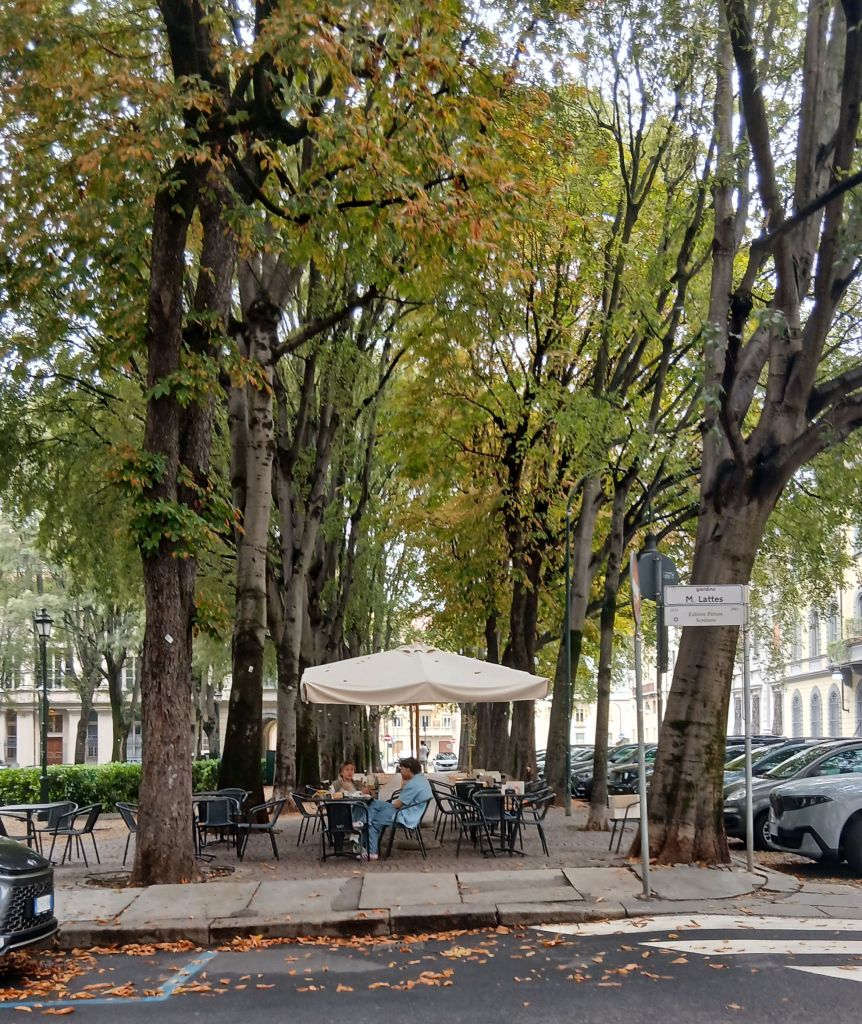
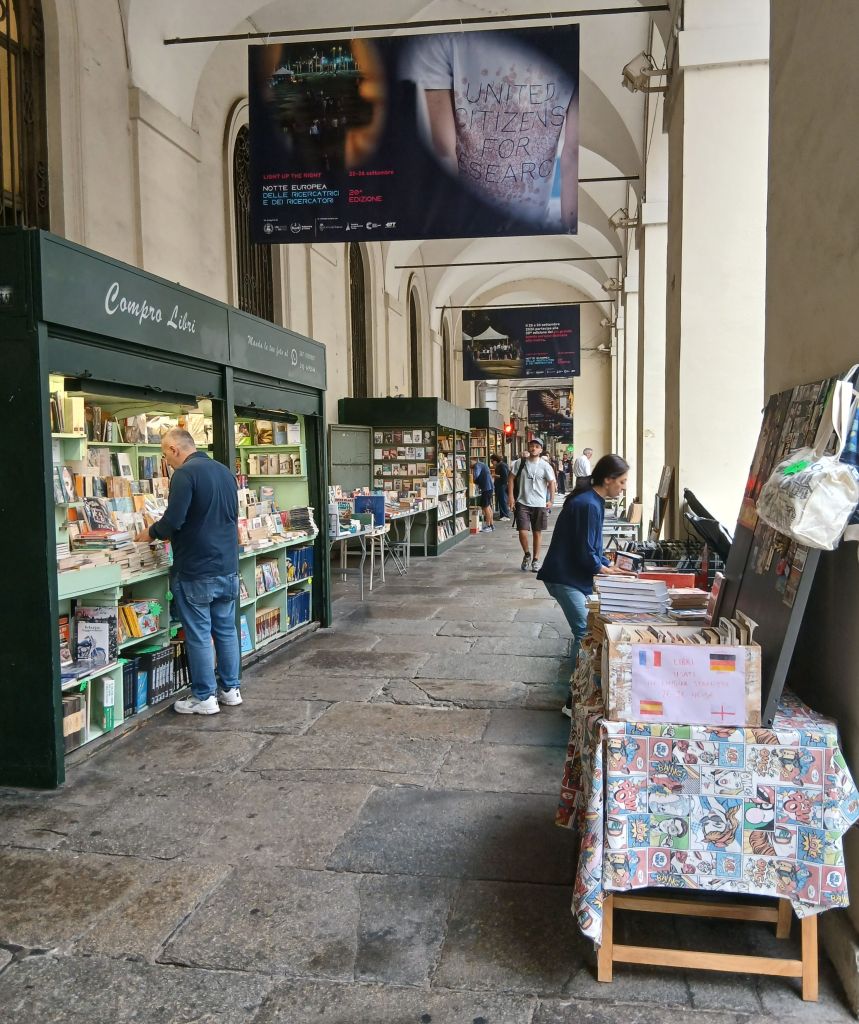
The arcaded streets and many small shops typical of Italian towns are also still there, but the big international brands (of which quite a few, I suppose, are Italian in any case) are certainly making their presence very known, as are fast-food style eateries, many of which now look like chains even when they are not. It was hardly wall-to-wall McDonalds; what seems to be happening is that Italian food is moving with the times and promoting itself in a brasher, more commercial way. Pizzerias are everywhere and seemed to be the food of choice. There are also a lot of focaccerie, also in plenty of cases modelling themselves on fast-food joints, even if the products were completely Italian and far-removed from what you would probably find elsewhere.
But we had to work hard to find anywhere serving traditional pasta dishes, or the traditional primi/secondi/dolci menu. In desperation, on the second night, after trudging much of the centre for somewhere that felt right, we settled for one of the more modern restaurants – and ended up with probably the worst meal we have ever eaten in Italy, from which we quickly fled. Maybe it is reassuring that even Italians can mess up a bowl of spaghetti with poor ingredients and inadequate cooking – but it is disappointing if hitherto universal skills are becoming no longer quite so universal.
It is sometimes difficult to figure out what is going on: another issue was the lack of vegetarian dishes for my wife, not normally a problem in Italy. Is that because Piedmontese food traditionally is meat-heavy? (Yes, to some extent) – or is it more evidence that Italian tastes are changing? The longest queues we saw were outside a new burger bar. This, we should not forget, is the wealthy industrial core of Italy, where more internationalisation is probably to be expected. From recollection, Milan is even more like it.
I suppose this is just the latest evolution of the national style: there is of course no reason why Italy should preserve itself in a picturesque bubble just for the sake of the tourists. The same global forces are at work everywhere, and they are bound to have an impact. I can’t say that I noticed widespread displays of the famed Italian dress-sense either, though to be fair, things picked up a bit on the Monday as the working week began. But for the weekend, jeans, tee-shirts and trainers seemed to rule.
I bought a jacket in the end-of-summer sales, from a branch of a well-recognised and long-established Neapolitan tailor. Perhaps the low price should have been a clue: despite acceptable Italian colour and styling…. Made in China. Still, a frustrating reminder that in their homeland, nicely Italian-styled clothes do not need to cost the fortune they do when purchased in another country. The underlying aesthetic is still there; I could have bought much of the shop. But “authentically Italian”? Not entirely.
To be fair, most people still looked neat – one does not see the downright shabbiness that is the norm of much of the British population, and people still seem to take some pride in grooming well. They also still seem to exercise restraint in the way they behave in public: we saw none of the carnage of evenings in British towns, partly perhaps because people of all generations are still out in the warm September weather.
In some ways, the bus ride from the airport is more informative: this is where you see the city that most of its residents actually inhabit. Outside the centre, large blocks of flats and wide traffic-clogged streets were the norm, and it’s difficult to see whether the local shops and neighbourhood facilities are still there, tucked away out of sight. I hope they are. But Italy too is embracing electric buses, cycleways and multi-way recycling bins. More trees are being planted. Does it still look Italian? Well, yes it does – there is no doubt that a strong national identity is being stamped on all these aspects of modernity. And for all its ancientness, Italy has always embraced the future, albeit of an eccentric kind; perhaps more so than Britain. Another contradiction, since both countries are generally socially conservative – but it is Italy that seems more go-ahead at the moment.
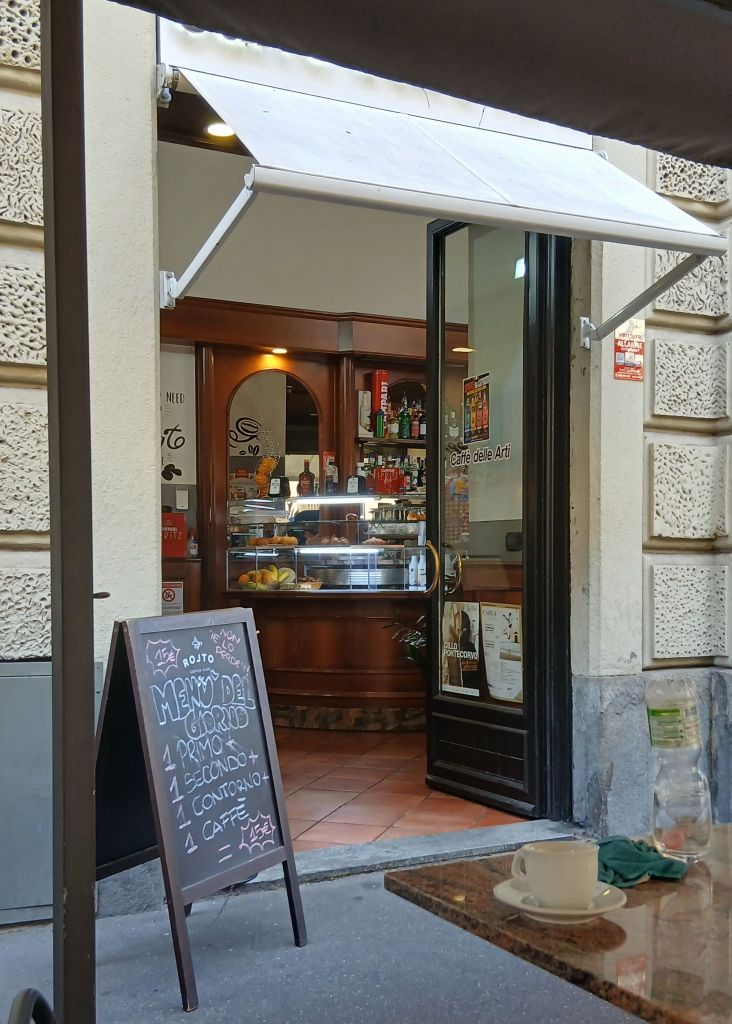
After our dismal meal on the second evening, things improved substantially. I will cover the following day’s trip to Genoa in a separate post, but we also managed to find a small caffè for breakfast, the very epitome of what such a place ‘should’ be, run by an elderly couple and just a short distance from our flat, in a direction that had previously not looked particularly promising. Perfect cappuccino (with a small glass of water) and filled crescante, while the old gents of the district took their espressi standing at the bar, chatting loudly. On our second visit, senora, clearly pleased by our return, brought out some complimentary biscotti….
And just round the corner, also somewhat off the main drag, was the Piazza Carlo Emmanuelle II, which turned out to be a well-patronised dining location, including a restaurant where we had perhaps one of the best meals we have ever eaten in Italy. It can still be done: albeit not at ‘high street’ prices but certainly excellent value compared with the U.K.
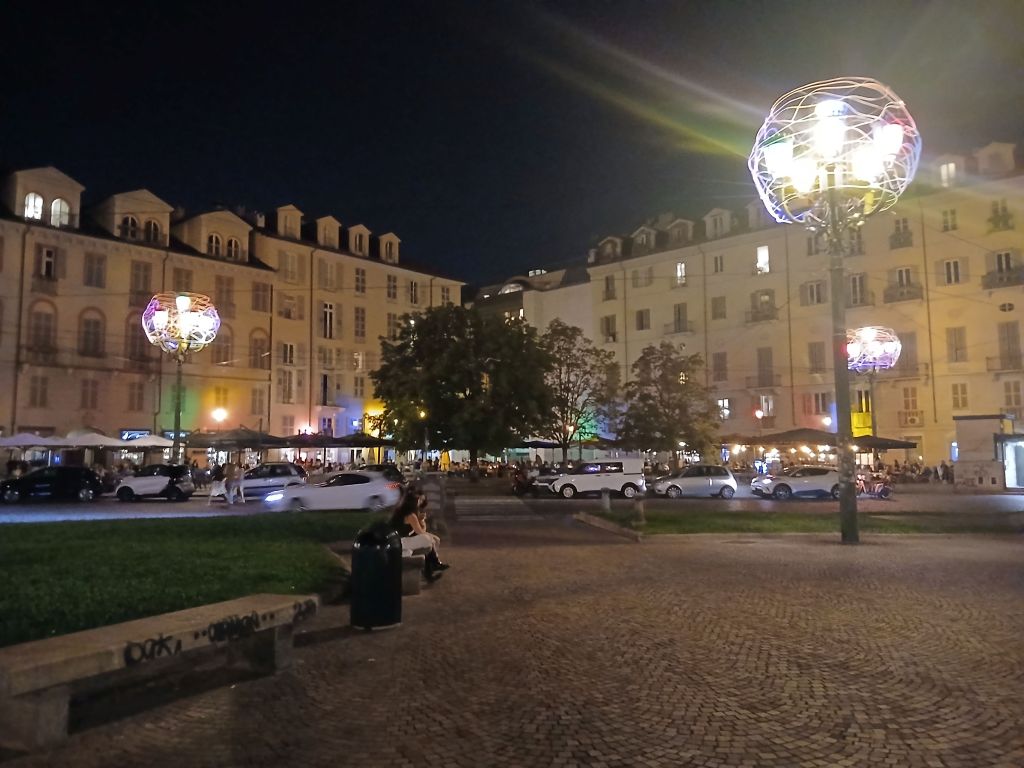
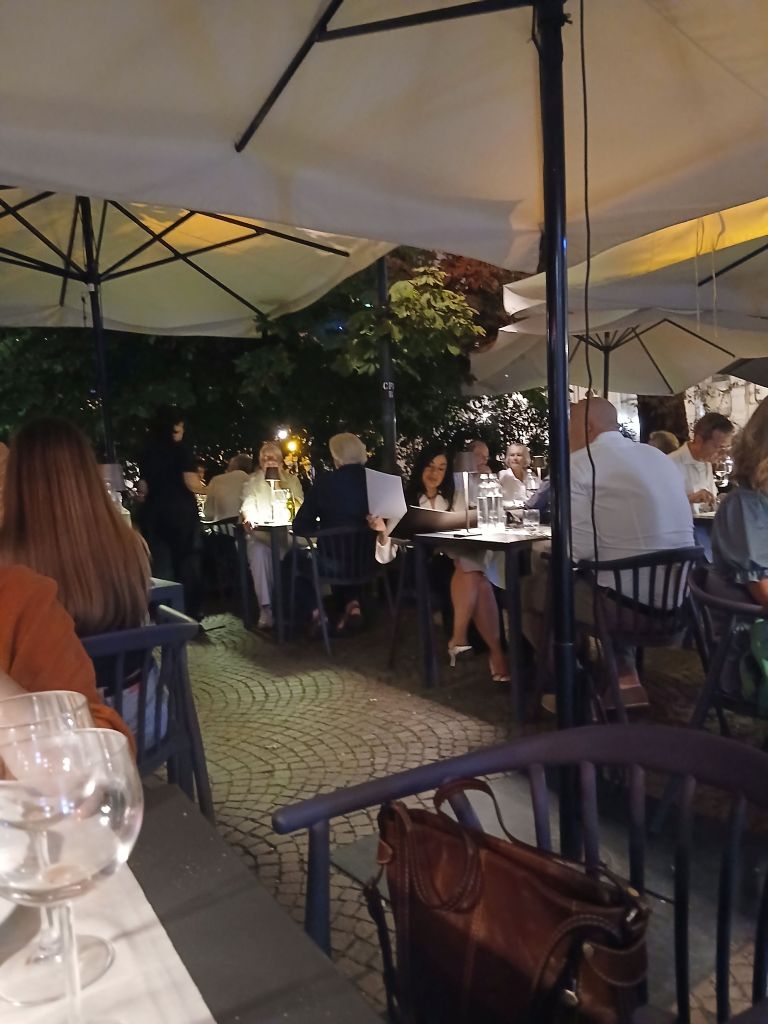
Sunday was spent following up a few remaining areas, including the promenade and park along the Po, which seemed another popular spot for hanging out in the late-summer heat.
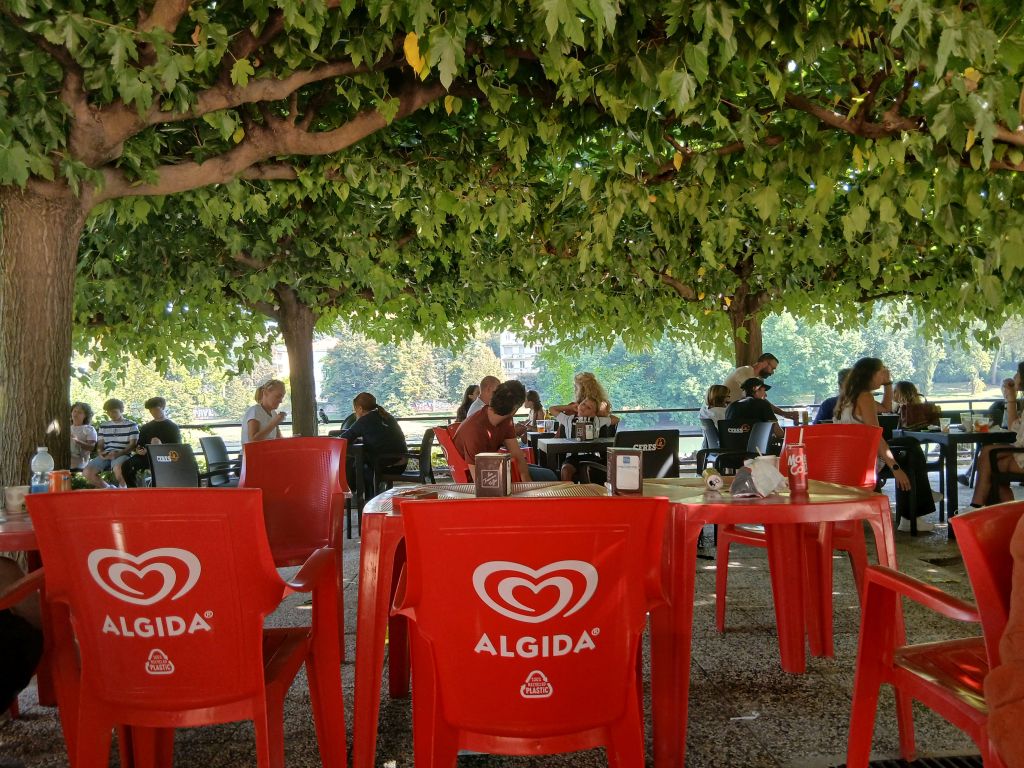
I don’t want to give the impression that Turin is not worth a visit; it certainly is – though it is probably not going to make my must-return-soon list. Part of the reality check involves precisely the process of adjusting one’s impressions to the actuality of the real place. For all our template, we are fully interested in knowing how the real Italy is. Otherwise, it would just be a condescending, picturesque tourist stereotype.
The ways in which traditional cultures are adapting and evolving in the modern era is fascinating. As internationalisation reaches everywhere, some of the old, appealing things are being lost, but others are not. In some ways, it is internationalisation that is adapting instead. There is a strange collision going on between the totally international (including the fact that we can eat better pasta in the U.K. than in a certain restaurant in Turin…) and the still-local. People mostly drive the same cars everywhere. The airport bus was provided by Arriva, a company headquartered in Sunderland. We can pay contactlessly now, and tap in and out on the trains, just as at home. WhatsApp looks just the same on an Italian phone. But I wonder if the conversations are different, still more traditionally Italian.
The quirky trains of my earlier visits now sit rusting in the sidings (as did their predecessors in their time); Trenitalia is now a modern (mostly) reliable operation much like those elsewhere in Europe; indeed, the trains are often the same. On the railways – and everywhere else – almost all announcements and signs are now in English as well as Italian, even if often digitised. Most of the people we interacted with had at least a little English (though we persevered with our limited Italian, as we should…)
I suspect that most Italians are still as sentimental about their country as ever. But they are probably not sentimental about the same Italy as the likes of us, and the hordes of tourists who file dutifully through the historic centres and major museums. A little research provided the thought that (world-wide) most museums are visited more by tourists than by locals. Meanwhile, real life in Italy is in many ways an entirely different thing, probably at least as full of frustrations and contradictions as ever it was. Or maybe that is changing too?
Perhaps more intriguing (and confusing) in Italy than in other places, is the difference between the ‘seen’ country and the social/economic/psychological landscape that in one sense is there in plain sight animating the actions of the locals one encounters and the development of their cities, but still fundamentally invisible to few-day visitors.
It is a major factor to understanding the place, and why even one of the most distinctive countries in Europe may be choosing (or at least allowing itself) to go down the path of internationalisation. For us, being provoked, however uncomfortably, into reflecting on these things hopefully creates a different understanding of the country from following the over-trodden culture-vulture tourist trails.


Hello Ian. Long time and all that. I have not been well since 2021. First Rheumatoid arthritis which is permanent and the last September whilst having a scan for summat else they discovered a small cancer in my right lung. After much further investigation they decided there were no more lumps anywhere and I had a lobe of my right lung removed in February. Now recovered from that but the RA has returned with a vengeance since they had to stop all my pills for a month. I am back to gardening but model making has been curtailed.The granddaughters can still run their trains!Unlikely that I will travel abroad again but your account of Turin is interesting. Julie is going with my daughter in law to see my daughter in DK next month. Girls week.My son Tim went to Gothenburg a few weeks back. He runs the Polestar Owners Ckub and they invited him over.He is now an electric head instead of a petrol head!Take care both.GeorgeSent from Samsung Mobile on O2
LikeLike
Hi George, sorry to hear of your ongoing tribulations. A few of my own here at present, which I could do without.
LikeLike
Sorry to hear you have issues yourself.Any details?The education system has been going downhill since the mid 1980s when the so called National Curriculum came in.Sadly all those with creative ideas were suppressed.Assessment can be measured so we will go with that! Ofsted has ensured that anything else in the human condition is ignored if it cannot be.Ofsted has got out of hand as the political wing. Destroy the teacher if they don’t comply.It has become very difficult to be creative hence the gradual destruction of the Arts in education. They just want idiots who can punch buttons now. Where new ideas will come from I am unsure. We will just stagnate.Now of course we have the great destroyers getting to National level – Trump, Putin, Modi, etc. The top level of “Ofsted”!I really fear for the future of my children and grandchildren.My daughter-in-law has just entered the hallowed profession and is finding a load of little dictators in so called management positions. She is for the moment following their ‘lead’. I don’t recognise much that she talks about, and cannot see how it develops minds. Take care both.Garden calls, and we are having a new garage door and patio door tomorrow so things to move!I still have my garden railway and make occasional entries in the Facebook 16mm garden railway group.I still have my workshop and still us it occasionally. My granddaughters like to run trains when here in the holidays and the occasional weekend. My son is taking me , him and 2 girls to a railway exhibition in Warwick in a couple of weeks whilst Julie and Tim’s wife fly to Denmark to have a girls weekend. My daughter lives in DK and works for a US firm. She has just completed an MA in AI (!) with distinction to continue to be employed.George.Sent from Samsung Mobile on O2
LikeLike