Food

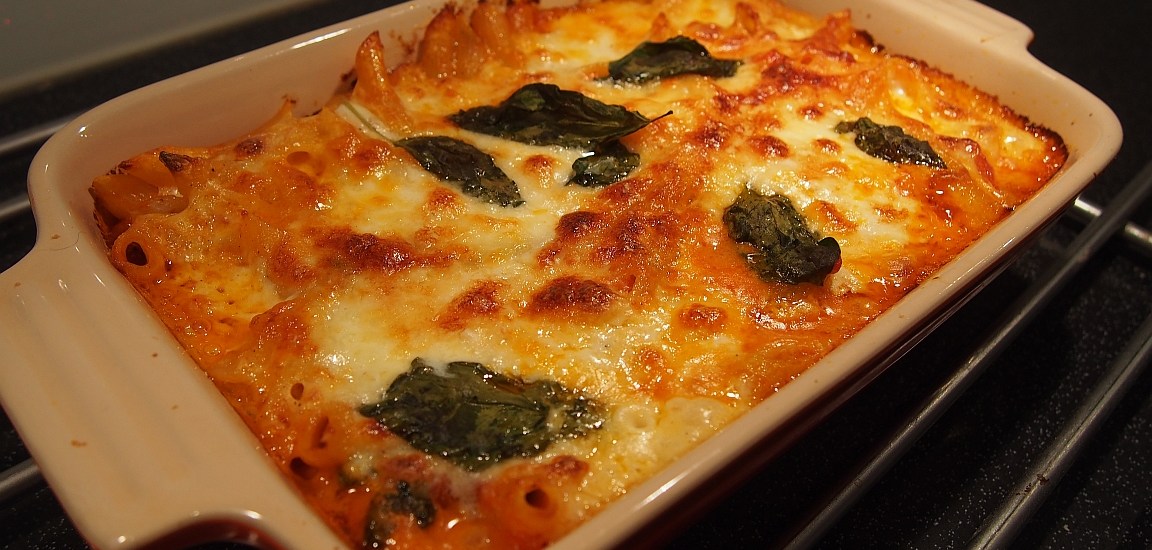
Pasta pomodoro al forno

OLYMPUS DIGITAL CAMERA

The latter part of the summer usually brings a glut of tomatoes, indeed in my humble opinion, it is about the only time in the U.K. when it is worth eating them; I’ve never been a fan of the hard, sharp British or Dutch offerings. This year though, our own crop has unfortunately been written off  by blight which has hit the allotment as a result of the recent damp weather…

So here is a dish that Italians use when tomatoes are so plentiful that they don’t know what to do with them all. It’s not fast food, but it most certainly is comfort food, and is now an established favourite at this time of the year in our household. The dish as described makes two to three generous portions.

I’m not sure what its proper name is, even assuming it has one – so the title is my own suggestion.

Ingredients:

  • Lots of very ripe or even over-ripe tomatoes – at least three or four per person. As always, San Marzano or similar are desirable, but even British tomatoes are usable with a little help (see below).
  • Clove of garlic, finely chopped.
  • A little sugar to judgement – if the tomatoes could be riper.
  • salt and black pepper to taste.
  • Two or three tablespoons of passata – more if the tomatoes are less than fully ripe. Quality makes all the difference – Cirio is the best; the sweetness of the tomatoes is needed for this sauce.
  • Two tbsp olive oil
  • Handful of torn basil leaves
  • Penne pasta at about 50g per person. De Cecco recommended.
  • Butter, milk and plain flour to make a béchamel sauce.
  • One ball mozzarella.
  • Parmesan for grating.

Method:

Pre-heat the oven to about 210°C.

Prepare the tomato sauce. To do this properly, skin and deseed the tomatoes (the former can be done easily by blanching them in boiling water for a couple of minutes, and then peeling). Chop them coarsely. (Tinned tomatoes can probably be used but at the cost of some texture freshness of taste; again Cirio are the best).

Put the oil, passata, sugar, salt, pepper, garlic, tomatoes and torn basil in a saucepan and place on a moderate heat. Simmer gently for perhaps 30 minutes until the sauce starts to reduce. Stick your head over the pan and inhale.

Towards the end of this time, par-boil the pasta – about 8 minutes is about right for 13-minute penne. Drain and mix with the tomato sauce.

While the pasta is cooking, prepare the béchamel sauce – enough will be needed to cover the oven pot being used. This will probably be about 100g butter, 2 tbsp. flour and enough milk to make a fairly loose sauce. Season as necessary.

Drain and chop the mozzarella into bite-sized cubes.

Assemble in an oven-proof dish: first pour in the pasta/tomato mix and spread out. Cover this with a layer of béchamel sauce. Scatter the cubes of mozzarella on top, add a few more basil leaves and grate parmesan cheese liberally over the top.

Cook in the oven for around 20 minutes, or until the top of the dish is nicely browned. It is worth allowing the dish to cool a little after removing from the oven, as the flavours come out better as a result.

OLYMPUS DIGITAL CAMERA

Food, Opinion & Thought, Sartoria

The not-so-bare necessities

I have been looking at some architectural impressions of various new developments. I always find architects’ sketches an attractive source of optimism, a promise of a better future. But notice how the human representations within are always stylishly dressed: people who, one could imagine working in glamorous creative industries or finance.

When these creations get built, many do bear passing resemblance to the designers’ dreams of a corporate Utopia – but those who populate them most definitely don’t look the same. I’ve recently spent time in a few such places: the enormous development that is the Stratford Olympic site for one. For all the lustrous finishes of the Westfield Shopping Centre, for all the stylish shops that occupy it, the majority of the clientele actually sports jeans and T-shirts or branded leesure-wear; stylish they aren’t. Truly well-dressed people are few and far between: one wonders who actually buys the clothes on show in the windows – maybe it’s just foreign tourists? Snobbery might resort to the fact that this is East London – but the same was pretty much true of the Grand Arcade in Cambridge, Chapelfield in Norwich, the Highcross Centre in Leicester, central Manchester and Birmingham, not to mention the glamorous alien that has landed in distinctly humdrum Chelmsford – Bond Street.

Truly stylish people have become almost an extinct species in Britain. It’s not as though we don’t have a time-honoured reputation for sartorial quality – even the Italians have a soft spot for traditional British style, menswear in particular. But who wears it any more, except possibly City bankers and Sloanes in Kensington? And even there, I suspect standards are slipping – the workplace is the last bastion of formal dress in Britain, but  that too is going increasingly casual.

Having done a little delving, there seem to be two issues that might be to blame: long working hours and a Protestant Anglo-American history.

Having recently suspended my own full-time employment, I can well appreciate the effect that it can have on one’s mind; when the attention is fully on the career, there is little mental space or energy left for the other aspects of life, let alone something so supposedly trivial as dressing artfully. And that’s where the second element kicks in: for all our supposed modernity, there remains a stubborn distrust of ‘show’ in British culture. A puritanical understatement is preferred, whether people are aware of it or not. I was inclined to blame America, the source of so many cultural evils, but there actually seems to be more interest with dressing well in the States than there is in Britain, if a quick web-trawl is anything to go by.

In fact, perhaps the mistrust is less spiritual and more societal: traditional British style still has strong associations with Class. People who choose to dress smartly are ‘probably’ either Hooray Henries, Toffs or other upper-class twits, and it isn’t cool to be identified as one of them. Much better to affect the inverted snobbery of wearing extortionately-priced sportswear and bling that make you look as though you’ve come straight from The Bronx.

Or maybe it isn’t even that: I suspect the majority of modern Britain either simply never thinks about how it looks, or doesn’t care, to the point of neglect. A concern for such issues only shows how shallow you are anyway, doesn’t it?

Well, I beg to disagree. True, taking care of one’s self may be unimportant when compared to huge global issues, but if every life is precious, then why waste it through neglect? Effort expended on small niceties adds colour and artistry to everyday life; it has a cumulative effect on the quality of that life and is a sign of self-respect.  I challenge anyone not to feel better if they eat well, live in cared-for surroundings, and take care of their personal standards in general. Conversely, what does it say not to care about these things? That life is trivial, unimportant, not worth taking care with? It may be that your priorities in life lie elsewhere – but somehow I suspect that they actually just took their leave some time ago. I think it was the designer Tom Ford who said that dressing well is a courtesy to others; if he is right, then it cannot say much about one’s care for other people either, to deprive them of that small pleasure.

What is true of clothes is also true of food, standards of speech and conversation and all other aspects of social intercourse. Collectively, these things create a context and tone for social interaction. In Britain, we supposedly had a food revolution. It’s true, the quality on offer has vastly improved, but eating well is still for the special occasion rather than the quotidien, and I suspect that most foodie books and programmes are consumed vicariously. When one listens to what people actually say about their lives, casual junk and supposed convenience seem to reign supreme.

It takes courage to maintain personal standards when everyone around you is dropping theirs, but I suspect there is a sneaking respect for people who do. In the small town where I live, there is one gent, probably in his early seventies, who regularly steps out in tweeds, plus-fours, waistcoats and a natty line in caps. He is clearly untroubled by the fact that he stands out.

But, in a very positive sense, everyone knows who he is.

Food, Opinion & Thought

Chain unchained


caffe-concerto

When living within striking-distance of London was still more novelty than nuisance, I used to travel into the city frequently. A favourite pause came to be the Costa Coffee bar at Liverpool Street Station. It was tucked away almost under the stairs by the entrance to the underground station. It was only small, with a glass frontage and polished granite counter piled high with all sorts of Italian goodies. Mostly, one perched on stools at a high counter in the window; as a place to pause for an espresso, it was just like a snippet of Italy dropped into the station.

Fast-forward three decades, and Costa is of course massive. It was bought from the original Italian family by Whitbread and rolled out ad nauseam across the country. To be fair, the coffee is still pretty good, but the décor was rapidly watered down into something more anodyne and cheaper to mass-produce. What we gained in ubiquity, we lost in style. The food is acceptable, but has again become less distinctive rather international-bland; various types of themed drink that have never been anywhere near Italy have been introduced. It’s pretty much a standard chain now.

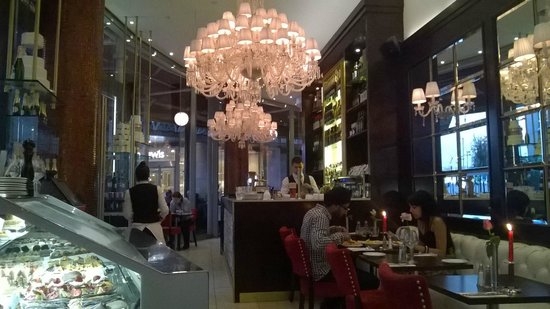
Last Saturday, we travelled to Stratford to meet family who were visiting the World Athletics Championships. Hunting around a packed Westfield Centre, we couldn’t find anywhere to eat that didn’t have an hour’s queue. After running out of ideas, I eventually spotted a cafe that also had the word pasticceria over the door. Hmm: I guess not many chains – or their punters – know what one of those is. Maybe this is worth checking out – and thus we landed in Caffé Concerto.

For a new building, the fitters have done a very passable job of conjuring up a dark-wood and marble Torinese-style interior. The materials seem to be real, and the place felt right. Many of the touches that one would see in Italy, but the average theme restaurant would ignore or filter out, were there. It was no surprise that there had been at least some Italian input into the place; the Maître d’ was clearly Italian, even if most of the other (properly-attired) staff were Easterners. They appeared to have had proper training – or at least they were working somewhere where their likely exposure to proper ‘waitering’ from back home could be applied. All very impressive; and what’s more, despite the queues, there was no hustling people to move on quickly.

As for the food: my expectations always fall when one is given a laminated menu – although to be fair this happens very often on the continent too, these days. The fare was a slightly strange mix of English and Italian, with some notable omissions – no pizzas, and no pannacotta on the desert list. But there was an excellent choice of risotto and pasta dishes, much for veggies, and some correct-looking meat and fish. And one or two give-aways that these people know what they are doing, such as Bellini on the cocktail list.

Sure enough, when the food arrived, it was excellent and clearly prepared by someone who knew what they were doing. I opted somewhat hesitantly for a spaghetti carbonara – risky when unknown, as it can be turned into a solid lump of pasta and congealed cream all too easily. But this was light and in moderate portion, with decent pieces of what looked like hand-cut pancetta giving an excellent smoky-salty hit. My wife’s aubergine rigatone siciliana was equally excellent.

I pined due to the lack of pannacotta on the desert menu, as this is always an acid test of an Italian eatery – but a piece of tiramisu gateau was a reasonable substitute, even if it lacked totally in liqueur content. The follow-up espresso was of a good size, though somewhere up Mont Blanc in terms of strength, not quite fully Italian and missing the accompanying glass of water. But these are minor niggles in what was otherwise a surprisingly good experience. What pleased me too, was the fact that the place felt right.

It was only when I got home that I discovered that Concerto is a chain – at least within the bounds of London, there being about a dozen more dotted around the capital – plus one in Birmingham. But I think it shows that control has been retained by people who know what they are doing, by which I mean serving up a good Italian experience rather than making money for some anonymous venture capital company. My other favourite, Carluccio’s is just about managing the same trick, even though Antonio relinquished day-to-day control some time ago. That said, a look at the website shows the full corporate infrastructure behind the thing. Perhaps it shows that chains do not have to be dumbed down and characterless.

So on the one hand, it would be nice to see Caffé Concerto spreading to places that did not involve hauling into the capital, but on the other, what risk that it would do a Costa, be bought out by big business and turned into a shadow of its former self, whence everyone except the investors lose out? Quite a dilemma.


Food

The taste of summer

OLYMPUS DIGITAL CAMERA

Given the labour of love that is food styling and journalism, I won’t be turning this blog into a cookery course; more likely I will be discussing food-related issues. But some things are too good not to share, and this is one – it has to be one of the simplest pasta dishes of all. I can’t remember where the recipe came from, but it has become a summer staple in our home.

Ingredients:

Two or three ripe tomatoes per person

75g of ricotta per person

50g of conchiglie (pasta shells) per person

Torn basil leaves

Olive oil

Sea salt, pepper, sugar (to taste)

Method:

Cut the tomatoes into bite-sized chunks. Very ripe tomatoes are best, San Marzano if you can get them. If not, season with salt, pepper and possibly a little sugar in order to bring the juice and flavour out. Place in a bowl with several tbsp of olive oil, the seasoning and the torn basil. Leave to marinade as convenient.

Boil water and cook the pasta al dente (usually about 12-13 minutes).

Just before it is ready, add the ricotta to the tomatoes and stir to mix ingredients. Some people prefer the ricotta to remain crumbly; I prefer to mix it until it becomes a sauce.

Drain the pasta and return to the pan. Add the tomato mix, stir and leave for a couple of minutes. The residual heat from the pan is all that is needed to warm the tomatoes and sauce a little. Italian food is rarely served piping hot.

Serve