 ijstock
This is the first of two reviews of two recently-published books on the nature of human thought and behaviour.
An ‘interesting’ little ruck on Facebook recently illustrated very nicely why this is an important book:
Having finished reading it recently the timing could not have been more perfect.
The ruck arose around the ‘Landlord Investment Show’ in London, which was recently invaded and brought to a halt by a tenant organisation called Acorn. A clip of the proceedings was posted by an organisation called TitleSplit, whose strapline reads, “Helping property developers escape a saturated market, while doubling the value of their portfolio.”
Not exactly in keeping with their claim that landlords are a social good.

The presenters appeared totally uncomprehending of the reason for the invasion. The fact that there might have been “reasons” why tenants felt the need to invade a landlord investment show did not appear to register. They went on to explain what a hard life landlords have these days and how it is not fair that they are taxed quite heavily. According to one of the presenters, “if it was not for us landlords, these people would have nowhere to live”.
Awareness of the destructive effect that opportunisitic private landlords, their rent hikes, abstraction of public money, no-fault evictions and buy-to-let activities have had on British social fabric was conspicuously absent; more informative was the barely-suppressed revulsion with which they reacted to the invasion of their show by the tenant group.
A torrent of protest duly landed on the post’s comment thread, together with a few in defence of landlords, along the lines of “that’s just how it is” and “the politics of envy”. Very few of the defenders made a serious attempt to answer the comments of their critics. And thus it has ever been.
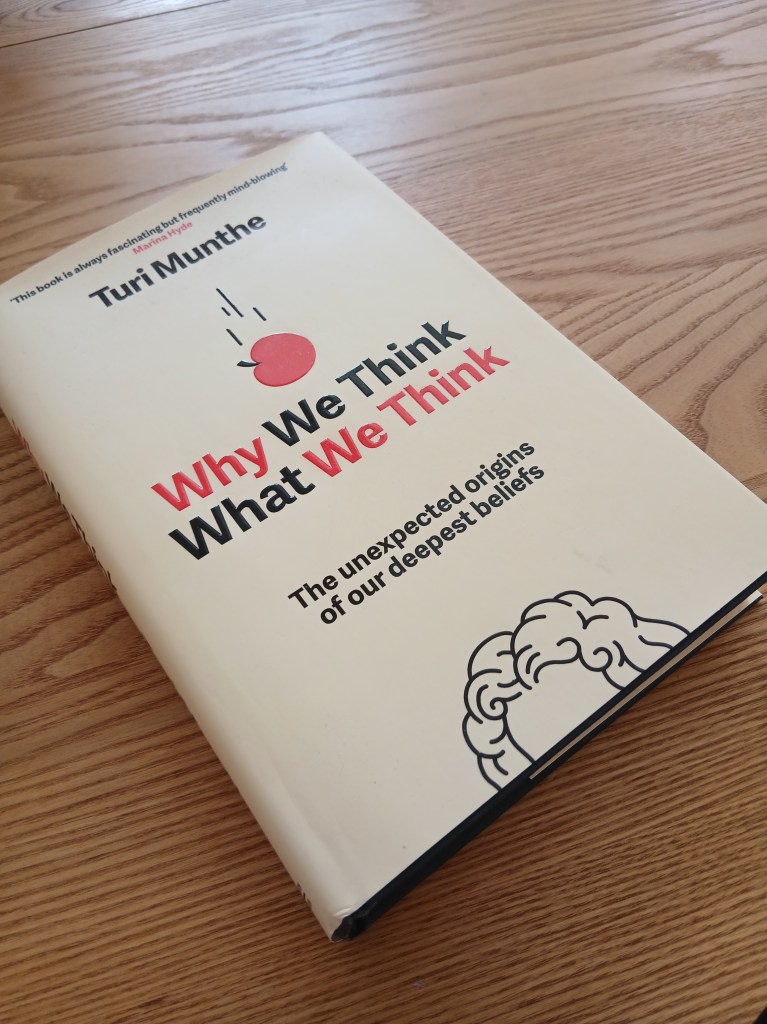
This is why Turi Munthe’s book Why We Think What We Think is important. Munthe has an adequate but not outstanding written style, and the first part of the book duly trots through the possible the reasons why people think what they do; he advances the idea that it is less to do with free will (as we like to think) and more to do with both environmental and social factors that bear on us, even below the level of conscious awareness. There are some interesting nuggets, such as the correlation of county-scale American electoral outcomes and soil types. (Apparently, differing agricultural systems tend to produce varying levels of wellbeing, which in turn influence whether people end up being conservative (because they are secure) or radical (because they are not). And then it transmits down the generations, showing up as spatially-evident electoral anomalies.
Munthe also proposes that physically attractive people politically tend to the Right because they generally are treated better by others and thereby have more stable, successful lives. There is fact, he claims, behind the idea that the Beautiful People tend to be pro-establishment. But they also become more risk-averse because they have more to lose… Hence, those who argue for the status quo tend both to have done better from it but are also more fearful of change; cue their inherent conservatism.
All this is interesting, if only partly convincing. The quality of Munthe’s supporting argument and evidence is a little patchy, and I found myself not always convinced by the too-simple causality being claimed. There is some interesting discussion of the possible influence of genetics on people’s worldview, though he is balanced enough to accept that environment is a very important factor too.
It is in the second part of the book where the real value lies. Having argued that the differences between people and groups may go deeper than we like to think, Munthe goes on to discuss what can be done about it: a very relevant topic given the level of discord in current society. As witnessed by the episode mentioned at the top of this piece, people’s worldviews (and the assumptions behind them) seem to run deeper than they can really control.
In simple terms, Munthe argues that individual human reasoning is not as powerful as we choose to believe; he suggests that confirmation bias shows that individual thought is more a matter of self-justification than a real attempt to arrive at an objective truth. Even as a trained critical thinker, I find myself forced to accept that this is a strong possibility: truly objective thought is an extremely difficult thing. This need not be a problem, so long as we accept that fact, and understand that our worldview is more about justifying and explaining our personal experiences of life than any genuinely objective position.
But most powerfully, Munthe argues that the true strength of human reasoning only comes when one engages in it collectively: that the existence of an implacable opposition is an essential thing for human progress and achievement – be that for the playing of a football match or the process of academic peer review. It is only collectively that humans do their best thinking – and innovating.
He cautions, however, that one should not expect victory – the whole point is the unending tension between implacably opposed worldviews, whose basis may lie deep in our formative and ancestral experiences. He argues that conservatives and progressives do quite literally inhabit somewhat different realities, that it is not possible for one side to be ‘right’ and that in effect, the two groups can’t help themselves.
Munthe says that accepting this reality is probably the best we can do in terms of defusing the increasingly confrontational nature of society. Accepting that we need our opponents – and they need us – and that disagreement is part of a greater purpose – may be the most important contribution of this book. I think it should be recommended reading for all those who engage in culture wars on social media or elsewhere.
Since reading Munthe’s book, I became involved in a local social media discussion about the “threat” presented by groups of men from a nearby asylum-seekers’ accommodation centre. It rapidly became apparent that I was wasting my time trying to advance an alternative to the fearful, right-wing inspired local view. People seemed unable to accept that there even is another perspective on such issues (whether they agreed or not), and sadly they became abusive rather than concede even a politely-argued point contrary to their position.
I don’t know what the solution to such entrenched thinking is: if people can’t even accept that there is a legitimate alternative view, even if they don’t agree with it, then we are in a difficult place. I don’t think social media are the root of the problem; while they undoubtedly make views more public and perhaps more extreme, I suspect the views have actually been there all along, just more privately – in this case, a relatively small, inward-looking community being faced with an influx of outsiders. It’s the same with the double-think between landlords and tenants – particularly the way in which rental property-owners dehumanise the human cost of their activities with talk of “investment opportunities” and “returns on their investments”. Rarely talk of tenants as people, let alone needy ones.
How much can rational thought help address such issues? Maybe not as much as we think – unless we are prepared at least to accept the existence of our opponents, and engage with their thinking. It might help if all sides would read and consider the wisdom of Munthe’s book – but when the definition of balkanised thinking is having a closed mind, I suspect that those who would most benefit from it probably would rather die than do so.

