Sartoria

There is no such thing as a work-shirt.

The Irish, it has to be said, will probably never win prizes for being the best-dressed people in Europe. I think I can say that fairly, coming from the neighbouring country where, these days, the same is certainly true. (To my mind, it is obvious who the runaway winners are…)

To be fair, when in Ireland I tend to head out to the rural west, and it is a good while since I was in central Dublin where a more urbane disposition might perhaps be expected. But as with many aspects of Ireland in the quarter-century that I have been visiting regularly, things have moved apace.

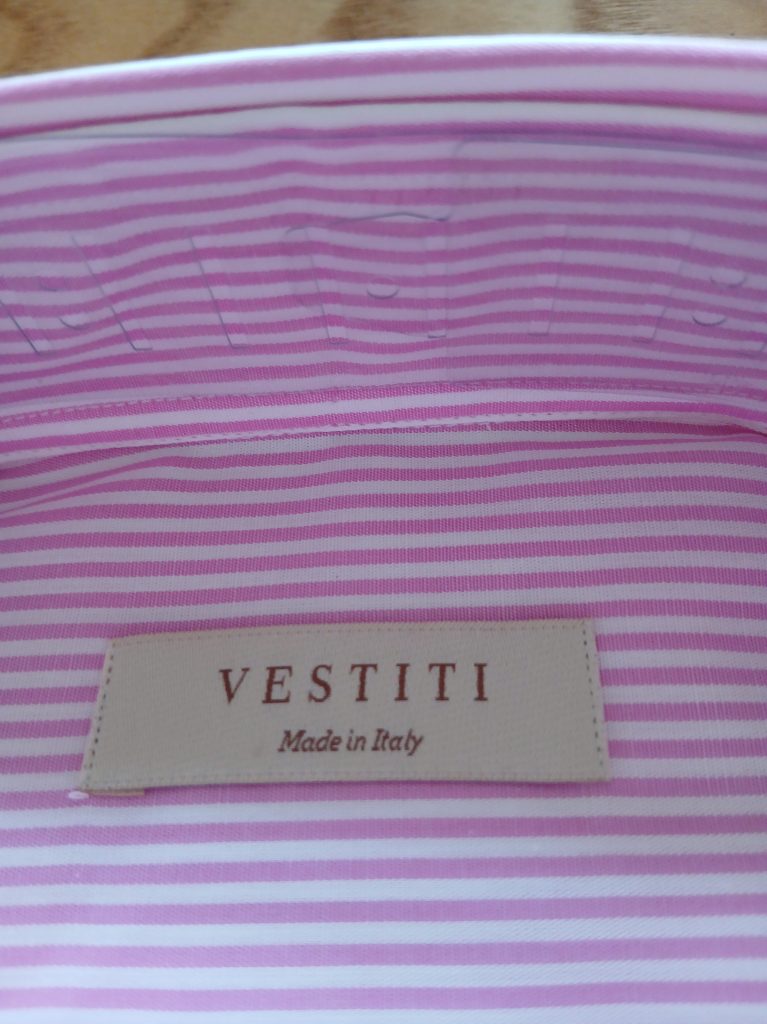
So I hope that the owner of Vestiti will not take affront at the above comments, for he is doing a good bit to bring more elegance to not only his homeland but also the rest of these islands. No surprise, though, that through his wife’s family, Jon Carmody has connections in the Italian clothing industry, and he has been able to source excellent quality shirts for his e-business and his one current connected shop outlet in Dublin.

I happened on Vestiti shirts purely through its social media presence, and it was immediately clear to me that here was excellent tailoring at a reasonable price: hardly cheap but certainly nowhere near the figures being asked for comparable items by the big Italian names. The high thread count is there, as is excellent stitching, and give-away details such as generous tails and the lowest buttonhole being placed horizontally as an anchor.

What’s more, Jon has been able to adapt the cut of his shirts to suit his home market, away from the ultra-slim offerings that have dominated in recent years – but which are of no use whatsoever to those of us who are not ourselves of an ultra-slim cut. But the cutaway collars, which for me are the epitome of Italian shirt style, are still there.

In a sense, I regret the need of those of us who live and dress in other countries to refer back to the “one true source” of really great modern clothing; it ought to be possible for others to develop their own styles too. There have, of course, been designers from other countries, including Britain and Ireland. But I suppose the Italian benchmark is so well established that it is inevitable that that is where we will look, and in my opinion (being just back from Italy) even today, nobody does it better. That said, it is good to see a small entrepreneur taking the inspiration and offering it more widely – and I have remarked before that, for all its negative impacts, e-commerce does allow one to support worthy small businesses without requiring geographical proximity.

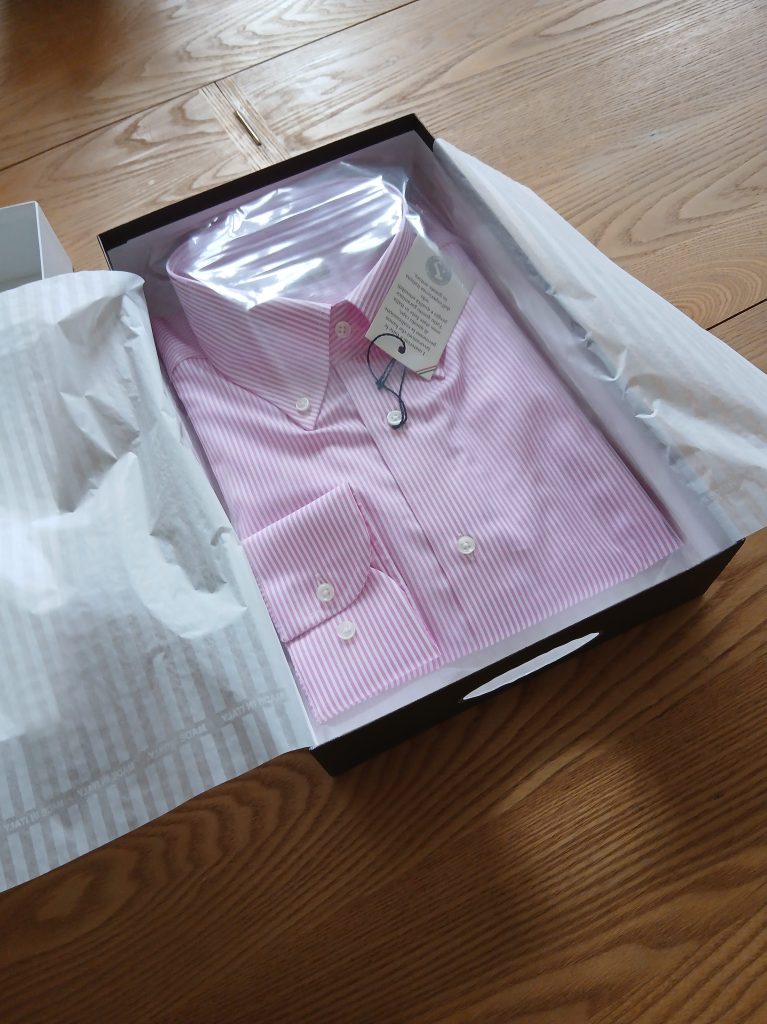
Jon’s business still seems to be developing; his prices have crept up in recent months, but for the quality, they are still competitive.The shirts come well-presented, as one would expect for a high-quality item.
I will close by saying that I have no personal stake in Vestiti; I just so happen to have been one of Jon’s early customers, have had several excellent items from him, and a degree of subsequent correspondence following my feedback. However I am happy to do what I can to support wider knowledge of an excellent small supplier. Having just retired, it might seem I have no great need any longer for “work” shirts. But, as Jon agreed, there are only good and bad shirts, so I shall continue wearing these good ones, even if not in the workplace!

Disclosure: Jon has offered me an ongoing price reduction for personal use, and he is happy to offer a similar 15% reduction for first purchases made as a result of this review.  

The Vestiti website can be found here and the following discount code may be used: SPREZZATURA

This image from Vestiti website.
Opinion & Thought, Sartoria

The Curator

When I was about ten years old, like several of my friends, I had a stamp collection. It proved to be a transient interest, and I never did progress to being a fully-fledged philatelist. Dusty stamps were soon replaced by the collecting of numbers of (equally dusty) 1970s diesel railway locomotives. Even though I didn’t realise it at the time, I witnessed the protracted swansong of traditional steam-era railway infrastructure in the U.K. before it was massively transformed into the modern system we have today.

In their time, locomotive numbers were replaced by LPs, then CDs. The latter collection still exists; I haven’t gone the digital route, in part because my obscure tastes don’t always make it to the big digital download stations, and partly because I still like to have a tangible manifestation of my listening.

All that said, I have never really considered myself an avid collector of anything – if nothing else, I am not a great fan of massive accumulations of stuff, especially non-productive stuff. But somewhere in the mix, it also needs to be acknowledged that the urge to collect does seem to run quite deep in the human psyche. Maybe it is nothing more than a primitive urge to hoard the provisions needed for survival…?

But I feel more at home with the word curation – which, although it has overtones of the rarified atmosphere of fine art connoisseurs, recently seems to have gained wider currency. Perhaps there is something more intentional about curating, rather than simply accumulating that which happens to become available. Maybe the word also implies a sense of restraint, as in knowing when to stop – whereas the only thing to do to remain a collector is to carry on collecting ad infinitum…. Perhaps there is also an overtone of caring for one’s items, which again seems a little more productive than just archiving them.

And so, the word seems to have gained traction for me with respect to three things that, while hardly constituting collections, do seem to have value in the judicious assembly and management thereof:

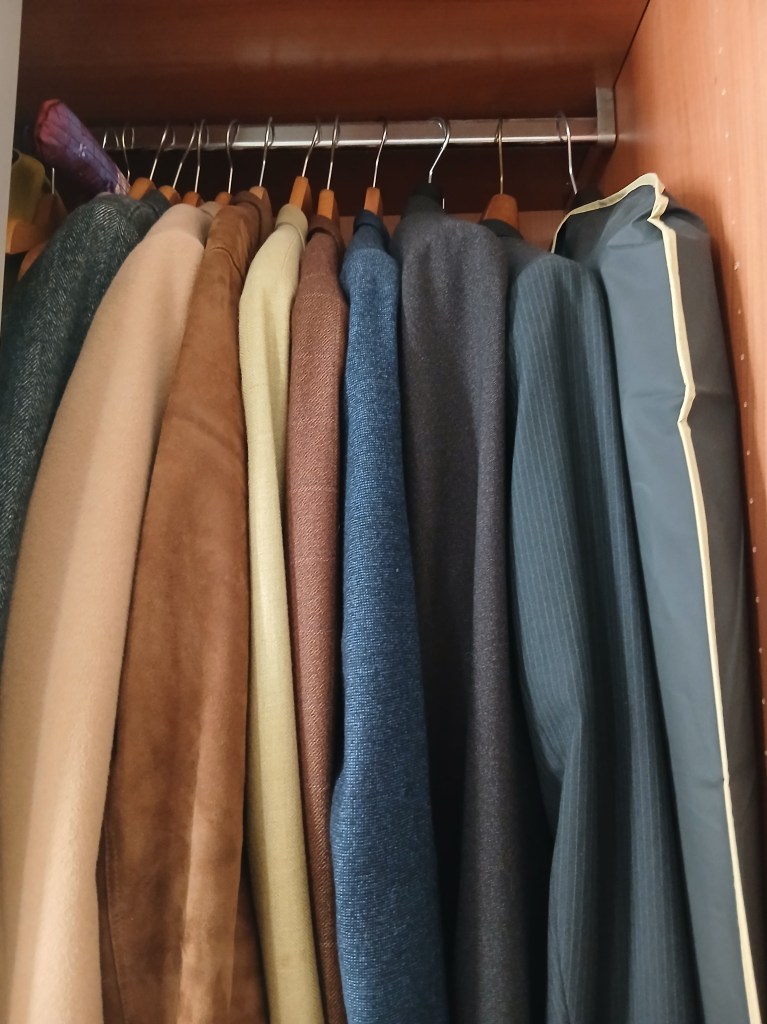
  1. My wardrobe. I recently became aware that classic menswear is apparently having a moment, not that you would know from observing the average British street. I don’t collect clothes in the sense of wanting ever more – but there is something undeniably satisfying about assembling and then maintaining a meaningful and coherent wardrobe. This has become stronger as I have learned more about Italian tailoring which is my preferred style. It is perhaps easier for men, inasmuch as their classic style has a stronger code than the relative freeform of female scene, and thus it is perhaps a little easier to know what is needed. I will admit that opening a wardrobe to find a considered collection of appealing things to wear is very satisfying.  I have even learned to brush my shoes regularly.
  2. Our home. The great thing about modern interior design is its lack of constraint from traditional notions of what an interior requires: no three-piece suites here. There is far more freedom of form and composition possible with modern approaches. I bring the consideration of design to bear on any and everything our home needs: when one appreciates the way that good design can transform even mundane items into things of satisfaction, why would one not? So inadvertently, we seem to have created a small collection of modernist design with pieces from the 1930s to the present represented. People don’t seem to see anything odd in collecting antiques – but doing the same with modern pieces….?
  3. Our art works. That sounds terribly grand, but we are hardly in the league of collecting Picassos. What we have done is amass a small but pleasing selection of contemporary ceramics, mostly from makers in our region of eastern England, but also occasionally further afield. More recently, we have added a couple of original paintings. Viewed collectively, they add great visual richness to the experience of being in our home, to the extent that we sometimes have the pleasant sensation of living in a small art gallery.

None of which adds up to being avid collectors of anything – but somehow, the gentler sense of curating one’s possessions does enhance the process of owning things that we either need, or which more likely, just please us…