 ijstock
Rather better now thank you…
Moving swiftly past the corny jokes, I can at least say therein lies some truth. My previous acquaintance with Genoa was restricted to having driven through – or rather over and under – it, on the coastal autostrada quite a few years ago now, on journeys between Switzerland and Tuscany.
The city is renowned for its constrained location, squeezed between the northern tail of the Apennines where they curl westwards to meet the Savoy Alps, and the Mediterranean. The conurbation stretches for nearly 20 miles along the coast, but apart from tendrils up several valleys, is only a fraction as deep heading inland. Consequently, the autostrada passes directly through the city at rooftop height, before tunnelling under the eastern side in a series of narrow and rather hair-raising tunnels. Not to mention the former Ponte Morandi that fatally collapsed in a storm in 2018. (It looked distinctly dodgy at the times we crossed). But even that brief experience was sufficient for me to be intrigued by this place, and to want to take a better look.
The train ride from Turin is about 1 hour 40 minutes on an Inter-City, more on the more frequent regional trains, and is a journey of two parts. Mostly it traverses the flat western end of the Po Valley, but the last thirty minutes is more interesting, as the train climbs through the same mountains that constrict the city. Indeed, one sees relatively little of the immediate city approaches, as the line is in a tunnel that only ends a little short of the platform ends where it joins the coastal route coming in from Monaco and Nice. Much of the railway, too, passes under the city in more tunnels.
Having found Turin less ‘Italian’ than we expected, it became rapidly apparent that Genoa is the opposite. Even the name of the main station – Genova Piazza Principe – trips off the tongue like good Italian should. Having a south-facing microclimate giving onto the sea, and the vitality of a port city on the shimmering Med, albeit by way of a vast port complex, certainly helps. Genoa is full-on.
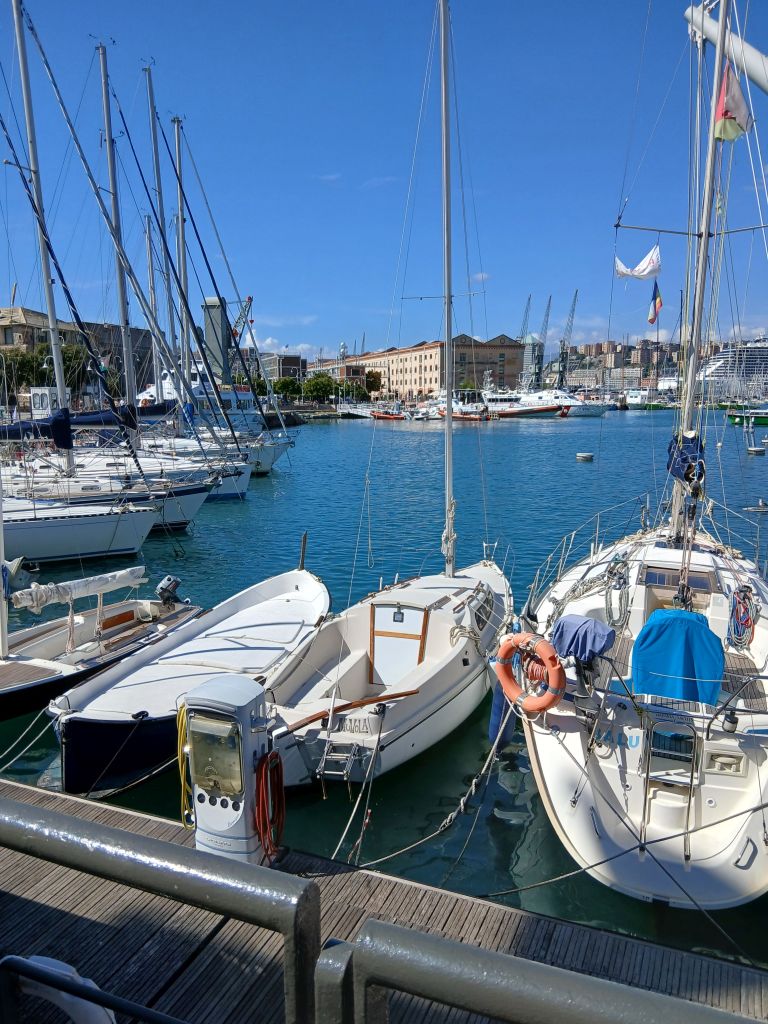
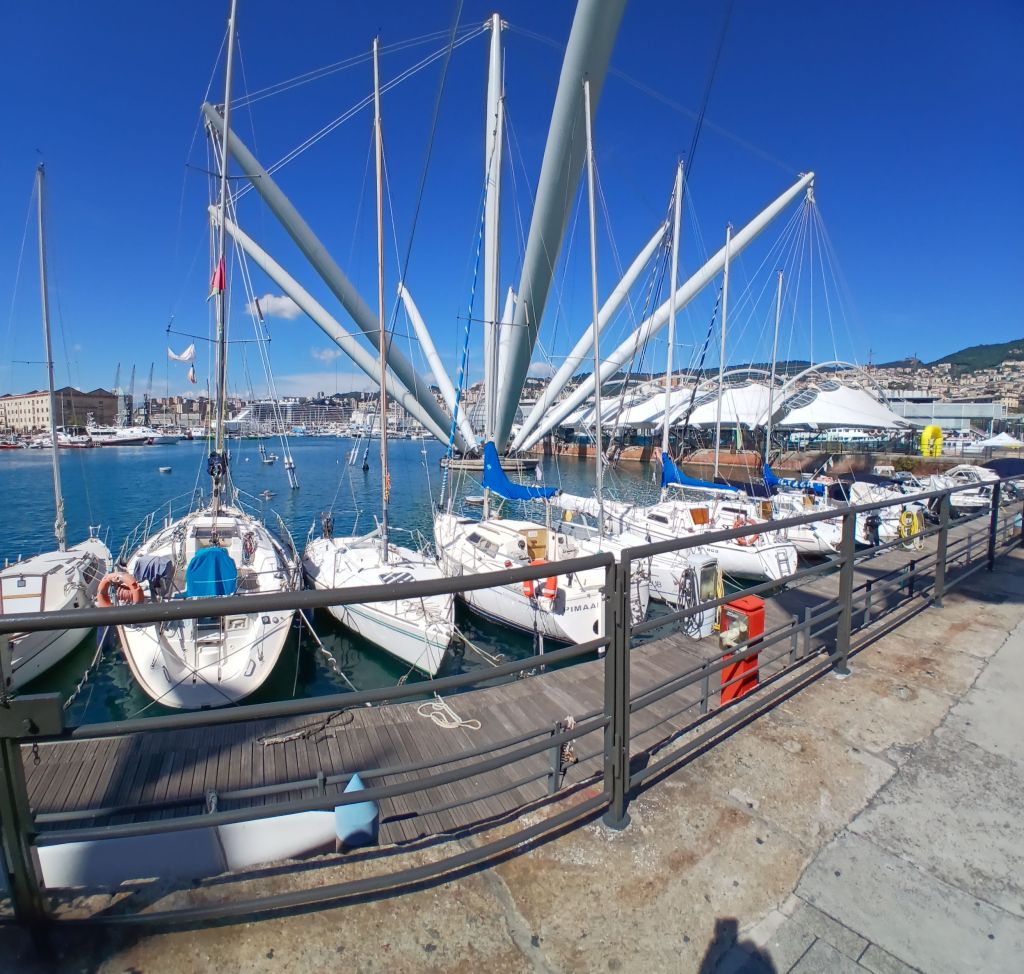
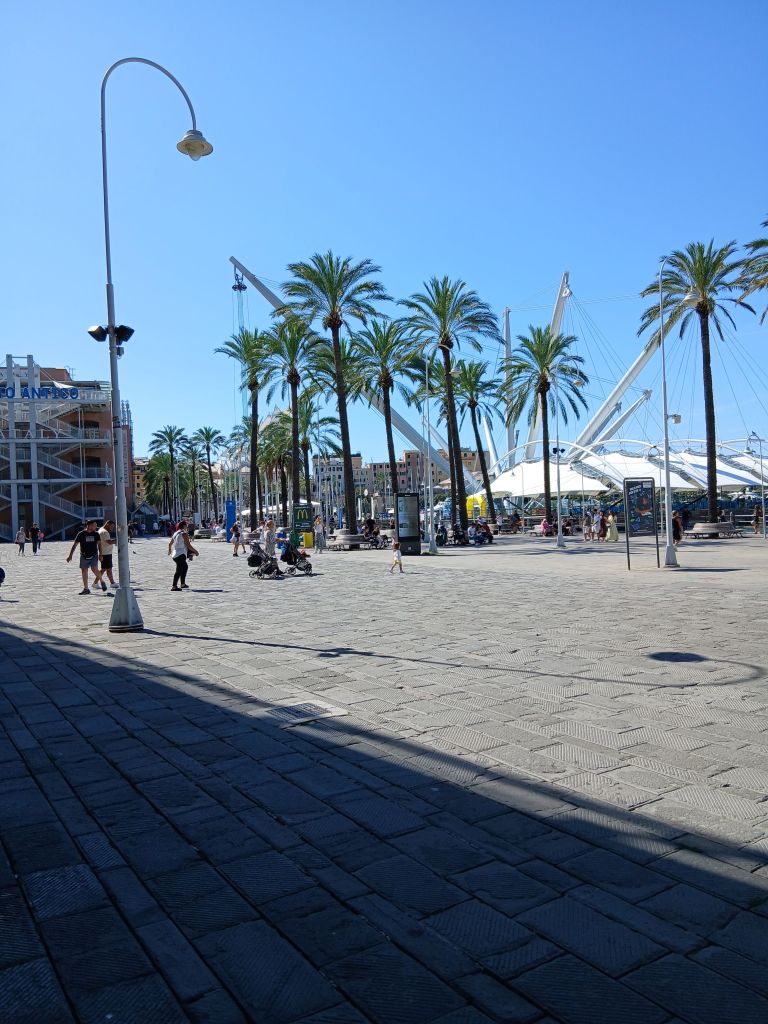
We headed for the old port, an area that has been renovated by a well-known son of the city, architect Renzo Piano. As in many similar places, old warehouses are now flats, shops and cafes, the freighters replaced with yachts and cruisers. There is a large aquarium and high-level viewing platform up to which one can be hoisted. And lots of imported palm trees. Even here, there is an elevated roadway which adds a lot of noise but at least keeps the traffic out of the way. The modern port is visible in the distance, with some truly immense cruise ships docked – which may have explained the noticeable frequency of American voices. And it was blissfully warm – the middle of September, but still in the low thirties.
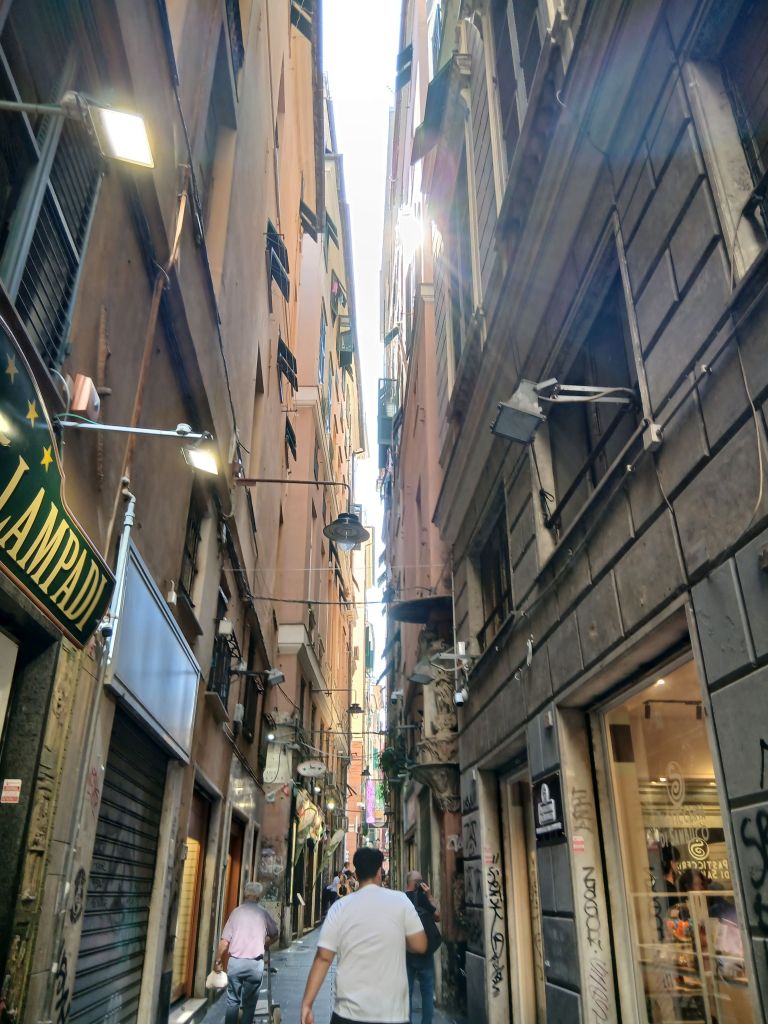
Having had a somewhat nail-biting experience of Naples many years ago, I was wondering whether this northern port-city might feel equally alarming. But it did not (and to be fair, maybe Naples has moved on in the meantime too?). Everywhere we saw felt safe and well-maintained. The narrow and dark vici leading away from the waterside are home to gift shops and restaurants as well as the expected mix of food, clothes and other more indeterminate small retail premises.
We took the little tourist train because of the heat – given our shortage of time, these forty-five minutes served as a helpful orientation aid in this hilly, sometimes almost vertical city. Otherwise climbing seems obligatory; staying on a level route risks missing a lot of what there is to see.
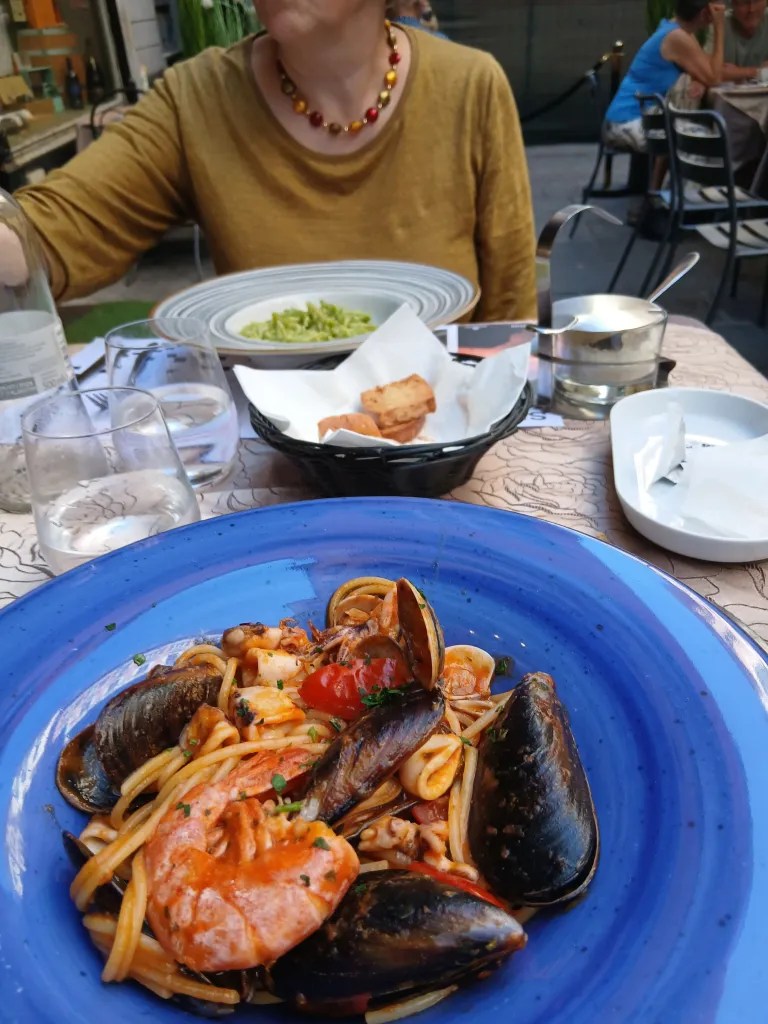
We followed up with a walked transect of the city centre, interrupted by the lunch that we had struggled to find in Turin. Trofie alla Genovese was on the menu, of course, while I opted for the most magnificent spaghetti alla marinara – as only ultra-fresh seafood can be.
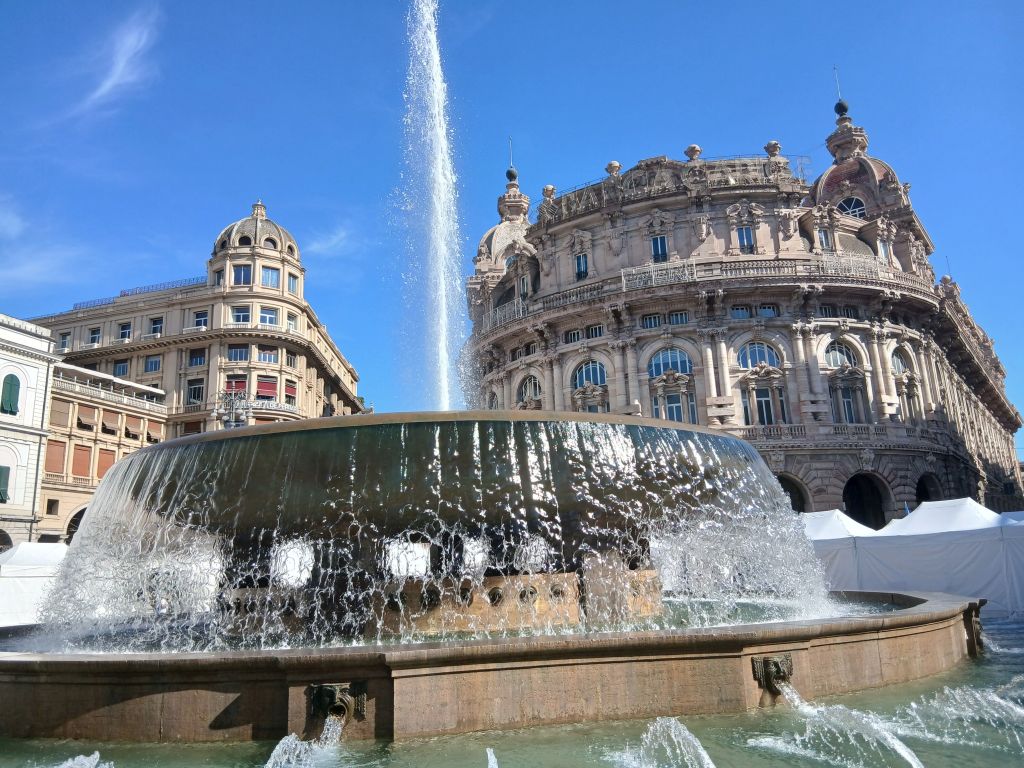
The city is loud, traffic-heavy and bustling. No doubt the effect is amplified by the topography and the high buildings. But the architecture is glorious; Genoa’s past trading wealth is amply displayed to this day in its grand buildings and piazze. Parts are a UNESCO World Heritage site. One can still visit Christopher Columbus’ house. The Piazza dei Ferrari, the centre of the city, was occupied by a market of French regional produce, well patronised though perhaps a little surprising given the strength of Liguria’s own regional specialities. I suppose people always like novelty.
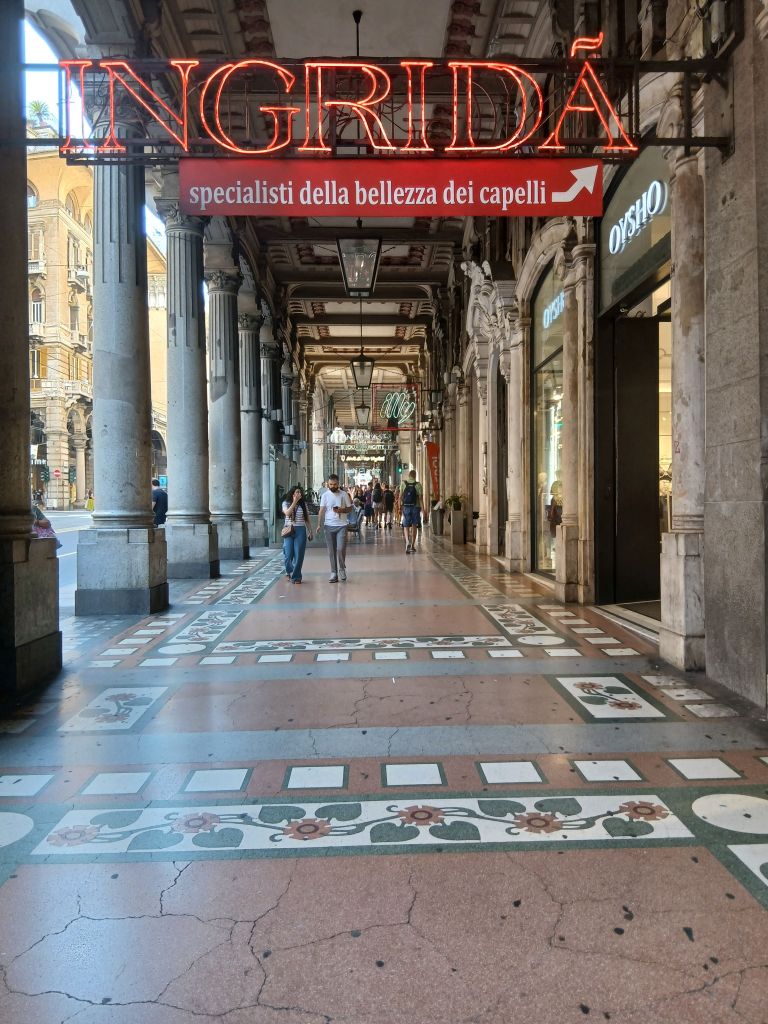
We walked on, down the Via Venti Settembre which is dramatically arcaded, adding wonderful atmosphere and which permits a little shade from the sun. Then through a bric-a-brac market equal to any in France. I still don’t understand why people want to buy other people’s twt…… I suppose some of it has some character, if you are of a certain nostalgic Baroque disposition. More of interest was finding a gelateria, this being one thing thus-far absent from our short holiday. Mission accomplished, we sat in the small Piazza Colombo appreciating the late-afternoon full-on Italian-ness of the place.
Nearly out of time, we headed for Brignole railway station and the train back to Turin.
Too short a time in this place. Having planned a trip to Turin with a day in Genoa, next time it will probably be the other way round; Turin was nice enough, but it was Genoa that fired the soul. So yes, we do know Genoa rather better now – but there is still more to do.

