Food, Opinion & Thought

Chain unchained


caffe-concerto

When living within striking-distance of London was still more novelty than nuisance, I used to travel into the city frequently. A favourite pause came to be the Costa Coffee bar at Liverpool Street Station. It was tucked away almost under the stairs by the entrance to the underground station. It was only small, with a glass frontage and polished granite counter piled high with all sorts of Italian goodies. Mostly, one perched on stools at a high counter in the window; as a place to pause for an espresso, it was just like a snippet of Italy dropped into the station.

Fast-forward three decades, and Costa is of course massive. It was bought from the original Italian family by Whitbread and rolled out ad nauseam across the country. To be fair, the coffee is still pretty good, but the décor was rapidly watered down into something more anodyne and cheaper to mass-produce. What we gained in ubiquity, we lost in style. The food is acceptable, but has again become less distinctive rather international-bland; various types of themed drink that have never been anywhere near Italy have been introduced. It’s pretty much a standard chain now.

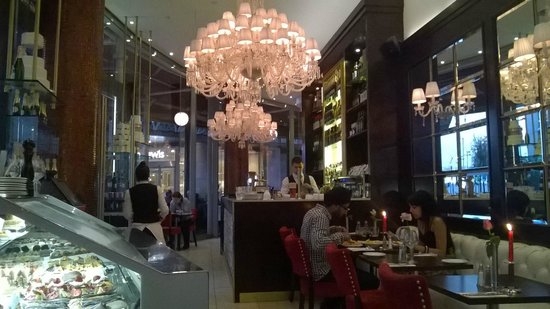
Last Saturday, we travelled to Stratford to meet family who were visiting the World Athletics Championships. Hunting around a packed Westfield Centre, we couldn’t find anywhere to eat that didn’t have an hour’s queue. After running out of ideas, I eventually spotted a cafe that also had the word pasticceria over the door. Hmm: I guess not many chains – or their punters – know what one of those is. Maybe this is worth checking out – and thus we landed in Caffé Concerto.

For a new building, the fitters have done a very passable job of conjuring up a dark-wood and marble Torinese-style interior. The materials seem to be real, and the place felt right. Many of the touches that one would see in Italy, but the average theme restaurant would ignore or filter out, were there. It was no surprise that there had been at least some Italian input into the place; the Maître d’ was clearly Italian, even if most of the other (properly-attired) staff were Easterners. They appeared to have had proper training – or at least they were working somewhere where their likely exposure to proper ‘waitering’ from back home could be applied. All very impressive; and what’s more, despite the queues, there was no hustling people to move on quickly.

As for the food: my expectations always fall when one is given a laminated menu – although to be fair this happens very often on the continent too, these days. The fare was a slightly strange mix of English and Italian, with some notable omissions – no pizzas, and no pannacotta on the desert list. But there was an excellent choice of risotto and pasta dishes, much for veggies, and some correct-looking meat and fish. And one or two give-aways that these people know what they are doing, such as Bellini on the cocktail list.

Sure enough, when the food arrived, it was excellent and clearly prepared by someone who knew what they were doing. I opted somewhat hesitantly for a spaghetti carbonara – risky when unknown, as it can be turned into a solid lump of pasta and congealed cream all too easily. But this was light and in moderate portion, with decent pieces of what looked like hand-cut pancetta giving an excellent smoky-salty hit. My wife’s aubergine rigatone siciliana was equally excellent.

I pined due to the lack of pannacotta on the desert menu, as this is always an acid test of an Italian eatery – but a piece of tiramisu gateau was a reasonable substitute, even if it lacked totally in liqueur content. The follow-up espresso was of a good size, though somewhere up Mont Blanc in terms of strength, not quite fully Italian and missing the accompanying glass of water. But these are minor niggles in what was otherwise a surprisingly good experience. What pleased me too, was the fact that the place felt right.

It was only when I got home that I discovered that Concerto is a chain – at least within the bounds of London, there being about a dozen more dotted around the capital – plus one in Birmingham. But I think it shows that control has been retained by people who know what they are doing, by which I mean serving up a good Italian experience rather than making money for some anonymous venture capital company. My other favourite, Carluccio’s is just about managing the same trick, even though Antonio relinquished day-to-day control some time ago. That said, a look at the website shows the full corporate infrastructure behind the thing. Perhaps it shows that chains do not have to be dumbed down and characterless.

So on the one hand, it would be nice to see Caffé Concerto spreading to places that did not involve hauling into the capital, but on the other, what risk that it would do a Costa, be bought out by big business and turned into a shadow of its former self, whence everyone except the investors lose out? Quite a dilemma.


Opinion & Thought, Sartoria

Chasing the wrong rainbow

When your professional life takes as its raw material human beings themselves, it is difficult not to become curious about what makes them tick: why some people take one course while others take a different one, why some people respond well to a particular stimulus while others do the opposite. Then there is the whole issue of what constitutes ‘success’ in life – something the education world is almost obsessed with.

I don’t intend to delve into nature versus nurture here, but the choices individuals make do seem to be governed in part by the prevalent cultures within which they live. When I ran a partnership with a school in Switzerland, the differences were pronounced: before pairing students up, I used to ask for a written self-portrait from each participant. Year upon year, it was remarkable how the Swiss came back with long lists of favourite authors, musical instruments played, sports and hobbies pursued, languages spoken and more – while many of my own British students struggled to write much at all, even when prompted. Shopping and ‘socialising’ were the main two; there were exceptions on both sides, of course – but the pattern was too marked over too many years to be mere chance.

Long acquaintance with both countries does suggest that this reflects a wider pattern: it’s hard to substantiate such things, but my lasting impression is that the Swiss lead active lives, wherein they themselves are the main instigator of their chosen path, whereas the typical Briton is more passive and herd-like, perhaps feeling less able to assert their own direction and individuality, and more content for (and dependent on) third parties to provide the stuff of life.

The reasons for this are too complex to explore in depth here, but I suspect that they go well beyond the respective wealth (and therefore means) of the countries concerned; perhaps British passivity is rooted in history, in a strongly hierarchical society where people knew their often-suppressed place, and have never really shaken it off. The Swiss, by contrast, have a strongly egalitarian streak, and despite the immense wealth of some people in that country, it rarely seems to express itself in the kind of (anti)social snobberies that are rife in Britain.

This concerns me especially at the moment, given the current flux in relations between Britain and the continent. My own hopes of European union were always primarily cultural – but it seems that, as a nation, we really haven’t learned very much from our close relations with our neighbours – and now it appears we are about to pull up the drawbridge again.

What has always inspired me most about the continent might be summed up in its relative resistance to the ultra-liberalism of the Anglo-Saxon economic model, where just about everything in life is becomes a commercial opportunity to be exploited – and much thereby loses its authenticity. Ironically, this comes out strongly in the respective ways of life: unlike the British, there does not seem to be the same chasing of material status Switzerland, though that is absolutely not to suggest they don’t appreciate substance; things are appreciated for their quality and style, not their trendiness, branding or opportunity to flash ostentatious wealth. People seem to be less taken in by commercial manipulation, in the way one sees plenty of people in the U.K. spending their cash on armfuls of ephemeral trendiness irrespective of the fact that the quality may be poor.

It seems to me that in their rush to prove (mostly to themselves) that they are not the poor relations, many Britons fail to appreciate the things – material and otherwise – that really add up to a good life. I will develop this idea in another post in due course – but as a culture we often scoff at the things that really can improve one’s quality of life while expending huge effort on doomed attempts to be cool or trendy. The main reason is this: we don’t seem to realise that a well-lived life comes from self-respect and self-knowledge, not from the contents of your shopping bags.


Opinion & Thought, Politics and current affairs, Travel

Missed again – or why Britain’s public transport lags behind its neighbours’

657_Electrification_of_Ardwick_Depot__Stabling_and_fuelling_roads_from_eastern_end_looking_west

In 2012, the government announced the largest investment in railway electrification since the 1970s.  Lines to Bristol and South Wales, Sheffield and the East Midlands, and across the Pennines between Manchester and Leeds, and from Southampton to the Midlands were all due to be wired. We were told that it would bring journey savings, efficiency gains, environmental gains, removal of freight from the roads, and more – all of which in technical terms is true.

Last week, the same party scrapped most of the schemes due to cost over-runs on the one that has actually got underway between London and Bristol. We are now told we don’t need electric trains and the ‘visual intrusion’ they bring. They can’t both be right.

Why does this county so often fail in matters of national investment? By comparison, virtually all of the French, German and Italian main line networks have been electric for decades – and in Switzerland the coverage is 100% – even down to rural branch lines. Then there is the money that has already been wasted raising bridges and tunnels for wires that will not now appear, and designs for trains whose performance will be compromised from the start by the need to carry round heavy diesel engines.

What the government never admits is that the problem here is of its own making: by privatising the railways, a great deal of technical expertise has been lost: private franchise holders are not interested in this kind of long-term investment, and much of the skill-base that was present under British Rail was simply pensioned off. Replacement expertise can be, and has been bought in – at a cost. The new infrastructure was developed in Switzerland – but as with all private ventures, the costs of the profit motive, delay compensation and legal complexity ratchet up overall costs and have resulted in a huge cost-overrun on the Great Western scheme even before it is finished.

The other unspoken matter, I suspect, is the imminent loss of EU moneys that would have funded some of the work under the Trans-European Network programme and for instance, the follow-on electrification of suburban lines in the Welsh Valleys, which will presumably not now happen either. In the past few years, schemes in this country have been funded to the tune of €43 million by the E.U. Also note that it is the provinces that are going to lose out yet again – I wonder whether the same decision would have been taken for London’s network. The graph below shows per capita investment by English region in public transport in 2016. It makes salutary viewing in that respect.

transport spending

A  fast, modern and efficient rail network is an essential piece of infrastructure for any nation, but yet again our masters have failed to grasp the opportunity to make a radical step forward – a valuable scheme torpedoed by short-term political expediency. Once more, this country is failing to deliver something than many of our neighbours have had for decades, and which will be all the more necessary to allow the British economy to compete when or if Brexit occurs. The contrast is notable between the fanfare with which the programme was launched and the way it was unceremoniously buried on the last day before the parliamentary recess: standard procedure for failed policies. Yet again, our sclerotic, indecisive political system will have wasted money planning but then failing to  deliver what a few years it told us we urgently needed.


Opinion & Thought, Politics and current affairs

The Long Game

May
photo: http://www.theguardian.com

I wonder how History will judge this period in the story of the British nation(s). Living through it, the predominant impression is of directionless chaos, with all the usual certainties about the State we live in suspended, not least that unspoken national belief that disasters happen elsewhere.

Having encountered grass-roots continentals on an annual basis for the last couple of decades, it has only reinforced my view that by comparison there are some very ugly, uncivilised characters in Britain. We’re not the only ones of course: there is a segment of German society which is pretty brutal too, and no doubt most countries have their equivalent – otherwise we would not have seen the rise in far-Right support that we have. How do you respond to such threats?

When Theresa May became Prime Minister, I suspect like many, was prepared to give her space, if only because the alternatives were worse. Despite her secretive and authoritarian instincts, she is no fool, and at least projected the right image. It doesn’t need me to describe what has happened since.

But I wonder whether History may still judge her more kindly than we currently suspect. When I was teaching, I sometimes used a form of reverse psychology with difficult pupils. If one creates what is admittedly an illusion between the consequences of two courses of action, it is possible to deflect people from self-destruction without a loss of face. It uses a classic cognitive flaw where people fall for a false dichotomy.

I find it hard to understand May’s trajectory on Brexit without recourse to one of two explanations: either she was a closet Brexiteer all along, and she simply kept her powder dry during the referendum campaign – which is disingenuous enough that if true, she deserves to lose her position on the strength of it alone; or she is playing the same cognitive flaw with the nation. Realising the democratic impasse created by the referendum result, could she be giving the nation a taste of the consequences that it will face if hard Brexit goes ahead, in the hope that enough people will recoil before it actually comes to pass, that a rethink becomes possible? Why else would she still be playing hard-ball? It is like my teacher-strategy of outlining consequences to a difficult pupil and then asking, “Do you REALLY want to go down that path? Are you SURE?”

Meanwhile, prominent characters on the EU side seem to be doing as much as they can to leave the door open for Britain. Their motives may be less than pure, of course – but my admittedly-biased impression is that they are showing a concern for the people of this country that many do not show for themselves, and nor indeed do their national leaders. Will they yet save us from ourselves?

The current debate in Britain is not just the one that should have happened before the Referendum, but the one that should have been happening for the last forty years. But maybe at last, the British are starting to realise what the European project is really about.

Events in the interim have clearly not gone to plan for May – but there are some signs that public opinion is indeed beginning to shift about what outcome it prefers. Maybe the brinksmanship is starting to have an impact. There’s a long way to go, and I offer this theory without much confidence that it holds water.

But if it turns out to be correct, May could still go down in history as one of our most courageous Prime Ministers after all.


Opinion & Thought

Death by management

I’ve been dabbling on the fringes of local democracy. The small town where I live is noted for its outstanding heritage and excellent quality of life, but like many such places, it presently faces multiple challenges from various forms of development that are closing in. In the case of housing, the big builders frequently target such places because homes sell quickly there for a premium. But in the process, they very often ruin what was attractive in the first place.

Neighbourhood plans were a political initiative to give at least a semblance of local self-determination – it depends on how cynical you want to be. But my impression is that these activities are suffering from the same malaise that seems to afflict all of modern life – over-management.

I will hasten to say that I am sure those heading in this direction mean only well; it is just that for many people, professional life has become about little more than endless committee meetings and they can see nothing beyond this approach. It seems that nothing in modern organisations can move without a pile of policy objectives, dozens of meetings and tome of paperwork.

There are some people who glory in all of this – and I have met my fair share of professional committee-sitters in my time. The Healthy Schools Initiative was one; I spent a fair amount of time in meetings with people who seemed far more concerned with ticking boxes, writing policies and acquiring accreditation logos than actually effecting real change. And for all that the logos were indeed acquired, very little of real use actually changed. Certainly nothing that justified all the expensive professional hours spent in those meetings.

If local democracy is to mean anything, be it in schools or entire communities, it is surely about giving people the ability to make a real impact on the places where they live and work. That should not require dozens of sub-committees and expensive consultants and analysts. And when I put some practical ideas forward, it seemed as though, being ‘projects’ – as opposed to policies – they have to go in the box marked ‘aspirational’, for attention only at some ill-defined moment in the far future.

The cynic in me says that death-by-management is a product of a society that struggles to create enough ‘real’ jobs for its people. Equally, I know that communal activities do need to be co-ordinated, money accounted for, and democracy observed. But on that last point, the triumph of the professional committee-member is not democratic, for it excludes a whole tranche of people who do not operate in that way. Furthermore, such hidebound procedure strangles the ability of the doers to operate in their own, possibly rather esoteric ways; bureaucracy and committee-work are not known for their creativity and imagination, and history is littered with influential people who revolutionised their fields precisely by not following the rules laid down by their dullard masters.

Over-management kills stone dead the ability of such people actually to bring about real, on-the-ground improvements.